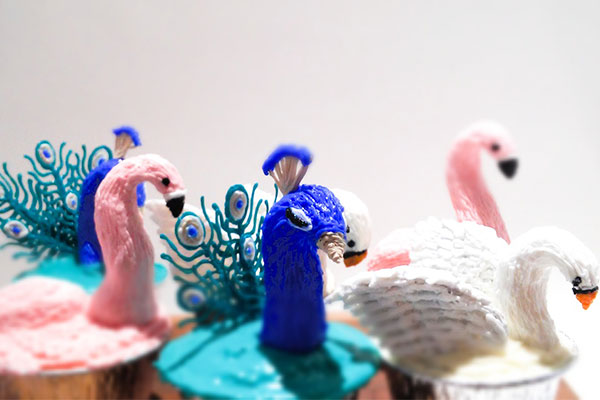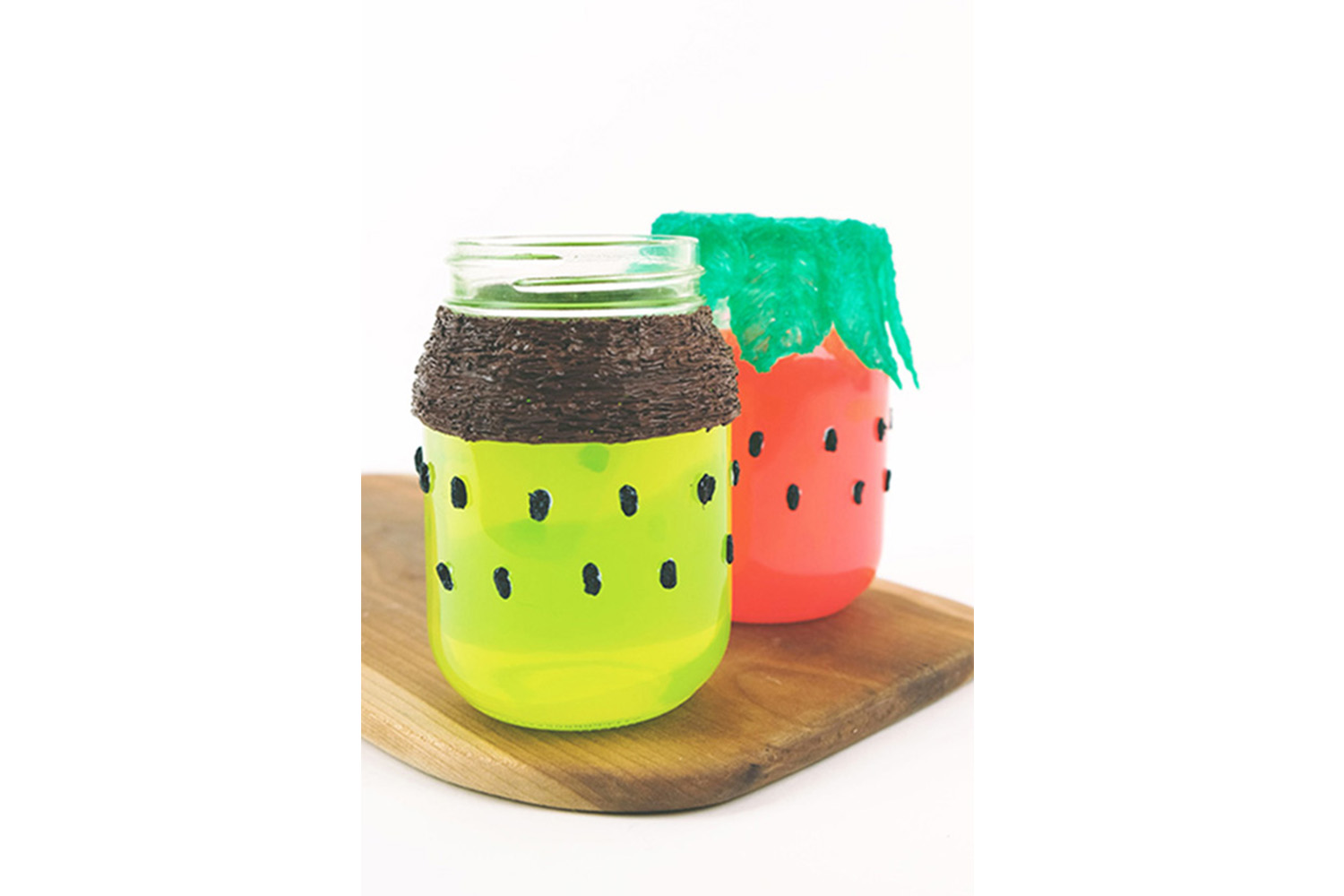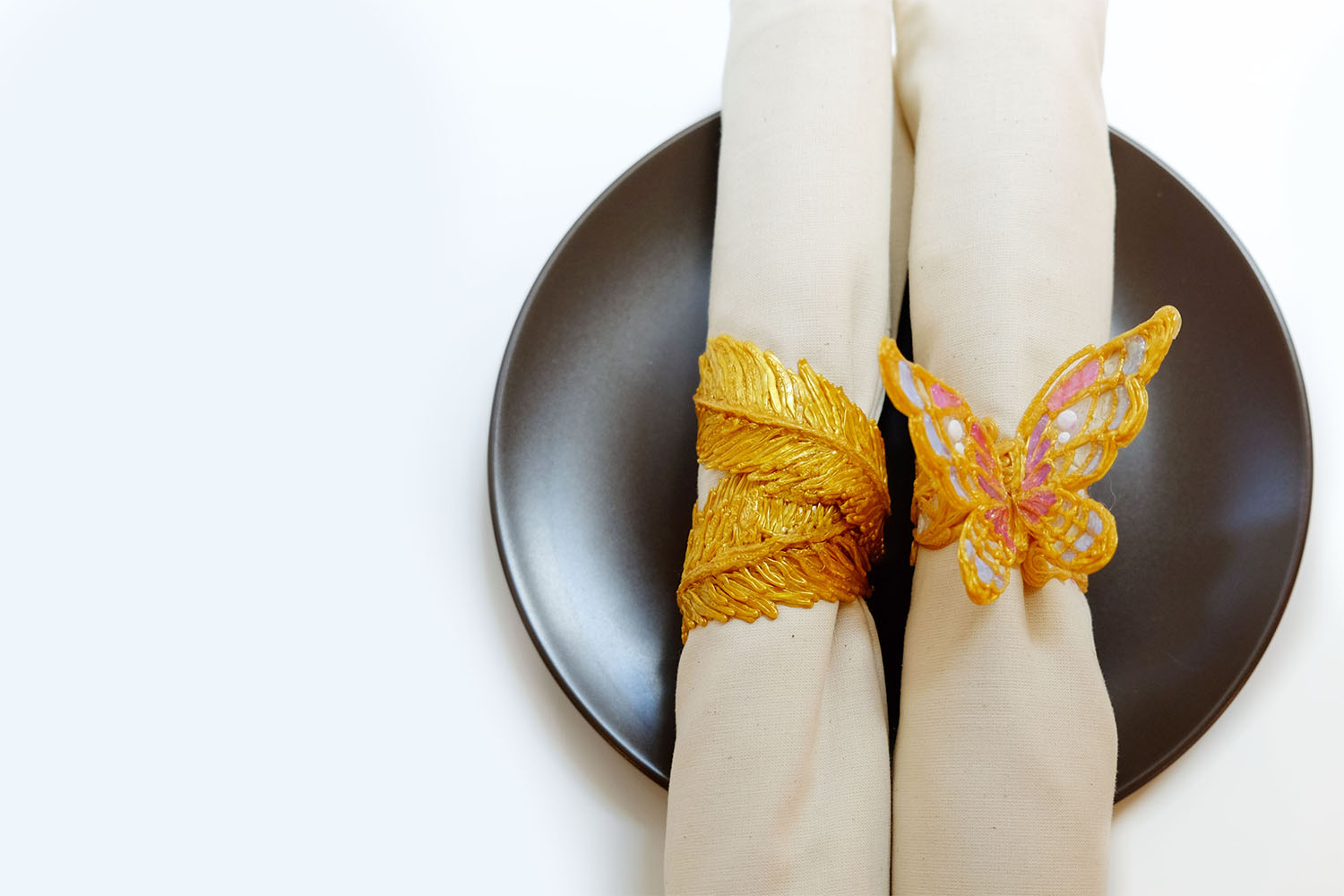
Ultimate College 3D Pen Projects That Will Transform Your Dorm Room

The ultimate guide to creating 6 projects with your 3Doodler 3D pen that are purposeful, creative, and ~aesthetically pleasing~ without breaking the bank!

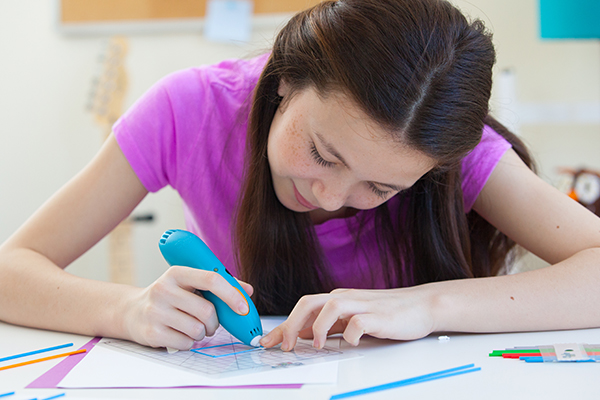
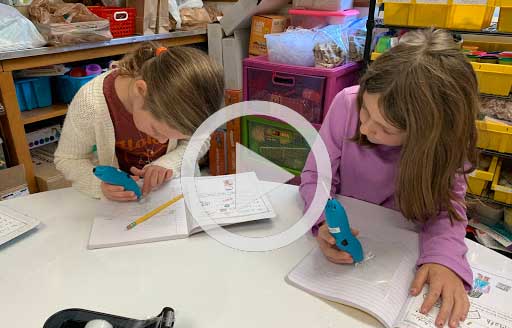
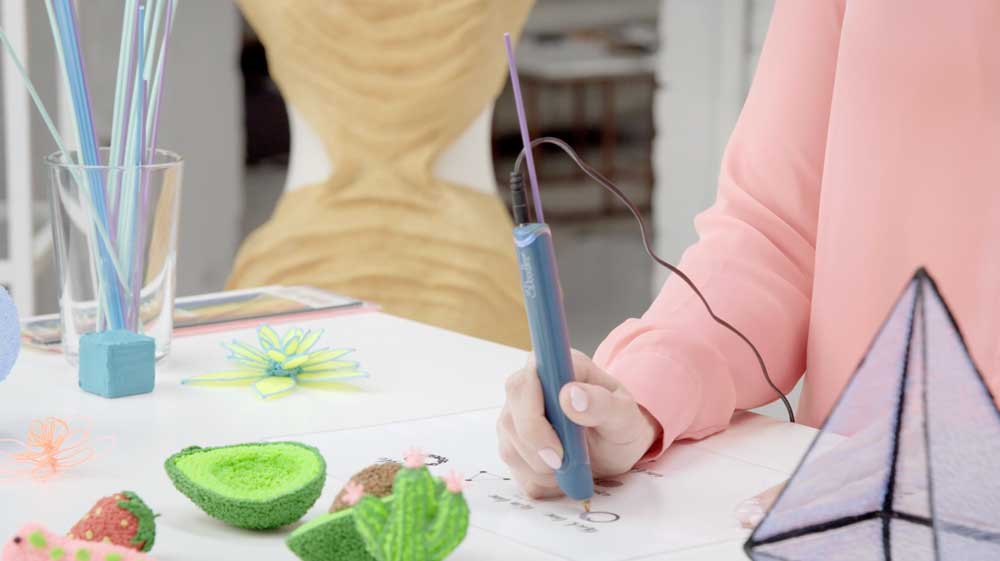
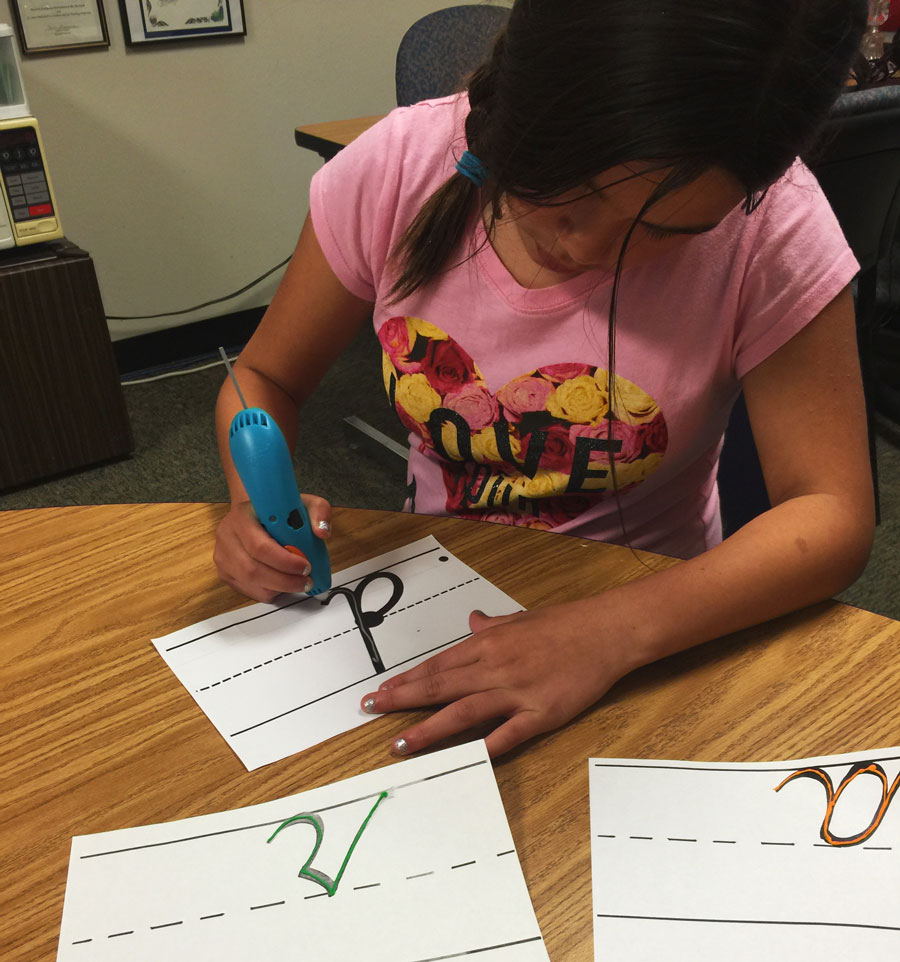
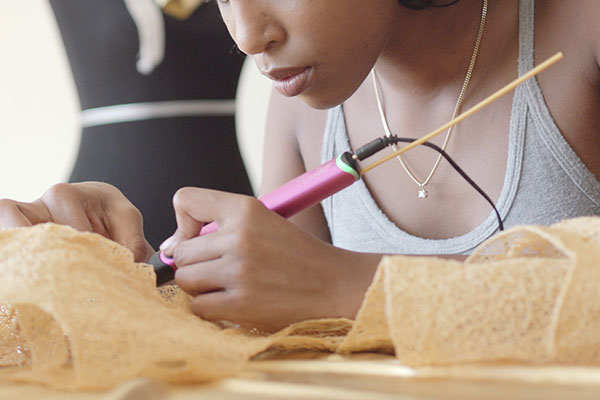
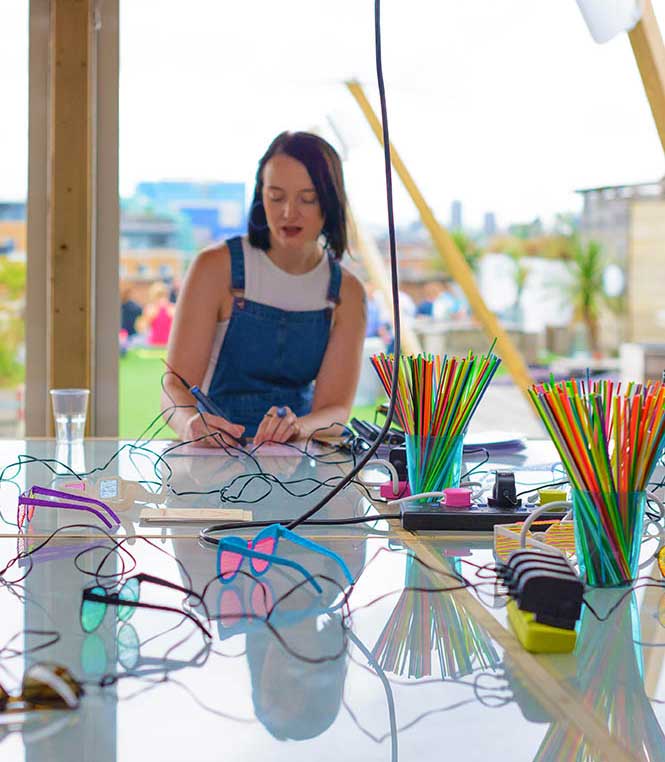
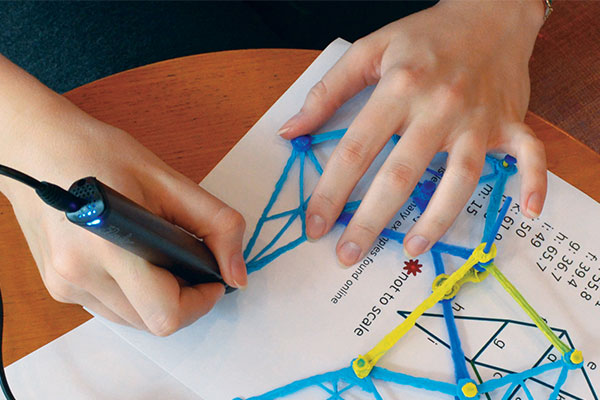
Asian woman creating 3D pen art at a table

As many of you are heading out to college this September, we wanted to take the opportunity to talk to you about how to decorate your space on a student budget!

The good news is, if you have a 3Doodler pen already, then you have a great tool on your hands that’ll allow you to create practical and personalized creations perfect for your new space.

Here is our list of favorite dorm projects to do with a 3D pen!

1. Create personalized wall decorations!

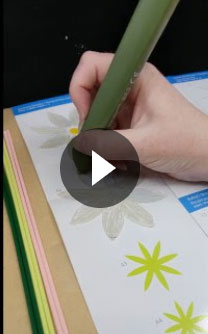
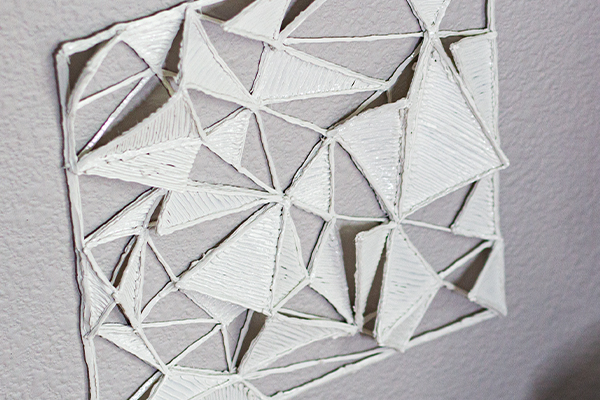
Wall Art Wall Art

Chances are you’ll have plenty of bare wall space. This is where you could buy an expensive wall tapestry. Or you can use your 3D pen and our free stencil and Doodle your own!

You can download a free stencil for this project here. Check out the tutorial here

Cost of materials: $7.99 (1 25-pack of PLA filament)
Retail price: $39.00
Saved: $31 or 79%

Extra tips
  • Preferred filaments: PLA 

2. Easily organize all of your cords by creating your own cord holder!

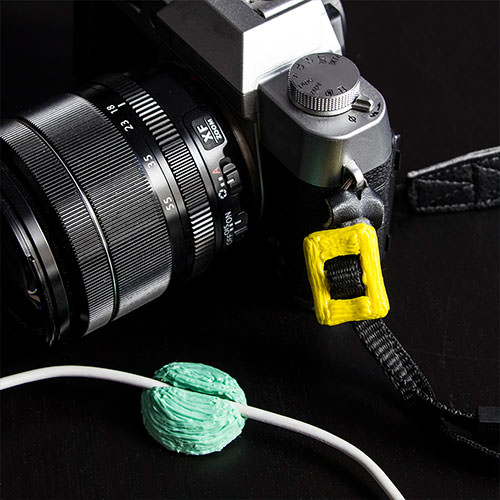
Cord Holder Cord Holder

Today everything needs a cord, especially at your desk. If you’re anything like us, they tend to get tangled up in one another and can clutter up your space pretty quickly. It’s easy to Doodle your own cord holders similar to these with your 3D pen, and stick them anywhere you want!

You can download a free stencil for this project here.

Cost of materials: $0.32 each (1 strand of filament)
Retail price: $4.99 each
Saved: $4.67 or 86%

Extra tips
  • Color code your cord holders by using different colors of filament.

  • Preferred filaments: ABS or FLEXY

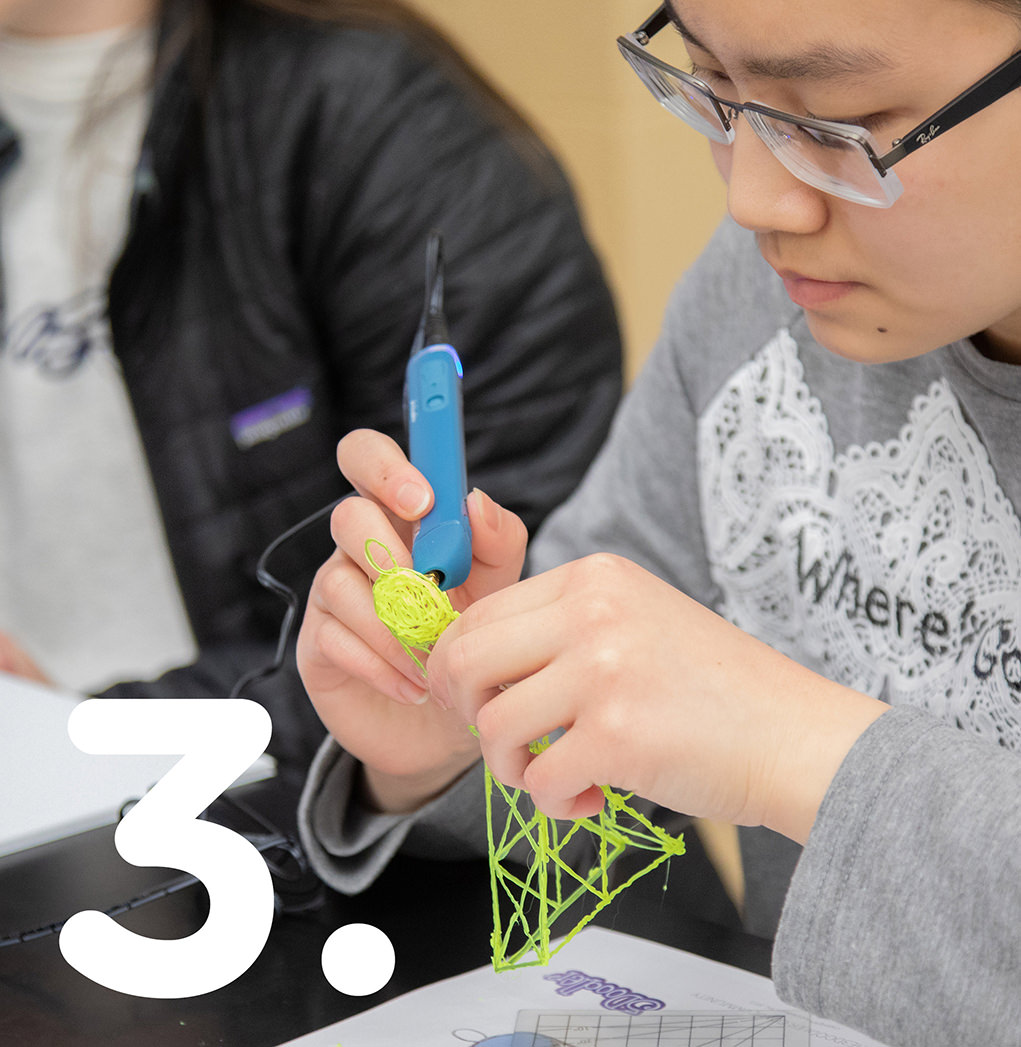
3. Create the perfect accessory to hang all of your favorite photos!

Photo Hanger Photo Hanger

Why buy an expensive photo hanger like this from the store, when you can create your own custom version that will reflect your personal style? This project will completely transform your dorm, and we love using it to store all of our favorite photos and memorabilia!

You can download a free stencil for this project here.

Cost of materials: $7.99 (1 25-strand pack of PLA or ABS)
Retail price: $21.51
Saved: $13.52 or 63%

Extra tips
  • Simply retrace the outer frame to add more sturdiness.

  • Use the holes on the corners to hang it onto the wall!

  • Recommended filaments: ABS

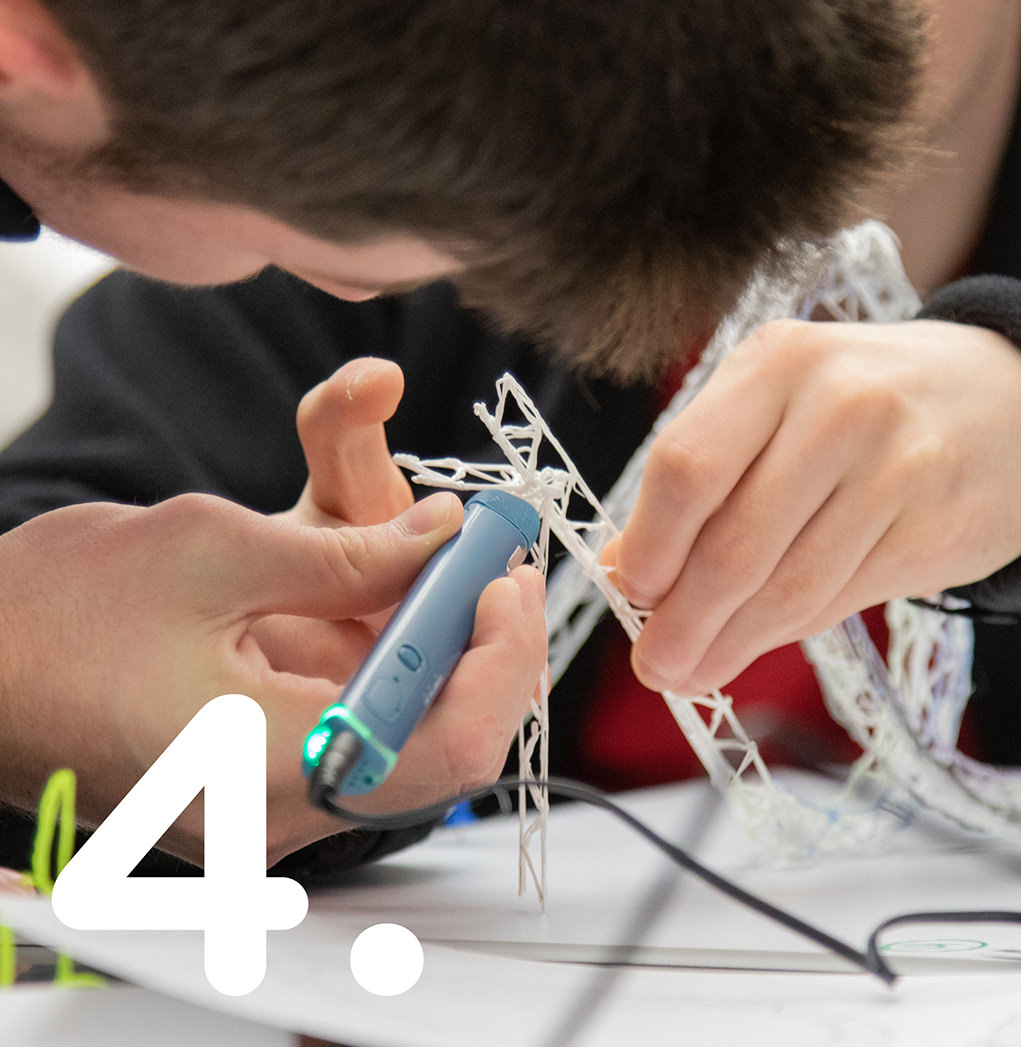
4. The ultimate project to add that ambiance you never knew you needed!

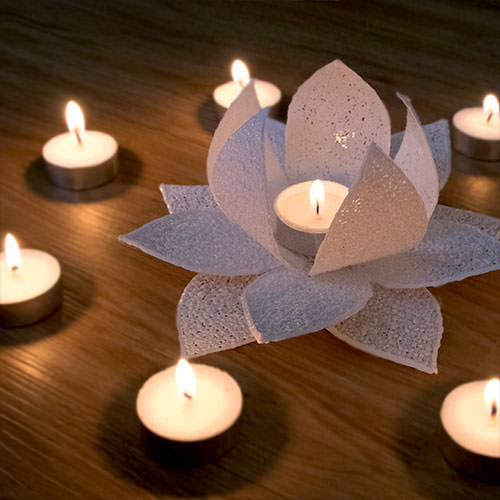
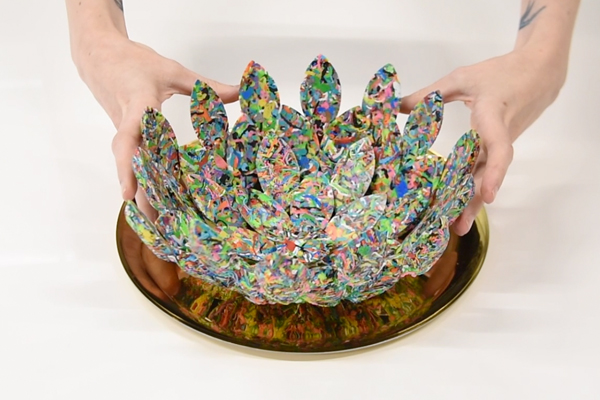
Lotus Flower Lamp Lotus Flower Lamp

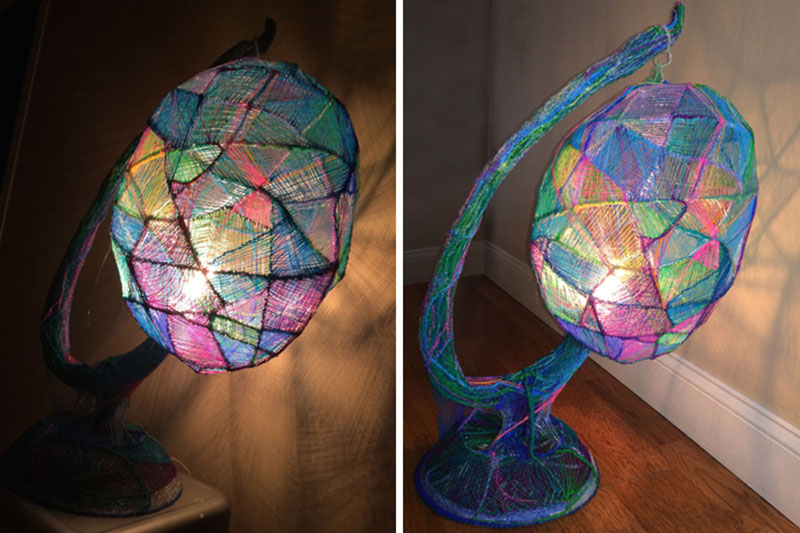
Your friends will be completely envious of your dorm with the beautiful DIY version of this lotus light! Just add an LED candle in the middle to add a laid-back vibe to your room.

You can view the video tutorial here and download a free stencil for this project here.

Cost of materials: $14.99 (1 75-strand Collection of PLA or ABS)
Retail price: $83.71 each
Saved: $68.72 or 82%

Extra tips
  • To create curved lotus petals, simply trace and Doodle over the stencil using a mason jar.

  • Preferred filaments: PLA

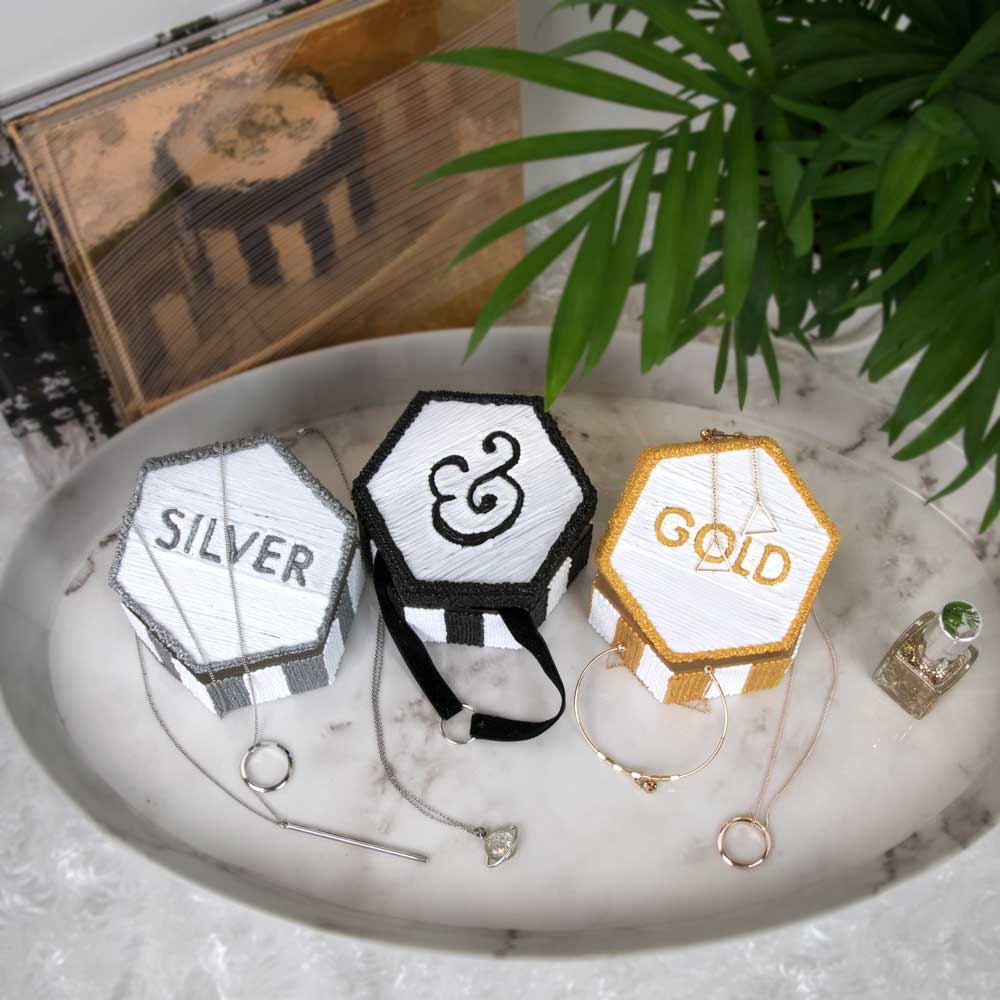
5. Never lose your keys & keep your jewelry organized

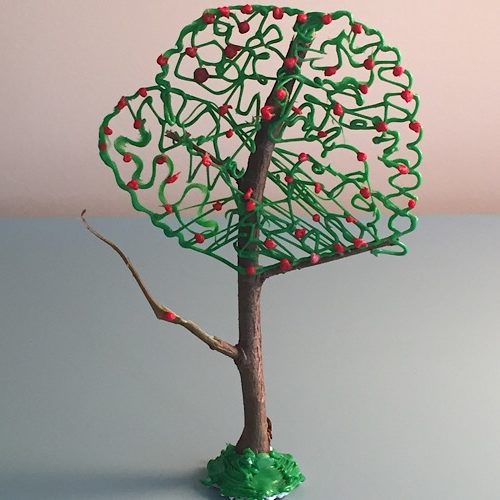
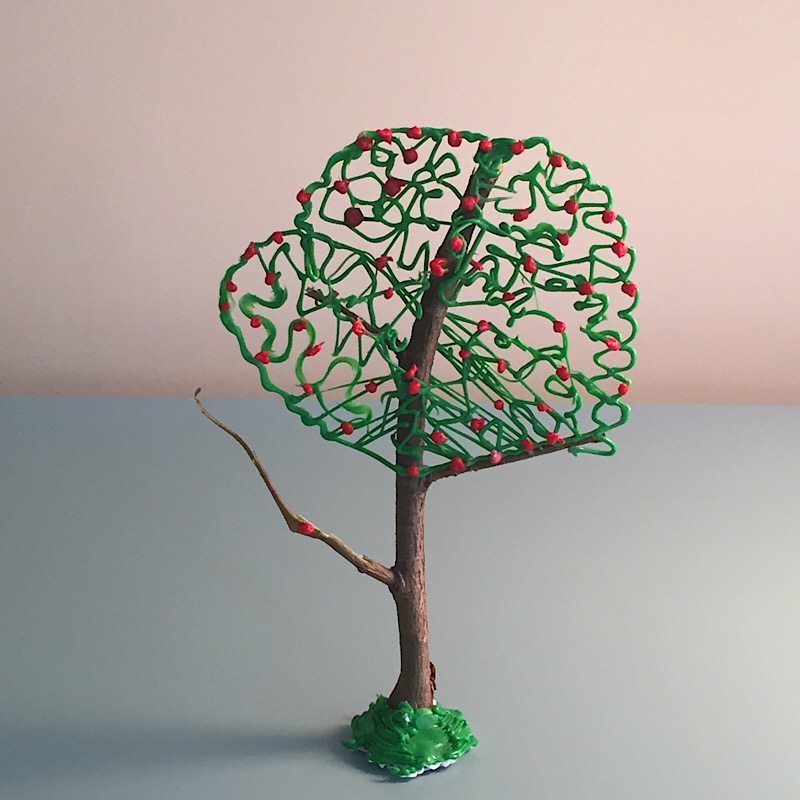
Jewelry Tree Jewelry Tree

This jewelry tree is very simple to make, and it checks the boxes of being functional and decorative.

You can view the video tutorial here and download a free stencil for this project here.

Cost of materials: $9.99 (1 25-strand pack of WOOD filament)
Retail price: $20.98 each
Saved: $10.99 or 52%

Extra tips
  • Use the holes in the tree stencil to put your earrings!

  • If you want to Doodle a tree with a more circular base, simply use a bottle cap and trace around it until you get your desired tree height!

  • Preferred filaments: WOOD

6. A project inspired for the Doodler who appreciates minimalistic vibes!

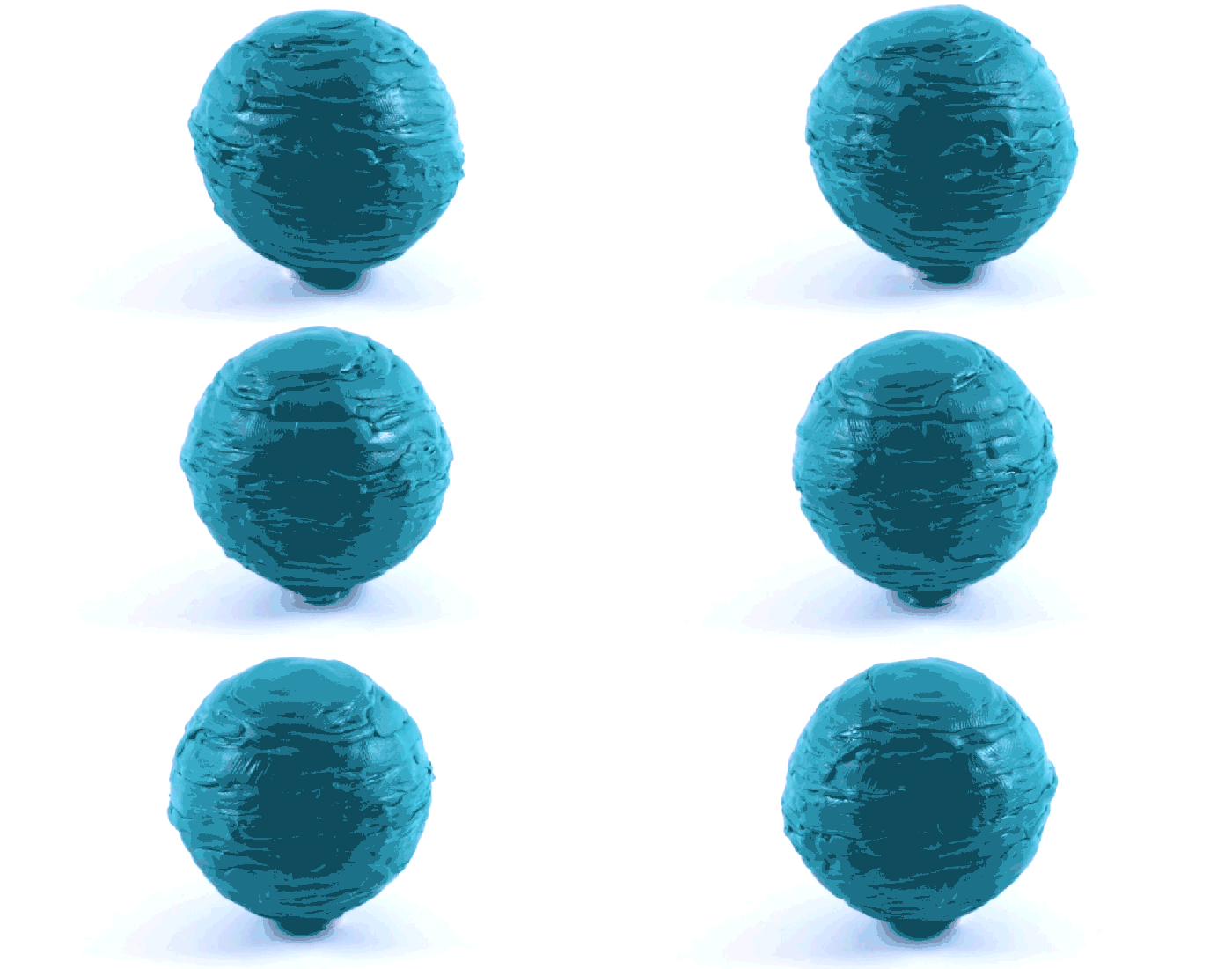
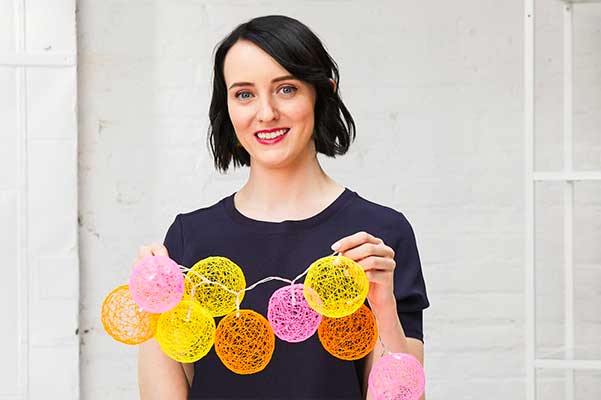
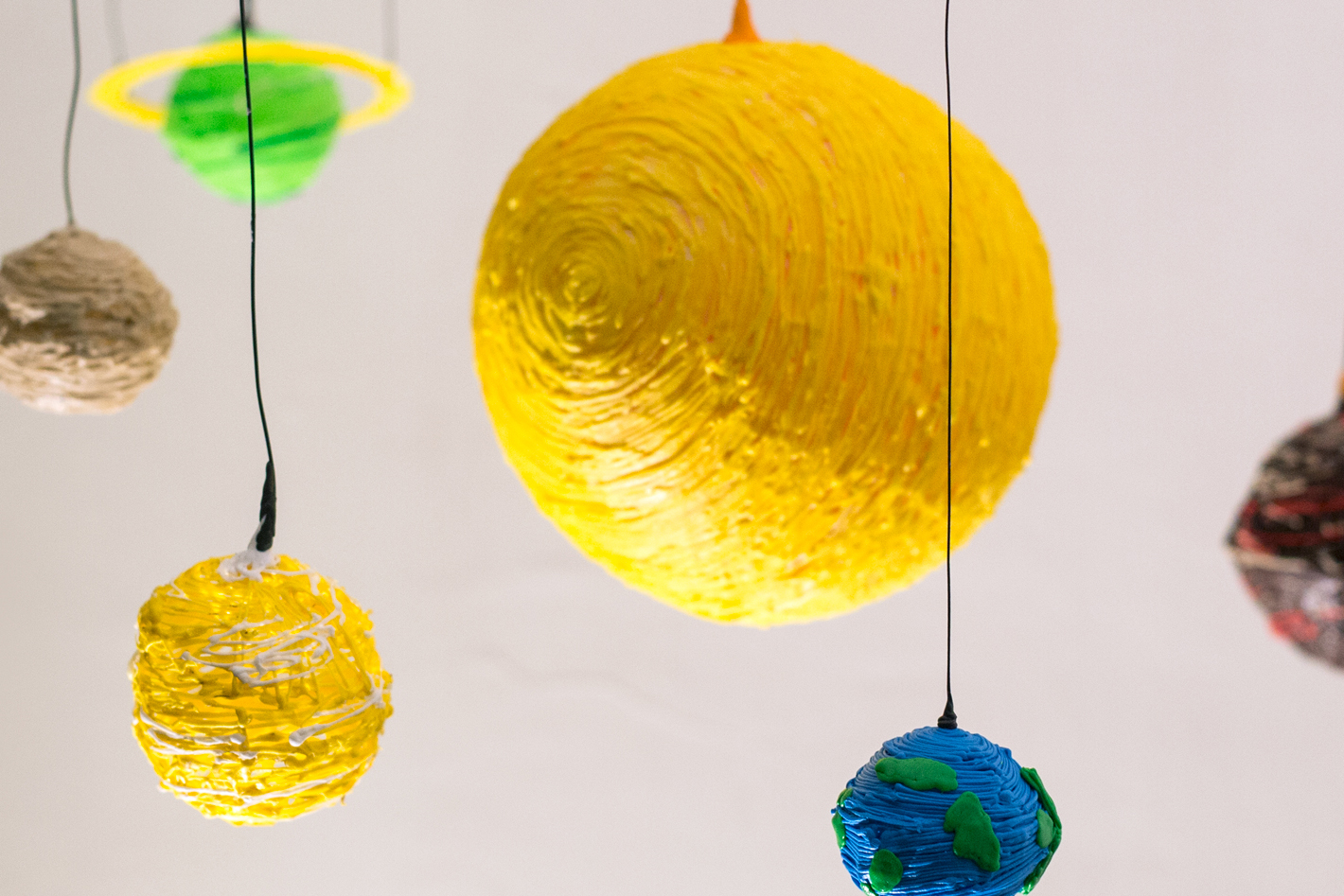
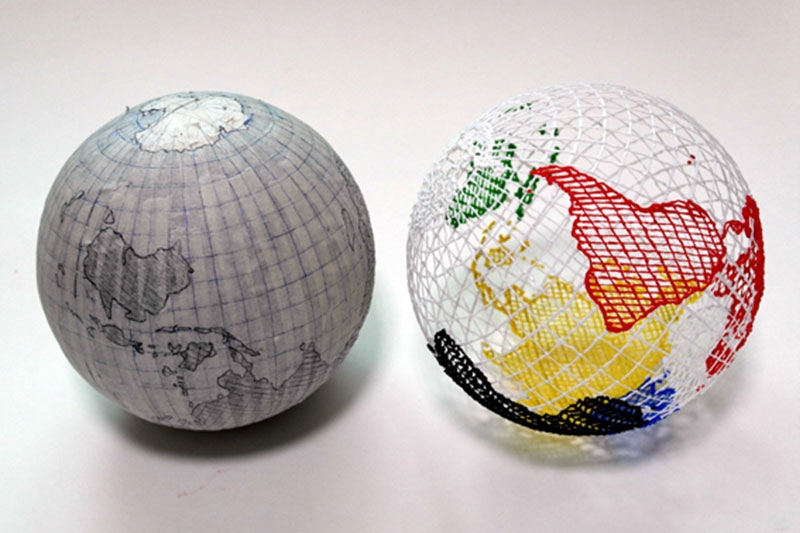
Orb Lights Orb Lights

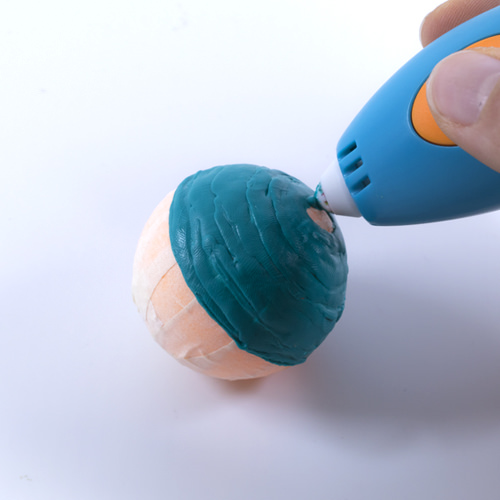
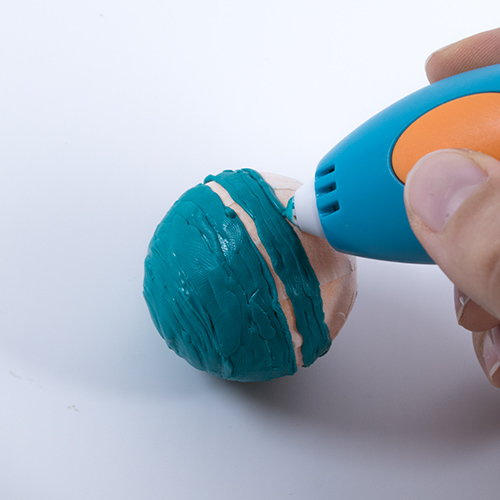
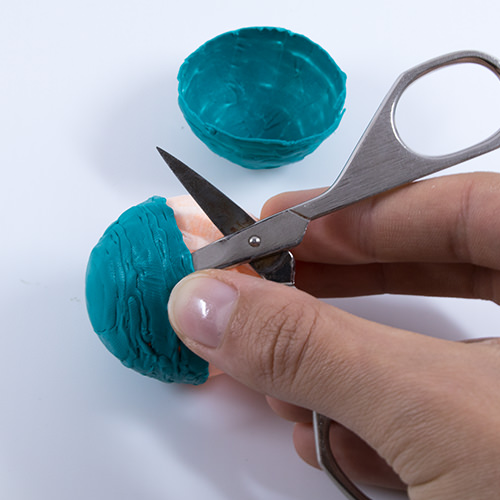
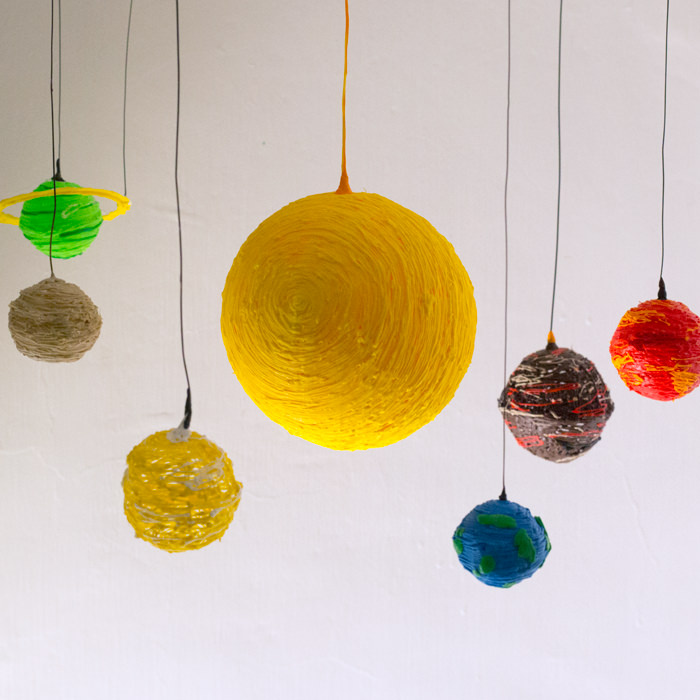
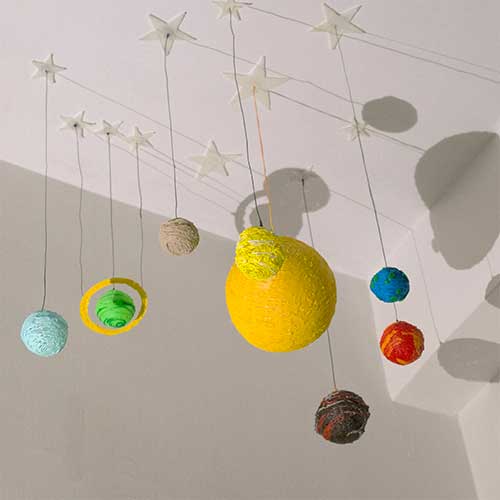
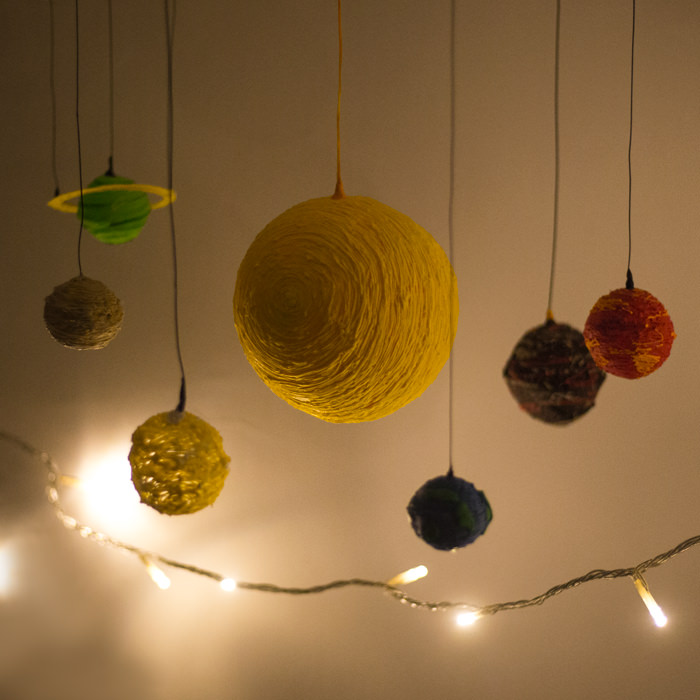
If you want an item in your dorm that pulls everything else together and adds style to your space, this orb light project is perfect for you! Grab a friend and you can finish the entire project in no time.

You can view the video tutorial here.

Cost of materials: $14.99 (1 75-strand Collection of PLA or ABS)
Normal price: $39.99
Saved: $25 or 63%

Extra tips
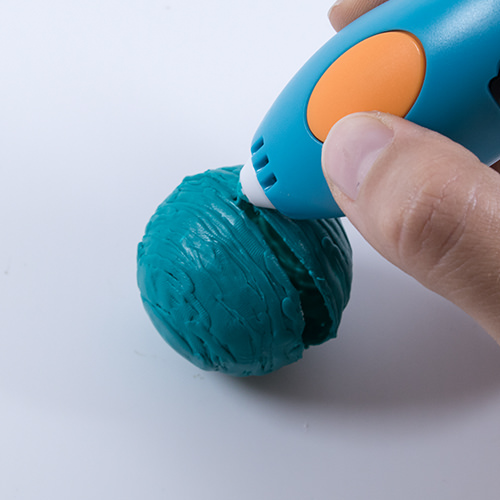
  • If you don’t want to use the method shown here, you can Doodle on two halves of a tennis ball, and then fuse them together to make one whole sphere.

  • Preferred filaments: PLA

Overall, we saved a total of $154 (or 73%) on these 6 items!

Finding creative ways to save money is always something to be proud of! We hope you had fun getting inspiration from things you find in stores or online, and then trying to recreate them on your own at home. With 3Doodler don’t have to sacrifice substance and style for price, and each item you create is sure to be a conversation starter, just wait and see! We hope we’ve inspired you to be creative and try something new for your dorm room this year!
Don’t forget to share your dorm decorations with @3Doodler #3Doodler #WhatWillYouCreate.

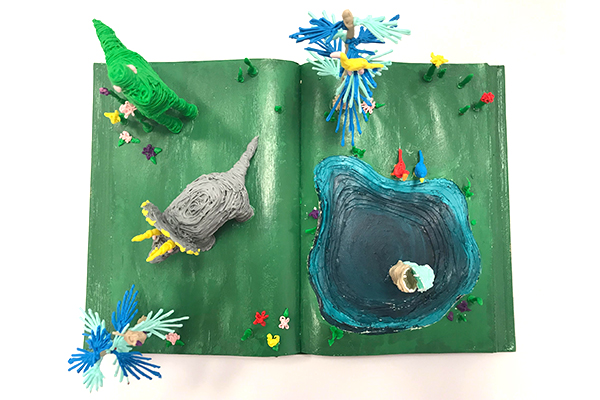
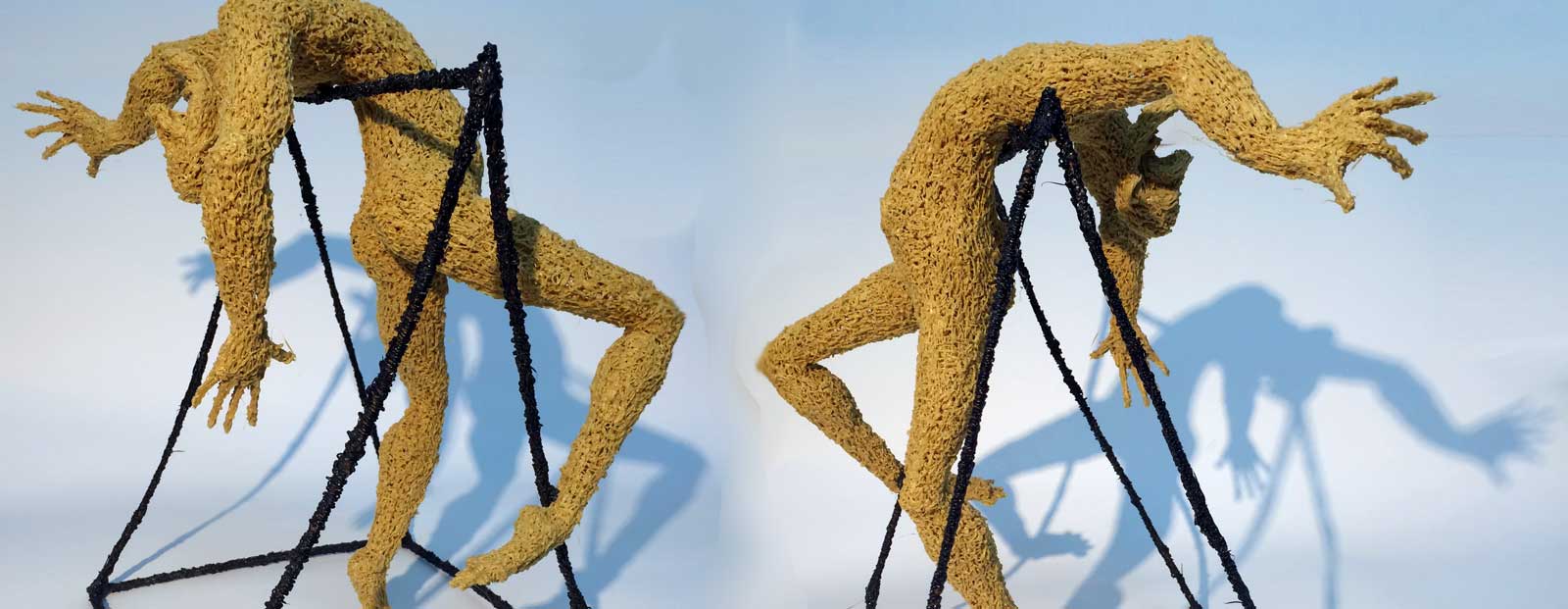
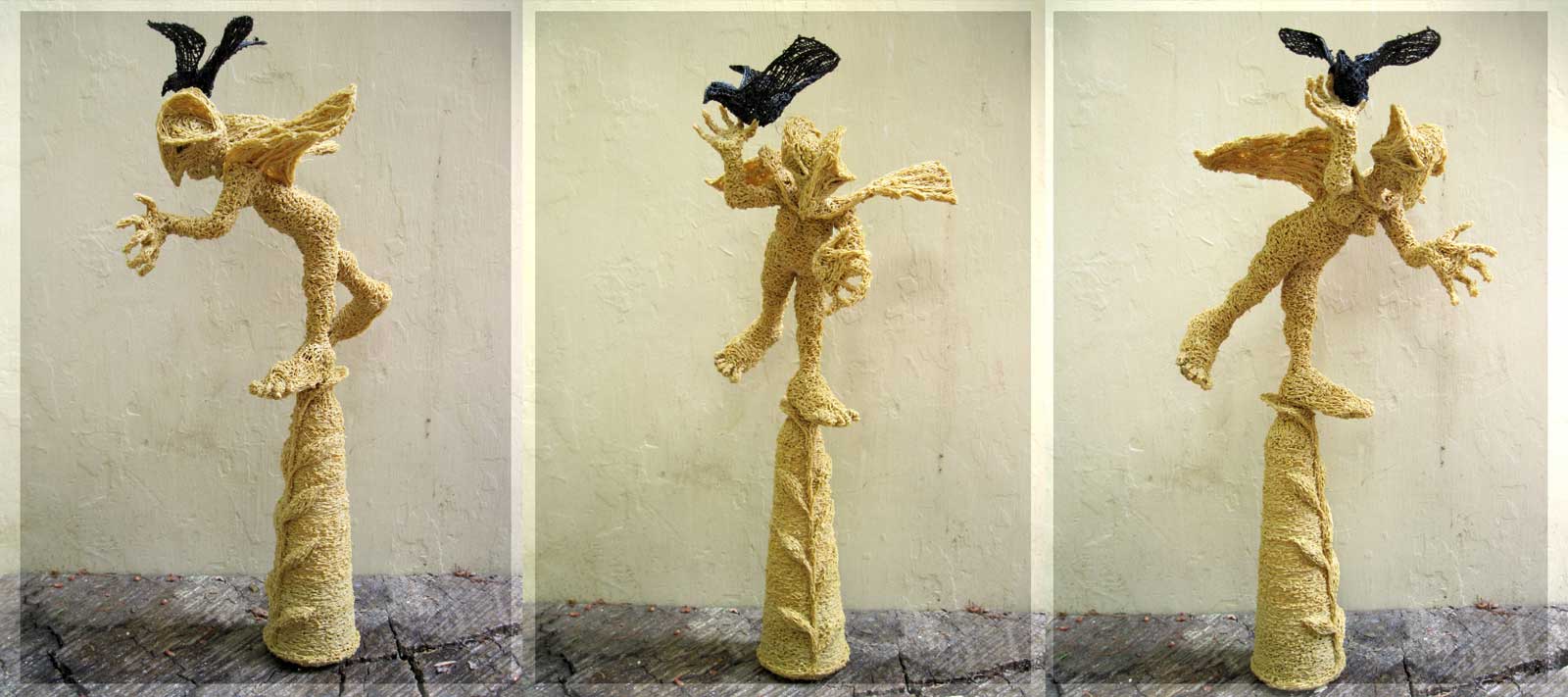
Artist Spotlight: Marc Bühren’s 3D Pen Landscapes

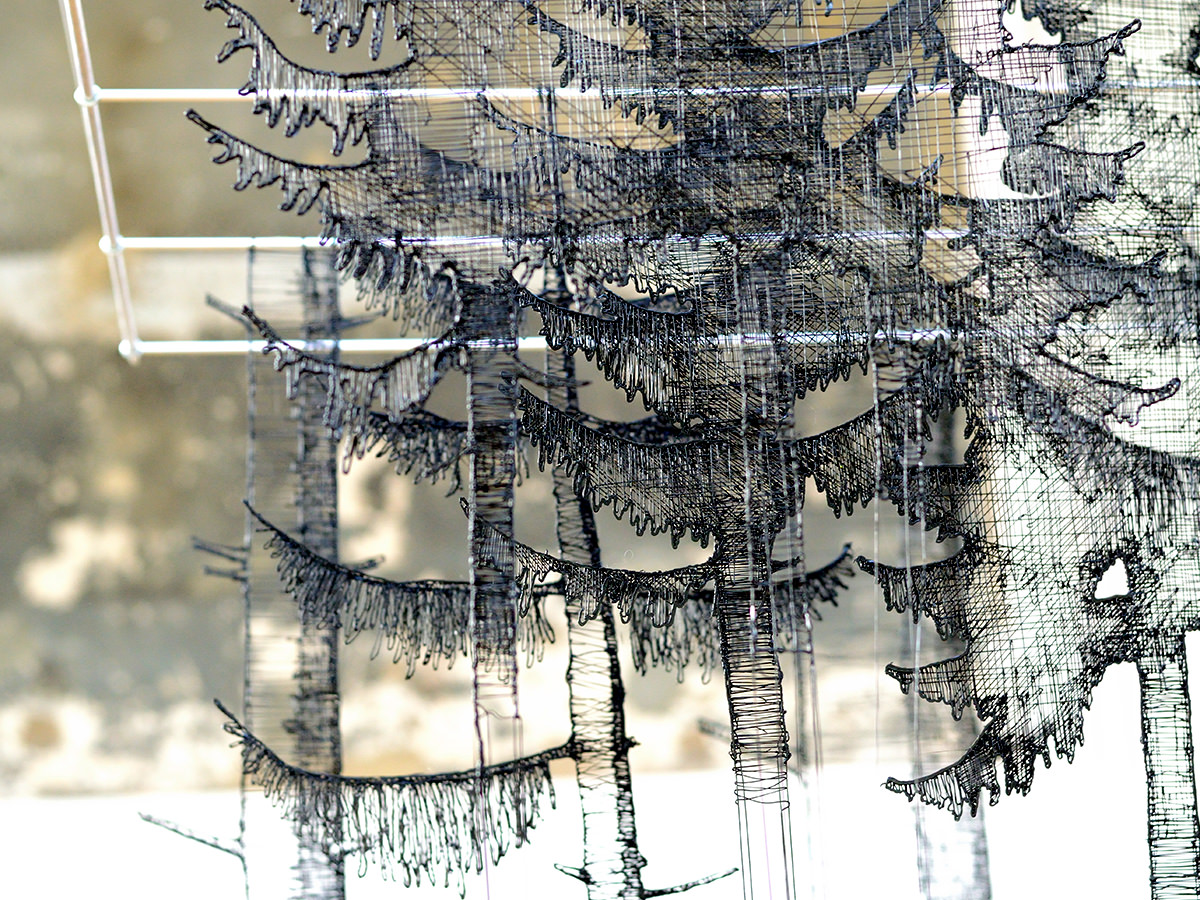
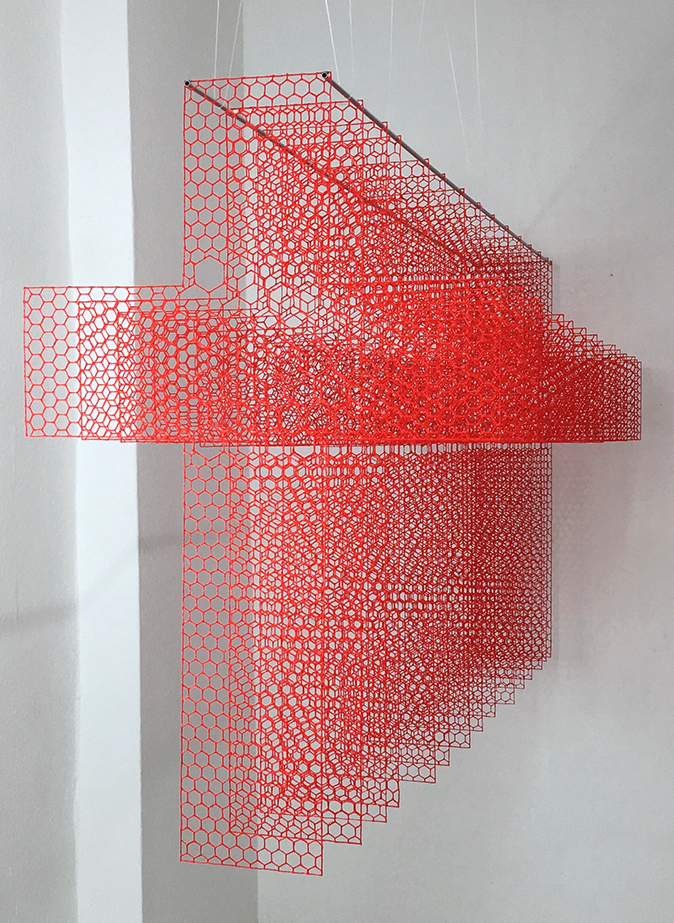
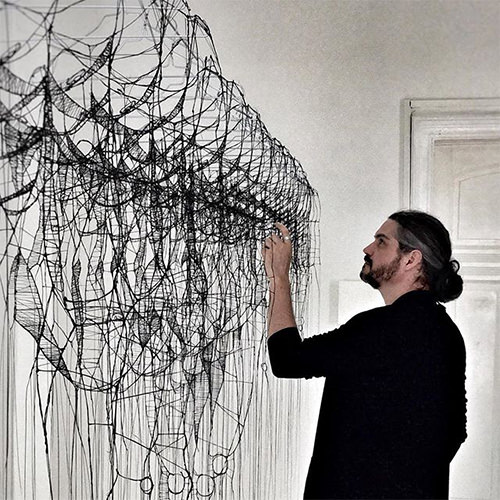
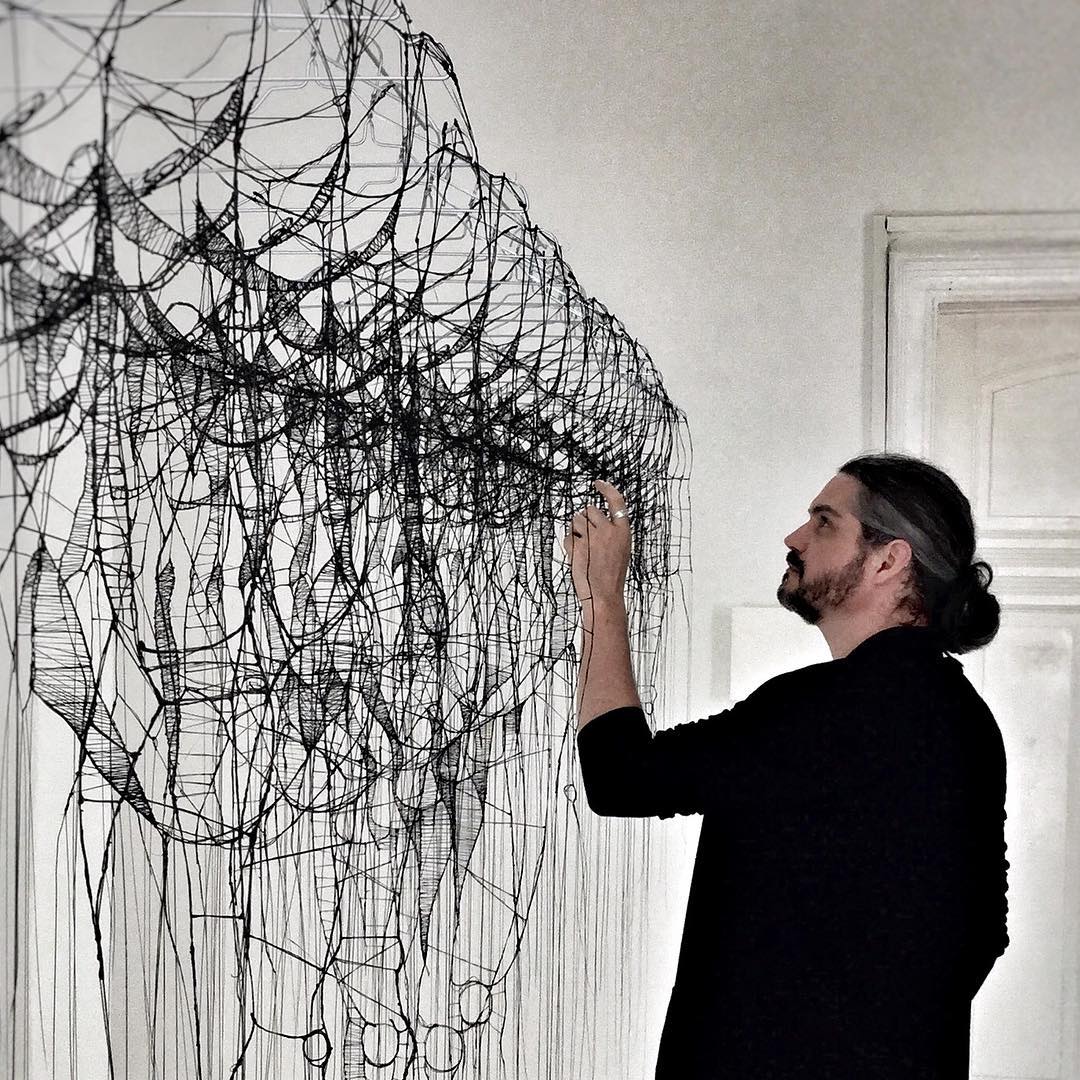
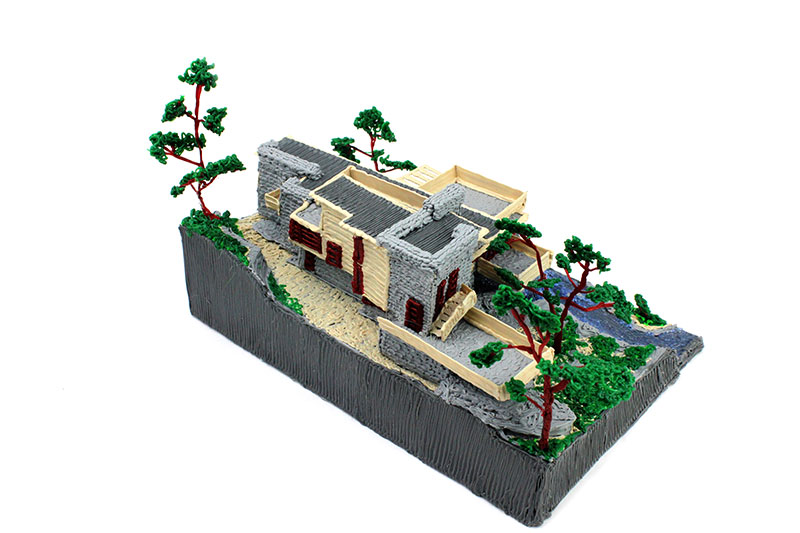
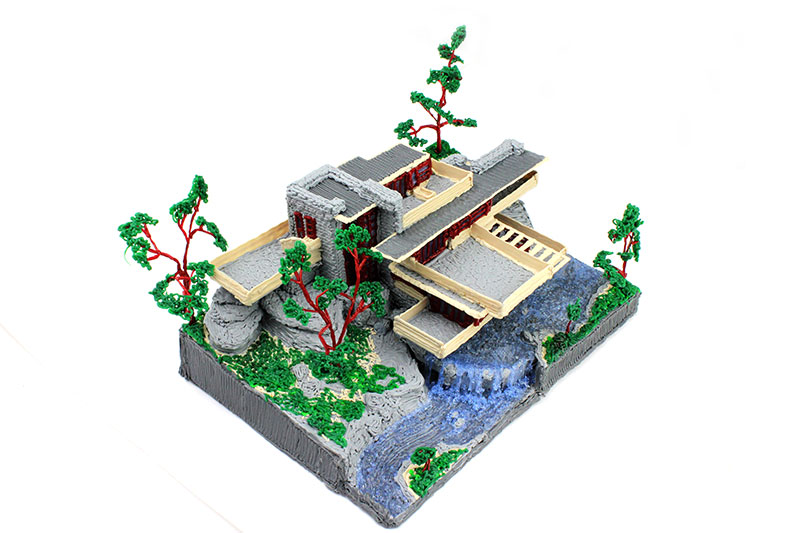
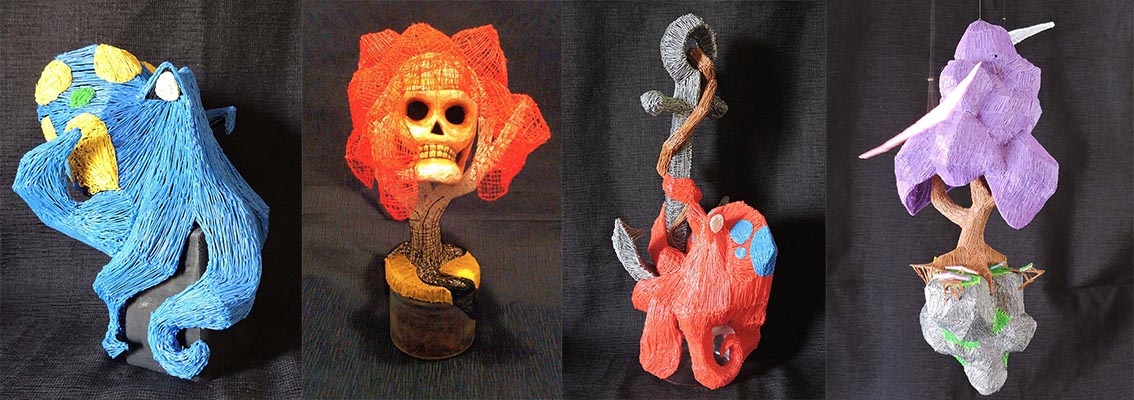
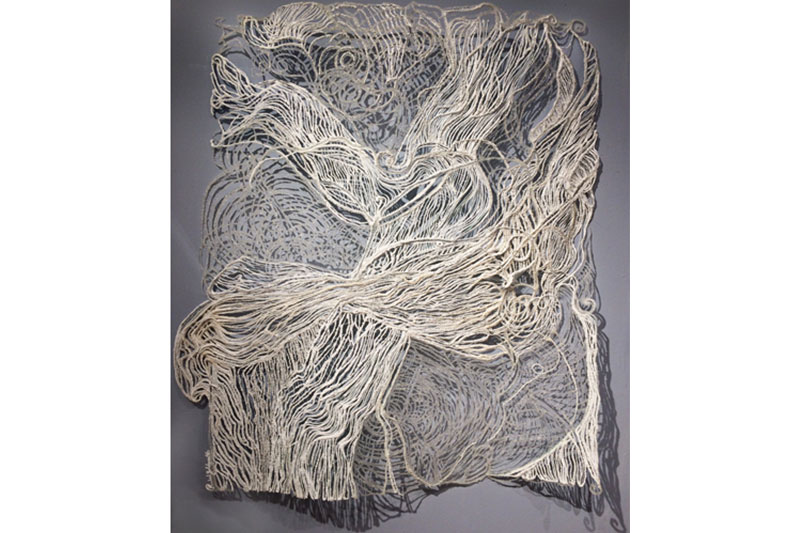
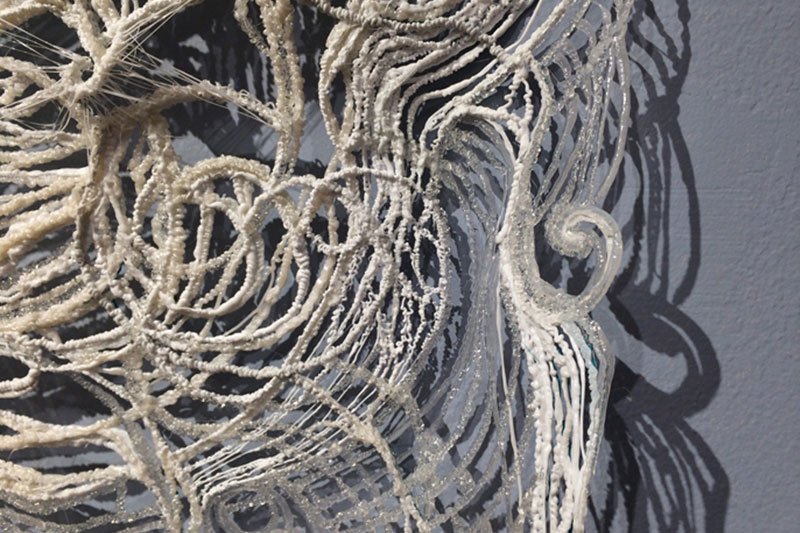
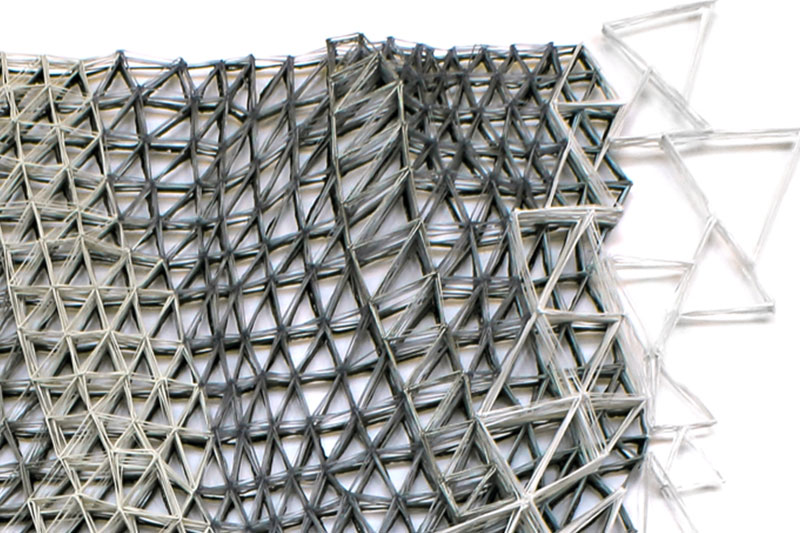
Welcome to the visionary 3D art of Marc Bühren. Hailing from Germany, Marc is a 3Doodler pen master that pushes the boundaries of what is possible with 3D pen artwork. If you want to see Marc working in his studio and hear him discuss his art check out this behind-the-scenes video. His 3-dimensional installations, comprising tessellating geometric patterns and awe-inspiring imagery, are made by hand with the 3Doodler Create+.

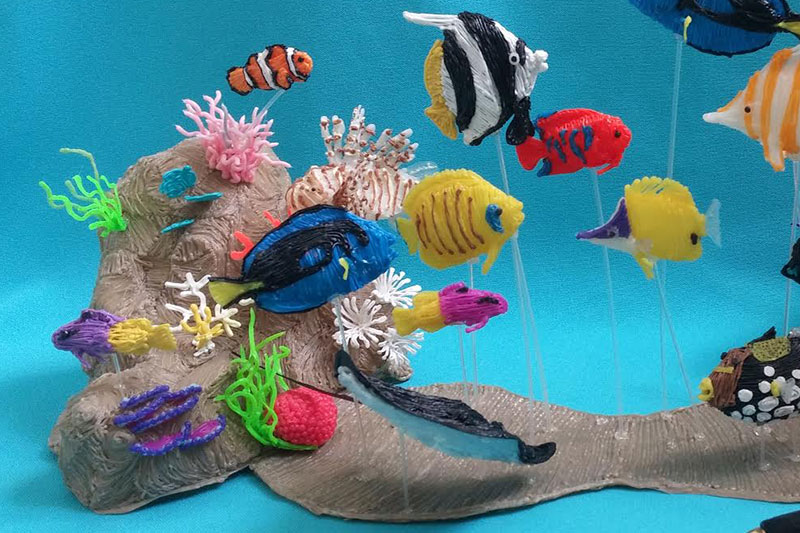
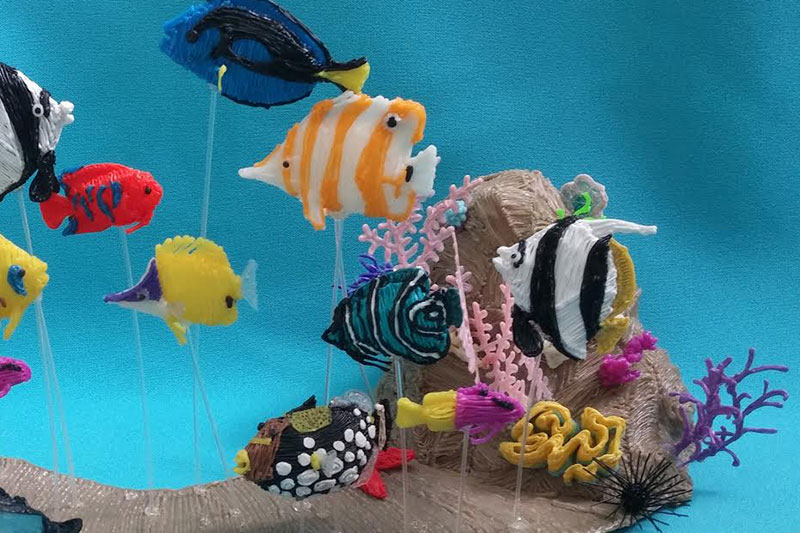
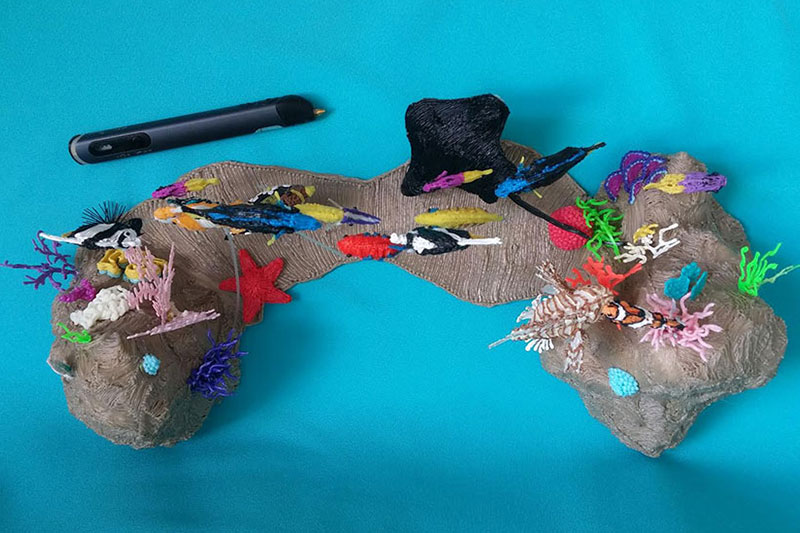
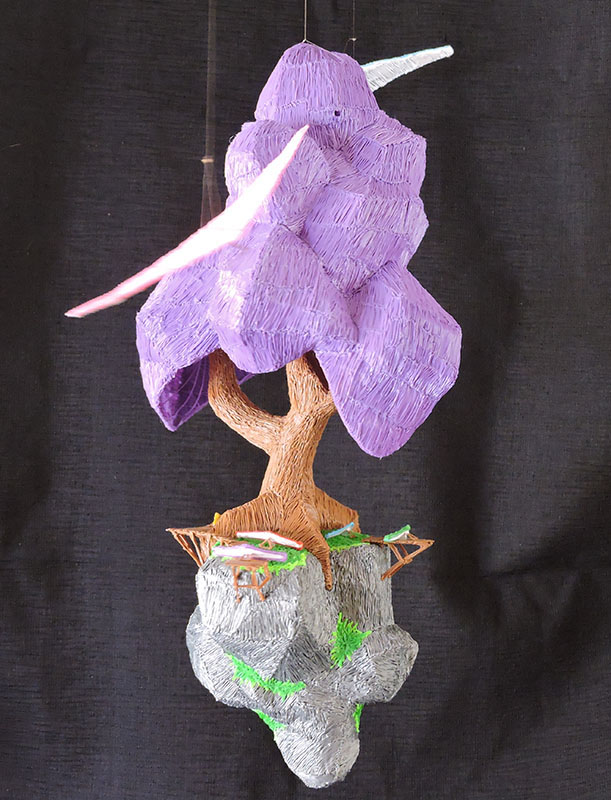
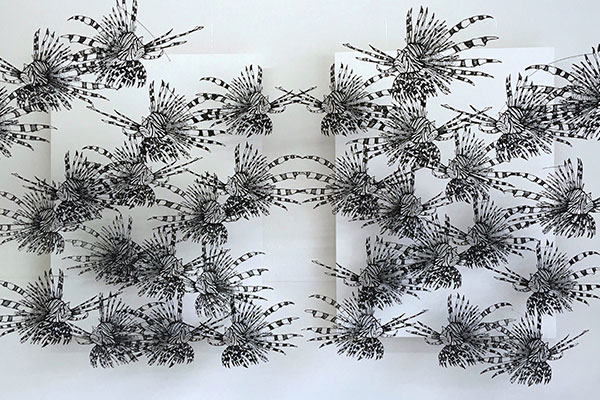
From hanging trees that transport the viewer into abstract forests, to arrays of ocean fish and bird wings that open up the dimensions of nature, Marc’s installation art is truly magnificent to behold. We had a chance to connect with Marc to hear more about the exhibition.


"I worked on the artwork until the day the exhibition was set up. It was six months of hard work, but it was absolutely worth it!" Share

“At exhibitions, it is always very exciting how the visitors react to and interact with the artwork because the installations invite them to circle around, to kneel down or to stand on their tiptoes to catch more visual impressions. It is an exhilarating and emotional experience for me and for the visitors.”


Reflecting on this latest project, Marc noted that “Working with 3Doodler pens for the exhibition at the Maschinenhalle Scherlebeck Art Gallery was a big challenge for me. I had great ideas and have never worked with 3Doodler pens on this scale before.”


About Marc

The 44-year old contemporary artist, Marc Bühren, has been drawing and painting all of his life. Since he found the charcoal of his father as a three year old he has always been drawing.

In elementary school his aspiration of having a career as a painter was born. As a teenager, he completed a training in classical watercolor painting, and after graduation he studied communication design at the University of Wuppertal. Since 2008 he works as a full time artist at his studio in Dortmund. He teaches painting and drawing in his studio, at schools and at other institutions. In April 2017 he started working with 3Doodler pens.

Marc’s extraordinary masterpieces are truly amazing to witness. Does his work inspire you? Share your 3Doodler creations on social media to spread the inspiration.

Follow Marc on Instagram at @marc_buehren. His website is marc-buehren.com

For more artist spotlights and inspiration, be sure to check out our Instagram.

View Instagram

How to Express Yourself Through Doodles

Activism, education, and advocacy are three ways that women and girls around the world have been able to make a tremendous impact throughout history.

Perhaps one of the most memorable feminists over the past 50 years is Ruth Bader Ginsburg, an associate justice of the Supreme Court of the United States who passed away in September of 2020.

Ginsburg was known as “The Notorious RBG” for her passionate dissents. But today, we want to take a look at one of the creative ways that she found to express herself in a field dominated by men — no discussion required.

Woman with crown quotes in 3Doodle.

Redesigning a Judge’s Robe

RBG often said that a traditional judge’s robe was made with a man in mind, with the space around the neck meant to emphasize a shirt and tie. To put her feminine touch on this traditionally masculine piece of clothing, RBG began wearing decorative jabots, or collars, around her neck to bring some pizzazz — and femininity — to her own robe.

And while she may be best known for her lacy “dissent” collar, RBG actually had an impressive collection of unique jabots to help her creatively express herself without words.

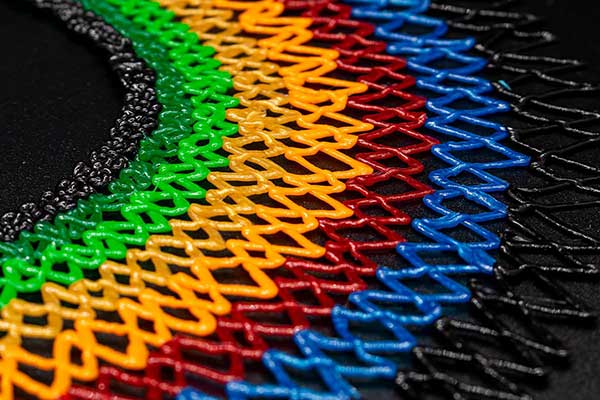
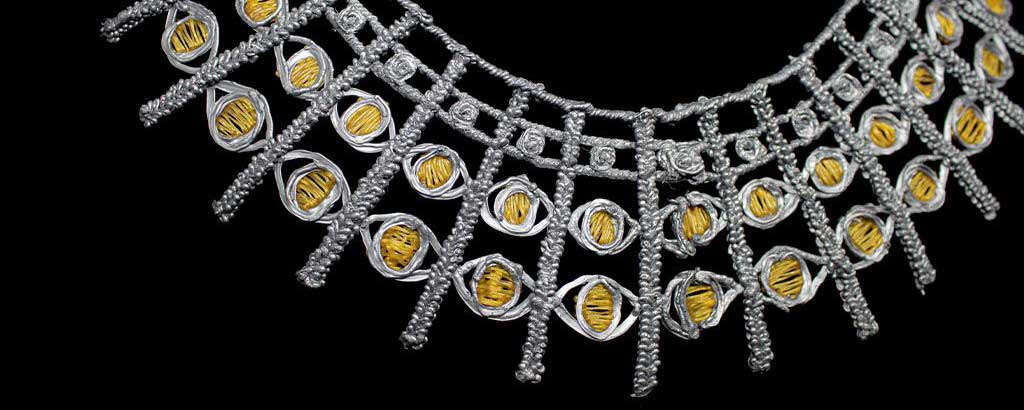
Close-up: 3D pen necklace with yellow & silver beads

From a pride collar, to a collar she reserved for oral arguments, to a majority collar meant for announcing majority opinions from the bench, she was a woman who understood that she could send a powerful, meaningful message without any words.

Create Your Own Collar

Imagine that you have been asked to design a custom jabot to represent yourself. What would the collar look like? Would it be colorful? Would it be made of shells, or jewels, or cloth? Would it be intricate, or would it be simple to look at?

Today, in honor of RBG and International Women’s Day which took place earlier this week, we challenge you to download one of these free stencils and create a unique collar that represents you. We’ve also included a short tutorial.

Share your own Dr. Seuss-inspired designs with us on social media on FacebookTwitter or Instagram: @3Doodler #3Doodler #WhatWillYouCreate

3 Ways to Celebrate Dr. Seuss in your Classroom

Did you find a fun way to celebrate Dr. Seuss’ birthday this week? Whether you’re a student, parent or teacher, you’ve undoubtedly read some of the author’s most beloved stories — whether it be by eating green eggs and ham for breakfast or making their own oobleck.

We created a few fun STEM activities to help your students get creative while celebrating Dr. Seuss. Check out our latest Dr. Seuss tutorial found in our content library and make sure you have easy access to your 3Doodler 3D Printing Pen that will help them “think and wonder, wonder and think.”

Create Crazy Hair for Thing One and Thing Two

Blog with 3D cat drawing

Perhaps the most relatable characters from The Cat in the Hat were Thing One and Thing Two. The twins emerged from a box that the cat brought into Conrad and Sally’s home, and as soon as they were released they proceeded to make an incomparable mess. Thing One and Thing Two are well-recognized by their red jumpsuits, unruly blue hair, and penchant for mayhem.

While some of your students probably wish they could run wild like the twins, this activity will help them focus on letting their imaginations run wild instead. Download our free stencil and check out our tutorial on how to help your students create their own crazy hair.

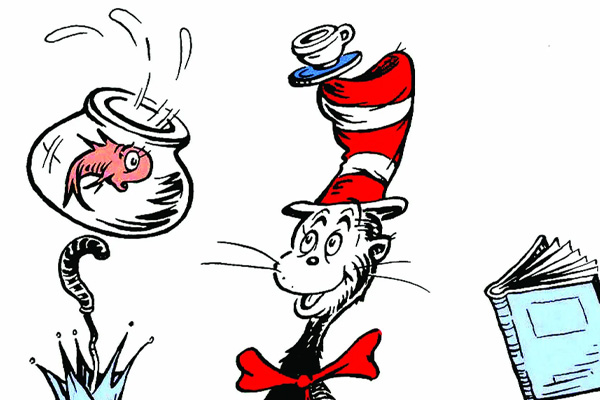
Redesign The Cat in the Hat’s Famous Hat

Close up of 3D cat in the hat hat on blue background

Known for his red bow tie and his red-and-white-striped top hat, The Cat in the Hat is one of the most iconic characters in children’s literature. The cat is quirky, rebellious, and a little bit mysterious. Kids often wonder if he is a “good guy” or a “bad guy.” But, for better or worse, his character has become so well-known that it is now a mascot for Random House, the largest general interest book publisher in the world.

But what would the cat look like without his trademark hat? Encourage your students to create a new look for The Cat in the Hat. Start by modifying his hat — what would it look like if it was a baseball cap? A cowboy hat? Or, what if he wasn’t known for his hat, at all?

Doodle Yourself a Fancy Mustache Like The Lorax

Yellow banana on stick with yellow background - 3D pen art

Dr. Seuss’ favorite book (by Dr. Seuss) was The Lorax. And while it is a children’s book, it tells the very adult story of how humans are destroying the natural environment. It has been well-received by both teachers and students. In fact, in 2007, the National Education Association listed The Lorax as one of its “Teachers’ Top 100 Books for Children.”

Students seem to enjoy the kind-hearted Lorax. He is hard-working, optimistic, rational, understanding, trustworthy, and helpful — not to mention, he has an outrageous mustache that personifies these traits quite impressively. Ask your students which other characters in literature sport unique mustaches, and what traits they associate with those people — Jafar from Aladdin or Yosemite Sam from Looney Tunes come to mind.

Next, ask your students to doodle a new mustache for The Lorax. Does it change how they think of him?

Share your own Dr. Seuss-inspired designs with us on social media on Facebook, Twitter or Instagram: @3Doodler #3Doodler #WhatWillYouCreate

DIY Valentine’s Day Projects Roundup

Share the love this year with these fun Valentine’s Day themed projects. Simply download, print and get to Doodling! Creating something handmade to give to that special someone can be a fun creative activity for you, and a much appreciated gesture to the recipient.

Here is a round-up of some of our most popular Valentine’s Day stencils, templates & tutorials. Tag us on social and let us know which one is your favorite!

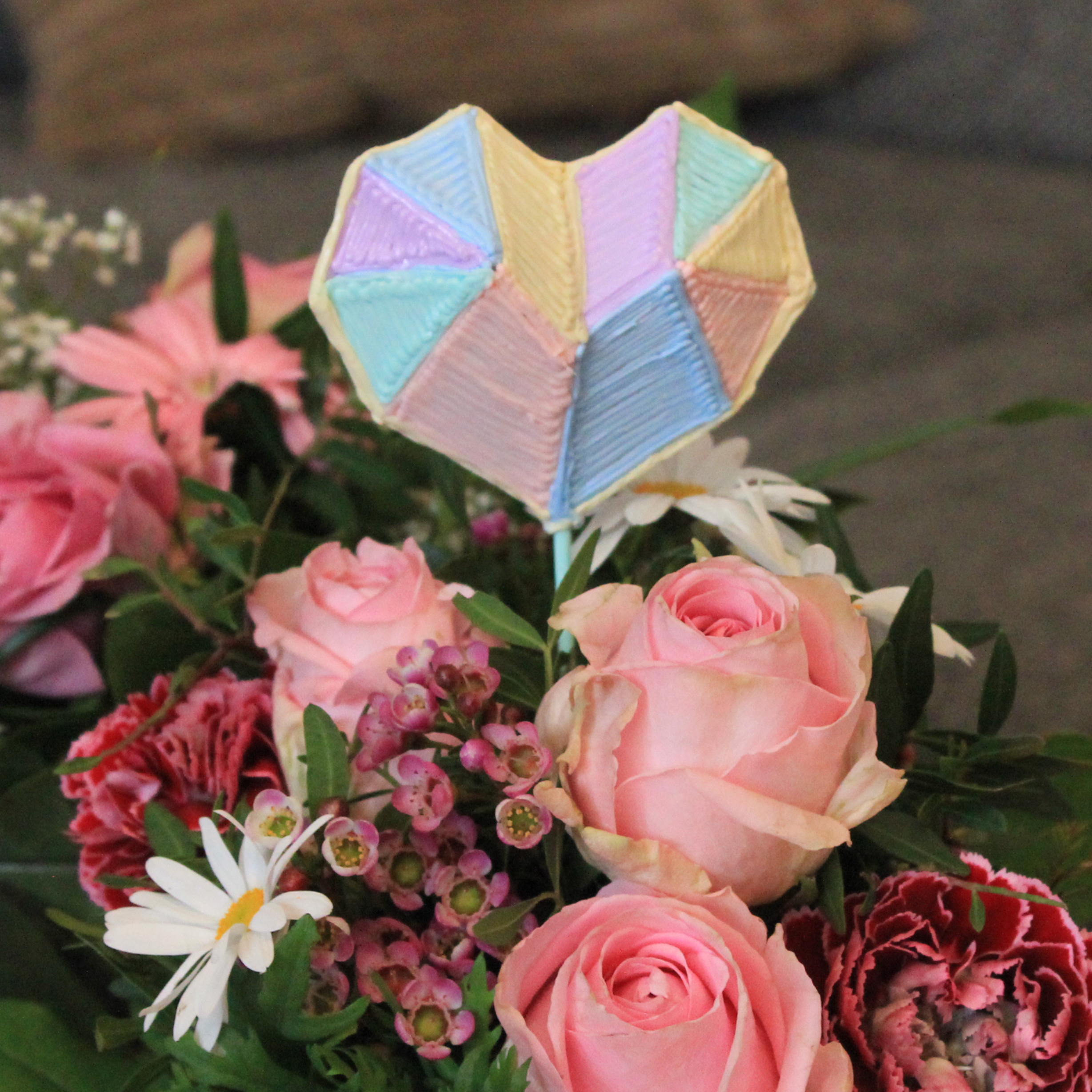
Geometric Heart: Building positive relationships with others is more important than ever. Create your own 3D geometric heart in your favorite color and style. You can even draft a note to place inside the heart!

  1. Print out the stencil for our Geometric Hearts
  2. Assemble the pieces to form one heart
  3. Tag your creation onto a gift, a sweet treat, or a flower bouquet. Doodle someone’s name on the heart for a personal touch!
Heart Garland: A room filled with 3D pen art, featuring a cascade of hanging hearts.

3D Heart Garland: Here’s a template you can use with your 3D pen to add some festive flair to your home office, your classroom, or general living space.

  1. Print out the stencil for our 3D Heart Garlands
  2. Doodle the pieces in a variety of festive colors
  3. Attach your hearts to some string, twine or fishing line
  4. Hang!
Four cupcakes with unique toppings on a table - 3D pen art.

Valentine’s Day Cupcake Liner:

  1. Print out the stencil for our Cupcake Liner and cover the front and back with clear tape
  2. Cut the stencil out and tape into shape
  3. Doodle directly on the stencil until it is all filled in
  4. Add a few finishing accents in other colors
  5. Peel the stencil off
  6. Add it to your cupcake!

Valentine’s Day Cupcake Toppers:

  1. Print out one of our Cupcake Topper stencils
  2. Doodle a message
  3. Secure it to a toothpick and insert it onto the top of your cupcake!
Sharing is caring, so please post some of your Valentine’s Day Doodles on Instagram or Twitter! @3Doodler #3Doodler

Share on Twitter

Tactile Tech Builds Community & Awareness for the Visually Impaired

3Doodler is proud to raise awareness and create accessible ways for visually impaired individuals to interact with art, literature, and symbolism.

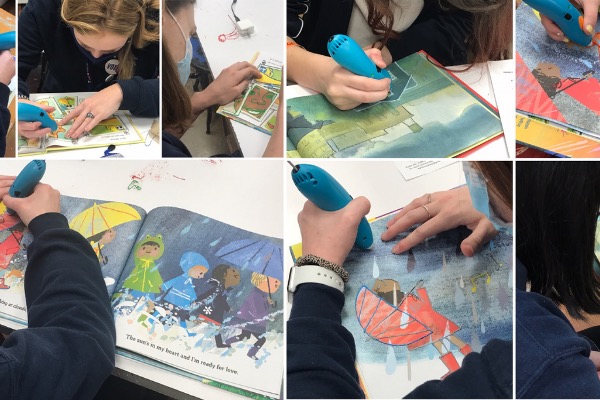
In recognition of Braille Literacy Month and in remembrance of Louis Braille, who was born on January 4th, 1809, we are pleased to share a snapshot of the incredible work that teachers and students did to transform storybooks using their 3D pens in support of the blind and visually impaired as part of 3D Giving Day.

Cat 3D pen art on book with cat picture

Support for the Visually Impaired

3D Giving Day is a unique opportunity to bring together students and creators from around the world to use 3Doodler pens and transform the pages of storybooks into tactile, 3D learning tools, giving the visually impaired a new way to connect with literature.

In partnership with the Build a Better Book project, based at the University of Colorado Boulder, 3Doodler was able to reach out to invite students and their teachers to help support people with visual impairments as well as other learning disabilities. Together, we encouraged middle and high school youth to develop their hands-on tech skills and learn about their community as they design and create accessible, multi-modal picture books, graphics, and even games that people can experience through touch.

Here is a message from a member of the after-school program at CCHY in Picayune, Mississippi, explaining 3D Giving Day, in her own words.

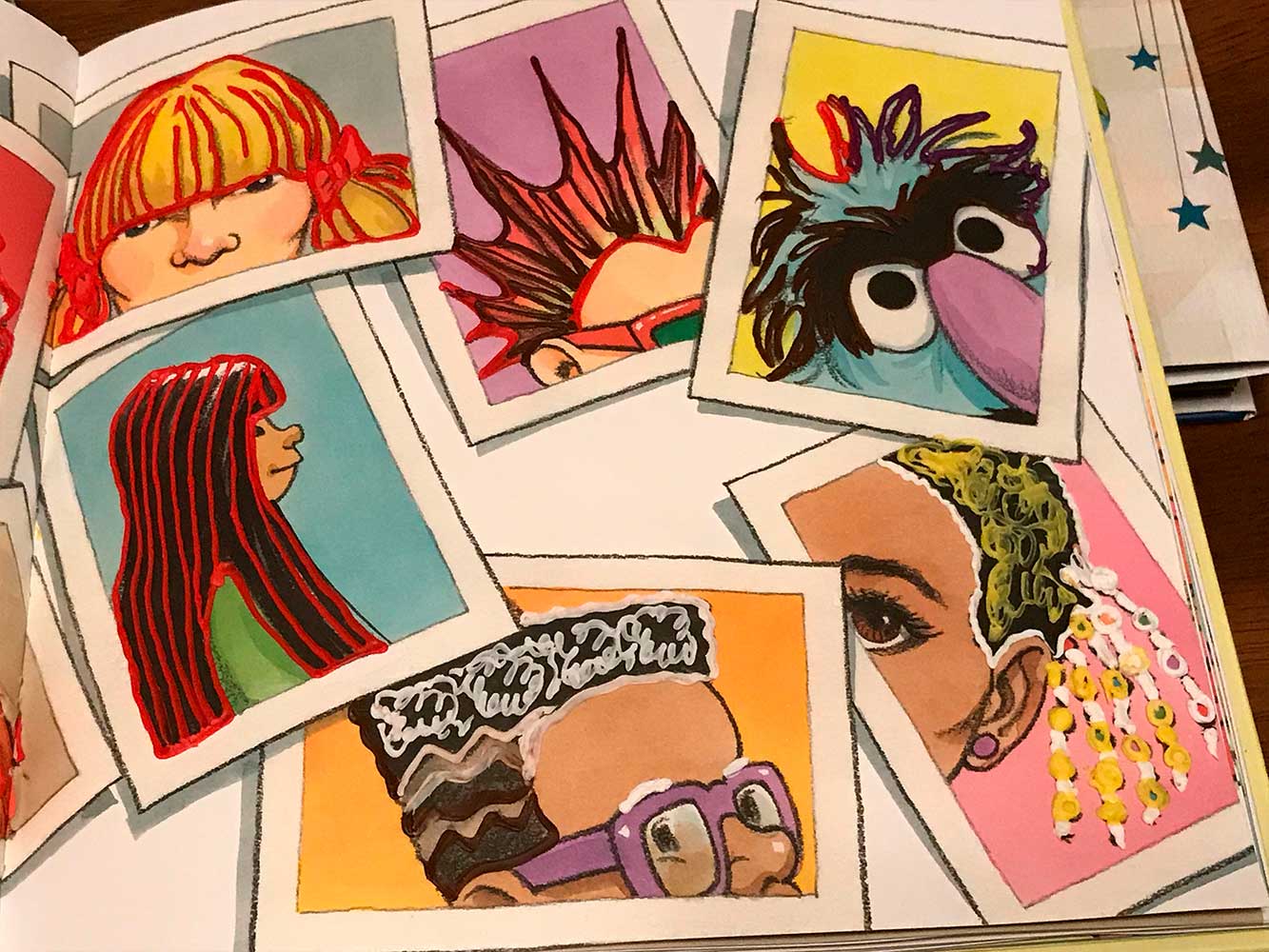
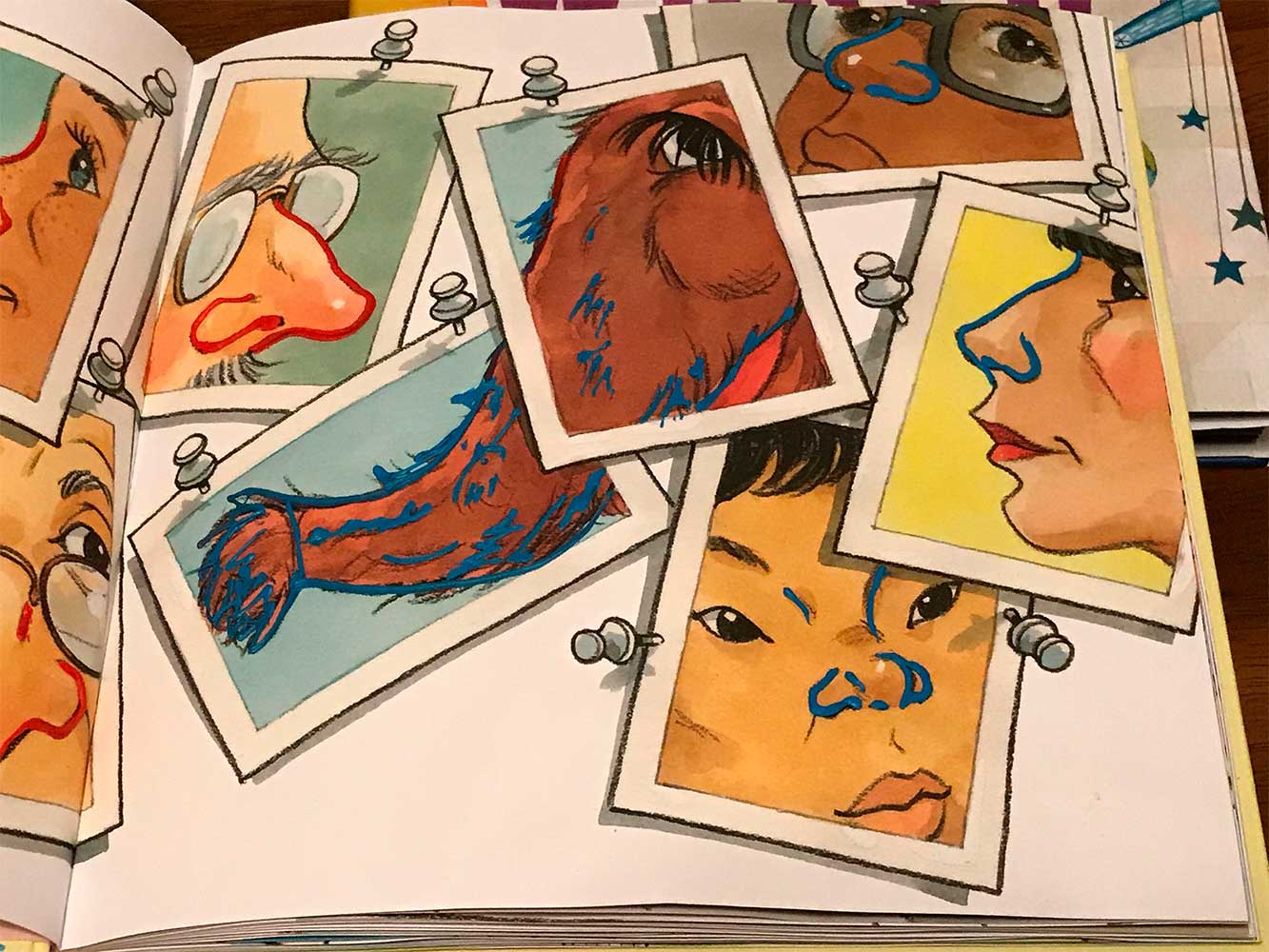
Teachers, students, and creators across the country made picture books more accessible with images that readers could touch and feel to trace the outline of images or text. The opportunity to combine touch and sensory experience through tactile books ensures that blind and low vision individuals can access classic stories in new, imaginative ways.

"In a challenging year, we are grateful that so many teachers and students stepped up to support their local community with picture books to aid the blind and visually impaired."-Maxwell Bogue, Co-Founder at 3Doodler Share

Here are just a few examples that were submitted to 3Doodler by participating schools around the country.

  • 3d pen art showcasing unique hairstyles on painted pictures.
  • 3D pen art featuring portraits of diverse faces.
  • Creative 3D pen art featuring a girl and boy at a table.

The finished products were donated to libraries, hospitals, and preschools with blind and visually impaired programs in December 2020.

As part of an ongoing effort to provide students with the appropriate tools to learn from home due to the current pandemic, the picture books were adapted for at-home use to ensure that education and collaboration would continue to thrive.

Creative Freedom Through Accessibility

3Doodler is committed to making our products accessible to all users, lowering barriers and obstacles, and putting the power of creativity into the hands of more people.

Recognized by the Royal National Institute of Blind People (RNIB), one of the UK’s leading sight loss charities and the largest community of blind and partially sighted people, 3Doodler incorporates unique features to help users navigate their 3D pens and offers audio files for additional orientation.

Forecasting a Wintry Mix with New Lessons

Looking for a fresh start in the new year? Look no further. We have just what you need to get students’ attention and spark hands-on learning with 3D printing using the 3Doodler Start or Create+ pens in the classroom or at home.

The 3Doodler Start in Classroom The 3Doodler Start in Classroom

Schools across the globe encouraged outdoor learning this year to reduce the spread of the pandemic and students couldn’t be happier. In fact, many schools are looking to keep outdoor learning experiences in place even as temps dip and winter weather moves in.

“They’re seeing the outdoors around them and it brings relevancy to what they’re studying,” said Cindy Soule, a fourth grade teacher in Maine, in a recent article. “They will remember that forever.”

Encouraging students to explore the outdoors and apply real-world concepts to their work is easier than you might think with a few new lessons we’re excited to share.

Ellen Peterson, a science teacher at Smithfield Middle School and frequent Doodler, offers up her wintry mix of new lessons designed for students in grades 6-12.

Bubble: Small ornaments on table - 3D pen art

Frozen Bubbles & Bubble Wands – (Grades 6-8)

Students will delight in this hands-on experiment with a cool twist! Designing your own bubble wand in 3D is a fun, creative, and easy way to boost learning outcomes and study changes in temperature. Using the scientific method, students will make hypotheses, track their observations, collect data, and record their findings. Freezing the bubbles either in dry ice or during a quick trip outdoors enables students to measure their bubbles for added experimentation and study. What did the class learn about the “perfect” bubble?

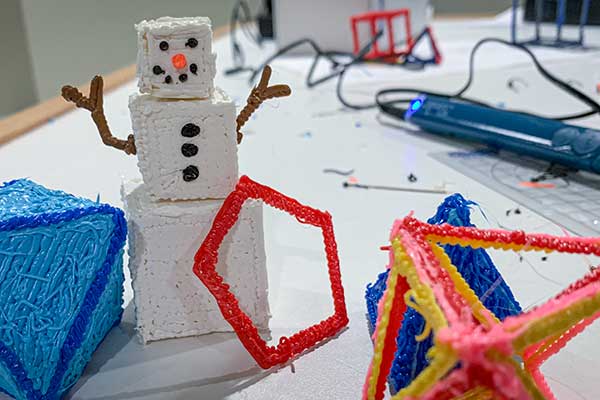
Marshmallow Snowman - 3D pen art on table

Platonic Solid Snowman Math Challenge – (Grades 9-12)

In this lesson, students will research and study the Platonic solids with an opportunity to apply their learning and craft their own model in 3D. Once their research is complete, students will choose 3 platonic solids that they learned about to construct a snowman with the 3Doodler Create+ pen. At the end of the lesson, students report their findings and share their snowman creations. How many different snowmen designs can they create?

Winter is a fantastic time of year for outdoor exploration and providing new creative hands-on learning opportunities.

What other hands-on lessons do you have planned in 2021? Share your fun classroom lessons and designs with us by tagging: @3Doodler #3Doodler #WhatWillYouCreate

Travel The World Without Leaving Home This Holiday Break

We’re inviting our imaginative Doodlers to join us for a trip around the world with an opportunity to take your 3D pen along for the ride without even leaving home! How will we accomplish this do you think?

We’ll explore different cultures and holiday traditions with a fun assortment of 3D designs you can create on your own with your 3Doodler pens and our stencils!

Together we will travel to Mexico, Israel, the Philippines, Sweden, and the United States. Holidays traditions vary from country to country and we’re excited to see your designs as we criss-cross the world this holiday break.

Once you’ve Doodled your way across the globe, consider your own family traditions and take a turn at designing your own creations to represent your favorite holiday activities or memories to share with family and friends.

Poinsettia

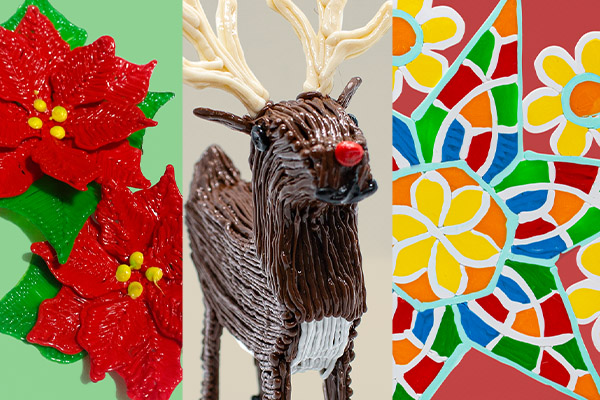
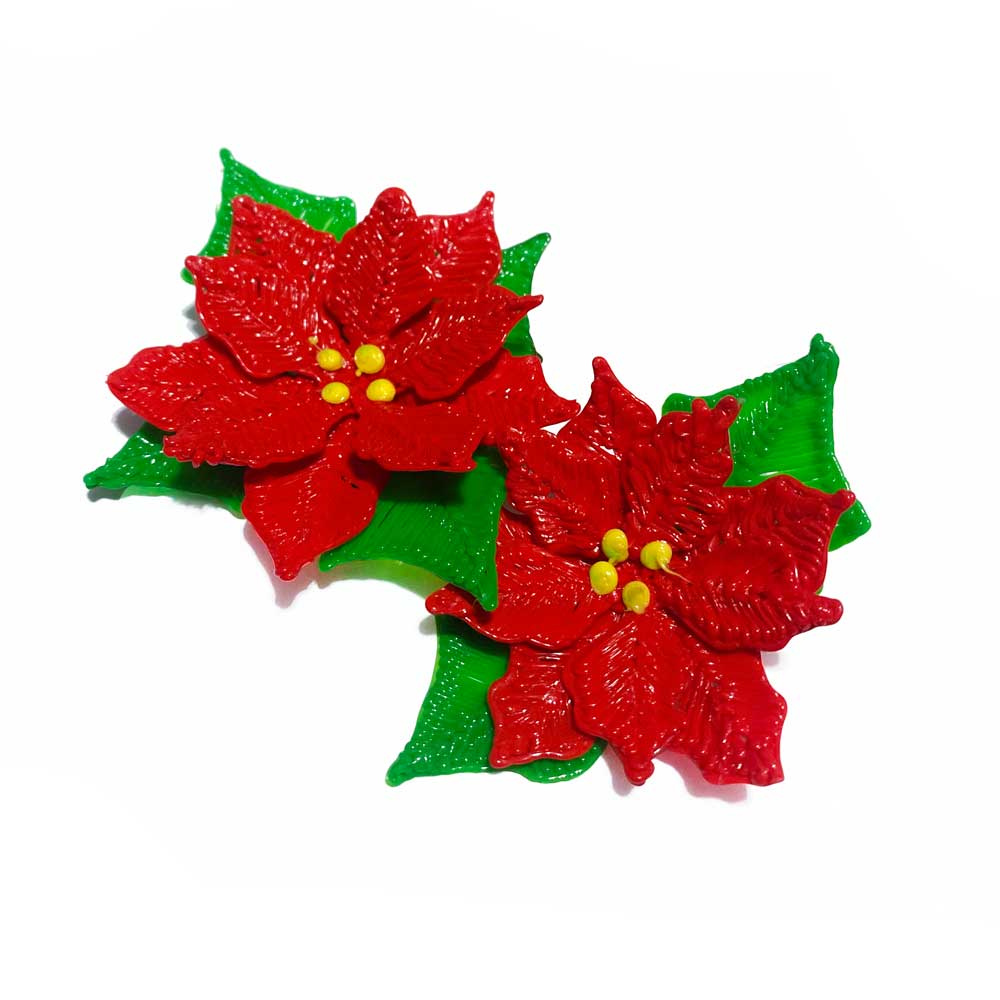
Originating in Mexico, the poinsettia or Flores de Noche Buena (Spanish for “flowers of the holy night”) was introduced in the U.S. in 1828 by the first U.S. Ambassador to Mexico, Dr. Joel Roberts Poinsett. According to a Mexican legend, there was a girl who could only offer weeds as a gift to Jesus on Christmas Eve. When she brought the weeds into a church, they blossomed into these beautiful red plants. The poinsettia flower is part of Christmas Eve celebrations in Mexico to this day. Check out our Poinsettia tutorial and create your own!

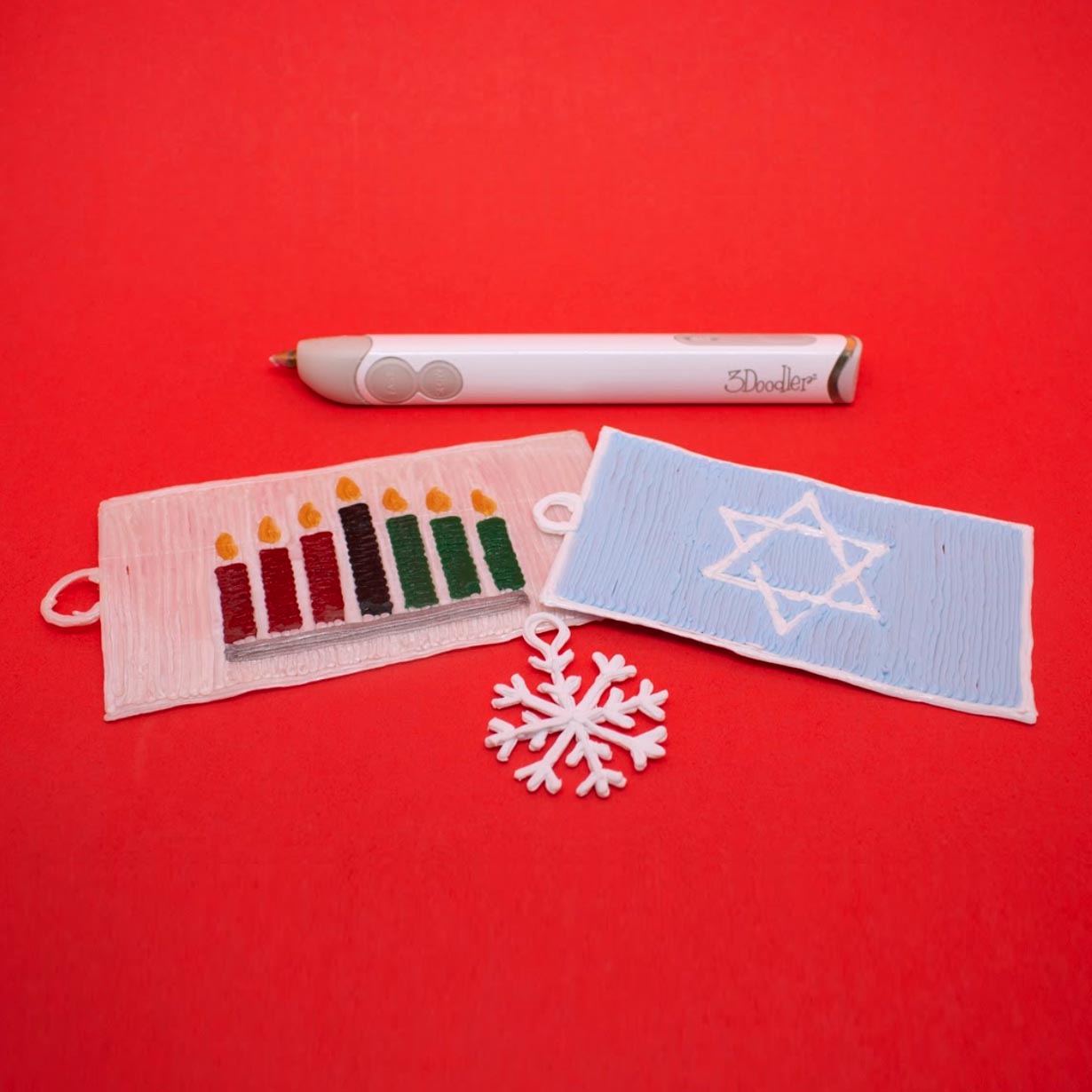
Hanukkah Menorah

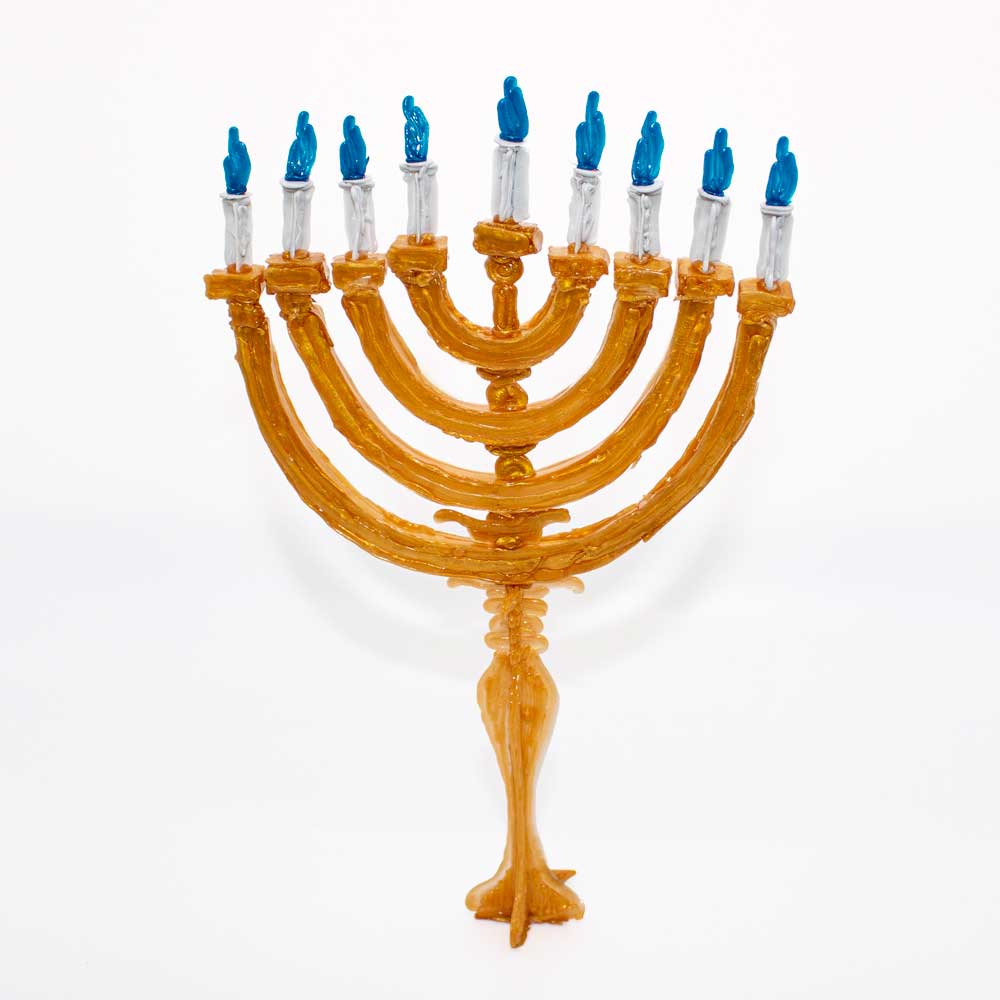
Hanukkah, which means dedication, is an eight-day Jewish celebration that begins on the 25th of Kislev which is the ninth month on the Hebrew calendar. The menorah, the Hebrew word for lamp, has nine branches, one for each night of the Festival of Lights, plus a shamash, meaning helper or attendant, which is lit first and then used to light the other candles. Often called the Festival of Lights, the holiday is celebrated with the lighting of the menorah, traditional foods, games, and gifts. Create your own menorah using this tutorial to celebrate these Jewish traditions.

Giant Star-Shaped Lantern

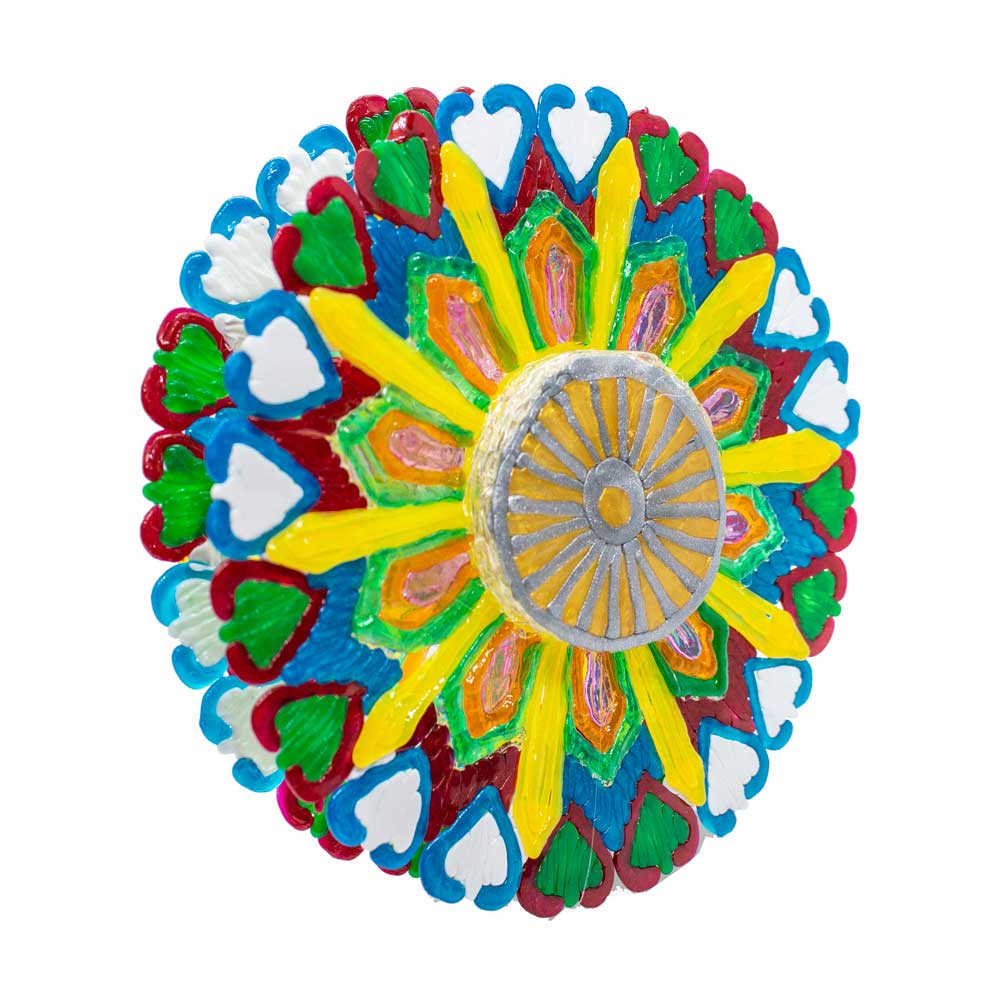
The city of San Fernando in the Philippines draws crowds each December for its Giant Lantern Festival. The local townspeople create colorful intricate lanterns and compete for the best lantern before they are exhibited in the city. The lanterns evolved from the Filipino Catholic tradition of building small, colorful lights to illuminate the procession to Christmas Eve mass. The lanterns today feature a lengthy light show set to music and are giant—measuring approximately 20 feet tall with as many as 10,000 light bulbs. Join in the celebration this season with a star-shaped window pendant, or star-shaped lantern, and delight your friends and family with the novelty of a new tradition. For additional guidance we created a Star Window Pendant tutorial as well as a Star-Shaped Lantern tutorial.

Yule Goat

3D goat cake with red ribbon, created with a 3D pen.

In Sweden and across northern Europe, people celebrate the holidays with Yule festivals that coincide with Christmas celebrations in December. One of the more common traditions in Sweden is the Yule goat, which was believed to deliver presents. In fact, folklore suggests Santa Claus would ride a goat instead of his sleigh! Small goats made of straw are still one of the most popular Christmas decorations in Sweden. For additional guidance, we created this Swedish Goat Tutorial.

Rudolph

Our holiday journey ends with the time-honored story of Rudolph the Red Nosed Reindeer. In 1939, Robert L. May wrote the story of Rudolph for Montgomery Ward, a department store in Chicago that wanted to pass out free coloring books to children during the holiday shopping season. Montgomery Ward printed more than two million copies of Robert L. May’s book that year. He got letters from children, teachers and store managers from across the country. Nearly a decade later, May got the rights to the story and evolved it into a song with help from his brother-in-law who happened to be a songwriter. Enjoy a nostalgic holiday tradition and share the story of Rudolph complete with your own Doodled version of the world’s most famous reindeer.

Wishing all of a Doodlers a bright holiday season and happy new year! Share your creative holiday traditions and your designs with us by tagging us: @3Doodler #3Doodler #WhatWillYouCreate

Vote 3Doodler for 2021 Toy of the Year

Often referred to as the “Oscars” of the Toy Industry, the Toy of the Year Awards program celebrates the top playthings on the market across 16 categories and serves as a vital fundraiser for the Toy Foundation which provides toys to millions of kids in need.

The 3Doodler Start Learn from Home Pen Set is a finalist for STEAM Toy of the Year. 3Doodler’s Start Learn from Home Pen Set engages kids’ imagination as they express their ideas visually with the press of a button. This open-n-go toolkit provides a creative outlet for at-home learners to make art, design objects, and build real working models that demonstrate their understanding of STEAM concepts.

Cast your vote for 3Doodler’s Start Learn from Home Pen Set now through January 5, 2021! Winners will be announced at a virtual celebration on February 12, 2021.

Vote Today

Free 3D Pen Lesson Plans and STEM Classroom Tips

Velvet Holmes Velvet Holmes

“Do you have any lessons where you find student engagement to be down? This is a great place to offer an activity with the 3Doodler pens. It can be the smallest project, but it will give new life to the lesson in the learners’ eyes.” -Velvet Holmes

In this Blog
  • Meet Velvet Holmes, District Technology Literacy Specialist from Oregon School District in Wisconsin.

  • When Velvet seeks increased engagement in her classrooms, she brings out 3Doodler pens.

  • Explore three new lessons written by Velvet, two for grades 3-5 and one for grades 6-8.

Velvet Holmes, district technology literacy specialist, believes it is her role to encourage learners to take risks and think outside of the box.

We had the opportunity to speak with Velvet about using technology in the classroom. In the interview, she shares tips on keeping students engaged, and as a bonus she has created three low-prep lessons that you can start using today.

Thanks so much for meeting with us, Velvet! Can you please tell us about yourself, your district, and a quick snapshot of your goals?
"“It is important to me to be a strong female role model for my learners that are interested in STEAM. Most of my focus lies in Computer Science and coding, where the female voice is missing.”" Share

I have been an educator for 25 years, the past 22 serving in information technology literacy in the Oregon School District of Wisconsin.

My role is district wide, so I work with K-12 staff and students to integrate technology meaningfully into their classroom curriculum.

I am passionate about encouraging learners to take risks, even if it means they fail.

That failure teaches them. I often answer questions with a question.

Students feel frustrated sometimes, but it helps to walk them through a thought process. Once they know I will not give them an answer, they take the time to problem-solve and build confidence as they answer their own questions.

It is important to me to be a strong female role model for my learners that are interested in STEAM. Most of my focus lies in Computer Science and coding, where the female voice is missing.

How do you use 3Doodler pens in your student activities?
"“Giving learners immediate power to create is priceless.”" Share

I invested in a few 3Doodler Start pens several years ago, and now I have a full cart of them! Giving learners immediate power to create is priceless. In a world that is so busy, it is nice to put a 3D pen in a student’s hand and let them quietly take the time to express themselves.

  • 3d pen STEM 3doodler start in classroom
  • 3d pen STEM 3doodler start in classroom
  • 3d pen STEM 3doodler start in classroom
  • 3d pen STEM 3doodler start in classroom

We do a project called “City X” which is about building a community away from earth.

Each citizen in the community has a different problem. Each person has to come up with an invention that has not been created, and students use the 3Doodler pens to make a prototype.

In Math, they build a community of stores with the 3Doodler pens, create a budget and work to find the area and perimeter of the store.

When using the 3Doodler pens, the students are quiet and happy Doodling.

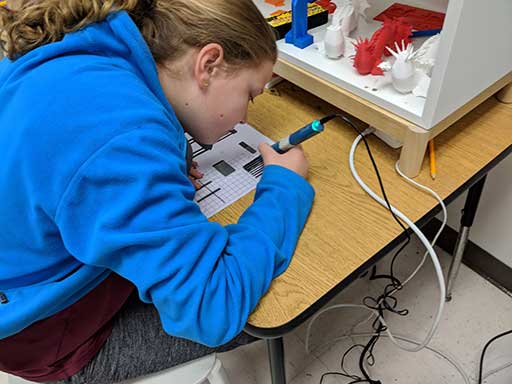
The 3Doodler pens are amazing tools for mental health and being in one’s own mind. Students are inspired to create by seeing other Doodles, too!

Do you have any tips you can share with our 3Doodler EDU community?
"As you move through the design process, the 3Doodler pens are great tools for students to mock up prototypes and see an immediate visual of their creative idea." Share

Do you have any lessons where you find low student engagement? This is a great place to offer an activity with the 3Doodler pens. It can be the smallest project, but it will give new life to the lesson in the learners’ eyes. As you move through the design process, the 3Doodler pens are great tools for students to mock up prototypes and see an immediate visual of their creative idea.

I use a mobile cart to travel from class to class with the pens.

To ensure our students treat the materials with respect, I share a life rule from a fellow teacher: “Keep a neat appearance, keep your belongings in order, and pick up after yourself.”

When our learners understand this expectation, they take ownership and ensure that things are put away, plugged in, and tidy.

I truly believe this sense of responsibility builds community and student engagement, while allowing time for me to teach!

New Lesson Plans for Elementary and Middle School

STEM: 2D vs 3D Bubble Wands
Time: One 60-minute session
Skill: Beginner
Grades: 3rd to 5th

Learners will plan and create a two dimensional bubble wand using 3Doodler pens. They will test their wand to see the shape, size and number of the bubbles that come out. They will then create a three dimensional shaped bubble wand and see if that changes the bubble sizes, shapes, and quantities.

3D Geography: My Land
Time: Two 40-minute sessions
Skill: Beginner
Grades: 3rd to 5th

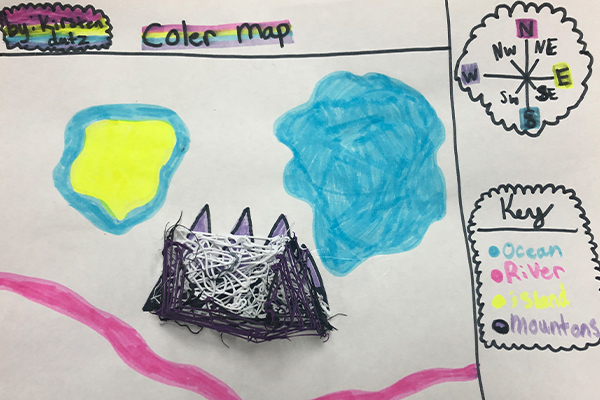
Learners will use their knowledge of landforms to create a paper map with a compass rose and key. The map will include at least one 3D landform, made with the 3Doodler pen.

History: First Nation Symbol
Time: Two 40-minute Sessions
Skill: Beginner
Grades: 6th to 8th

Learners will plan and create a meaningful symbol to represent the Wisconsin-native First Nation group that they researched. They will showcase this symbol as part of their presentation and gallery walk.

Do you have tips to share on using tech tools in your learning space? Share your thoughts with the 3Doodler EDU community on social media, and be sure to follow Velvet on Twitter!

Tag Us: @3Doodler, #3Doodler, #3DoodlerEDU

Celebrating Earth Day: Prototyping Tools to Make a Cleaner Tomorrow

In this article
  • Middle School science teacher, Ellen Peterson, shares how prototyping can help students take risks and invent new things.

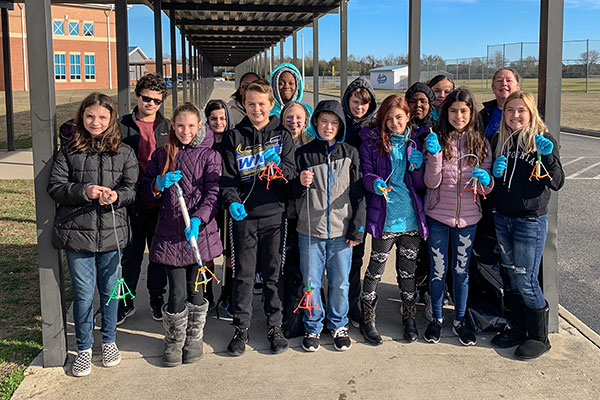
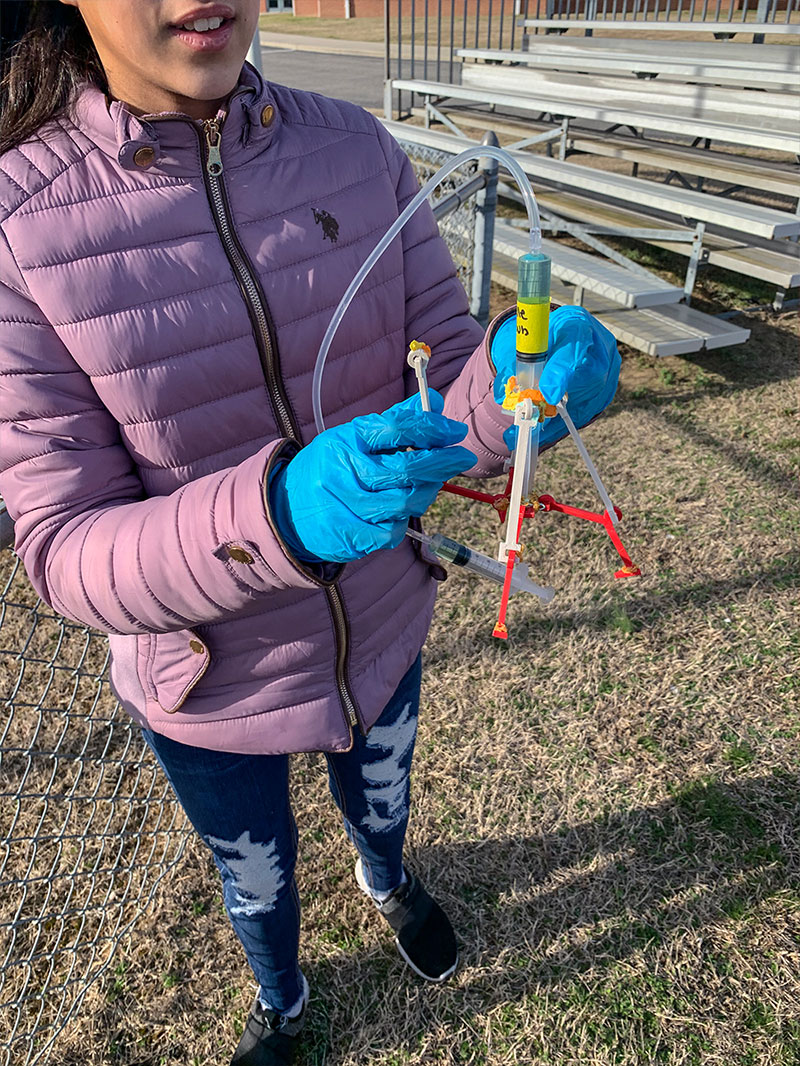
  • Ellen’s students prototyped hydraulic claws, which were then used to clean up trash on their school grounds.

  • Students discovered they were learning more from their failures than their successes.

  • Scroll to the bottom to see our free hydraulic claw stencil that can be used to replicate this project at your home or school!

Written By Ellen Peterson, Science Teacher, Smithfield Middle School

Helping students develop ideas and create things is such an important process. Oftentimes I find my students will not take the risks involved in inventing new things because they have never learned about prototyping. They’ve often never been encouraged or allowed to truly explore the process involved in bringing great work to life. With that as my goal, we started working with 3D printing to create hydraulic claws.

"“Oftentimes I find my students will not take the risks involved in inventing new things because they have never learned about prototyping.”" Share

I introduced my students to 3D printing using 3Doodler Start pens. First we played with them, doodling our names and building small characters or logos that the students wanted to create. Soon, we moved on to using molds to create the parts of hydraulic claws.

  • children 3d pen prototyping in STEM classroom
  • children 3d pen prototyping in STEM classroom
  • children 3d pen prototyping in STEM classroom
  • children 3d pen prototyping in STEM classroom

My students didn’t know anything about hydraulics so we took a small detour in our process, got out some tubs and buckets of water, a few pieces of aquarium hose, and some syringes and figured out how water could be used to push a syringe plunger up while we pushed the connected plunger down.

This led to more than a few conversations about how we used that in real life – the brakes on cars, the lifts on our adjustable stools, and heavy machinery like cranes at our local shipyards. After exploring that, we went back to assembling our claws. The first claw that was assembled was used to pick up a piece of trash on the classroom floor. It worked!

After several class periods of exploration, we decided we needed a way to test all of our ideas, so I posed the question, “What could we do to test our inventions?” It was a student’s idea to pick up the trash we could see right outside our window.

Given the opportunity to brainstorm, they realized that their ideas would be taken seriously and they turned their attention to solving a problem we’d been hearing about in our local community… litter along our roadsides that was ugly, messy, and causing a multitude of problems. The students asked, “Could we pick up the trash outside to test our claws?”

"“Given the opportunity to brainstorm, they realized that their ideas would be taken seriously and they turned their attention to solving a problem we’d been hearing about in our local community.”" Share

That led to picking up other, heavier items and a race to finish more claws. After a few items were picked up, one claw broke. That brought about the process of repairing and improving each version of the claw, only now the kids wanted to know if bigger syringes worked better, if additional “fingers” on the claws would make for better claws, or if there were better materials for making the claws into sturdier tools.

  • students 3d pen prototyping for STEM class
  • students 3d pen prototyping for STEM class
  • students 3d pen prototyping for STEM class
  • students 3d pen prototyping for STEM class

We talked a lot about how other people’s ideas gave us more ideas of how to improve our own work and how, even if an idea didn’t work, it gave us more ideas. Several students took their ideas to more precise methods, using TinkerCAD and our 3D printer to manufacture parts.

Soon we moved away from just creating claws to adding handles and activation buttons to improve our inventions. Each time a new idea was proposed, I tried to make sure materials were available to make that idea possible. I didn’t know if their ideas would work (and often, I was sure they would not) but we tried to build them anyway.

When the project was over, students were surprised to discover they would be receiving grades for their work! They brought up the fact that not one of our homemade claws was still intact. Did that mean they would get a failing grade?

This led to a discussion about the importance of the process, and not the final product. Most of my students felt they had learned more from their mistakes than their successes! Many of them realized they got new ideas when something failed – not when something worked.

For teachers interested in recreating this project, I think it is important to understand it is a process that takes patience and time to explore. The time investment was well worth it for the learning that took place. Having lots of materials on hand was helpful, as was having professionally created “trash pickers” that students could look at for ideas.

Probably the most important thing I would recommend is making sure to build a claw and go through the process that you expect your students to go through. That experience was priceless in helping students to problem solve.

Ellen Peterson
Middle School Science Teacher
Smithfield Middle School
Smithfield, Virginia

Want to replicate this in your learning environment?

Use our free hydraulic claw stencil to get started, or check out our 3Doodler Start Science and Engineering Activity Kit, which includes everything you need to make a hydraulic claw. You can watch a complete video tutorial here.

Do you have educational Earth Day projects to share? We want to hear about them! Post your innovations and tag us @ 3Doodler or # 3Doodler and be sure to follow Ellen Peterson on Twitter.

A Global Celebration of Lace: International Tatting Day

In this article:
  • International Tatting Day is a global celebration of creating delicate lace.

  • Festive lace-themed stencils are included for the occasion, and they are free, printable, and easy to use.

  • See inspiration from some of our favorite Doodlers who make breathtaking lace projects, including Eden Saadon, Erica Gray, Patrick Tai, and SHIGO.

Did you know that today, crafters all around the world are celebrating lace?

That’s right! Today is International Tatting Day, and tatting is a very specific type of lace that is made of delicate knots and loops. This artform is enjoyed by countless people across the globe, and has been since the 1700s.

On this day, tatters around the world celebrate their creative hobby. To help you join in on the festivities, we have some stencils just for you, as well as some creative inspiration from some of our favorite Doodlers.

"“When I don’t know what to wear, I wear black lace.”"-Carine Roitfeld, former editor-in-chief of Vogue Paris Share

Lace Stencils

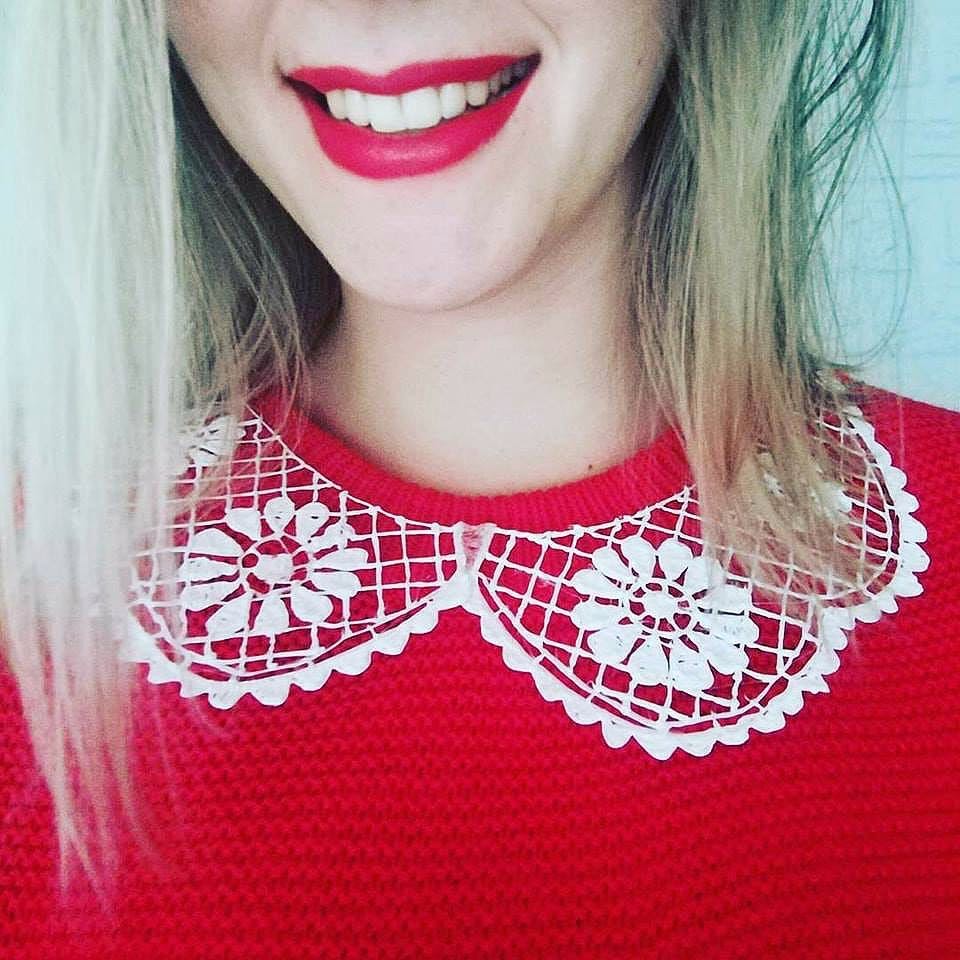
Cute Lace Collar Stencil
Bring an elegant touch to any shirt or sweater with this fun and easy-to-use stencil!

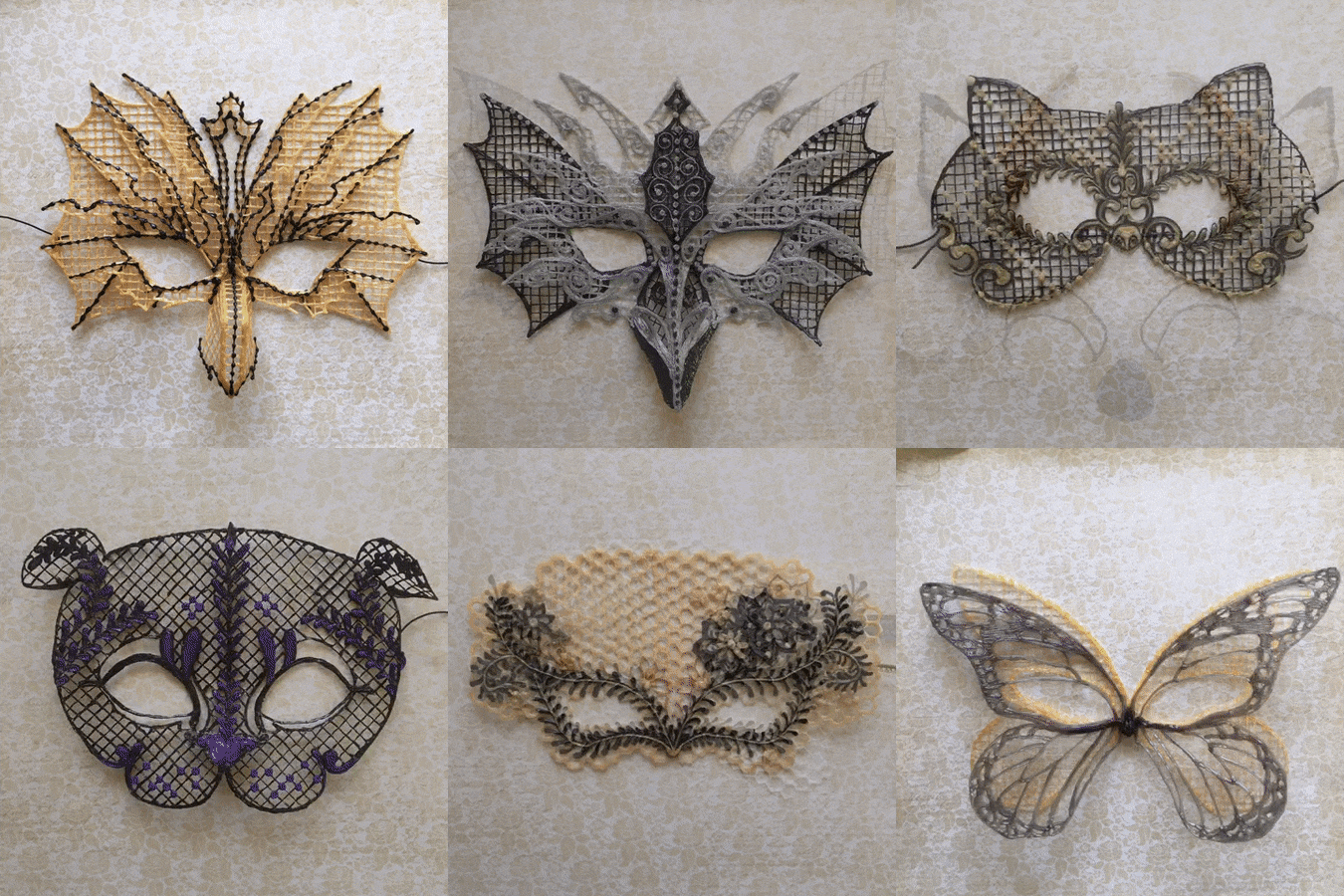
Erica Gray’s Mesmerizing Mask Tutorial
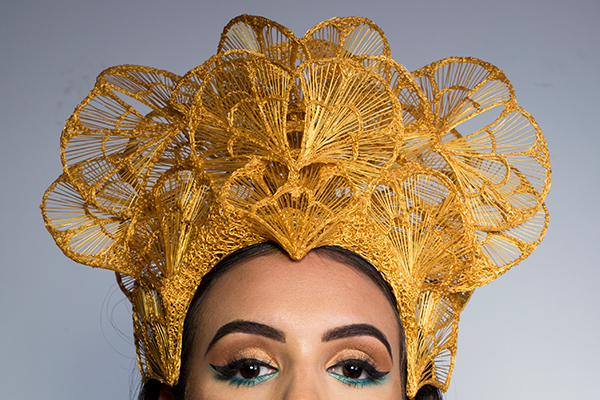
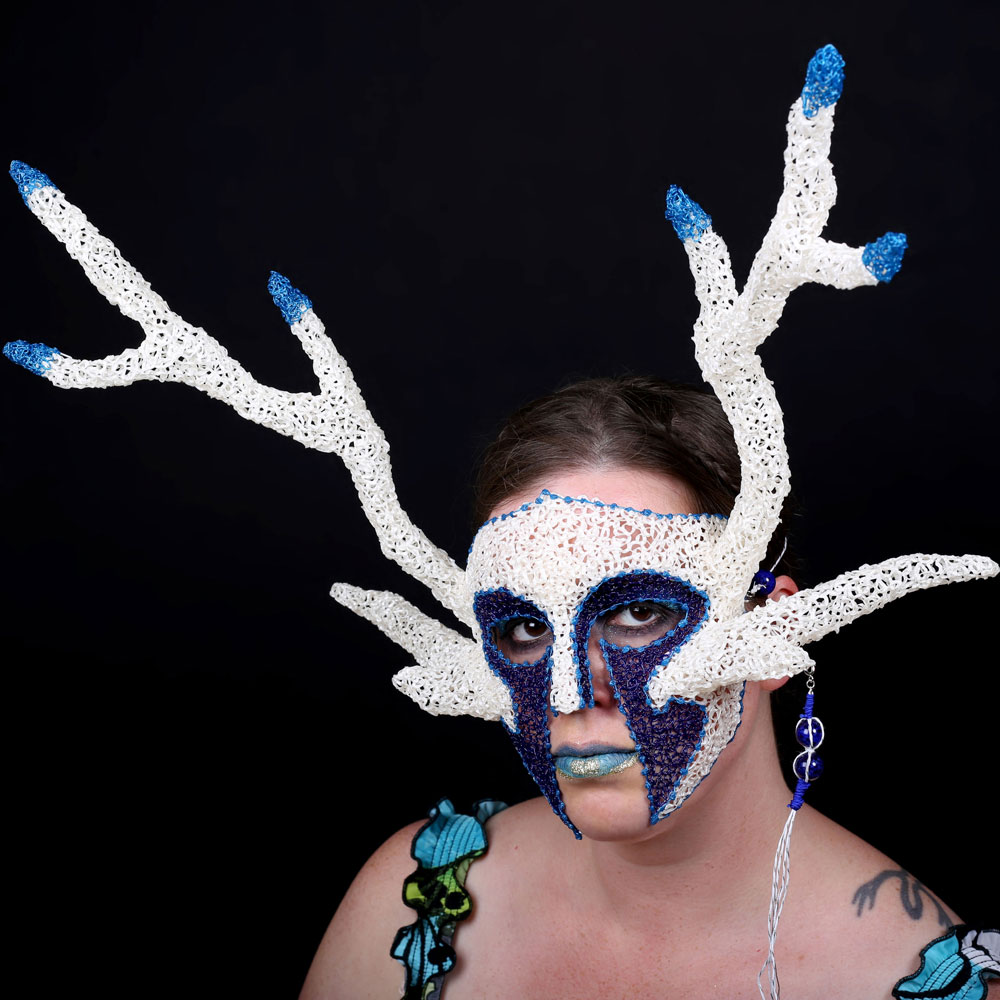
Costumes aren’t just for halloween! It’s always cosplay season, and you can use designer Erica Gray’s mask stencil to make a unique headpiece for your next event, or use the tutorial as a springboard to create your own design.

Lace Inspiration from 3Doodler Designers

To show you that lace projects have no limits with 3Doodler pens, we have highlighted some awe-inspiring pieces from some of our favorite Doodling designers below.

"I think it’s the responsibility of a designer to try to break rules and barriers.”"-Gianni Versace Share

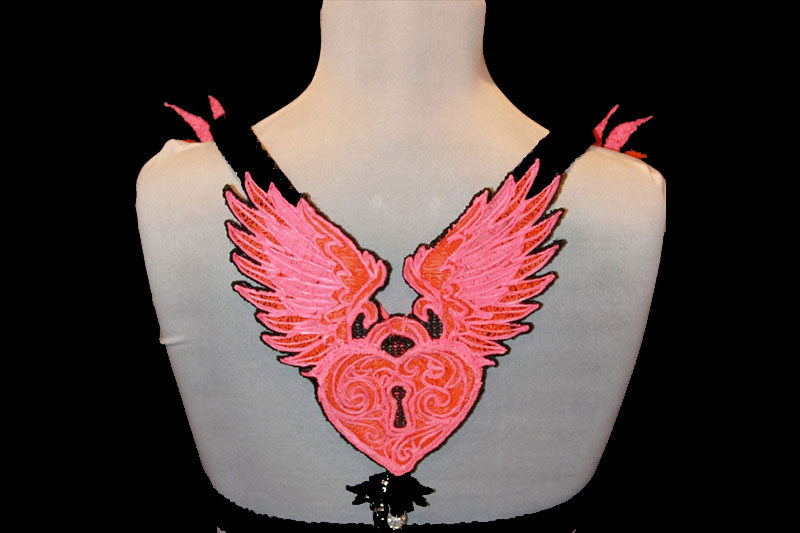
Eden Saadon’s Lacy Lingerie and Accoutrements
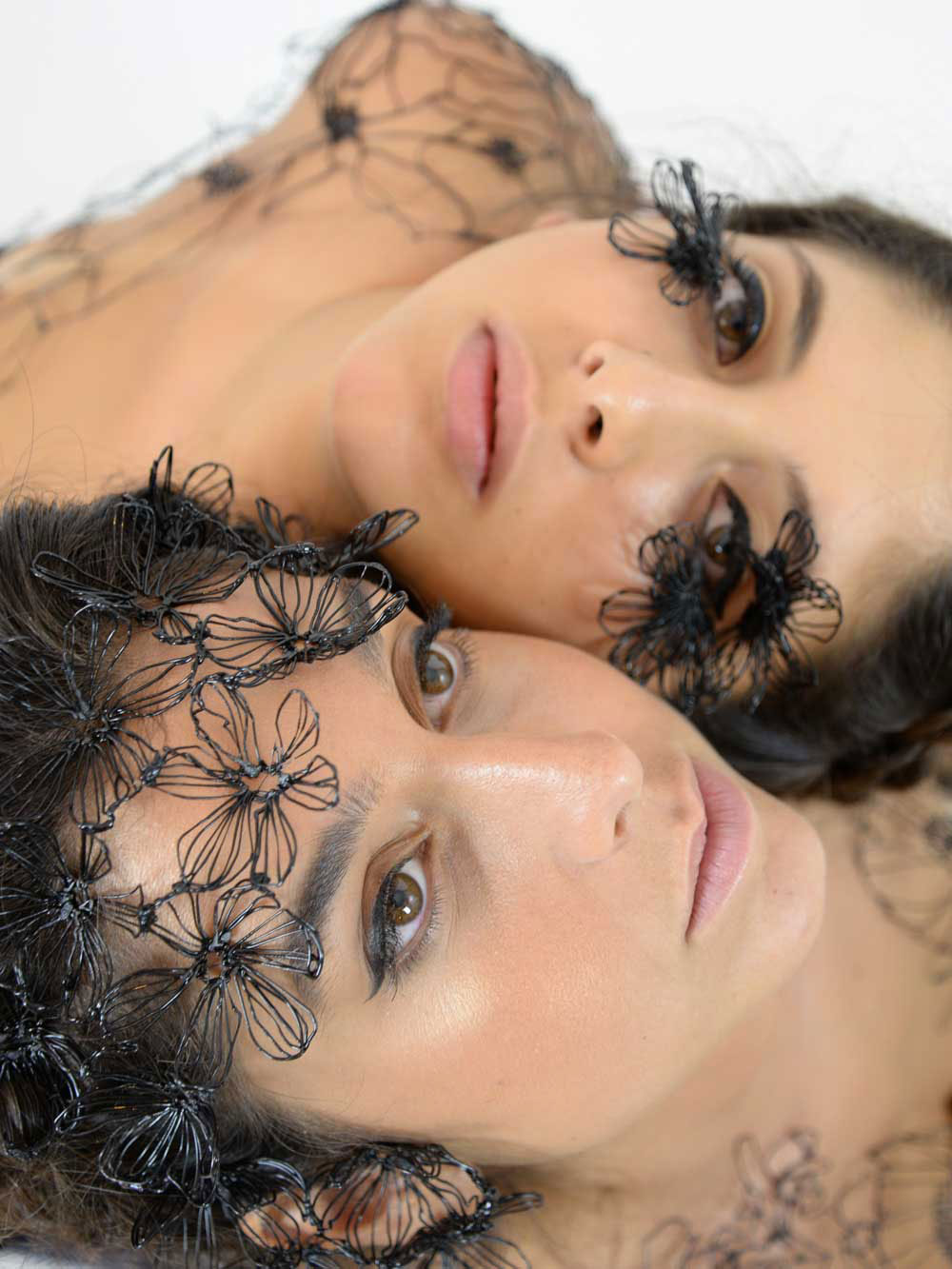
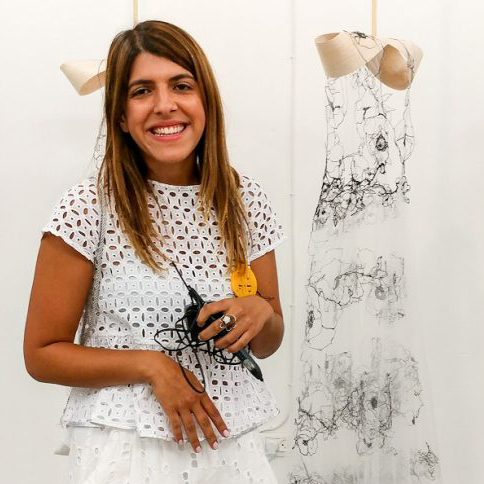
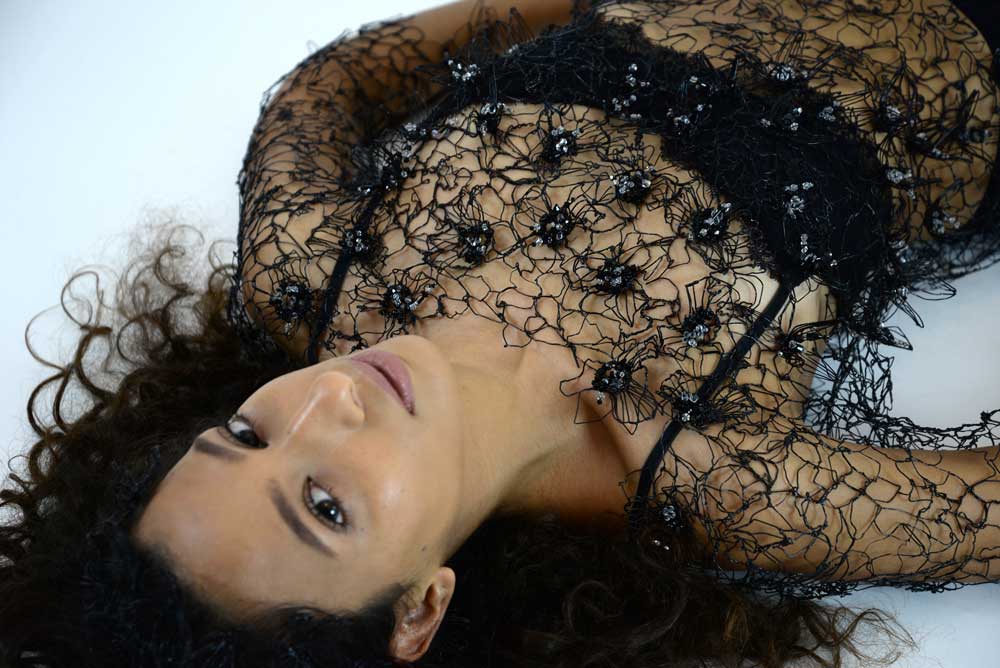
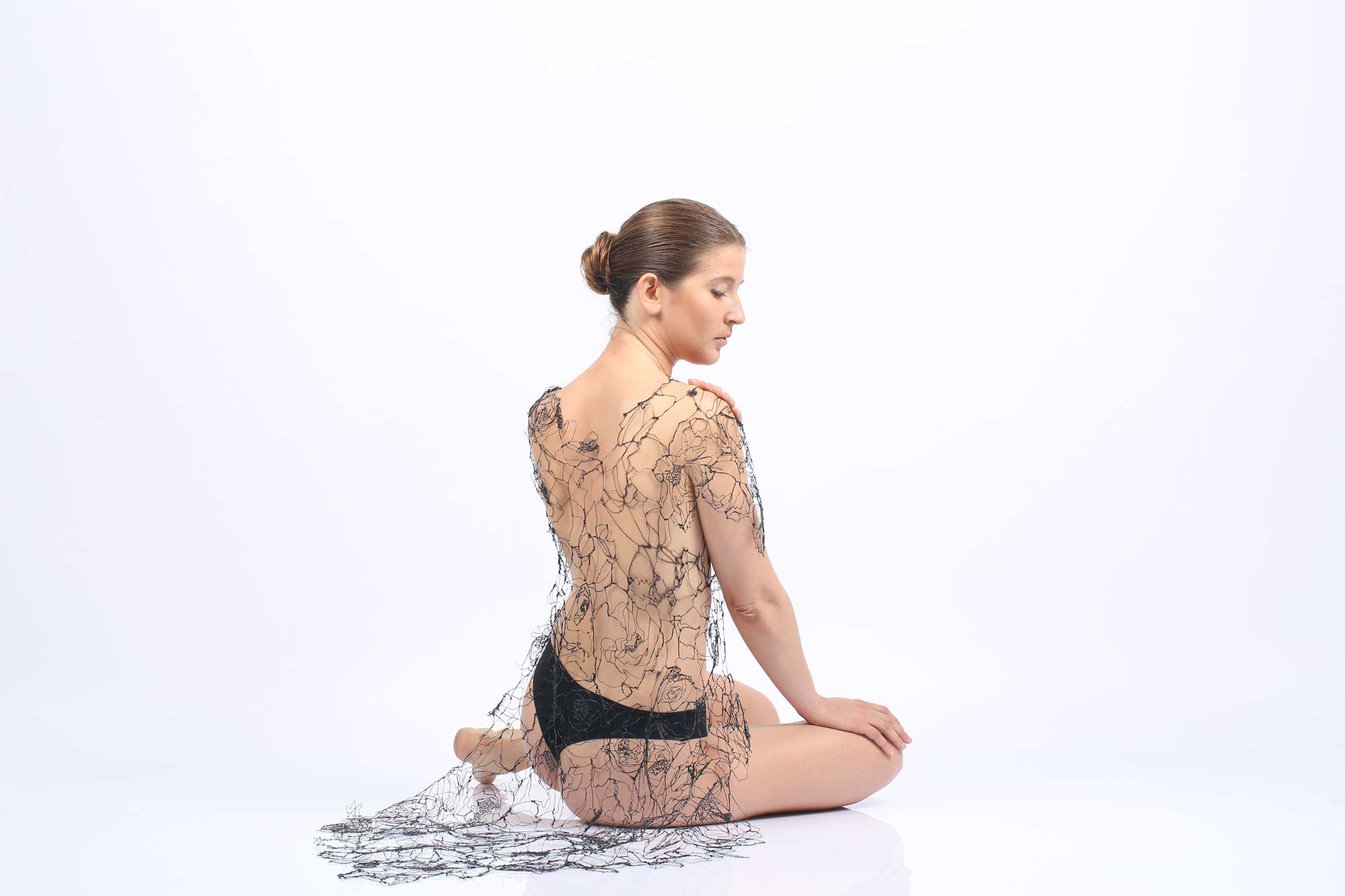
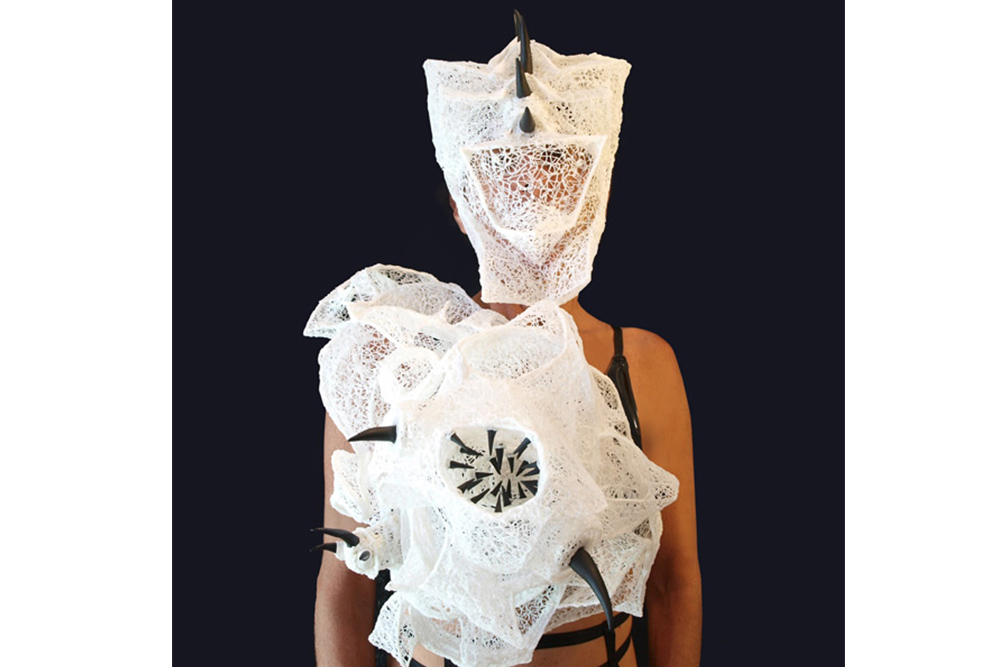
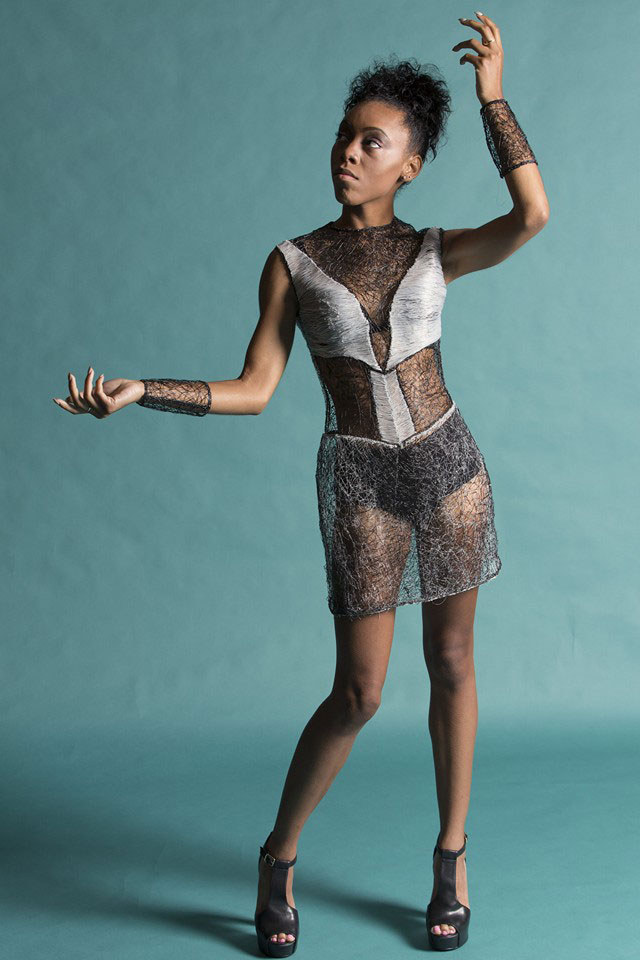
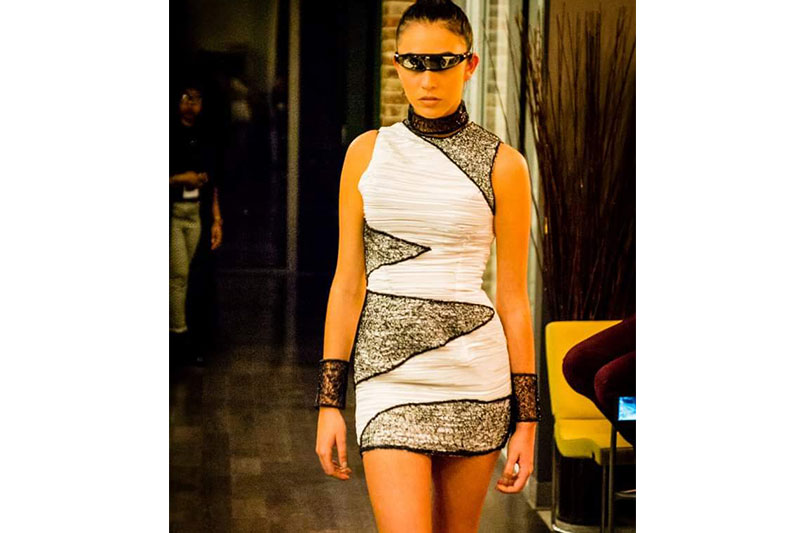
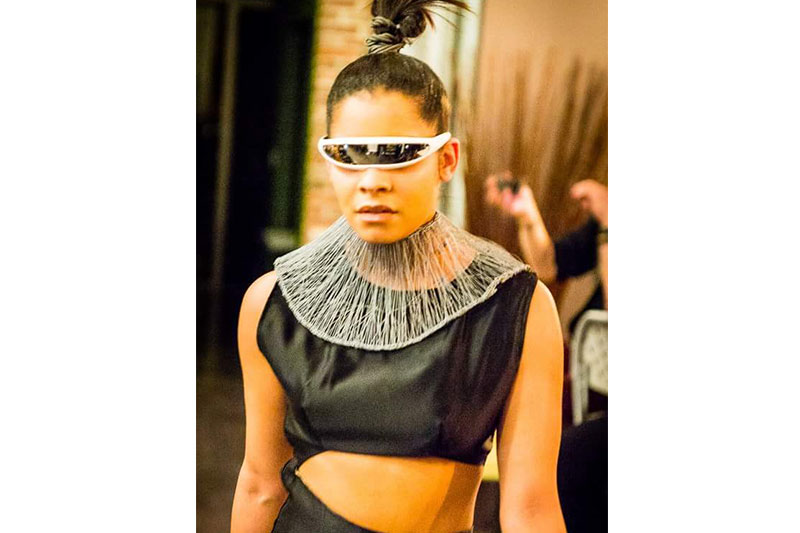
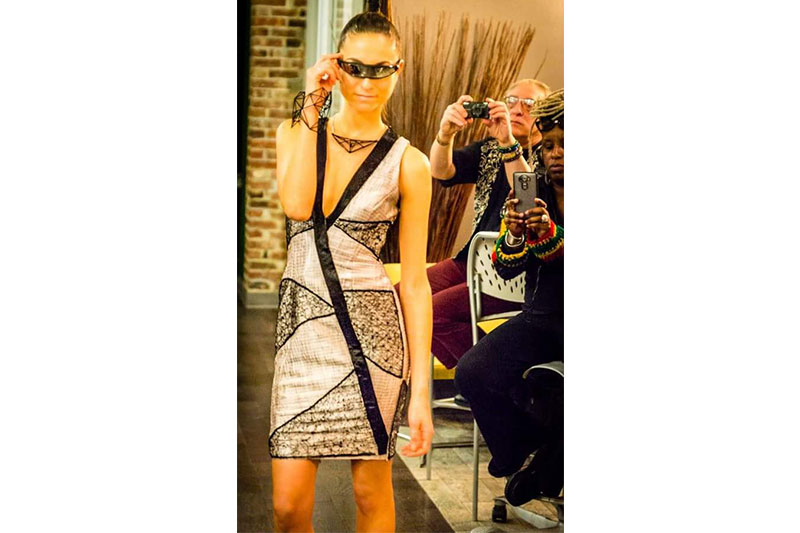
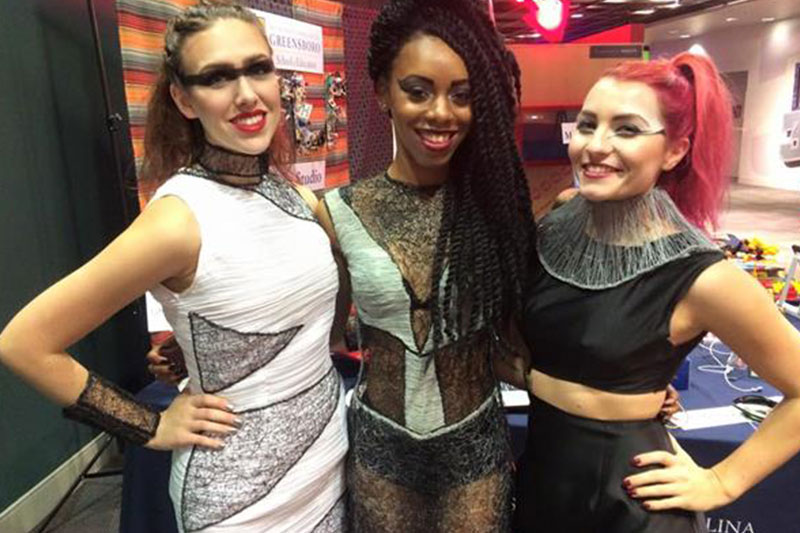
Israeli fashion designer, Eden Saadon, is a pioneer with 3Doodler “lace” wearables. She fell in love with using Black FLEXY filaments for designing her lace collections. You can learn more about Eden here.

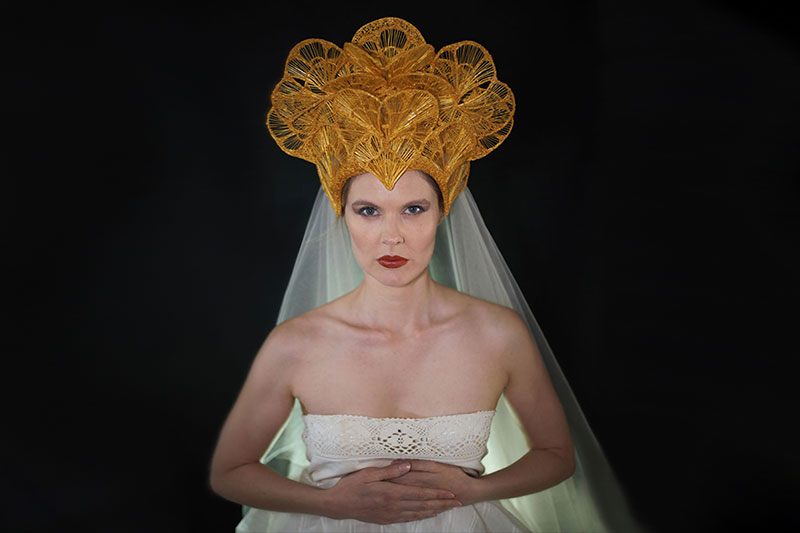
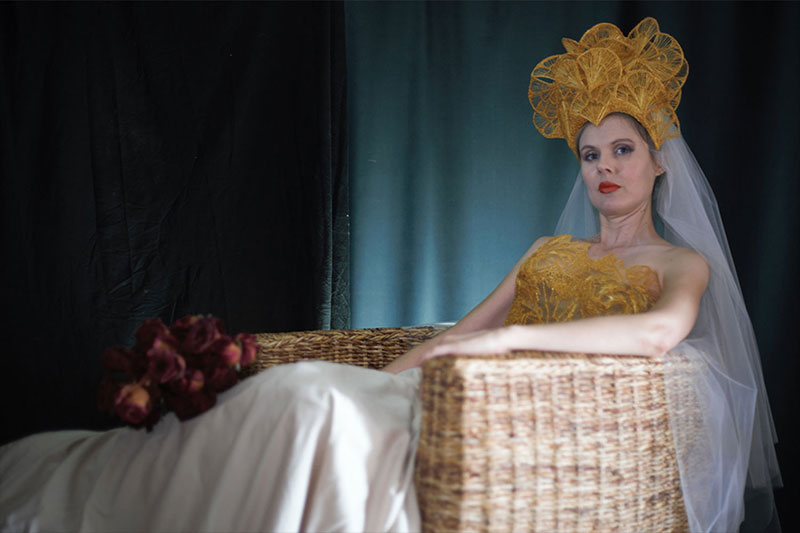
Erica Gray’s Lacey Wearables
Australian fashion designer, Erica Gray, created these beautiful lacey pieces with White FLEXY, Gold FLEXY, and the 3Doodler Create+ pen.

Patrick Tai’s Lace of the Future
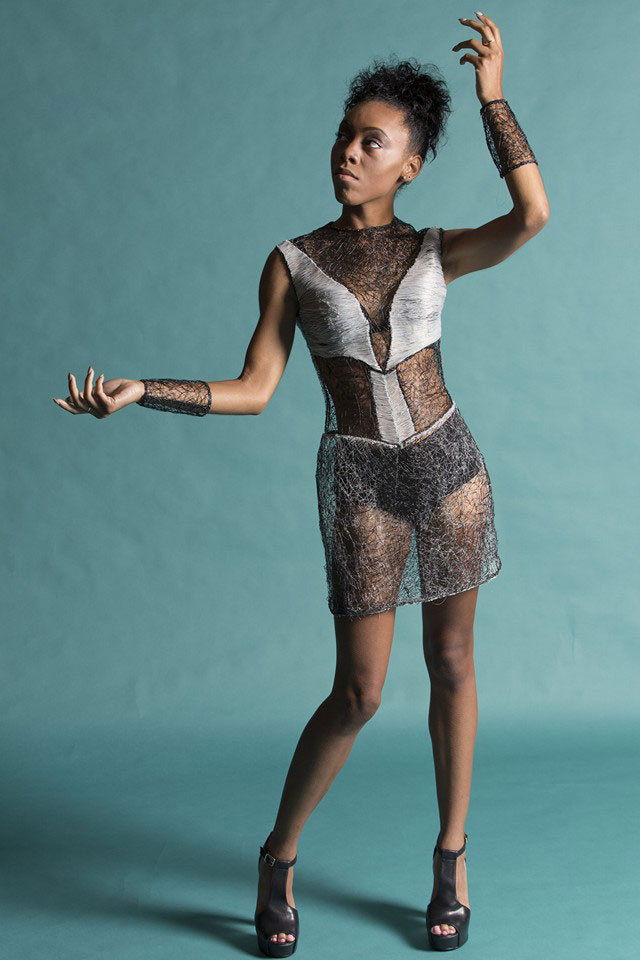
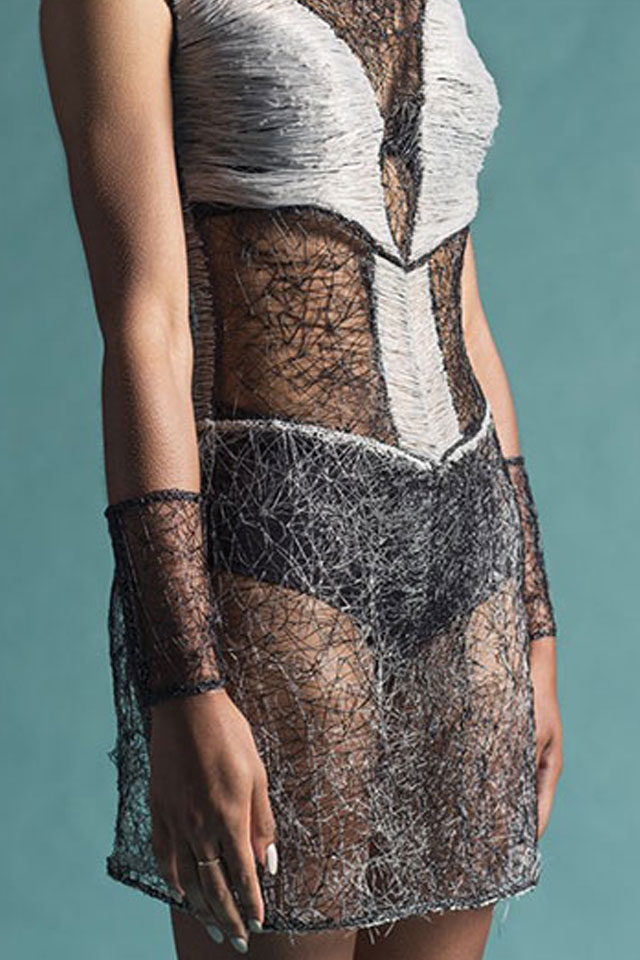
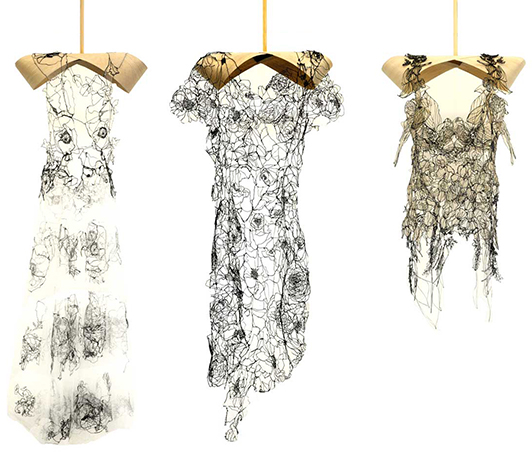
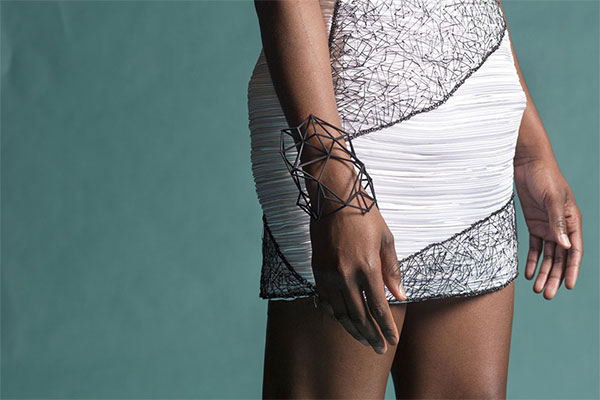
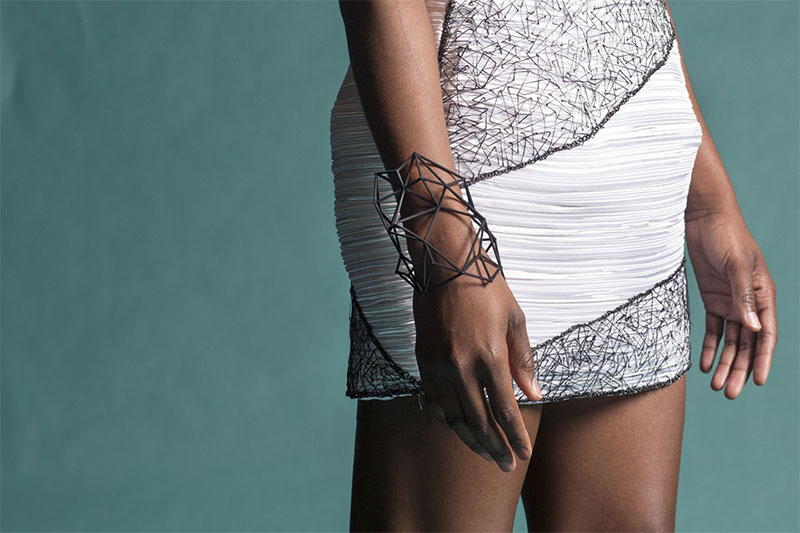
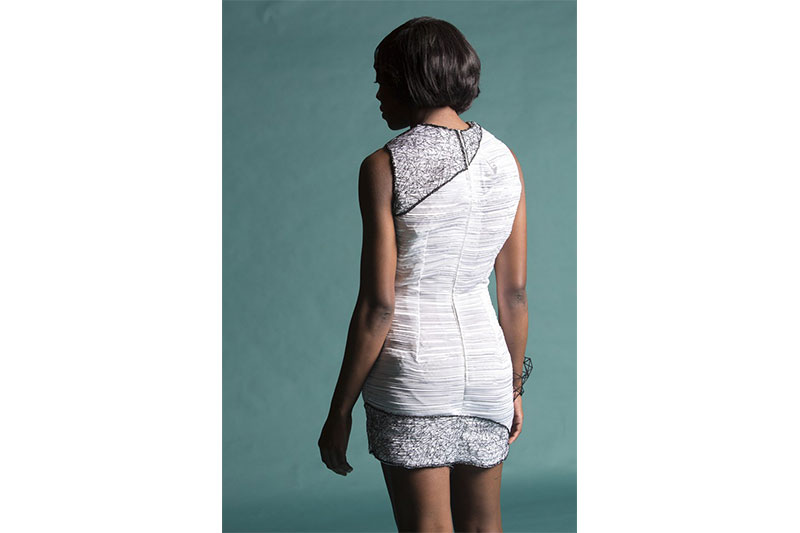
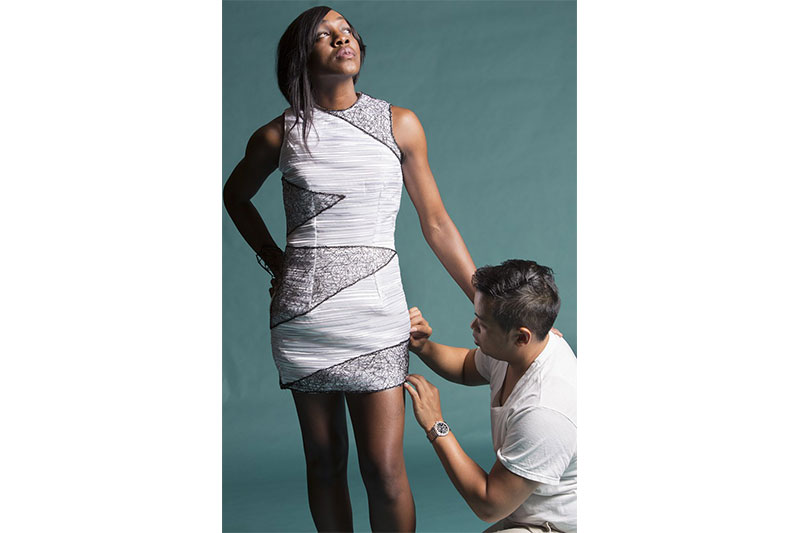
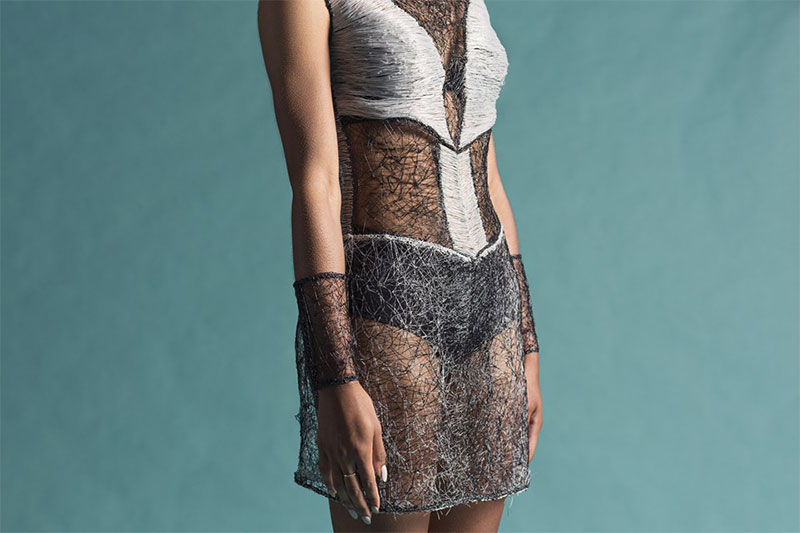
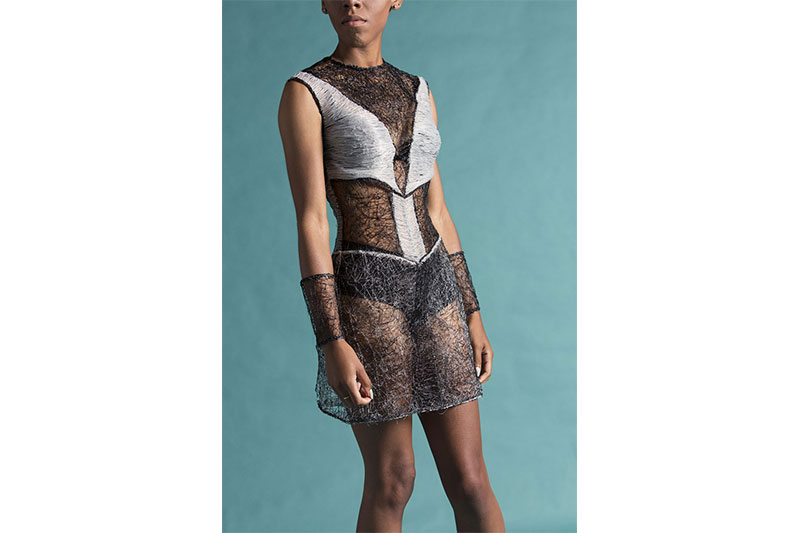
The visionary fashion of Patrick Tai is truly unique in every way. This dress and cuff bracelet are made entirely of FLEXY, and the composition is a delicate, lacy web of interweaving geometry. You can learn more about Patrick’s creations here.

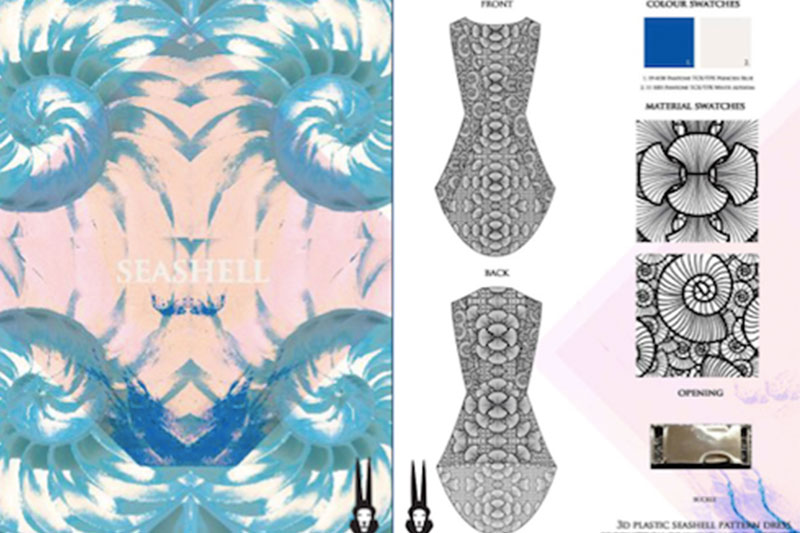
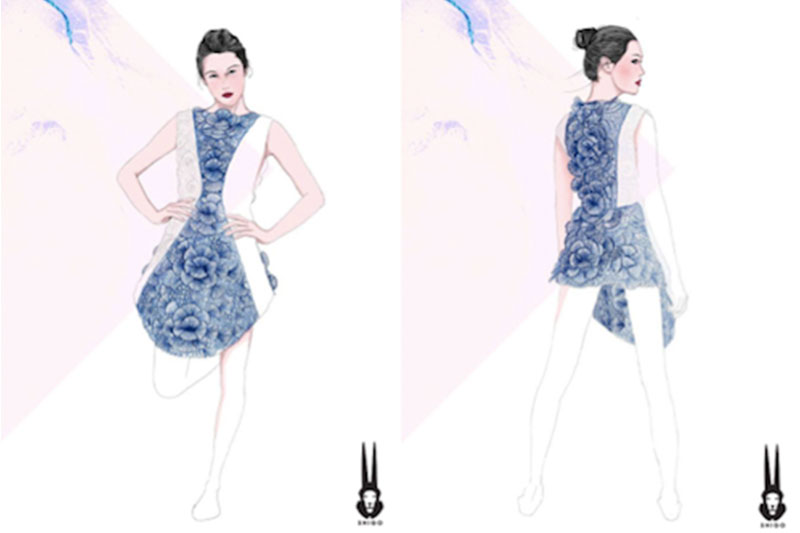
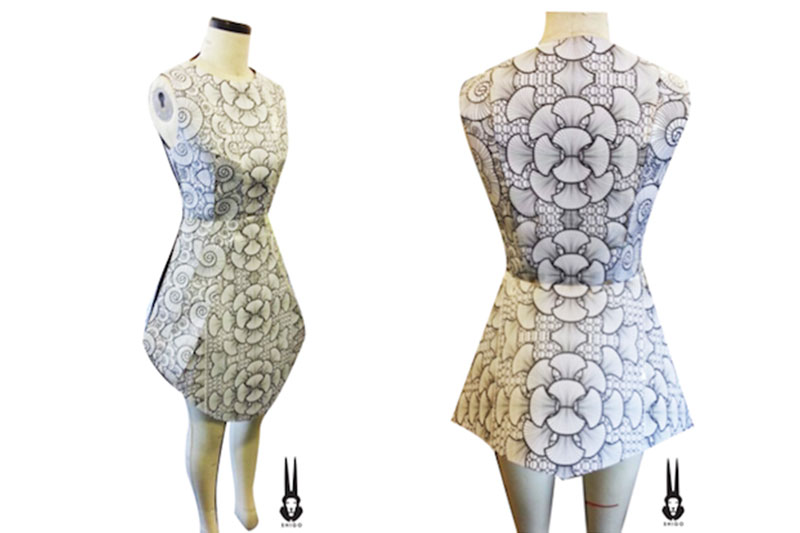
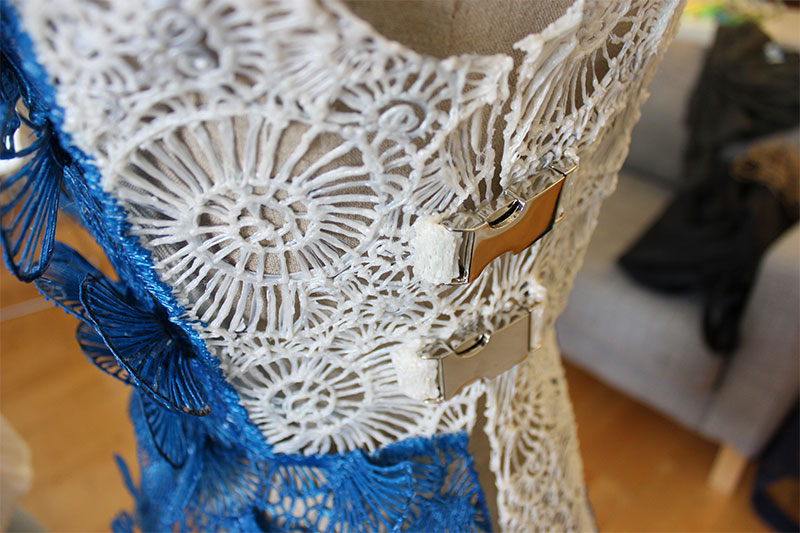
SHIGO’s Lace Designer Dress
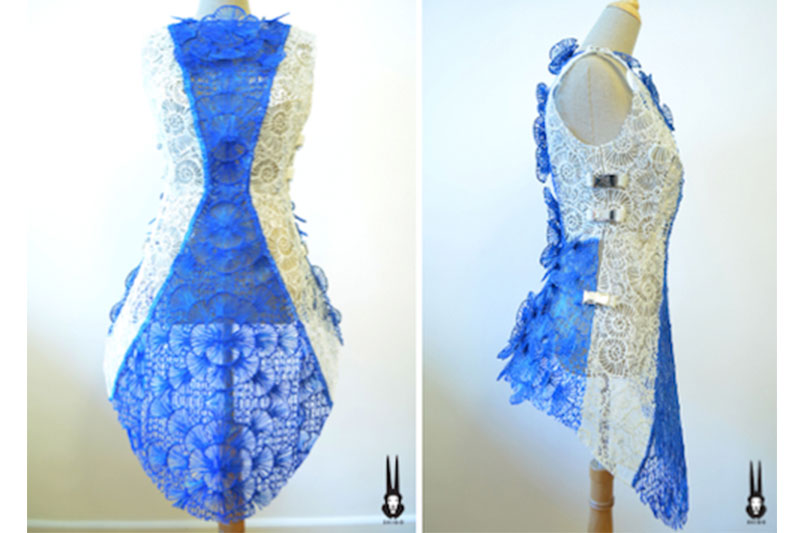
SHIGO, a design team hailing from Hong Kong, created this fashionable lace dress using a 3Doodler pen, Blue Steel PLA and Diamonds & Pearls PLA. To learn more about how they made their dress, you can see their step-by-step process here.

Other Doodlers want to see your lace creations! Share your lacy Doodles with them on social media.

@3Doodler #3Doodler #InternationalTattingDay

Eden Saadon’s Photo Credits
Eden’s Collected Works
Photo Credit: Doron Sieradzki
Photo Credit: Achikam Ben Yosef

Erica Gray’s Photo Credits
Photo 1 and 2:
Designer: #ericagrayartist
Photo 3, 4 and 5:
Photo Credit: Lauren Young Creative, @huxleyschoolofmakeup
HMUA: @makeupbybrooklyn.k
Photo Credit: @gothiczenstudios
Model (Photo 3): @amyejbrowne
Model (Photo 4 and 5): Good Vibes Clare

Patrick Tai Credits
Images courtesy of Patrick Tai

SHIGO Dress Credits
Images courtesy of SHIGO

Join From Anywhere: 3Doodler EDU Webinar Series

Calling all kid inventors, parents, teachers, and creators!

We’re excited to announce our new weekly webinar series, which is completely FREE, and will provide fun, educational, hands-on activities to bring learning to life in 3D.

Maxwell Bogue, 3Doodler’s founder, is excited to host topics designed to encourage young learners to create, build, and explore using three dimensional shapes. This series was created with flexibility in mind — join live or stream it anytime via our YouTube channel. Demonstrations, challenge prompts, and questions will spur learning. Take a look at the full schedule and the quick list of materials you’ll need.

Bonus: You’ll also have a chance to win a Learn From Home Pen Pack during the first webinar!

Schedule

When: Every Wednesday at 1pm EDT
Where: Join on YouTube

What will you create?

April 1: Explore the Seasons
What you’ll need: 3Doodler pen, 3Doodler filaments, Lesson plan, 4x sticks from outside, paper, pencil

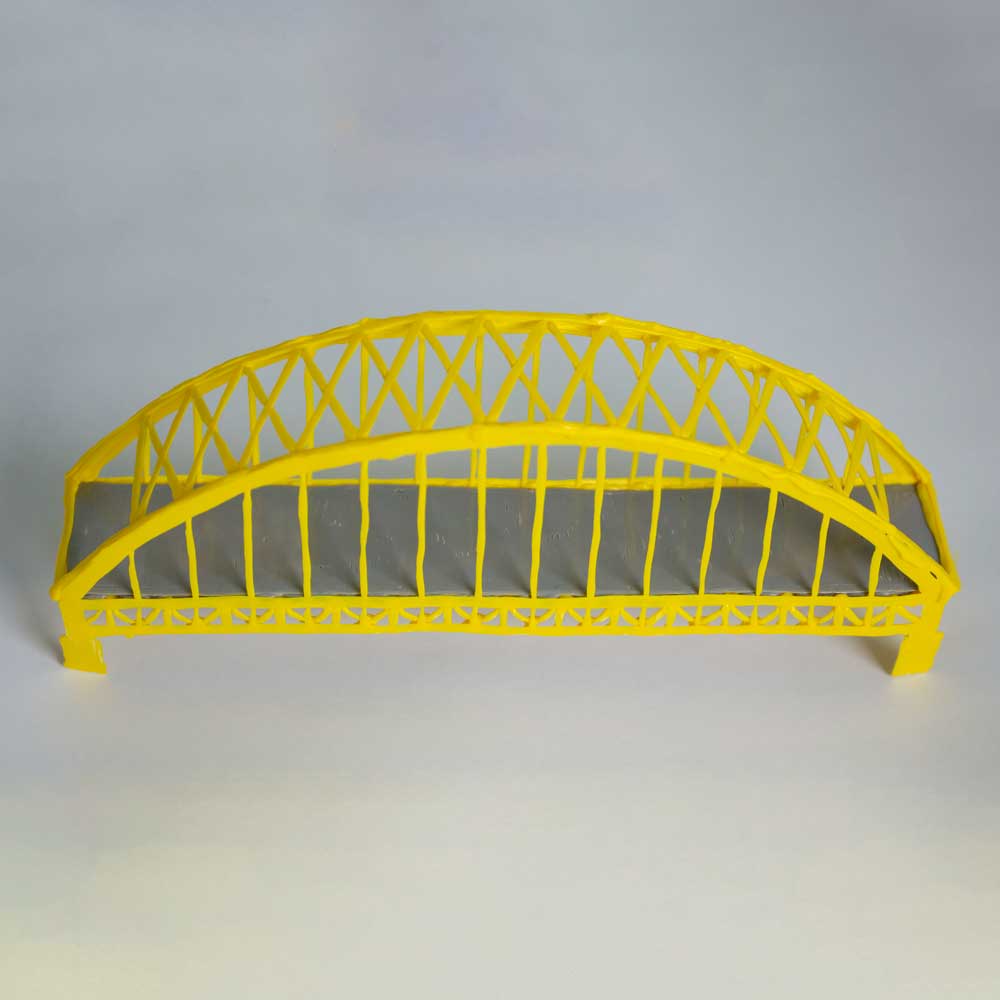
April 8: Building Bridges & Learning 3D Structure
What you’ll need: 3Doodler pen, 3Doodler filaments, printed stencil

April 15: Creativity Shines with Upcycled Inventions!
What you’ll need: 3Doodler pen, 3Doodler filaments, Lesson plan, upcycling items (paperclips, egg cartons, cardboard, etc.)

April 22: Bring the Outdoors In & Get Doodling!
What you’ll need: 3Doodler pen, 3Doodler filaments, Lesson plan, 4-6 leaves from outside

April 29: Lifting Stories off of the Page!
What you’ll need: 3Doodler Start pen, 3Doodler Start filaments, Lesson plan, printed stencil

May 6: Abstract Concepts Realized in 3D!
What you’ll need: 3Doodler pen, 3Doodler filaments, printed stencil, balled up paper to use with catapult

Spread the word about our new 3Doodler EDU webinar series and share what you’re learning with us on social media. Tag Us: @3Doodler, #3Doodler, #3DoodlerEDU!

Posted in EDU

STEAM Education: An Overview from an Expert

Written By Brittany Ballou, K-5 STEAM Teacher, Grange Hall Elementary

Students using the 3Doodler Start Students using the 3Doodler Start

STEAM is an acronym that stands for science, technology, engineering, art, and math, but what exactly does it mean? How can you integrate it seamlessly into your classroom? How will it enrich your students’ learning? In order to have the biggest impact on your students’ education, you want to truly understand all of the ins and outs of STEAM education.

When teaching STEAM you are not focusing on isolated subjects, but rather combining knowledge from all areas as students complete design challenges. When presented with a design challenge, students move through the engineering design cycle (ask, imagine, plan, create, improve, and share) to tackle the problem at hand. This approach allows teachers to be facilitators of learning as students take ownership of the content through project-based learning.

Through the engineering design cycle, students learn by researching the topic, trial and error during the building process, and discussion with teammates. Peer collaboration is a large part of STEAM education because students learn together as they brainstorm ideas and analyze their design through the testing phase.

The problems or challenges that you present to students should not have one right answer, but instead allow students to create a variety of solutions. The teacher is not prescribing a set path and correct solution, but rather allowing the creativity of the students to shine through. This method helps students learn how to approach problems in an organized and effective way – learnings which can set them apart in their future careers.

Bb 3D drawing: Note with 3D pen & paper clip

STEAM education enriches students’ lives because it provides an opportunity for them to apply their knowledge through real-world application. Students love to ask the question, “when am I ever going to use this in real life?” This is your opportunity to expose them to actual problems that involve the application of skills they are learning in the classroom.

While doing this, you can take the opportunity to inform them of the various career paths available to them. If students are never exposed to career paths, such as being an architect, software developer, or medical engineer that utilizes 3D-printing, then they will never have an opportunity to see what they could be when they grow up.

The goal of STEAM education is to create both analytical and creative thinkers. We want students to be able to think outside the box, collaborate with their peers, overcome obstacles, and apply their learning to benefit society. You too can do all of this in your own classroom! Below you will find lesson criteria to help you start implementing STEAM challenges with your own students, as well as tips to help you along the way.

Lesson Criteria
  • Introduce the topic to students.

  • Find literature that goes with the topic. This is optional, but I love finding a new book to read to students. We discuss story elements and link science and/or math curriculum to the storyline with the STEAM challenge that is given.

  • Discuss background knowledge of the topic. This is where you unpack the standards you want students to review before giving them the STEAM challenge.

  • Present the STEAM design challenge to students so that they can relate it to things they already know, and feel connected to the problem.

  • Give students time to create a plan. Their plan should have a picture and be labeled with the materials they need to build.

  • You can provide a set amount of student materials to add the concept of limited resources to the lesson, or let them choose any materials they want.

  • Provide time for students to build, test, and improve their plan. This step can take as much time as, or more than, the previous work thus far.

  • Have students share their designs.

Tips:

STEAM education is not meant to be an “extra” thing to check off your to-do list. Instead, it should help you teach the assigned curriculum in an integrated way, accomplishing several class goals in one project. You should start by unpacking your curriculum standards. I find it helpful to start with science because it naturally lends itself to hands-on projects, but any area can be a starting point.

When you first start using STEAM challenges in your classroom, start small. Give students a time limit to complete the challenge (about 30 – 45 minutes). After students become comfortable with the engineering design cycle, you can complete more in-depth STEAM challenges that require multiple class periods to complete. For example, as you complete a unit of study in science, students can be simultaneously working on a STEAM project to apply and demonstrate their learning.

Not every STEAM project is going to work. Students are going to fail, and that’s ok! Your students will learn more by failing than they will by succeeding. Make sure they have some time to analyze what went wrong. They should always apply what they learn in one challenge and use it in future challenges.

What are your thoughts on STEAM education?

Our EDU community would love to hear about it! Share your thoughts with them on Twitter. @3Doodler #3Doodler

Be sure to follow Brittany Ballou on Twitter.

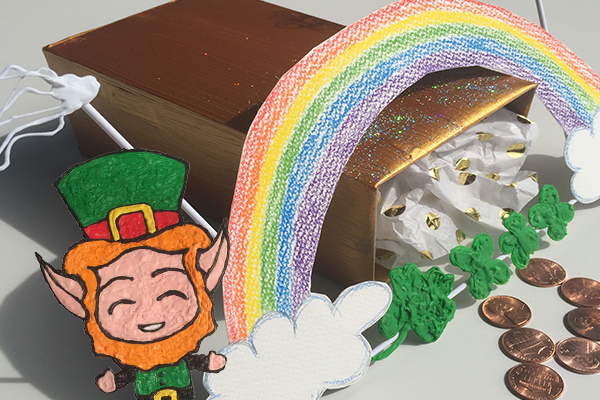
St. Patrick’s Day Lesson and Memory Game

Do you want your next lesson to be the pot of gold at the end of the rainbow?

If so, this is just for you!

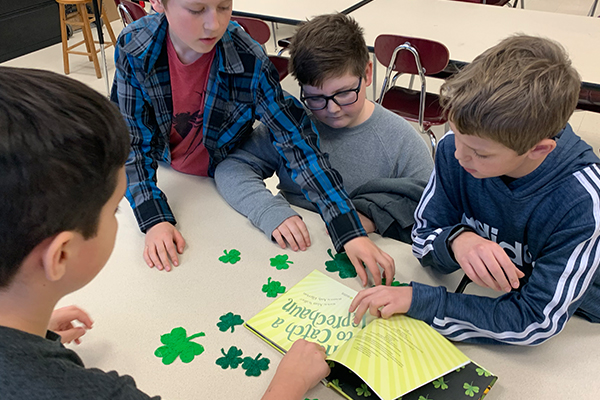
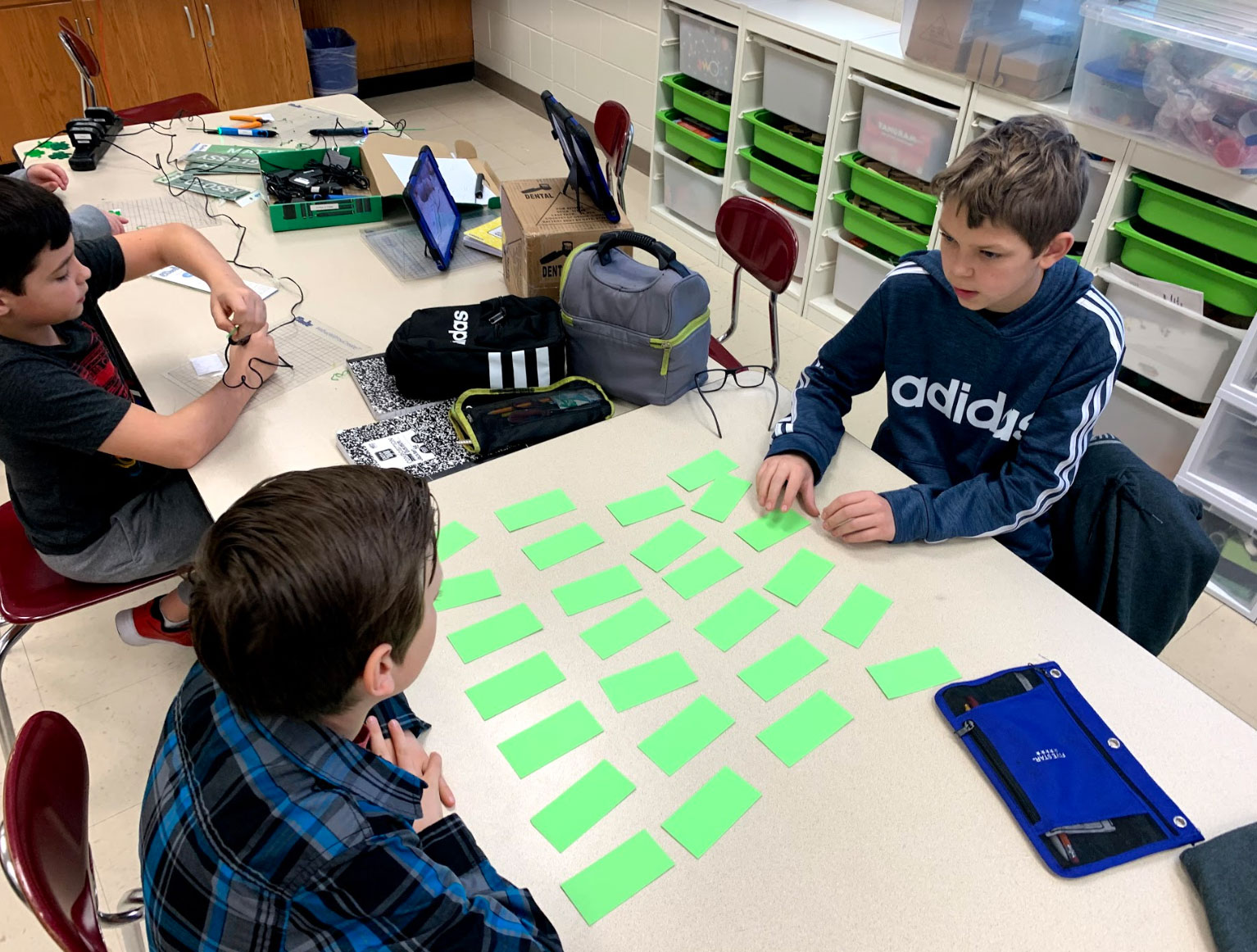
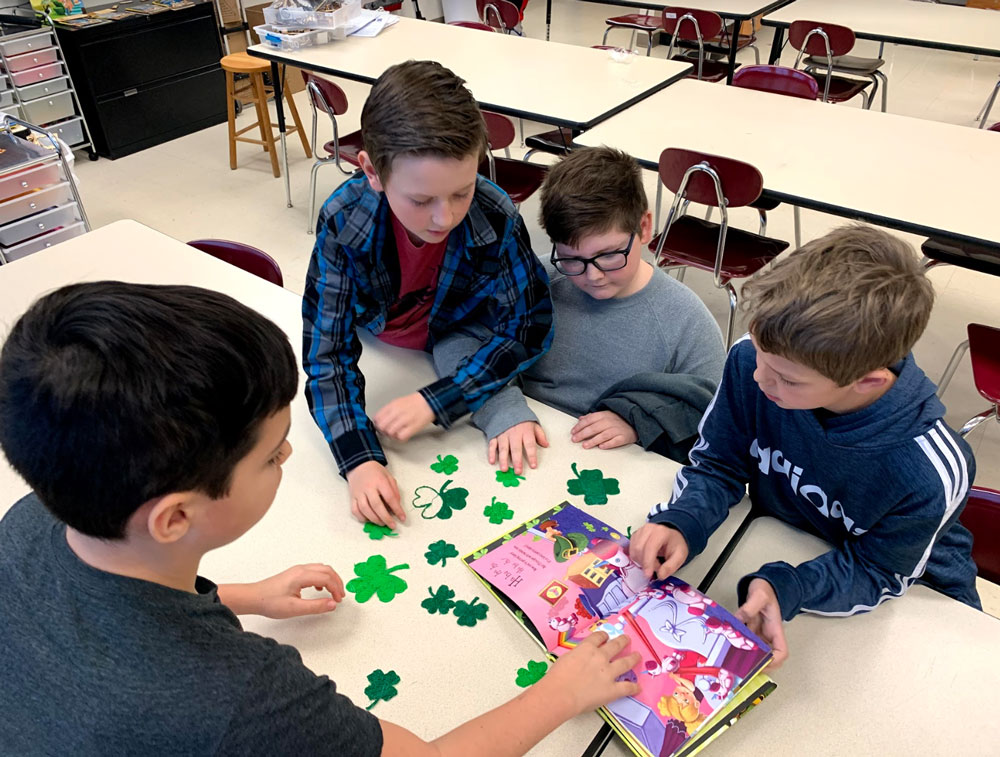
Middle school teacher, Ellen Peterson, has put together an exciting lesson plan and memory game to bring some festive fun to your classroom this St. Patrick’s Day. Not only will it teach your students about the science behind 4-leaf clovers, but it will also bring some focused-fun to this festive holiday.

Teacher Tip: Have students use the hot tip of the 3Doodler Create+ to clean messy edges and smooth out rough corners on their Doodles.

Teachers can follow along to the easy step-by-step instructions and print off the lesson resources for the game, which include the Shamrock Memory Game cards, a score sheet for the students, and 3-leaf and 4-leaf clover stencils.

Teacher Tip: Did you know that you can laminate our stencils so they can be used over and over again? Feel free to print the stencils and laminate them before class. Laminated sheets will work with both the 3Doodler Start pens and the 3Doodler Create+ pens.
It’s Not as Simple as Mendel Said: A Lesson in Shamrock Genetics
Time Required: One 60-minute session
Skill Level: Beginner
Recommended Grades: 6th to 8th

In this activity, students will review the science behind 4-leaf clovers. Individual students will doodle a 3-leaf or a 4-leaf clover based on their final score in the Shamrock Memory Game, which will be played after a review of lesson materials.

Teacher Tip: We have about 100 lesson plans available for free on our website! Each lesson includes step-by-step instructions to accomplish the learning objectives. All of our lessons are written by teachers, for teachers, and they include Common Core, NGSS, CSTA and ISTE educational standards.

Once the lesson plan is complete, you can use the Doodled clovers to decorate the classroom for the occasion!

Other teachers want to see what you’re doing in your classroom for St. Patrick’s Day! Share your classroom happenings with them on Twitter, and be sure to follow Ellen Peterson.

Tag Us: @3Doodler, #3Doodler, #3DoodlerEDU

New Lesson Plan: STEAM Design Challenge

Do you want to bring a fresh design challenge to your students? How about one from an ISTE expert?

You’ve come to the right place! Steven Jones, co-chair of the ISTE STEM personal learning network, has compiled a very special lesson plan that focuses on prototyping. He put the lesson to the test with his students at Hauser Jr. High in Riverside, Illinois with amazing results! We had the opportunity to ask Steven some questions, and he shared some helpful tips for teaching in the classroom.

3D pen art on notebook with sticky notes
"“By accepting that failure is part of the learning process on the path to success, students will be more likely to persevere in the future.”"-Steven Jones Share
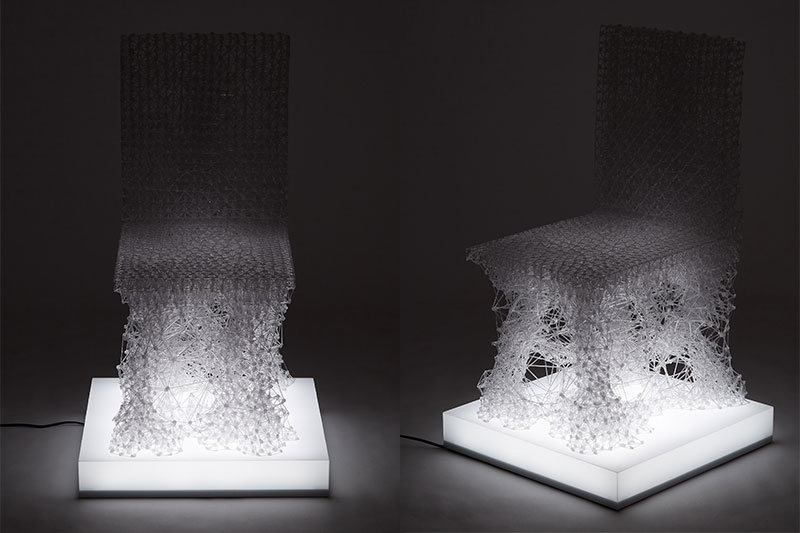
STEAM Design Challenge: Chair Prototyping
Time Required: 3 to 4 40-minute sessions
Skill Level: Intermediate
Recommended Grades: 6th to 8th

For this STEAM based lesson, students will work individually or with a partner. They will use 3Doodler pens to iteratively develop a chair design using criteria and constraints.

Thanks for taking the time to meet with us. Do you have any tips for other teachers administering lessons that incorporate 3Doodler pens?

I would recommend that teachers start small and build up to bigger projects. If you are not used to utilizing technology like this, you and your students might become disheartened if you initially try something that is not successful. Try a simple, introductory project first and support your students in becoming familiar with the technology, then the sky’s the limit.

  • basic 3d shapes made using 3d pen in STEM classroom
  • basic 3d shapes made using 3d pen in STEM classroom
  • basic 3d shapes made using 3d pen in STEM classroom
  • basic 3d shapes made using 3d pen in STEM classroom

Do you have tips for teachers hoping to create their own mini activities for classroom use with 3Doodler, or EdTech in general?

Think about the purpose of what you want to accomplish at the end. Use technology in a unique way to help achieve a goal. Technology is a tool and tools need good ideas. Once you understand your goal for learning, then it should be easy to create activities that integrate versatile technologies such as 3Doodler pens.

Can you share tips on supporting student engagement from day to day in the classroom?

Don’t be afraid to get feedback from your students. Nobody is perfect. By offering the opportunity for students to share their ideas with you, it is possible to turn good lessons into great lessons. Part of the reason that great lessons are successful is because there is a high level of student engagement due to the incorporation of student input and interests.

  • basic 3d shapes made using 3d pen in STEM classroom
  • basic 3d shapes made using 3d pen in STEM classroom
  • basic 3d shapes made using 3d pen in STEM classroom
  • basic 3d shapes made using 3d pen in STEM classroom

Please follow Steven Jones on Twitter (@mrjonesteaches) to see what his classroom stays up to.

Are you inspired by Steven, or perhaps you have a 3Doodler activity to share with our community? Share it all with the EDU community on Twitter!

Tag Us: @3Doodler, #3Doodler, #3DoodlerEDU

Bringing the Anatomy Textbook to Life with Ricardo Martinez

In this article
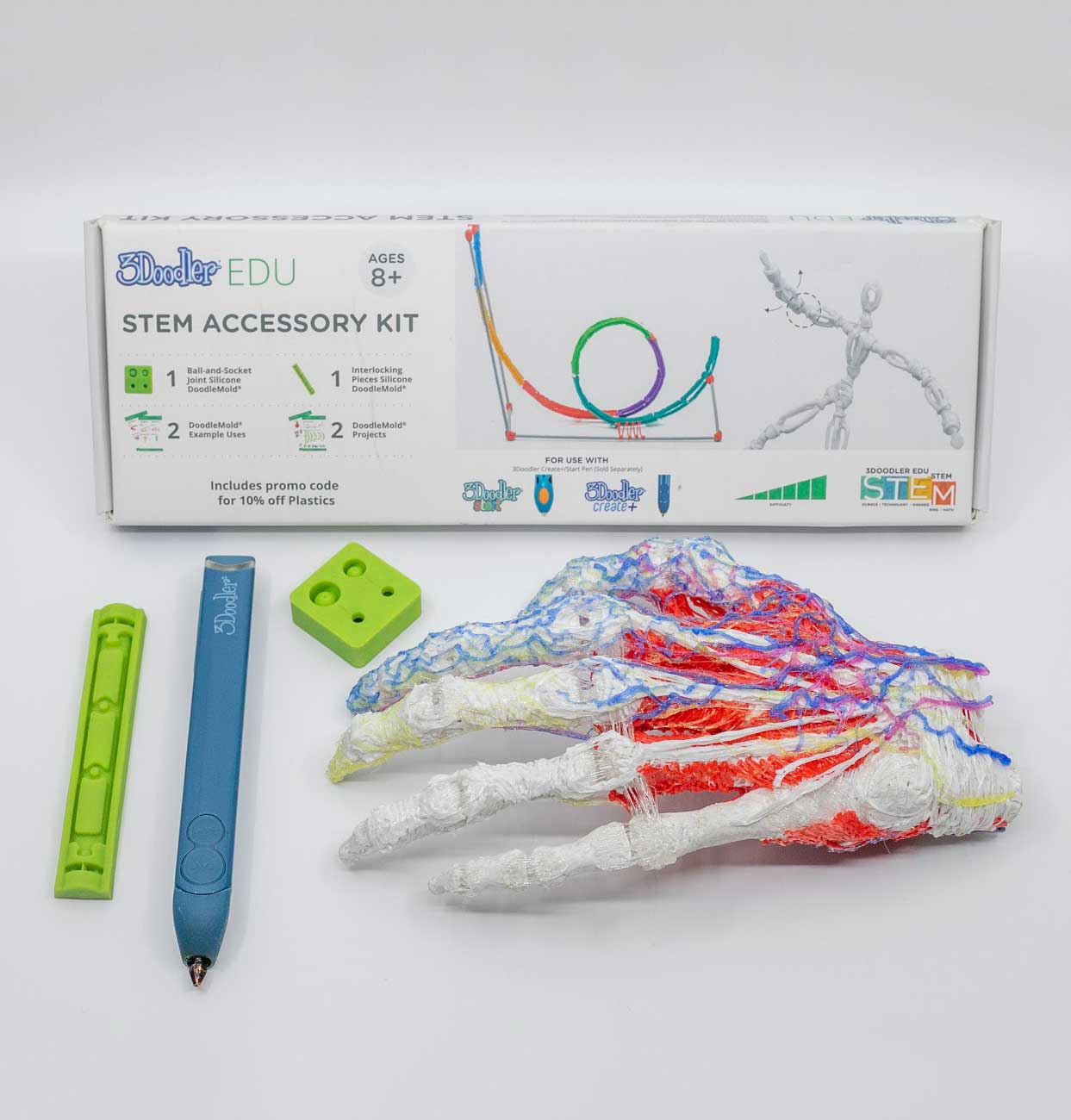
  • Internationally renowned Mexican artist, Ricardo Martinez, has a background in medical anatomy drawings, painting, and sculpture. He’s made a moving anatomical hand with the 3Doodler Create+ pen and the 3Doodler STEM kit.

  • Moving 3D anatomical models benefit those who may not learn as well through 2D visual resources.

  • You don’t have to be a sculptor or an anatomy expert to create this model.

  • Scroll to the bottom of the page to see the step-by-step tutorial and filaments used for this project.

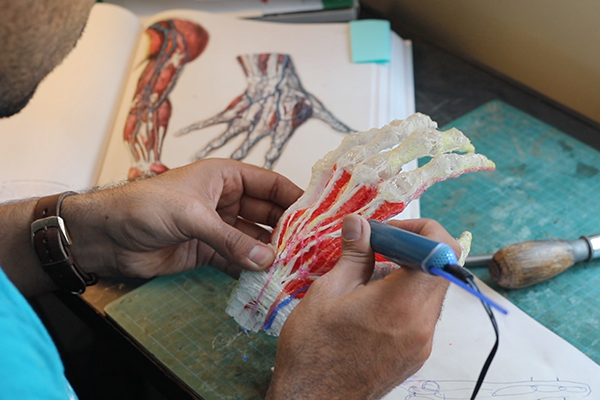
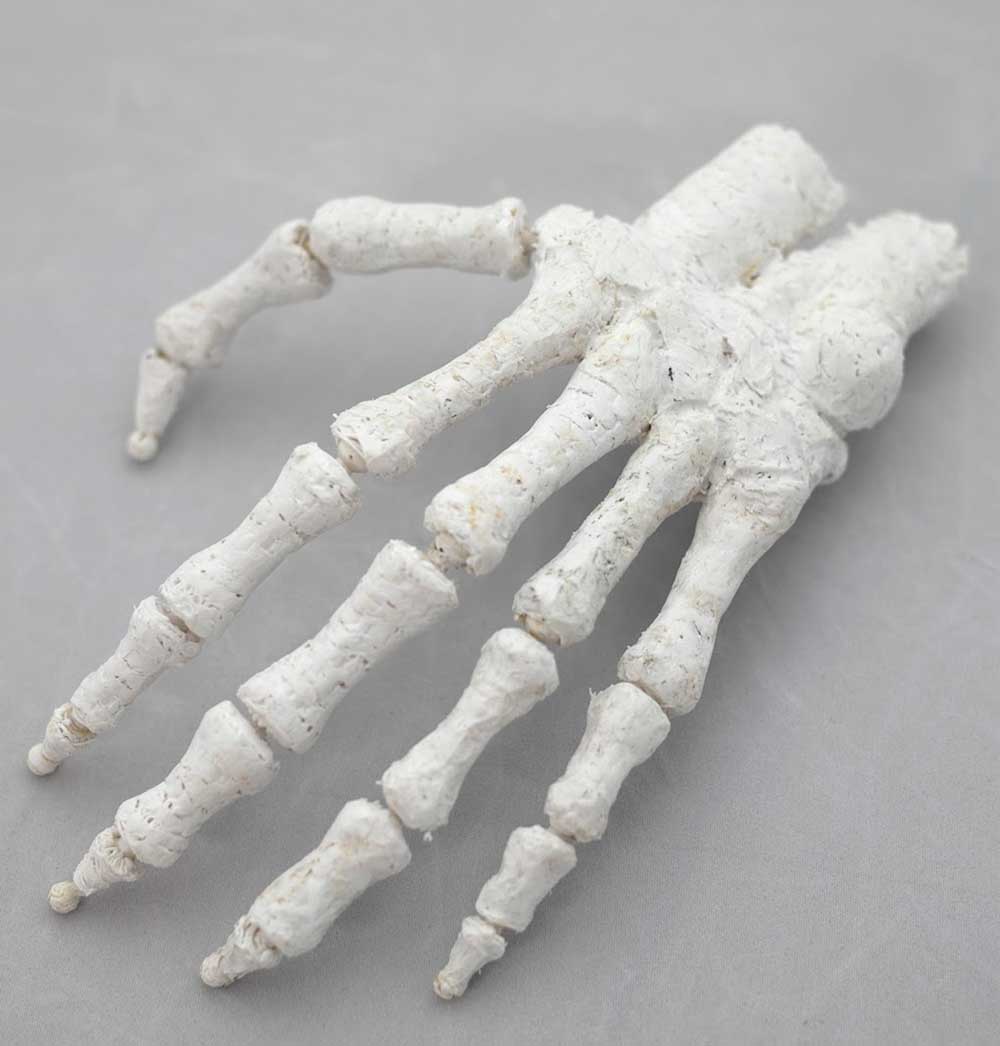
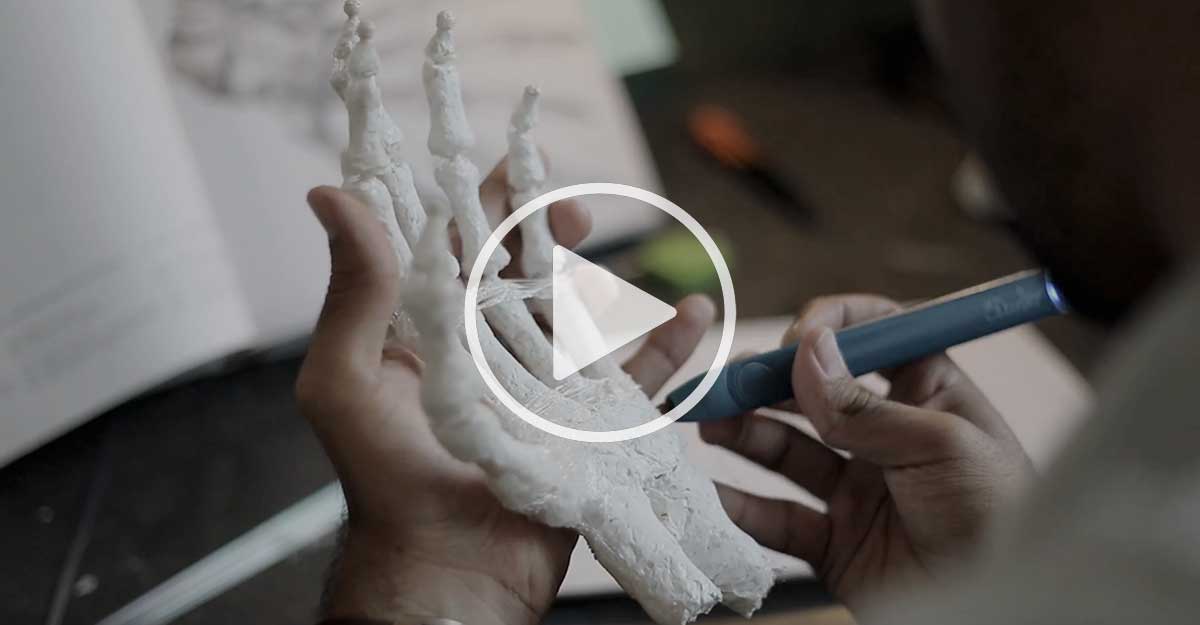
Mexican sculptor, painter and textbook anatomy artist, Ricardo Martinez, has been diligently creating a realistic anatomical hand, made entirely with the 3Doodler Create+ pen, 3Doodler filaments.

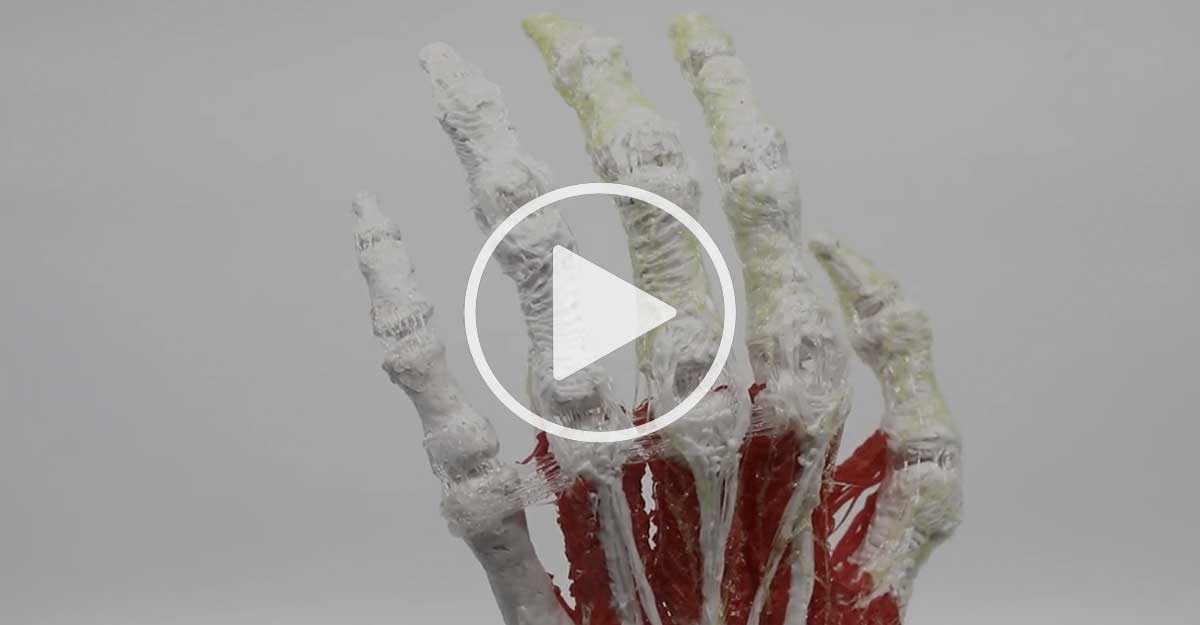
The joints are movable due to being created with the ball and socket DoodleMold included in the STEM kit. Likewise, the hand is able to be moved despite the layers of tissues and veins on top due to them being Doodled with FLEXY, our flexible filament for the Create+.

We had a chance to catch up with Ricardo to learn about his process making the hand, and he even provided a brief tutorial for you to follow along with, either with your students or at home.

"“…the advantage of a 3D anatomical figure is it that it gives students the opportunity to manipulate the hand, watch the muscles flex, follow the path of arteries and veins, and so on.”"-Ricardo Martinez Share

3Doodler: Thanks for taking the time to meet with us, Ricardo! Can you please give a brief introduction to who you are?

My name is Ricardo Martinez Herrera and I am a Mexican sculptor, painter, and photographer. In my work as an artist I go by Riikc. Since finishing my sculpture studies at the Académie Royale des Beaux-Arts in Brussels, Belgium, I have had the great pleasure of creating dynamic art pieces around the world, including in Canada, Mexico, Belize, and now back in Belgium.

You used to create anatomical drawings professionally for medical use. Can you please share a brief history of your experience doing that?

My experience with medical drawing came long before my formal studies, while I was still living in Mexico. In fact, I feel incredibly lucky that someone decided to take a chance on this aspiring artist from Mexico, with no formal studies, but a real drive to apply himself in the art world.

  • White flower on table, created with a 3D pen.
  • 3D pen art: Holding small bird on white background.
  • Blonde woman with green eyes, 3d pen art.

One of my best friends was studying medicine and he came across a call for proposals from a group of researchers in the department. He passed it along to me, and I submitted an application with some of my past illustrations. The team accepted me almost immediately, and I was brought on to illustrate their upcoming publications. I ended up working with that team of researchers for several months, and my illustrations were featured in their published medical articles, and even a reference book.

The experience left a deep impression on me, in particular because I come from a family of doctors. My family has always been supportive of my pursuit of a career in the arts, but I don’t think they really understood the spectrum of art until they started to see my work published in medical journals and texts. It is easy to overlook how much of our world is underpinned by creative, artistic pursuits like these.

Based on your experience, can you comment on the benefits of learning from 3D anatomical figures as opposed to 2D drawings?

Many students learn best when they can be physically moving and interacting with an object. So, the advantage of a 3D anatomical figure is it that it gives students the opportunity to manipulate the hand, watch the muscles flex, follow the path of arteries and veins, and so on. This is really beneficial for students who may not learn as well through solely a 2D visual resource, like a textbook.

There is also the advantage of using 3D figures to explain systems thinking. Particularly in anatomy, it is important that students can think about how individual parts work, and then relate each of them to their function within the whole system. Even with myself, despite having been working with drawings for years, I found the structure of the hand so much easier to understand when I saw it layered into a 3D model, where you can physically trace each element and see how they are connected.

Ricardo’s Journey Creating the Anatomical Hand

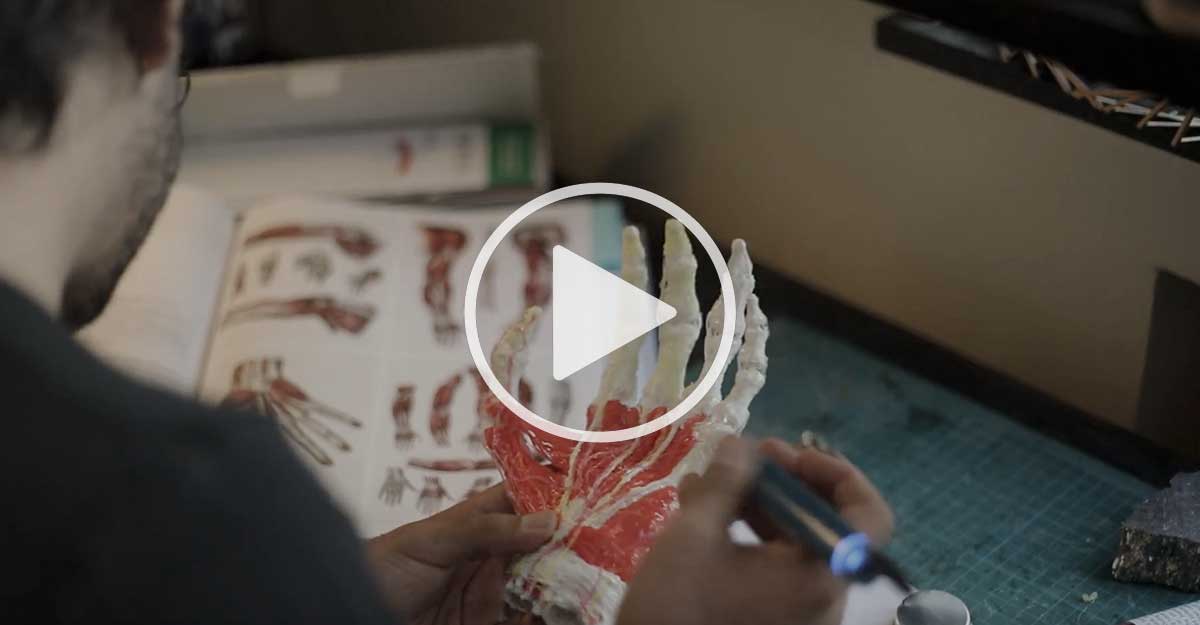
1. Before starting, it was important for me to find the right reference materials. In my case, I was working with The Atlas of Human Anatomy and Surgery, which is not only a solid reference text, but it also contains illustrations that are visually beautiful.

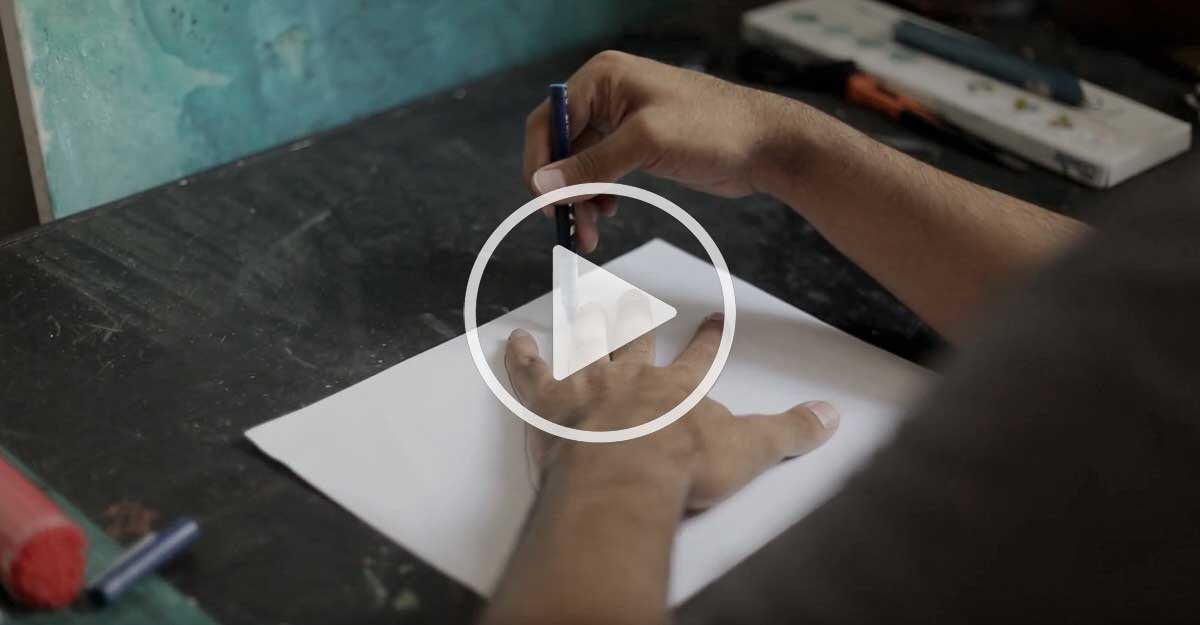
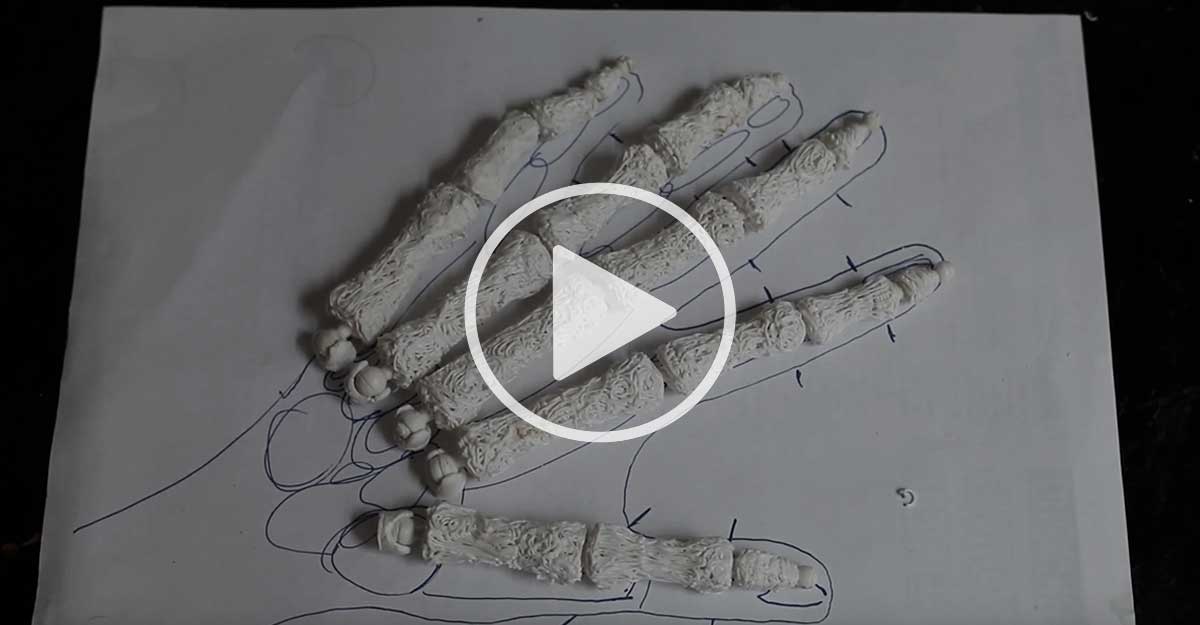
2. From there I began with a pen-and-paper sketch of my own hand to use as a blueprint.

3. I then moved onto the ball and sockets to begin building out each finger joint. For the bones I used white ABS filament, the standard nozzle, and the smoothing tool to give the bone texture. Once I had built out the general shape of each finger, I used a Dremel and sandpaper to smooth them out, and create a more realistic bone shape.

4. After the bones, I created the ligaments, using white and clear FLEXY filament and the ribbon nozzle. This connective tissue was one of the quicker elements to create, as it simply reinforced the bones and joints and ensured their smooth articulation.

5. The ligaments were followed by muscles, drawn in red FLEXY filament using the ribbon nozzle. I chose this nozzle because it creates a flat, sinuous thread that was much closer to the texture you would find in muscles. The challenge with this step is that muscles occur in several layers throughout the hand. This means that while the first layer of muscles might lay directly on-top of bone, there are others that will be on top of nerves, veins, and arteries. This step took a lot of precision.

6. I then drew the nerves in yellow FLEXY using the 0.5mm nozzle. Fingers are some of the most sensitive parts of the body, which means there are a lot of nerves running all the way to the tips of our fingers. This step required a lot of patience and attention to detail to accurately represent the paths of these nerves.

7. Finally, I drew the arteries in red FLEXY and veins in blue FLEXY, using the 0.5, 1, and 1.5 mm nozzles. The diameter of veins and arteries changes as they branch off toward the fingers, so at the base and top of the hand they are much thicker, while in the fingers they become much thinner.

8. Lastly, for educational purposes, you will see that I progressively added layers, but not on all parts of the hand. So the pinky is bone and ligament alone, the ring finger adds muscle, the middle finger adds nerves, and then the index finger and thumb include all elements.

3Doodler: For all of our STEM followers, do you have any advice on making 3D anatomical figures you can share with them?

My main advice is that you don’t need to become an expert on anatomy or sculpture before you start working, and you don’t have to have a full understanding of the final product right from the beginning. Focus more on the function of each element than you do on the form, and eventually you will come out with a useful model.

For instance, if you are unsure what type of material or nozzle to use, take a moment to study the element and its function. Ask yourself questions like, “How does this move?” “Where does this connect,” and “Should this be smooth, coarse, or sinewy?” When you focus on the function, and work one element at a time, the final form will eventually emerge.

Step-by-step for the creation of the hand:

The best way to start is to have a reference of the inner anatomy of the hand:

1. Draw the outline of your hand on a piece of paper.
2. Add bones to your 2D drawing
3. Mark every joint between phalanxes. These spots will require one ball and socket combo.
4. Create all the balls + sockets and join them accordingly. See pic.
5. Doodle the bones in!
6. Once the bone hand takes shape, add all other elements in this order:
— Ligaments
— Muscles
— Nerves
— Arteries
— Veins

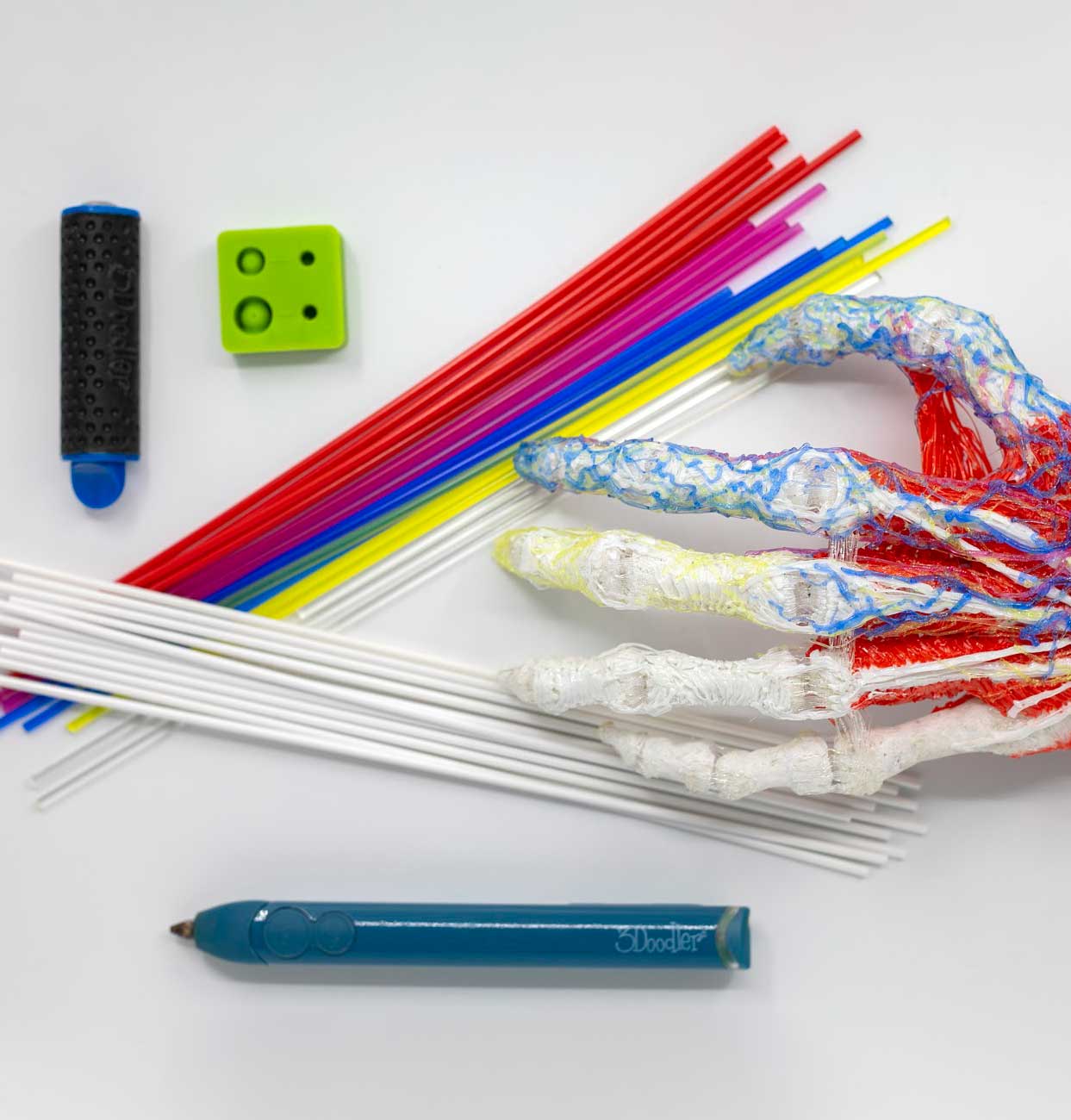
A list of the filament colors and which anatomical parts they represent:

Polar white ABS filament — Bones
Flexy White & Clear — Ligaments
Flexy Red — Muscles
Flexy Yellow — Nerves
Flexy Blue — Veins
Flexy Pomegranate Pow — Arteries

Are you inspired by Ricardo’s anatomical Doodles? Share them with others on social media, and let us know what you think!

Tag Us: @3Doodler, #3Doodler, #3DoodlerEDU

Be sure to follow Riikc on Instagram!

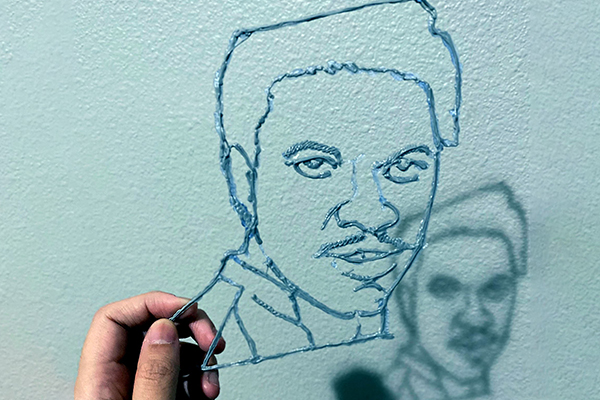
The Fine Art of Billy Dee Williams

Though revered for his iconic Star Wars persona, few know that the first love of Billy Dee Williams was fine art.

Billy Dee Williams Billy Dee Williams

Long before he took on Lando Calrissian in The Empire Strikes Back, he was granted the Hallgarten Award scholarship to attend New York’s National Academy of Fine Arts and Design. The truth is, his primary motivation behind his acting career was to fund his art supplies!

"“I am an artist no matter what I do. I live for creativity. I think everyone should. It is the antithesis of being destructive.”" Share

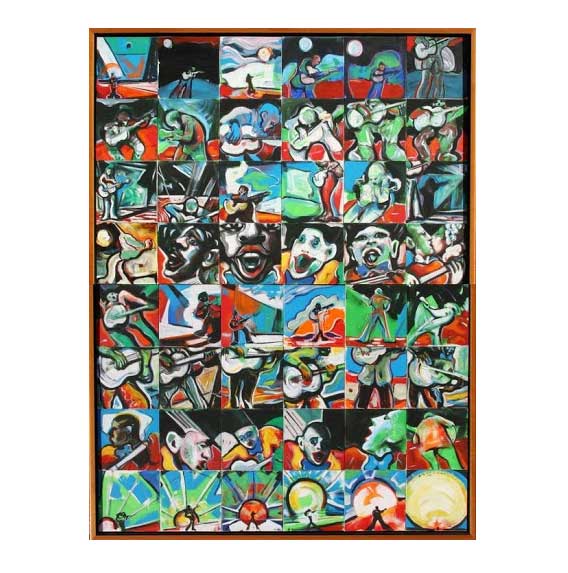
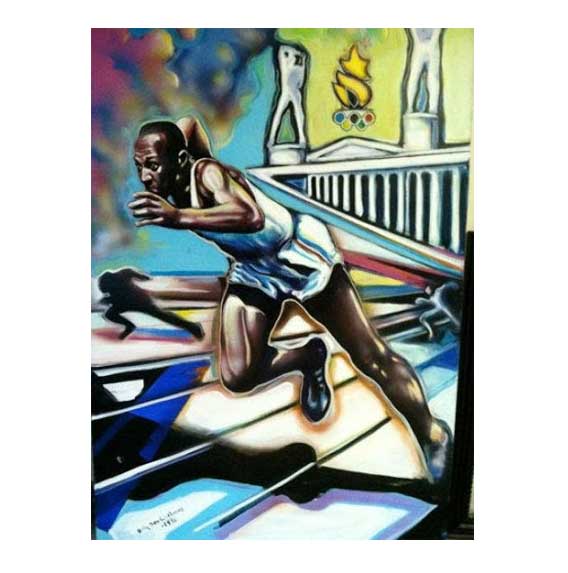
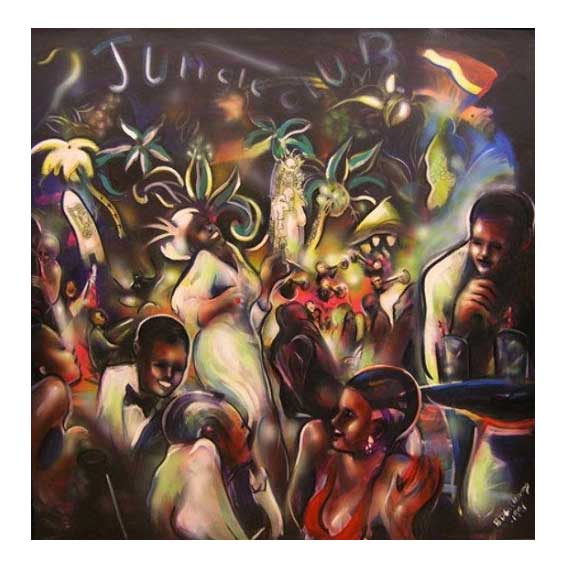
Billy Dee’s journey in fine art has been a lifelong endeavor, and though he has focused more on acting during certain periods, he has considered himself an artist first and foremost. In fact, he once created 120 paintings over a two-year period.

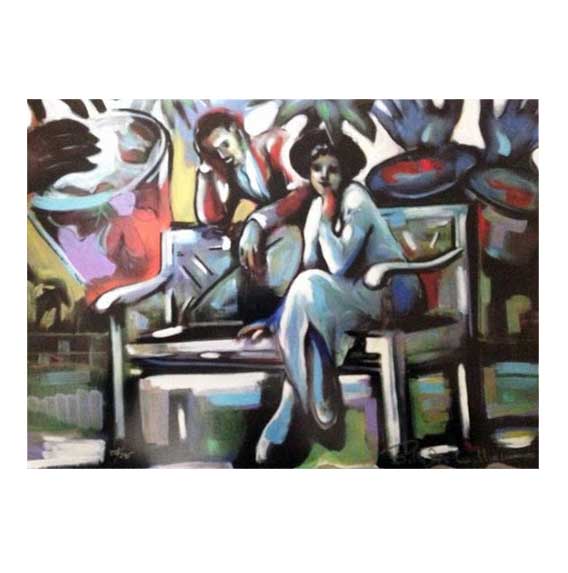
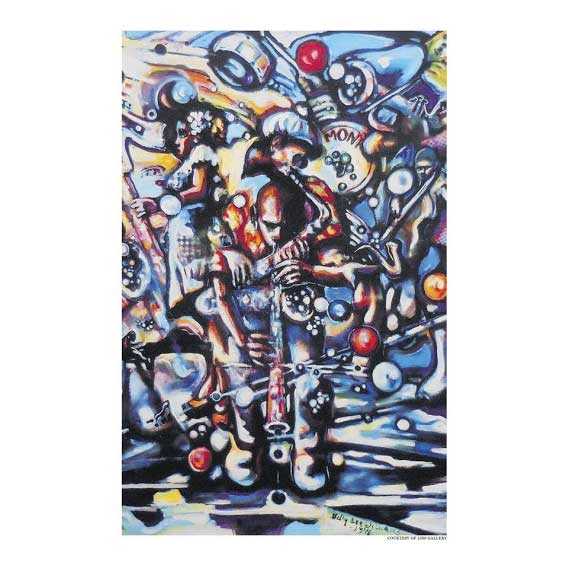
Most of his paintings are made with acrylic paints on canvas, applied with both a traditional paintbrush and an airbrush. He has also explored experimental art, creating custom 3D canvases that incorporate ceramics and neon light.

  • Large group of people in room - 3D pen art
  • 3D pen art: Woman on bench with man on chair
  • 3D pen art: Man riding motorcycle with guitar & others
  • Lg doodle: man running on track, stadium in background. 3D pen art.
  • Group of people with woman in dress 3D pen art
"“I was in the National Academy of Fine Arts and Design, on a scholarship. I was – still am – an artist. They were looking for an actor for ‘Take a Giant Step,’ and a producer liked my look and asked if I could act. I said, ‘Yep!’ Then I got into acting more or less just to make money for paints and canvases.”" Share

Billy Dee has had numerous art exhibitions in a variety of fine art galleries around North America, and has had originals on display at the Smithsonian Institution, the Schomburg Museum, the National Portrait Gallery, and the Liss Gallery in Toronto.

Lando's 3D pen art: a man sitting in a garden chair

Williams has shared that some of his biggest inspirations in the field of art are the well known Mexican muralists José Clemente Orozco and Diego Rivera.

"“I don’t want to find myself ever locked into what people think I should think or do. In my art, and acting, I have a universal vision of things, an international vision. Bigger and broader and beyond. ‘Bigger than life’ is always on my mind.”" Share

He has expressed admiration for their paintings, and that they give the viewer “a sense that reality was much more than life.” Billy Dee has communicated that he himself wants his artwork to express this expansive quality.

Billy Dee’s works evoke powerful emotions in the viewer, telling larger-than-life stories through abstract compositions and vibrant color schemes. You can view an online gallery of Billy Dee’s artwork for purchase here.

Are you inspired by the artwork of Billy Dee Williams? Share your thoughts with our community on social media.

Tag Us: @3Doodler, #3Doodler, #3DoodlerEDU

20 Inspirational Quotes for 2020 from our STEM EDU Community

Now that we’re all getting back into the school rhythm, we wanted to share some great quotes we’ve received from 20 different teachers.

Many of you have spoken of amazing experiences with 3D pens in your learning environment, and we wanted to share them with our community to help spread some inspiration for the New Year. You can share these quotes on Twitter directly from the blog. Just click, post, and spread the inspiration!

Images courtesy of Steven Jones

Engagement

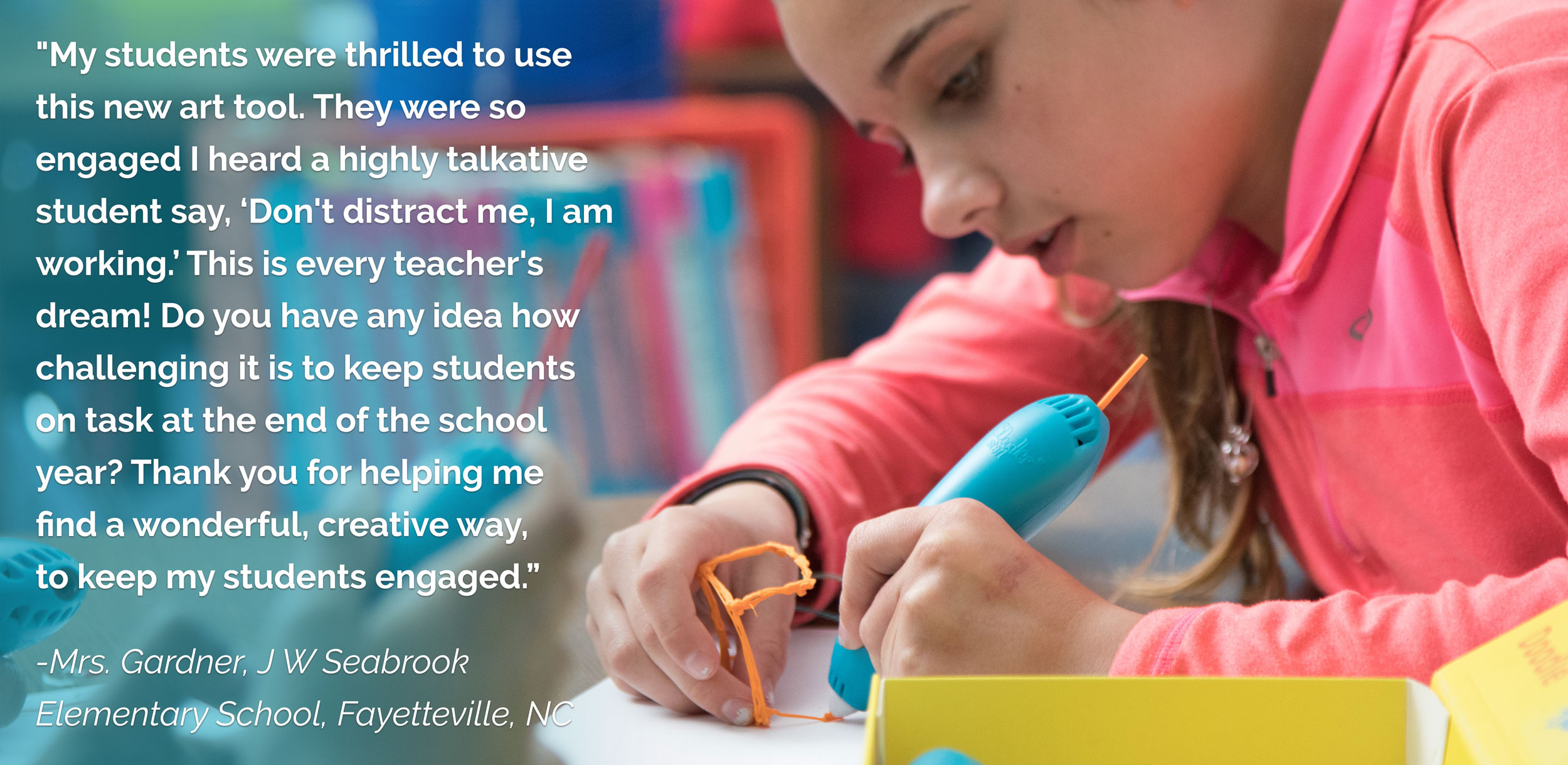
"“I can’t say enough good things about the Start pen. It provides problem solving and perspective to students, which is very valuable. It’s another tool in the teacher’s toolbox to engage students in a new way, to engage learning in a new way.”"-Garrick Grace, District Technology Integration Specialist, Minnesota ISD 741, Paynesville, MN Share "“One interesting benefit is how engaged and focused my students who have attentional difficulties can be when doodling and creating their own designs. The 3Doodler pens have given some students a new way to learn about math, and have added a great deal of excitement to geometry time.”"-Mrs. Lounsbury, Wenonah Elementary School, Lake Grove, NY Share "“They were so engaged I heard a highly talkative student say, ‘Don’t distract me, I am working.’ This is every teacher’s dream! Do you have any idea how challenging it is to keep students on task at the end of the school year? Thank you for helping me find a wonderful, creative way, to keep my students engaged.”"-Mrs. Gardner, J W Seabrook Elementary School, Fayetteville, NC Share "“3Doodler pens are fantastic!! They keep my students creating for their entire session without breaks. Great tool for creation and attention building! 3Doodler pens are motivating my students to do so much more. They are easy to use and loads of fun.”"-Kirti Vyas, Brookside Elementary School, Monroe Township, NJ Share
Image courtesy of Susanne Firestone Image courtesy of Susanne Firestone

Whole-Student

"“When using the 3Doodler pens, the students are quiet and happy Doodling. The 3Doodler pens are amazing tools for mental health and being in one’s own mind. Students are inspired to create by seeing other Doodles.”"-Velvet Holmes, District Technology Literacy Teacher, Oregon School District, Brooklyn, WI Share "“We started with basic 2D shapes like circles and squares. Then we moved on to cubes. Now they are inventing their own creations! It’s really neat to see them think about what will work and how they need to problem solve to make their creations come to life. They are so engaged when they are working with their 3D pens.”"-Ms. Smith, Woodford Paideia School, Cincinnati, OH Share "“It is our role as educators to support students. We can do this through facilitating the use of empathy and EdTech to improve our communities. This can be as simple as using a 3Doodler pen to create tactual artwork for someone with visual impairments, or as powerful as using artificial intelligence to better our society.”"-Steven Jones, Riverside School District 96, Riverside, IL Share "“Students used the 3Doodler pens in math class to build geometric models, base ten models, and more. The students who learn best through tactile representations really benefit from this hands-on option for showing their learning.”"-Mrs. Hubert, William Berkowitz Elementary School, Chelsea, MA Share

Creative Exploring

"“For every grade level, the 3Doodler Start is their favorite STEM center in the makerlab. They are relaxed using the Starts and they have fun being imaginative. Students aren’t afraid to fail with the 3Doodler pens. They are relaxed and social, and that’s the mindset you want.”"-Susanna Hite, STEM Teacher, St. Peter School, Geneva, IL Share "“Each student is responsible for drawing an organism in their food chain and making it 3D by using the 3Doodler pens. Along the way students have learned about trial and error and how designs are not going to be perfect the first time. This is a life skill that I’m constantly trying to demonstrate in my classroom. I want students to know that failure isn’t a bad thing and they can learn how to re-design and make it even better. This has resulted in some fabulous 3Doodler organisms!”"-Brittany Ballou, STEAM Teacher, Grange Hall Elementary, Richmond, VA Share "“These 3Doodler pens have made a tremendous impact on my classroom. Creating is the highest-order thinking skill, and with these pens, my students are able to create projects that help them visualize concepts they’ve learned in math, language arts, science, and various other subject areas.”"-Ms. Soriano, Waianae Elementary School, Waianae, HI Share
Images courtesy of Ellen Peterson
"“The 3Doodler pens created opportunities to explore reading from a different angle. As a result, scores increased by more than 10% overall and students made gains. This project encouraged at-risk readers to re-compose as they read and respond to text through visual literacy, technology, and engineering. The 3Doodler pens are AWESOME!”"-Mrs. Epps-Primas, Best Academy 6-12, Atlanta, GA Share "“After some practice and learning the technique, they were drawing people, animals, cars, plants, and putting together helicopters. It was truly amazing to see their projects come to life with all sorts of objects and vibrant colors.”"-Ms. Obata, Dewey Elementary School, San Gabriel, CA Share "“Students love the instant gratification of Doodling. The 3Doodler pens are more exciting than markers, pens, or paper, and more accessible than a full scale 3D printer. 3Doodler pens are a gateway to technology. My makerspace is 50% girls at all times, and 3Doodler is a great way to get girls interested in tech.”"-Robin Fosdick, Makerspace Coordinator, Morse Library, Natick, MA Share "“I’d definitely recommend 3Doodler to other teachers because it helps teach students to build 3D shapes from 2D shapes. Students can create anything they can think of. Where they are limited with building blocks, 3Doodler pens can make any shape.”"-Roland Fisher, Owner/Operator, Engineering for Kids, Indianapolis, IN Share

Teamwork

"“These pens have helped the students harness their creativity and have really allowed some students that tend to struggle with relationships and peers to shine. They amaze the other students with their skills and creations and it raises their confidence. That has opened the door for them to begin to build positive relationships with others.”"-Mrs. O'Reilly, Pembroke Elementary School, Virginia Beach, VA Share "“My students have worked non-stop to figure out the best way to build in 3 dimensions with our pens. They are helping each other, experimenting with new ideas, and building onto each other’s projects. In short, they are thinking! The best part is that they don’t even mind doing the work because they have a new “toy” to work with. Everyone is happy!”"-Ellen Peterson, Smithfield Middle School, Smithfield, VA Share
Images courtesy of Susanne Firestone
"“The students have loved using them to create sculptures, furniture, and prototypes for their projects. It’s been fun watching them create and teach each other tips and tricks on how to best use the 3Doodler pens. We are even finding ways to use the scraps and pieces that didn’t get used in finished sculptures.”"-Mrs. Kalcevic, Ardis Ann Middle School, Bentonville, AR Share "“The 3Doodler pens have been such a blessing to spark creativity in students that were otherwise stuck in a box. Bringing their 2-D learning into a 3-D world has brought basic learning and engagement into real life experiences they will never forget. As I write, my students are working cooperatively to develop 3-D models of their Simple Machines and then connecting them to create a new type of machine that can help the community.”"-Mrs. Smith, George Washington Carver Elementary School, Richmond Hill, GA Share

We want to express our sincere gratitude for all that each of you do to support the leaders of tomorrow. We are so happy that our 3D pens are a part of your teaching journey, and we are honored to be partners with you in the classroom.

Other teachers want to hear about your experiences with EdTech!

Share your story with them on Twitter.

Tag Us: @3Doodler, #3Doodler, #3DoodlerEDU
Posted in EDU

Kick off 2020 with 3Doodler Lessons and Tips from a Teacher

Getting lesson plans in order and planning for your class can be very time consuming, and with coming back after the holiday break there is a lot on your plate.

To help you transition back to school with ease, we have about 100 step-by-step lesson plans available in almost every subject! They are written by teachers, for teachers, and they call out alignment with educational standards such as NGSS, ISTE, CSTA, and Common Core.

Below is a list of some highlighted K-12 lessons that your class can launch the New Year with. We also have tips from Ellen Peterson, Smithfield Middle School’s Technology Resource Teacher, to help you get the most out of 3Doodler lesson plans.

K-2nd Grade

"When they have the opportunity to make models of their own, the learning that takes place is significant! Making models helps my students dive deeper into the content, plus, they usually are having fun while they are doing it."-Ellen Peterson Share
Lasso-Doodler Roundup
Time: Two 45-60 minute sessions
Skill: Beginner
Grades: K to 2nd

In this lesson, students will work with a partner to lasso words together that create contractions. Students will doodle a lasso, use it to isolate words that form contractions and then doodle the contractions to share with the class.

*Session 1 may be used for doodling the lasso.
*Session 2 may be used for lassoing and doodling the contractions.

STEM: Doodle-Parachute-Jumpers (Design Investigation)
Time: Two 45-60 minute sessions
Skill: Beginner
Grades: K to 2nd

In this lesson, students will work in pairs using the 3Doodler to design and create different parachute jumpers, as well as an aerodynamic parachute crafted with everyday objects, e.g., coffee filters and string. Students will make predictions, collaborate, problem-solve, test and retest in this hands-on design project.

MATH: Doodle-Touch-Dots (Addition)
Time: One 30-45 minute sessions
Skill: Beginner
Grades: K to 2nd

In this activity, students will work in pairs to practice adding numbers from 0-9 using touch dots. Students will add touch dots to numbers, and then doodle their own touch dot numbers to create unique addition problems to solve.

3rd-5th Grade

"One thing I recommend to teachers when doing 3Doodler lessons is to build a prototype before asking their students to make one so they can have a reference."-Ellen Peterson Share
STEM: Stars and Constellations
Time: One 45-minutes session
Skill: Intermediate
Grades: 3rd to 5th

In this activity, students will work in pairs to research what causes the apparent brightness of stars and constellations. Students will write a fact-based argument to respond to this question and then create a model of a selected constellation with a 3Doodler and glow in the dark filament sticks.

Doodle-the-Dots (Multiplication Patterns)
Time: One - 45 minute session
Skill: Intermediate
Grades: 3rd to 5th

In this activity, students will work independently to practice multiplication by connecting-the-dots with a 3Doodler. Students will predict which numbers will result in the same shapes. Students will combine shapes to create an artistic display of their multiplication facts.

6th-8th Grade

"If you are expecting your students to work in groups to share a pen, I recommend clearly defining roles for each group member, or setting time limits for pen use. When using timers in groups, make sure the other group members have something to do while waiting for their turn to Doodle, like drawing their ideas, writing about them, or otherwise."-Ellen Peterson Share
ELA: 3Doodler Stop-Motion
Time: One 45-minute session
Skill: Intermediate
Grades: 6th to 8th

In this activity, students will work in pairs or small groups to identify the theme of a fictional text, summarize a scene that best reflects the theme, and create a 3Doodler stop-motion animation to enact the scene. Creative thinking skills will be integrated into this hands-on project that will help you assess your students' level of comprehension.

STEM: Doodled Animal Prosthetics
Time: One-two 50-minute sessions
Skill: Intermediate
Grades: 6th to 8th

Doodle Doctor, STAT!

In this bioengineering and design activity, students will work in pairs to design and doodle a prototype for an animal prosthesis that meets the constraints of a simulated design problem.

9th-12th Grade

"Once you’ve decided on a specific lesson, make sure you have plenty of extra materials on hand. For new students, they need a certain amount of “playing” before they create a 3D model for a specific assignment. I have my students make a small stick figure statue and I have them practice molding a few parts together before expecting them to produce something assignment-related."-Ellen Peterson Share
The Basic Unit of Life: Prokaryotic and Eukaryotic Cells (STEM)
Time: Two 60-minute sessions
Skill: Advanced
Grades: 9th to 12th

In this activity, students will work in pairs to doodle two cell models, one of a prokaryotic cell, and one of a eukaryotic cell. The students will build all parts in each model such as the nucleus, plasma, cytoplasm, mitochondrion, etc. The student pairs will analyze and record the differences and similarities between the cells.

Doodle-Atoms
Time: Two 45-minute sessions
Skill: Intermediate
Grades: 9th to 12th

In this activity, students will work individually to create a Rutherford model of an atom. Students will also work with a partner who will be responsible for double-checking their work for accuracy as the project is worked on. Their work will be shared with the rest of the class and displayed for other classes to see.

Want to see more free K-12 lessons? Go browse our 3D Pen lesson library.

Other teachers want to see what you’re doing in your learning environment! Share your classroom happenings with them on Twitter, and be sure to follow Ellen Peterson.

Tag Us: @3Doodler, #3Doodler, #3DoodlerEDU

Banner image courtesy of Brittany Ballou .

Launch 2020 with Projects for your 3Doodler Pen

Happy New Year! Let the old year end and the New Year begin… with amazing Doodles!

The holiday hubbub is finally calming down, and now is a great time to start creating with your 3D pens, new or old. Whether you’re new to Doodling, or if you’re a seasoned 3D-pen pro, these helpful resources and 3Doodler projects will help take your Doodling to the next level.

If you’re a teacher and you’re interested in bringing 3Doodler into your classroom, we’d love to provide support tailored for your unique classroom needs. Feel free to reach out to us and we’ll be happy to help!

Getting Started with your new 3D Pen

More resources for your 3Doodler Start here.

More resources for your 3Doodler Create here.

Projects for Your 3Doodler Start Pen

Stencil
Bookworm Bookmark

Nothing expresses gratitude more than a personalized gift, so join 3Doodler in crafting the perfect Bookmark for your favorite Librarian!

Stencil
Fabric Prints

Add a custom touch to any piece of fabric by making your very own fabric stencils.

Stencil
Helicopter

Use this stencil to create a helicopter with moving rotor blades.

Tutorial
Handmade Beads

We are in love with these simple & stunning handmade beads, created by Grace Du Prez.

These beads tick all the boxes for us:

  • Modern & utterly wearable
  • Tailored to your style
  • Handmade look and feel
  • Myriad of applications
  • Gorgeous gifts
  • Super cool family project
  • Really easy for anyone to make
  • The larger beads are hollow so you use less filament, which means more pretty beads!

Projects for Your 3Doodler Create+ Pen

Stencil
V-Twin Engine

Make a model of a V-Twin engine using our simple stencil. Yes, it really cranks!

Stencil
Wine Holder

Deliver your next wine gift in a handmade wine holder, made with FLEXY filament. It’s guaranteed to wow all who behold it!

Stencil
Pot Pourri Holder

Add an elegant touch to your home with our lavish pot pourri holder stencil. The Doodle is sure to be a talking piece!

Stencil
2020 Glasses Stencil

We’ve made a special stencil just for 2020, which can be made with any of our 3D pens. Rock these 2020 glasses to launch the New Year in style!

Stencil
Lotus Light

Set a zen mood in your abode with our lotus light stencil.

Stencil
Cord Holder

Use our practical cord holder stencil and some FLEXY filament to organize your cables... in style.

Have a question about anything at all? 3Doodler’s renowned Customer Service is here for you. Contact Us.

"Should you ever need assistance, 3Doodler’s customer service is by far the most responsive we’ve encountered."-The Wirecutter Share

The world wants to see your Doodles! Please share them on social media.

Tag Us: @3Doodler, #3Doodler, #3DoodlerEDU

Holiday Doodles for Kids and Adults

The holidays are just around the corner and everyone is gearing up for the festivities!

We have compiled some easy holiday projects to help you get into the holiday spirit. So whether you’re a student, teacher, or parent, it’s time to get those 3D pens out and have some festive fun with our activities.

3D pen art: Row of three Christmas trees on a white surface.

Adorable Mini Christmas Trees

Oh Christmas Tree, Oh Christmas tree, how lovely are your Doodly details! Add tiny ornaments to embellish your Doodled tree with your own unique touch. These are guaranteed to wow your guests!

Materials:

3Doodler Start Pen or Create+ Pen
3Doodler Start Filament or Create+ Filament
Mini Christmas Tree Stencil
– Optional: Start DoodlePad or Create DoodlePad to trace the stencil

3D pen and needle on red surface. Xmas close-up.

DIY Holiday Gift Tags

Add a heartwarming touch to your Hanukkah, Kwanzaa, or holiday gifts this year with a personalized gift tag!

Materials:

3Doodler Start Pen or Create+ Pen
3Doodler Start Filament or Create+ Filament
– Pencil and Paper to make your own custom holiday stencil.
– Optional: Start DoodlePad or Create DoodlePad to trace the stencil

Snowflakes on blue surface with ribbon - 3D pen art

Splendid Snowflakes

Decorate your home with Doodled snowflakes to add some wintery flare to your abode. You’ll be walking in a winter wonderland, but staying cozy and warm inside!

Materials:

3Doodler Start Pen or Create+ Pen
3Doodler Start Filament or Create+ Filament
Snowflake Stencil
– Optional: Start DoodlePad or Create DoodlePad to trace the stencil

Santa & reindeer 3D pen art: 3 small Christmas figurines with gnomes & reindeer.

The Cutest Elves for your Shelves

Doodle these tiny elves and their reindeer buddy to bring the North Pole festivities to your decor.

Materials:

3Doodler Start Pen or Create+ Pen
3Doodler Start Filament or Create+ Filament
Elves and Reindeer Stencil
– Optional: Start DoodlePad or Create DoodlePad to trace the stencil

Blue surface with string ornaments & red ball - 3D pen art

Simple Holiday Ornaments

Everyone loves ornaments! Give your Christmas tree a personalized touch with your very own handmade ornament. Simply trace over the stencil outline to make a frame, then wrap filament around it.

Materials:

3Doodler Start Pen or Create+ Pen
3Doodler Start Filament or Create+ Filament
Holiday Ornament Stencils
– Optional: Start DoodlePad or Create DoodlePad to trace the stencil

Want more holiday decor ideas? Check out these links:

Classrooms, artists, and more want to see your holiday Doodles! Share them with the world on social media.

Tag Us: @3Doodler, #3Doodler, #3DoodlerEDU

Brittany Ballou on Harnessing Student Excitement + Winter Lesson Plan

In this blog post...
  • See Brittany Ballou’s New Winter Geometry Lesson Plan (elementary students) here!

  • To save time on grading, create student rubrics for project based learning (PBL) and grade them throughout the project process.

  • Hands-on activities will help you harness student excitement before the winter break. PBL will bring focused fun and keep students on the move, concentrated on a topic, and collaborating with others.

Brittany Ballou Brittany Ballou

December is such an invigorating time of year!

Both teachers and students are looking forward to the winter break, and it can be increasingly challenging for students to contain their excitement in the classroom.

We had a chance to catch up with STEAM teacher, Brittany Ballou, who not only wrote a superb winter lesson plan, but also provided some tips on bringing focused fun to your class before the holiday.

Be sure to check out Brittany’s Winter Lesson Plan here or check out a video of her class in action.

Q and A with Brittany Ballou

3Doodler: Thanks so much for meeting with us, Brittany, and for writing the winter lesson plan. Do you have any tips for other teachers on how to keep students engaged in the classroom before winter break?

The holidays are one of my favorite times of the school year because students are filled with excitement.

Boy with 3D pen art: green & blue design

Harness that excitement and you’ll have them engaged. Fun hands-on activities will get your students focused on learning without even realizing they’re learning. Don’t give them another worksheet. Instead, use literature to connect STEM/STEAM projects. Collect all of the recyclables, use Legos, pull out your 3Doodlers, and let students have fun. Give them structure on a project topic and you’ll see excitement and learning abound in your classroom!

Do you have suggestions for how teachers can make time to grade papers at school while keeping students focused and happy?

Teachers should create rubrics that students can access for their project-based learning.

As students are working, have your rubrics on a clipboard, ask them questions, look at their products, observe the teamwork, and grade the rubrics throughout the project process. That way you are not stuck with grading the project at the very end. Pace yourself and you’ll find that project grading is easy, and it doesn’t have to take time away from either the lesson or your home life.

The weeks leading up to winter break can be stressful for teachers. Do you have any advice that can help teachers during this time of year?

Let yourself and your students have fun. You have spent the first several months of school building relationships with your students. Now, use what you know about their interests to focus their learning. I love project-based learning because students learn without even realizing it.

If you haven’t done a hands-on project, yet, this is the perfect time to try one. Don’t stress about it being perfect, but instead focus on giving students an opportunity to explore their learning in a different way. Let them get up and move. With all of that excitement, they get antsy and the last thing you want to do is keep them sitting in one place. Project-based learning will keep them on the move, focused on a topic, and collaborating with others.

Doodle Snowflakes: Geometry and Symmetry
Time Required: Two 45-60 minute sessions
Skill Level: Beginner
Recommended Grades: K to 2nd

In this lesson, students will work individually using the 3Doodler pens to doodle a geometrical snowflake that is also symmetrical. Students will review the concepts of geometry, patterns, and symmetry.

Do you have tips for bringing focused fun to your classroom before the winter break?

Other teachers want to know! Share them with the EDU community on Twitter, and be sure to follow Brittany Ballou.

Tag Us: @3Doodler, #3Doodler, #3DoodlerEDU

Low-Prep Classroom Activities for Thanksgiving

We know that teaching your classes before the holiday break can be a challenge. You are ready for a break, and so are your students. It can be difficult for everyone to focus, no matter how enticing the project at hand may be.

As Edutopia and We Are Teachers have written, teachers will often opt to show a movie before the winter break since it can create a sense of fun and mental adventure. However, watching a movie has two shortcomings – collaboration with peers and hands-on engagement.

We have put together a few simple Thanksgiving-themed projects that will create a sense of camaraderie and accomplishment amongst your students. You can even decorate the classroom with the finished Doodles after they are complete, or send them home with students.

What better way for students to leave for Thanksgiving than with a sense of connection with peers and creative accomplishment? Let’s celebrate the upcoming break with some social-emotional learning and festive creativity.

The 5 Competencies of SEL According to CASEL
  • Self-awareness: Know your strengths and limitations, with a well-grounded sense of confidence, optimism, and a “growth mindset.”

  • Self-management: Effectively manage stress, control impulses, and motivate yourself to set and achieve goals.

  • Social awareness: Understand the perspectives of others and empathize with them, including those from diverse backgrounds and cultures.

  • Relationship skills: Communicate clearly, listen well, cooperate with others, resist inappropriate social pressure, negotiate conflict constructively, and seek and offer help when needed.

  • Responsible decision-making: Make constructive choices about personal behavior and social interactions based on ethical standards, safety, and social norms.

Thanksgiving Projects for your Classroom

To get started, split your students into pairs and hand out 3Doodler pens, filaments, and stencils (linked below). Then have the students take turns with the 3D pens to create a collaborative project using one or more of the stencils. Working in pairs helps students learn to cooperate, and it also builds community in your classroom. Feel free to give them and their partner the freedom to select the project(s) of their choice.

Teacher Tip: Did you know that you can laminate our stencils so they can be used over and over again? Feel free to print the stencils and laminate them before class. Laminated sheets will work with both the 3Doodler Start pens and the 3Doodler Create+ pens.

Colorful leaves on white surface - 3D pen art

Autumn Leaves

  • Skill Level: Beginner
  • Time: 10-15 minutes per leaf
  • Strands: 2-4 for Create, 2-4 for Start

View Project

3D pine cone on table, stunningly created with a 3D pen.

Perfect Pinecones

  • Skill Level: Beginner
  • Time: 20-40 minutes per pinecone
  • Strands: 4-6 for Create, 5-7 for Start

View Project

3D pen art: Turkey standing in leaf pile

Thanksgiving Turkey

  • Skill Level: Intermediate
  • Time: 30-50 minutes
  • Strands: 10-15 for Create, 10-15 for Start

View Project

3D pen art: Man with bird on his nose.

Encourage innovation

  • Have the pairs make their own Thanksgiving-themed Doodles!
  • Teacher Tip: Did you know that you can use repurposed materials to make your 3Doodler filaments last longer? Have students bring in cardboard, egg cartons, toothpicks and more to use in their projects.

    Other teachers want to see your festive classroom Doodles, and hear all about your pre-Thanksgiving classroom happenings! Share them on social media.

    Tag Us: @3Doodler, #3Doodler, #3DoodlerEDU

Teacher Spotlight: ISTE STEM’s Steven Jones

Do you want to hear about STEAM education from an ISTE expert?

Steven Jones, co-chair of the ISTE STEM personal learning network, is a middle school STEAM educator from Riverside, Illinois.

Steven believes it is his job as a teacher to support his students in solving real-world problems today, and using technology in his lessons is essential in bringing that to fruition.

Smiling man in blue suit with glasses - 3D pen art
"It is our role as educators to support students. We can do this through facilitating the use of empathy and EdTech to improve our communities. This can be as simple as using a 3Doodler pen to create tactual artwork for someone with visual impairments, or as powerful as using artificial intelligence to better our society."-Steven Jones Share

In this Teacher Spotlight, Steven gives us insights on STEAM education in the classroom, and how educational technologies have a positive impact on learning in his middle school curriculum.

Thanks so much for meeting with us, Steven! Can you please tell us about yourself, the school you work at, your role at ISTE, and a brief vision of your goals as a leader in education?

I’ve been a STEAM Facilitator at Hauser Jr. High in Riverside Illinois for the last few years. The students that I work with are in 6th through 8th grade.

"I believe that the 3Doodler pens, the CAD software, and everything else we utilize in the classroom makes learning more hands-on, meaningful, and engaging. There is something powerful about being able to create something as a prototype or a functional tool to solve a problem in someone’s life." Share

I teach an introductory class to STEAM, and I offer advanced STEAM classes as students move through each grade level. Some of the big topics covered are Design Thinking and the Engineering Design Process. Along the way students also learn about CAD, 3D printing, and building circuits. Prior to my current position, I was an Instructional Technology Specialist for grades K-8 in Chicago for a number of years. Starting this fall, I will be covering Artificial Intelligence in 7th grade.

Due to the recent completion of the ISTE-GM AI Explorations class, I feel confident introducing it to my students. I am currently the Co-Chair of ISTE STEM PLN along with Charles Randolph. This past year at ISTE in Philadelphia, Jessica Shupik and I presented on how we implement STEAM and 3D printing in two different classroom environments.

I believe my background in information technology, programming, art, and design has put me in a unique position as an educator. My perspective is a bit different and I am able to share my unique skill set with students on a daily basis.

Students using the Create+ Students using the Create+

As an educator I seek to provide my students with the ability to creatively problem solve and work collaboratively to meet the needs of people right now. This year my 8th graders made an assistive bottle opener that is being used by people with arthritis in the UK, and my 6th graders made tactile matching games that are being used by students with visual impairments in a nearby school district.

Have you found any benefits using 3Doodler pens in the classroom?

I received my first 3Doodler pens about halfway through the 2018-19 school year. The benefits have been wonderful. We are still learning together, but there has been instant engagement, and the ability to create right away has been very exciting.

While we still use Tinkercad and Fusion 360 as well as our 3D printers, it can take a considerable amount of time for students to see the final design they can touch. Using the 3Doodler Create+ is a more hands on approach and lowers the bar of entry to 3D design for students. I teach six STEAM related classes across three grades and I have utilized the Create+ in half of those. My seventh graders have used them the most in the STEAM Design class.

A classroom creation A classroom creation

In 7th grade, my students primarily use the 3Doodler pens in our architecture and natural disasters projects. Students have to pick an area that is greatly impacted by natural disasters such as hurricanes or earthquakes, and design a home to meet the needs of a family based on specific criteria and constraints. In addition to drawing appropriately scaled down blueprints of their home, they also have the choice of using the Create+ to make a prototype of furniture for specific rooms, or create the entire house. This is done in conjunction with CAD and Fused Filament Fabrication.

My 6th graders are currently using the Create+ to design prototypes for the games they are making for people with visual impairments. I have a few other students that are getting acquainted with the pens by going through some of the 3Doodler stencil tutorials with my support.

What other EdTech do you use in the classroom, and how do you feel that these technologies enhance learning amongst your students?

We use Arduino Uno, Raspberry Pi, Tinkercad, Fusion 360, and two 3D printers. Supplemental tools include Google Apps for Education, WeVideo, Soundtrap, Inkscape, and a few others. I believe that the 3Doodler pens, the CAD software, and everything else we utilize in the classroom makes learning more hands-on, meaningful, and engaging. There is something powerful about being able to create something as a prototype or a functional tool to solve a problem in someone’s life. These tools are helpful when I promote iteration and the continual improvement of ideas and designs.

How do you feel that EdTech is impacting the students of today for the jobs of tomorrow?

I think there are many wonderful EdTech tools available for free or for a moderate cost that help prepare students for future success in a wide range of fields. At the same time, they are tools and students need to learn how to use them safely, responsibly, and in a meaningful way.

3Doodler 3D Modeling 3Doodler 3D Modeling

It is our role as educators to support students. We can do this through facilitating the use of empathy and EdTech to improve our communities. This can be as simple as using a 3Doodler pen to create tactual artwork for someone with visual impairments, or as powerful as using artificial intelligence to better our society.

Would you like to share any success stories with us?

Absolutely!

While most of my students enjoy learning and creating with CAD software, a small percentage of them don’t find it intuitive and they struggle with it. However, after I introduced the 3Doodler pen, they had a newfound interest in the class.

Those kinds of little successes are important to me. I am truly happy to find new tools that help all of my students become engaged learners. We will accomplish even more next school year after I take some time this summer to do some additional planning.

Please be sure to follow Steven Jones on Twitter (@mrjonesteaches) to keep up with all of his classroom happenings!

Inspired by Steven? Share your stories with us on Twitter and connect with the 3Doodler EDU community!

@3Doodler #3Doodler

Wicked Witches and Mysterious Masks with Heather Baharally

“Double, double toil and trouble; Fire burn and cauldron bubble.”

3D pen artist Heather Baharally has been summoning the creative spirit, and has quite a few enchanting crafts for you to behold. Her weird witch Doodles and magical mask tutorial have landed just in time for All Hallows’ Eve.

We had the opportunity to speak with her about her creative processes and her very personal connection with this hair-raising holiday.

Thanks so much for taking the time to meet with us, Heather. We are absolutely in love with your Halloween masks and witches! We wanted to ask you, what do you love about Halloween?

It is so much fun to dress in costume and act silly or scary. I love the chance to get out and meet the neighbours – to celebrate and confront our fears as a community.

Can you comment on the inspiration behind your Doodled witches?

Kitchen witches are a tradition I grew up with, where you hang a witch in your kitchen to give good luck and prevent food spoiling or burning.

Often made as old women on wooden spoons, I changed the design to be pin-up figures on brooms. The bright colour range of filaments available encourages a playful attitude.

My first witch was inspired by a friend going through a hard time.

She was starting fresh in a new home and I wanted to give her some good luck. I love the story and symbol of kitchen witches and I keep making them and other fun fantasy figures that inspire narrative.

Can you speak about your creative process with the witches, and any challenges around Doodling human figures?

Creating a character is a chance to tell yourself a story. Who are they? What are they doing? What clothing or accessories do they have?

I like to start with the head of a figure. It is the hardest part to make, and the rest of the proportions for the body are based on the size of the head. Once I have a face I like, I can measure the length of the limbs and torso and begin to create the basic shapes, often using a ‘skeleton’ of filament strands. Smoothing the skin is challenging, but making costume details is a lot of fun.

You’ve been making Doodled masks for many years. What do you love about making masks and creating your own costumes?

This may sound strange, but I think my fondness for masks comes from the current social culture. It is a response to the lack of privacy and the saturation of cameras and social media in everyday life. Masks are also characters, telling a story, and I love how that reflects in a lot of my artwork.

Masks and costumes can come is any shape or color and gave me a form to experiment with the variety of materials and techniques available to 3Doodler users. I learned my scribble technique by making masks and wanting a light cool structure. I learned ways to mimic ice with layers of filament by making a couple of different styles of ice masks.

For all of the aspiring Doodlers out there, do you have any advice on making masks you can share?

Refinement can happen as you go, so don’t worry if it’s not perfect right away! Paper cutouts covered in tape work great to add details like ears or horns. Be inspired by what you love, then put the time in and see the project to the end.

Scales Mask Tutorial

Materials Needed

Directions

  • Let the pen warm up, and click to start, holding the pen’s nozzle where you want the first scale to go.
  • Hold the nozzle in place until a large blob of filament has accumulated. Click to stop, and hold pen in place a moment before quickly pulling away with a jerk.
  • Allow the filament to cool only a moment before pressing it down quickly in short, quick pats.
  • Once filament has settled in place, you can smooth fingerprints or scuffs out.
  • Heather’s Tip: Using a blank mask, I started in the center with yellow filament. Making scale rings around the eyes in yellow, green and turquoise. This mask is a great example of the scale texture and could be adapted for many kinds of creatures!

Are you inspired by Heather’s Halloween Doodles? Let us know on social media, and be sure to share all of your spooky sculptures with us!

@3Doodler #3Doodler

All Glow in the Dark Tubes are 2 for 1!
Load up on filaments with our spine chilling sale! While spooky supplies last. Act now before they disappear!
*Offer expires 10/31/19

Shop Now

About the artist: Canadian artist Heather Baharally started working with 3D pens when she received her first 3Doodler order from backing the kickstarter campaign. She has spent the years since exploring the endless possibilities of this new and exciting media, developing several unique and distinct techniques and styles using 3Doodler pens. She won several of the early 3Doodler social media challenges and contests, solidifying her intent to use the pen to create artwork. From drawing portraits on plexiglas to large sculptural paintings on canvas, wearable chainmail and masks to 3D fairies and witches, she continues to push the limits of what can be done using 3D pens and filaments.

Brew-tiful Create+ Projects for International Coffee Day

Smell the aroma of creativity in the air.

We love a good cup o’ joe at 3Doodler, and in celebration of International Coffee Day, we have put some great projects together for you.

International Coffee Day, which falls on October 1st of this year, is a day for bringing coffee lovers together around the world in celebration of their love of java. We also honor and support the millions of farmers whose livelihoods depend on this miraculous bean. Be sure to visit the International Coffee Day website to learn more about how to support coffee farmers around the world, and take the #CoffeePledge.

Who needs cream when we have creativity?

Coffee and creativity are indeed the perfect blend, so we’ve put together a list of Create+ projects to give you that extra shot!

Two cups of coffee displayed in 3D pen art.

Sleeves for Your On-The-Go Sips

It’s as easy as instant coffee to make these coffee cup sleeves! Simply draw the design you want onto a paper to-go cup and Doodle away with FLEXY, ABS, WOOD or PLA. Once finished, shimmy your sleeve off for re-use, and drink your coffee in DIY style.

3D pen art: White coffee cup with red apple

Mug Decor for Your Coffee-Loving Teacher

But first, coffee. We all know that special teacher who is very enthusiastic about their morning boost. Use our special stencil to make them a memorable addition to their morning brew. They’ll think you’re as sweet as extra cream and sugar!

Small blue flower on green leaf, 3D pen art

Boho Coasters for Your Bean Brew

Need some coasters for your coffee table? Use our bohemian coaster stencil to add some practical flare to your home decor. These coasters will definitely be talking pieces for your guests!

Share your creative coffee accoutrements with us on social media!

We will appreciate it… a latte.

@3Doodler #3Doodler

Teacher Spotlight: Ellen Peterson on Technology in the Classroom

So, you want the low-down on current classroom experiences with EdTech?

In honor of National Teacher Day, we are thrilled to launch our new Teacher Spotlight series. This ongoing series will highlight exemplary teachers in the field, and give you a glimpse into their tech-savvy classrooms. Ellen Peterson, middle school technology teacher, helps us kick off the series by sharing her classroom happenings.

"As a technology teacher, it is my goal to develop my students into creators versus consumers. I want to give my students the tools and skills they need for real-world problem-solving. It is as simple as that!" Share

Can you please tell us a little about yourself, the school you work at, and a brief vision of your goals as a teacher?

I currently teach middle school technology, and for the last 12 years before now I have been a science teacher. I teach in Isle of Wight County, Virginia, in a small, rural school district. My school, Smithfield Middle School, draws a wide range of students. I also work with the Verizon Innovative Learning program for rural girls during my summers, which offers girls the opportunity to learn about 3D printing, coding, entrepreneurship, augmented reality, and virtual reality. It was through this program that I became a fan of 3Doodler technology.

Our district is making changes to our programs that support students being college, career, and life ready. In doing so, we are developing our Career and Technical Education (CTE) programs, which encompass engineering, mechatronics, computer science, and more. With this push into real-world application of technology skills, my classes have been given the opportunity to expand and make use of tools like 3Doodler pens.

Ellen using 3D pen and laptop

As a technology teacher, it is my goal to develop my students into creators versus consumers. I want to give my students the tools and skills they need for real-world problem-solving. It is as simple as that!

What notable benefits have you found using 3Doodler pens in the classroom?

Most notably, I have my students’ attention! That’s a difficult achievement with middle school students. I start my 3D printing unit with 3Doodler pens. I want everyone to see that making things is possible, even if you aren’t “good at math” or are “not an artist” and “can’t” use computers to design things.

Even before the introduction to how to use the pens, student ideas are flowing. It doesn’t matter if you are a nerd or a jock, a great student or a below average one, etc. Everyone can use 3Doodler pens to create something. My students especially like to chat while they are working. I overhear them sharing ideas and user tips while they create. For stretches of 30-60 minutes, they forget about their phones and social media and just talk and create. I then encourage them to share their ideas and get feedback. I’ve not had a student yet who was not engaged in the process.

What subjects have you utilized 3Doodler pens in? Can you give some examples of lessons you have administered that include using 3Doodler?

I have used 3Doodler pens to reinforce my science content. We’ve “invented” our own organisms and given them adaptations to suit their environments. Using 3Doodler pens, we’ve made models of those organisms, then written “scientific journal articles” about the discovery of these creatures, classifying and identifying them as real scientists would do.

I have used 3Doodler pens in my summer program as a precursor to 3D printing and design with software and printers. Girls in the program were asked to create, prototype, and mock-market a telecommunication device of the future. Though several groups worked solely with the 3D printer, most groups chose a hybrid of technology, using the 3Doodler pens to create what they could not accomplish with the software.

I’ve shared my 3Doodler pens with the History teacher that was on my teaching team. He taught the History, and I taught the students how to use the pens. The kids then used the 3D pens to create “action figures” of historical characters, writing about events like the trials and tribulations of pioneers on the Oregon Trail.

We’ve even used the 3Doodler pens to create “costumes” for our Ozobot and Edison robots to enhance our learning.

You mentioned using Ozobot and Edison robots. What other EdTech do you use in the classroom?

  • Girl creating cell phone art with 3D pen
  • Person holding 3D pen art in room

I use anything I can get my hands on! In my classroom, I have two 3D printers, desktop computers, iPads, 3Doodler Creates, various coding robot platforms (VEX IQ, Meet Edison, Ozobots, Sphero, micro:bits), electrical circuitry (with copper tape, LEDs, batteries, etc.), 360 cameras, and a Full Spectrum laser cutter.

Though the bigger pieces have been funded through my school district, a majority of my materials are funded through alternative sources. Funding is slim so I spend a great deal of time and effort securing alternative funding through Donors Choose or grants when I can.

How have 3Doodler pens and other technologies enhanced learning in your classroom? How do you feel that EdTech is impacting the students of today for the jobs of tomorrow?

Above all else, I believe that engagement is key, especially with middle school-aged students. They are so difficult to impress and convince to learn. In their digital world, if it doesn’t do something really cool, RIGHT NOW, it isn’t worth giving it a second look. Most of the tools I have and use are chosen to do that. I find myself constantly looking for the next “thing” to capture their attention. Only when I have their attention can I help them develop skills like creative thinking, problem-solving, and communicating.

The days of learning facts and figures to help you in your daily life, including employment, are long since gone. I believe that adaptability and the ability to learn will be paramount in the jobs of tomorrow. Technology is evolving so quickly that I doubt programming languages that I can teach my students today will be still in use by the time they are employed. What I hope is that I can ignite a passion for learning and discovering how to use tools to solve problems that will take my students into the future.

Are there any classroom success stories you’d like to share with our community?

Ellen in her classroom Ellen in her classroom

I have one student that sticks out most in my head. I had the incredible fortune of being able to teach him for two years in a row due to my changing grade levels. Although he is a smart, capable young man, he hasn’t always been successful in a traditional school setting. Because I had him for two years, he was pretty familiar with the tools and technology available in my classroom.

Towards the end of the second year, our class was working on a project, readying it for presentation in a day or two. A filament part of our display broke somehow, and we could not get a replacement in the limited time we had left. I sat down at the table for a minute to think about what we could do to remedy the situation. Without missing a beat, he said, “Can’t we just use the 3Doodler or the printer and make a new one? It would probably only take about an hour.”

Please be sure to follow Ellen on Twitter to keep up with her classroom happenings!

Inspired by Ellen and her students? Post your classroom Doodles on Twitter and connect with the 3Doodler EDU community!
@3Doodler #3Doodler

3Doodler Raises Important Questions with Unique Answers

Welcome to our 4-part blog series on Demystifying Doodling. Written by educator and author, Julia Deck, this series explores the use of 3D pens in the classroom and reflects on common questions that teachers have about Doodling.

Students sometimes hold up a Doodle and ask me, “Does this look right?” I often answer them with the question, “What do you think?”

How far we’ve come from the days when our teachers were the keepers of all knowledge, along with the answer key at the back of the book. Those were limited times that yielded restrictive outcomes. Today’s teacher is a guide who facilitates instruction. Authentic questions arise naturally during the investigative process with students as the architects of their own learning.

I have found 3Doodler pens to be great tools that inspire growth-promoting questions among my students. You may wonder why questions are so important to learning. Here are six reasons students should ask questions.

1. Asking questions develops self-confidence.

John Lennon drawing: Human figure by a tree. 3D drawing: Dog rests under a tree.

While confusion may arise for a number of reasons, even the shyest or most hesitant student raises the proper questions when strongly invested in the outcome. As a result, students overcome their fears of social norms and pressures, developing their voices in the pursuit of a higher purpose.

2. No question is too silly to ask.

3D pen drawing: Surrealist man with birds on head and shoulder

A question that may appear absurd on its face may only seem so in light of the current thinking. Students in my class are in awe of the historical thinkers who asked the “ridiculous” questions. Newton once pondered why an apple falls from a tree, but the Earth does not fall from the sky. His steadfast passion for answers, despite condescension from peers, led him to epiphanies far beyond the consciousness of his time. Students who ask “silly” questions become intellectual and visceral thinkers that strive for answers outside the current norm of expectations.

3. Students overcome bias when inspired to question why.

Women with laptop creating 3d pen art

Beliefs and judgments are tested in concrete ways when designing hands-on solutions. The design process guides students to articulate new questions that test their preconceived notions. The results may alter their mindset, which influences the broader ways in which students think about the world.

4. Asking questions generates better questions.

John Lennon drawing with sheep, tree and shrubs in field; 3D pen art.

In other words, the more we question, the better we become at honing in on the questions that guide us through our discovery. The first question is only the beginning. There is an art to crafting the subsequent questions that arise as a consequence. Each question unpacks a new one, like a set of Russian nesting dolls. From largest to smallest, students’ questions will eventually lead them to the essential core question lying within the heart of any discovery.

5. Questioning raises the consciousness of our society.

3D drawing: person with insect upper body and birds around

When we think we know it all, we cease to question. Discussions become close-ended monologues when individuals are steadfast in their beliefs. Questioning widens our thinking, allowing in fresh perspectives and generating an open-minded exchange of ideas, promoting the greater good, rather than the independent gain.

And the most important reason…

In life, there is no list of questions to direct your learning. That means that students need to be critical thinkers who can not only answer, but ask the questions that direct and inspire others. You cannot send your students off with a list, but you can present them with learning opportunities that make them seek answers to their own questions for a lifetime.

Julia Dweck is a published children’s author and public school teacher who works with students in grades K-5. Her teaching style focuses on the importance of creative and open-ended thinking. Julia is the 2016 winner of the Da Vinci Science Award for her innovative integration of technology in the classroom.

She serves as a school resource and exemplar for inventive implementation of the arts and sciences. Julia encourages her students, friends, and peers to take risks, whenever possible, in order to grow. Follow her on Twitter @GiftedTawk

The Youth of Today and the Jobs of Tomorrow

At 3Doodler, we believe in nurturing the youth of today so as to prepare them for the careers of tomorrow. As the entry point into 3D printing for students, we aim to empower our future leaders with tools that promote open ended problem solving – tools that will help the next generation with affordable housing, space exploration, prosthetics and much, much more.

Equip the youth of today for the jobs of tomorrow. Equip the youth of today for the jobs of tomorrow.

We care about empowering the students of today to be leaders of tomorrow. In support of this, we want to share a powerful way that you can help inspire your students and children to cultivate an excitement for their future careers through mentorship with the leaders of today.

On April 25, 2019, school children all across the United States will go to work with a parent or mentor for Take Our Daughters and Sons to Work Day. According to Forbes, over 37 million adults in the USA will take their children to at least 3.5 million workplaces on this day. This national event supports future careers through allowing children to experience different workplace environments first-hand, which supports them in cultivating professional aspirations.

How can you make the most of it this year?

The Take our Daughters and Sons to Work Foundation has put together some great ideas to help parents, mentors, and school teachers get ready for the big event. In addition to this, they have a complete guide on how to plan for the event that includes preparatory steps, suggested activities, key messages, and more.

"As you know, 3D printing is having a substantial influence on industries such as affordable housing, medicine, engineering, and manufacturing. As the entry point into 3D printing, 3D pens are a great way to prepare the children of today for the jobs of tomorrow. If you’re bringing your child to work this year, take a 3Doodler pen along for the journey and challenge them to Doodle a model of a tool they envision needing for their future career. Have them explain the functionality of the design and how it will add benefit in the workplace." Share

Are you participating in Take Our Daughters and Sons to Work Day this year?
Share all of the details with us on Twitter!

@3Doodler #3Doodler #TakeOurDaughtersAndSonsToWorkDay

Fan Art: Doodles that Lift Your Favorite Stories off the Screen

What characters bring fire to your winter? 3D pen sorceress, @connie__doodles, has channeled her magic into spell-binding creations that celebrate your favorite stories!

Connie has ascended to the throne of Power Doodler over several years, her quest having started in the earliest days of 3Doodler. In fact, she won some of the very first Doodle-Offs with 3D pen fan art.

"I’ve been creating fan art ever since I was a child, starting with drawing Disney characters. I learned so much of what I know now from copying my idols’ works. For me, achieving their expertise and skill has been a goal of mine since I was a young child. Though I’ve never quite reached it, I’ve never stopped trying, and that has taught me so many lessons." Share

Check out the galleries and videos below to see Connie’s collection of 3D pen fan art.


We want to see your fandom Doodles! Share them on Facebook, Twitter, or Instagram for a chance to win a 3Doodler Pen Set.

To enter, share your fantastic fan art with the rest of the Doodle-verse and use the tags below. The winner will be announced on May 11th!

@3Doodler #3Doodler #3DoodlerFanArt

Connie Doodles is a 3Doodler Artist based out of Germany. All of her creations are made with 3Doodler 3D printing pens.
Show some love and follow Connie on Instagram at @connie__doodles.

National Library Workers Day: Lifting the Story Off the Page!

What is National Library Workers Day? This special day honors library staff members and administrators in recognition of the their exemplary contributions to communities in America.

Libraries give the gift of free knowledge to millions of us each year. Because of Libraries, we can access the resources we need to learn about virtually anything. Since the American Library Association first celebrated the National Library Workers Day in 2004, millions of people have given back by expressing gratitude and nominating the Librarians that they think are the biggest movers and shakers! Be sure to check out the American Library Association Website to learn more about voting for your local Library staff.

How can you give back to the library workers who have had such a powerful impact on our community? Nothing expresses gratitude more than a personalized gift, so join 3Doodler in crafting the perfect Bookmark for your favorite Librarian!

Share a pic of your Bookmark on Twitter in celebration of our National Library Workers!

@3Doodler #3Doodler #NationalLibraryWorkersDay

Bring your Lessons to Life with the 3Doodler STEM Kit!

Want to bring sought after STEM innovation to your classroom? No matter the subject or grade, 3Doodler has you covered. With the NEW 3Doodler STEM Activity Kit, your students can bring their lessons to life!

3D pen art: yellow rollercoaster mold with black handle.

The DoodleMolds are versatile and adaptable for any project, and are a great tool for open-ended, STEMulating classroom experiences.

From operational designs and opposable skeletons, to machine prototypes, geodesic domes and rollercoasters, students can use the STEM Activity Kit to create objects in real time with their 3Doodler Start or Create+ pens.

Shop Now

For teachers, click here to buy from 3Doodler EDU.

Each 3Doodler STEM Activity Kit includes 2 DoodleMolds, 2 project templates, and examples to inspire you, all of which enable endless possibilities!

Green robot with stem accessory - 3D pen art

Close up of white background 3D pen art items

We can’t wait to see your students’ STEM creations! Share them with us on Twitter and see what other classrooms are creating.

@3Doodler #3Doodler #STEM #3DoodlerStemKit

3Doodler is committed to providing you with the classroom solutions you need.

Check out the rest of our EDU Line!

Show Me

3DPod: A Podcast with the Inside Scoop on the 3D Printing Industry

3DPod is your all-in-one podcast to learn the ins and outs of the 3D Printing world.

Maxwell Bogue, co-founder of 3Doodler, has collaborated with editor-in-chief of 3DPrint.com, Joris Peels, to bring you a top-shelf podcast on all of the hot topics in 3D Printing.

From filaments to the “fourth industrial revolution,” to 3D printing prosthetics and K-12 education, you will certainly get the lowdown from these industry authorities!

Listen Now!

Episode 1Episode 2Episode 3

More episodes to come soon! Check them out at 3DPrint.com.


Are you liking 3DPod? Do you have 3D printing topics you’d like to hear about?

Share your thoughts with us on Twitter!

@3Doodler #3Doodler #3DPod

Click here to listen to 3DPod on Spotify

Listen On Spotify


Click here to listen to 3DPod on iTunes

Listen On iTunes

Top Teacher Tips for 3Doodlers

1. Do not emphasize perfection.

This is a life rule, too. As teachers, we should be modeling attention to the design process over outcome. You never want to stifle any student’s creativity, nor do you want to set goals so lofty that your students may refrain from doodling rather than fail.

Doodling a flying mouse over a planet with a rocket – top teacher tips, 3d pen art

2. Dare them to explore.

Consider your build area unlimited, both horizontally and vertically.Unlike 3D printers, the 3Doodler’s “build area” is infinite and can be directed up, down, left or right. Give students time to explore space in all directions.

3. Draw thicker lines.

Slimmer 3Doodled parts and details should be doodled a bit thicker or retraced. Due to the nature of the filament, you will want to keep finer details sturdier to increase the durability of your doodle.

Clock with cord, 3D pen art

4. Teach students patience.

Slowly count to 30 before removing filament from a stencil and then peel back gently. Although not a long wait, you need to wait long enough for the filament to harden. Otherwise, your students will stretch, tear and ruin their amazing doodles.

Stuart Davis inspired chair with paint rollers - top teacher tips for 3D doodling quotes

5. Hold stencils in place.

Tape stencil flat to table, so that it does not gap or curl under filament as you doodle. Rather than cutting out your stencil along its outline, leave a wider border around it, which can easily be taped down to a desk.

6. Allow access to the 3Doodler outside of instructional time.

This will give your students non-pressured, explorative time, during which they may come up with astounding new ways to use the 3Doodler! And, as in any new task, 3Doodling skills become stronger over time. *Model and praise persistence for the student who makes a mistake and figures out a way to fix it with his or her 3Doodler.

7. Different colors, different speed.

Note that different filament colors flow at different rates from the nozzle of the 3Doodler. In order to gain improved control of directional flow, allow students time to experiment with different colors, then record and discuss each color’s rate of flow.

Group of boats with man, 3Doodler 3D pen art

8. Set reasonable goals.

Before beginning any new 3Doodler lesson with your students, try it yourself first. Know your students and their abilities, e.g., prior experience with 3Doodler and fine motor skills. Rather than set your students up for failure, offer students plenty of upfront practice time using the 3Doodler before diving into that very cool language arts lesson, creating figurative doodles.

Boo! Transform your classroom into a creepy, crawly fabrication lab this Halloween!

Get Started

9. Doodling on paper.

When Doodling on paper, choose filament and paper that contrast each other in order for students to clearly see the filament as it extrudes from the 3Doodler and down onto the paper.

10. For Teachers: Work backwards.

Create freely and then determine how what you’ve designed could be used to teach a concept within your curriculum. Give yourself time to try all sorts of ways to use the 3Doodler, rather than diving in with a specific lesson plan in mind. It’s much easier to begin wide and focus in, rather than vice versa. Furthermore, investing time in your own 3Doodling skills will make you a better doodler, too.

Family celebrating birthday with cake 3D pen art

11. 3Doodle with your students.

Your enthusiasm for this tool and its endless possibilities will spread. Doodle alongside students during indoor recess. Offer 3Doodling as a class reward for good behavior. Hold a 3Doodling class birthday party. It’s a lot healthier than cake and a lot more fun, too!

Julia Dweck is a public school teacher who works with students in grades K-5, focusing on the importance of creative and open-ended thinking. Julia is the 2016 winner of the Da Vinci Science Award for her innovative integration of technology in the classroom.

She serves as a school resource and exemplar for inventive implementation of the arts and sciences. Julia encourages her students, friends, and peers to take risks, whenever possible, in order to grow. Follow her on Twitter @GiftedTawk

Making 3D Technology Accessible to More Classrooms

In November 2017, we joined with DonorsChoose.org for the second year to help get 3Doodler into more classrooms across the US. Our goal? To make learning fun and encourage students to thrive on hands-on learning with 3D technology.

Teachers were encouraged to submit projects on DonorsChoose.org for the 3Doodler Match Offer 2017, requesting 3Doodler EDU bundles for the chance to receive matched donations. This year we also put in a special bonus donation for Special Education teachers.

How 3Doodler Helped Hands-on Learning

Through this campaign, we raised $150,000, which helped 51,714 students gain access to the 3Doodler across 385 schools. Out of the 405 projects that were funded, 68% were from schools with students from low-income households, all the way from Pre K-2 to Grade 12. More than 10% of the projects supported special education.

3Doodler In The Classroom

We’ve received the sweetest letters from the students who have started using their 3Doodlers! Take a look at all the creative ways they’re using the pen:

  • Notes from children about 3doodler in classroom
  • Notes from children about 3doodler in classroom
  • Notes from children about 3doodler in classroom
  • Notes from children about 3doodler in classroom
  • Notes from children about 3doodler in classroom

Inspiring students to learn through creativity, play, and hands-on learning has always been a key focus at 3Doodler, and remains one of the key motivators for us to do what we do. We would like to take this opportunity to thank Donorschoose.org and all the teachers who have participated in this campaign for making learning fun again!

Watch this space for more updates on 3Doodler creations inside the different classrooms. We’re very excited to see what the students will create!

Inspiring students to learn through creativity, play, and hands-on learning has always been a key focus at 3Doodler, and remains one of the key motivators for us to do what we do. We would like to take this opportunity to thank Donorschoose.org and all the teachers who have participated in this campaign for making learning fun again!

  • Notes from children about 3doodler in classroom
  • Notes from children about 3doodler in classroom
  • Notes from children about 3doodler in classroom

Watch this space for more updates on 3Doodler creations inside the different classrooms. We’re very excited to see what the students will create!

Inspiring students to learn through creativity, play, and hands-on learning has always been a key focus at 3Doodler, and remains one of the key motivators for us to do what we do. We would like to take this opportunity to thank Donorschoose.org and all the teachers who have participated in this campaign for making learning fun again!

Watch this space for more updates on 3Doodler creations inside the different classrooms. We’re very excited to see what the students will create!

Listen to a podcast on ‘Creating Breathtaking Projects with 3Doodler’ on Scalar Learning here.

For more information about 3Doodler EDU products, please visit https://learn.the3doodler.com/edu/

Promising Penmanship: Doodling to Master Cursive Writing

Did you know that those who learn cursive handwriting show enhanced brain development in the areas associated with working memory, thinking, and language?

a
  • Person displaying
  • 3D pen art: Close-up of worded bracelet (Ad)
  • 3D pen art: Card with paper-cut design
  • God's grace cake topper - 3D pen art

It is also thought that writing in cursive significantly changes the way the brain operates since typing and printing do not stimulate the same response.

This is why 3Doodler EDU includes cursive exercises in our lesson plans to help set your students up for success!

Given the obvious neurological benefits of cursive, it is not surprising that this style of writing also enhances comprehension, as shown in the analysis of student SAT results. This analysis revealed that students who wrote their essays in cursive achieved higher marks than those who printed.

The running theory is that individuals who write in cursive have more time to concentrate on the subject matter of their essay due to the faster pace of writing in cursive as opposed to print.

"The tactile practice of handwriting leaves a memory trace in the sensorimotor part of the brain, which is retrieved when reading the letters. In other words, handwriting reinforces reading in ways that keyboarding does not."-Cindy Long, National Education Association Share
Design by Grace DuPrez Design by Grace DuPrez

While cursive is no longer required by many schools, many educators continue to promote cursive in their classrooms due to the overwhelming benefits of using it.

At 3Doodler we’re doubling down on the theories behind cursive and how cursive enhances brain development. If there really is a proven connection between tactile practices, memory, and recall, then imagine the possibilities if we deepen that sensory experience even further – in 3D and through touch.

Design by Grace DuPrez Design by Grace DuPrez

For your elementary school students, be sure to use our Touch Text ELA lesson plan for a fun classroom activity that explores tactile letters.

For middle school and high school students, challenge them to write their favorite quote from an assigned reading in their most promising penmanship!

Have your students benefited from cursive in the classroom?

Share your classroom story on Twitter!

#3Doodler @3Doodler #WhatWillYouCreate?

All designs by Grace DuPrez. Check her out on Instagram.

References: the New York Times and the National Education Association

Spring into the Season with Heather Baharally

Spring is around the corner and the terrain is being reborn! As the leaves unfurl into Spring, 3D pen artist Heather Baharally has been creating beautiful blossoms in celebration of the coming season.

We were able to speak with her about her creative process and her personal connection with this special time of year.

"I love when the snow melts and you can smell the earth in the air. I love when the lilacs, maydays, cherry and apple trees all blossom at once, and the winds carry their scents and cause a ‘rain’ of pink and white petals. It is a magical and brief time of the year." Share

Can you explain some of the benefits of working with 3D pens as a 3D art medium, as opposed to other 3D mediums you may have worked with in the past?

Colorful 3D pen flower bouquet in a vase on table.

3D pens are a ‘quick set’ medium, the filament cooling and firming rapidly after release. It is a very fast media, with no waiting time for baking (clay) or drying time like paint. The filament is reworkable with heat at any point, unlike baked clay or paper mache. The transparent and metallic filaments add a beautiful range of shine and sparkle.

Filament filament is not like any one media. Rather, it takes on aspects of different art mediums, and can be used in similar ways as many types of media! From clay to pen, and even to icing, 3D pens and filaments can take on the forms of so many other mediums, and do so quickly! Doodles can be reworked and refined, or left raw. You can always find new techniques with the filaments, with endless refinements of the process to explore. Inspiration surrounds the creative processes with 3D pens!

Why did you select the colors you did for the flowers, and how are those color combinations evocative of springtime?

Bold, bright, contrasting colors catch the eye and generate excitement! I love colors that evoke feelings of heat and sunlight. They are true to nature, and embody the realistic recreation of natural shapes and patterns.

Watch how Heather designs the flowers from start to finish!

Watch the Video

Describe your process with making the flowers, and the differences between working with the Create+ and the Start.

I like bright, high contrast patterns. Dynamic flowers appealed to me. Tiger lilys can always be found in my mother’s garden. Picking subjects that have an emotional connection to me inspires better workmanship. I draw the petals flat, adding layers of color and detail. I observe how the line of my filament abstracts the line of a petal’s veins in nature. I attach the petals together while drawing the core of the flower, adding pistil, stamen and stem.

"With Doodled flowers, the colors stay vibrant all year round. The transparencies can create beautiful reflected lights when touched by sunlight. The addition of LEDs allow the flowers to share their blooms at night." Share
Yellow and white flower with green leaves - 3D pen art.

While Doodling layers onto petals, it makes them warm and sometimes shapeable. If they are too cool, I use a heat gun for reshaping PLA, as the filament holds its structure well! I can bend and fold the Doodled PLA and it will retain its lined texture. Through pinching, rolling, and holding the curves in place, I can mimic natural shapes. Start filament must be warmed at a lower temperature because it is designed to melt with less heat. It responds more like clay when heated. It must be handled delicately, but takes to smoothing well when heated lightly and in small sections.

Can you offer any tips or tricks to readers who are using 3D pens to create?

Flower with clay-made, blue-orange 3D pen art.

Let the line be a line. Allow for the bumps and wiggles to exist, and celebrate the ‘mistakes’! They make the work natural. Create in variety. In the case of flowers, play with the size and width of the flower petals. Practice slow lines and fast lines. Don’t draw too much in one place, and allow for filament to cool to avoid warping, unless that’s what you want to achieve of course! Add layers to give projects more detail. Every time you add a line you are adding volume. Leave room for your shapes to grow as you add the layers of detail.

Do Heather’s Doodles ignite your inspiration to create?

Share your springtime Doodles on social media and connect with our community!

#3Doodler @3Doodler #WhatWillYouCreate?

Want to create some of your own springtime Doodles? See our flower tutorial here!

Canadian artist Heather Baharally started working with 3D pens when she received her first 3Doodler pen from backing the kickstarter campaign. She has spent the last 4 years exploring the endless possibilities of this new and exciting media, developing several unique and distinct techniques and styles using 3Doodler pens. She won several of the early 3Doodler social media challenges and contests, solidifying her intent to use the pen to create artwork. From drawing portraits on plexiglas to large sculptural paintings on canvas, wearable chainmail and masks to 3D fairies and witches, she continues to push the limits of what can be done using 3D pens and filaments.

Teacher Spotlight: Achieving the A in STEAM with Susanne Firestone

Do you love bringing art and design into your curriculum? We have just the educator to show you how to achieve that A in STEAM!

For this Teacher Spotlight, we had the opportunity to connect with Susanne Firestone from Presentation Academy in Louisville, KY. Her students create amazing 3D pen sculptures in her Design Studies and 3D Art classes, and we just had to get the inside scoop from her.

  • 3d pens in the STEAM classroom 3d doodles
  • 3d pens in the STEAM classroom 3d doodles
  • 3d pens in the STEAM classroom 3d doodles
  • 3d pens in the STEAM classroom 3d doodles
  • 3d pens in the STEAM classroom 3d doodles
Can you please introduce yourself, the school you work at, and your goals as an educator?

My name is Susanne Firestone and this is my 13th year teaching at Presentation Academy. I teach 2D Drawing and Painting, 3D Art (Ceramics and Sculpture), Intro to Art, Digital Photo, and Design Studies. I am also the moderator for the National Art Honor Society. I have a Bachelor’s Degree in Art Education and Art History, with a concentration in Painting, and my Master’s degree is in Gifted and Talented Education.

Presentation Academy is a Catholic, college-preparatory school for young women seeking the confidence and skills to become 21st-century leaders. Exclusively for young women in grades 9-12, Presentation Academy accepts students of all racial, ethnic, socio-economic and religious backgrounds. My school enjoys a truly diverse population, attracting bright and unique girls from over 50 zip codes throughout Jefferson, Oldham, Bullitt, and Shelby counties, southern Indiana, and the continents of Europe, Asia, and Africa.

My goals as a teacher revolve around the students not only learning from myself, but from each other. I encourage my students to challenge each other, and to experiment with new processes and techniques in order to develop different results. At the same time, I expect them to teach me so that I can learn different methods of creating and thinking.


What subjects have you utilized 3Doodler pens in?
"In my art and design classes, the 3D pens allow my students to turn their ideas into tangible works of art that they can touch and view from all sides. It makes them feel like they actually created something from nothing." Share
I’ve used the 3Doodler pens in 3D Art and Design Studies, as well as in collaboration with our Spanish class. In my art and design classes, the 3D pens allow my students to turn their ideas into tangible works of art that they can touch and view from all sides. It makes them feel like they actually created something from nothing.

When we celebrated Day of the Dead, I taught the Spanish students how to use the 3D pens during a few classes and gave them 3D printed skulls that were printed off our 3D printer. The students then took the 3D pens and decorated the skulls like they were sugar skulls, and the filament from the 3Doodler pens was the frosting. They had a great time doing this as a form of exploring social studies through art and design, and of course they were able to keep the skulls. With 3D printed skulls, they will last and not deteriorate like actual sugar skulls!

  • 3d pens in the STEAM classroom 3d doodle dinosaur
  • 3d pens in the STEAM classroom 3d doodle dinosaur
  • 3d pens in the STEAM classroom 3d doodle dinosaur
  • 3d pens in the STEAM classroom 3d doodle dinosaur

How have 3Doodler pens and other EdTech enhanced learning in your classroom?

3Doodler pens have allowed my students to create in ways they haven’t been able to develop in any other capacity. The pens have permitted my students to add onto current projects, providing details they couldn’t get otherwise. The pens have enabled me to share specific topics with my students that they can explore and investigate further on their own, leaving more time for them to work in the studio on their actual artwork, but still allowing them to learn beyond the area of art-making.

"3Doodler pens have allowed my students to create in ways they haven’t been able to develop in any other capacity. The pens have permitted my students to add onto current projects, providing details they couldn’t get otherwise." Share


Do you have any thoughts on how Educational Technologies are influencing your students preparation for the jobs of tomorrow?

I think educational technologies provide my students with alternative tools for learning and creating. Educational technologies give my students opportunities to explore learning on their own. For the jobs of tomorrow, students will have to show initiative and responsibility for their work, and will have to take it upon themselves to figure out how to manage in their relationships and environments. Knowing where to look and how to find the tools necessary to communicate and create in their jobs will only bring about success.

Are you inspired by Susanne’s classroom?

Share your thoughts with us on social media, and be sure to follow Susanne on Instagram.

Inspired by Susanne and her students? Post your classroom Doodles on Twitter and connect with the 3Doodler EDU community!
@3Doodler #3Doodler #3DoodlerEDU

Posted in EDU

St. Paddy’s Day Doodles for your K-8 Classroom!

St. Patrick’s Day doesn’t have to be a day for adults only! We have just the activities that will bring meaningful learning experiences to your elementary and middle school students to celebrate Irish heritage and folklore.

Now it is time to catch Leprechauns and make some lucky charms!

STEM Doodle Clouds + Leprechaun Trap Extension

Close-up of 3D cloud and cloud with line of clouds - 3D pen art

When students think of Leprechauns, they think of rainbows, gold, shamrocks and clouds! Guide your class to explore the characteristics of cloud formations in our Doodle Clouds Lesson Plan. After the students complete their lesson, sort them into groups and have them create Leprechaun Traps using their Doodled clouds and other materials in your classroom, such as construction paper, crayons, and cardboard!

Remind students that Leprechauns are attracted to anything which is glittery, shiny, and colorful – so encourage them to craft a trap that will catch those mischievous little leprechauns! After their traps are completed, have students explain the theories behind how their designs will catch leprechauns.

For some STEM Leprechaun Trap Inspiration, check out Education Closet’s amazing resources here!

STEM Lucky Charms!

In this STEM Lucky Charms activity, students investigate two of their five senses, touch and sight, then identify various patterns using these senses. Students will Doodle lucky “sole-charms” for their sneakers using the soles of their shoes to create a textured Doodle-charm.

Colorful 3D pen art on shoelace with attached object.

Share your classroom’s St. Paddy’s Day Doodles on Twitter! @3Doodler #3Doodler #3DoodlerEDU

Cock-A-Doodle-Do: Beginning Each Day with a Doodle

Welcome to our 4-part blog series on Demystifying Doodling. Written by educator and author, Julia Deck, this series explores the use of 3D pens in the classroom and reflects on common questions that teachers have about Doodling.

You may not have a rooster egging you on at dawn, but I encourage you to rise and shine because mornings are the best time to Doodle!

Scientific research indicates that our prefrontal cortex is most active during sleep, when we wake up, and shortly thereafter. It’s no wonder that we have the most creative thoughts at this time of day. You’re probably not a “sleep-Doodler”, so this leaves mornings. The early post-REM state is a time of open-mindedness that nurtures those “Aha!” moments which just might lead to great discoveries.

Here are four lessons we can learn from some of history’s most creative “morning” discoveries…

1. Keep a pad for doodling near your nightstand.

Dmitri Mendeleev, the creator of the periodic table, claimed to have seen a table in a dream where all the elements “fell into place as required.

Awakening, I immediately wrote it down on a piece of paper.” Mornings are critical for capturing dreams that often evaporate into the ether of our subconscious if we don’t actively build on them. Doodle your ideas on paper upon waking before they fly back into the recesses of your mind.

2. Creative thinking can clarify thoughts, leading to logical conclusions.

You could say that René Descartes was a morning person. He claimed that the idea for the Scientific Method came to him in a dream. Descartes felt that “Thoughts should be ordered, starting with the simplest and easiest to know, [then] ascending little by little, and, step by step, to more complex knowledge.”

Creative thinking can inform order that leads to further creative ideas and discoveries. Morning doodles can sort confusion into sense and order.

3. Doodling can express thoughts that go beyond mere words.

In that dream-like state between sleep and wakefulness, images can sow ideas never before spoken or written. You may not know the scientist, August Kekulé. Although not a household name, August’s morning discovery is one that changed the scientific world forever. In his dream, August saw dancing atoms moving around in a circle capped by the head of a snake. This led to his discovery of benzene molecules and their composition of circular “dancing” atoms. August didn’t wait for words. He began with an image. Morning doodles may help us express the sublime.

4. Doodles express thinking at the speed of light.

In dreams, our minds are open to receiving ideas and making connections. Edgar Alan Poe said that “Those who dream by night are cognizant of many things which escape those who dream only by day.” Einstein credits his theory for traveling at the speed of a light to a dream. He was sledding down a hill at a speed so far beyond the human experience that the stars appeared to transform. Meditating about what he had dreamt, Einstein was led to one of his most amazing discoveries. Doodling is a form of meditation that can promote deep reflection resulting in great epiphanies.

Morning Doodlers know that every new day can begin like Christmas morning, unwrapping the gifts of the previous evening’s inspiration, and unleashing the colorful swirls and lines that may result in great discoveries. So set your 3Doodler pen down right next to your alarm clock. For last night’s dreams may lead to some enlightening Doodles!

Julia Dweck is a published children’s author and public school teacher who works with students in grades K-5. Her teaching style focuses on the importance of creative and open-ended thinking. Julia is the 2016 winner of the Da Vinci Science Award for her innovative integration of technology in the classroom.

She serves as a school resource and exemplar for inventive implementation of the arts and sciences. Julia encourages her students, friends, and peers to take risks, whenever possible, in order to grow. Follow her on Twitter: @GiftedTawk

Enliven your Classroom with Read Across America!

Calling all classrooms! It’s time to read across America!

Every year the National Education Association hosts Read Across America, a program that helps classrooms around the country embrace the wonders of reading. The NEA’s Read Across America Calendar outlines suggested books for each month to help you plan your lessons ahead of time. No matter what grade level, they have you covered! And as a bonus, they provide resources and activities to bring the stories to life with your students!

"A reader lives a thousand lives before he dies. The man who never reads lives only one."-George R. R. Martin Share

So, how does 3Doodler help students read across America?

At 3Doodler, not only do we understand the importance of reading, we also know that learning takes place by reflecting on the stories that have been read. We’ve picked out two of our ELA Lessons for your Read Across America curriculum that will help your students lift the stories off the page!

Now, let’s have students explore what they’ve read in a fun and tactile way!

Elementary School

Puppets and Props (Story Retelling) Puppets and Props (Story Retelling)

In this English Language Arts activity, students partake in a read aloud, shared or guided reading experience with the classroom, then work together to enact a scene from the story using Doodled finger puppets. Story retells are a great way to build language, speaking and listening skills. The students’ puppet shows will reflect an understanding of story structure, sequence, and reading comprehension.

Suggested Books

Pie is for Sharing by Stephanie Parsley Ledyard
Saffron Ice Cream by Rashin Kheiriyeh

Middle and High School

3Doodler Stop-Motion 3Doodler Stop-Motion

Students identify the theme of a fictional text, summarize a scene that best reflects the theme, and create a 3Doodler stop-motion animation to enact the selected scene. Creative thinking skills will be integrated into this hands-on project that will help you assess your students’ level of comprehension.

Suggested Books

Aru Shah and the End of Time by Roshani Chokshi
Children of Blood and Bone by Tomi Adeyemi

Be sure to share your Read Across America projects with the EDU community on Twitter! @3Doodler #3Doodler #ReadAcrossAmerica

Check out our library of K-12 Lesson Plans!

View Lesson Plans

Unearthing the Hidden Curriculum through Doodling

While circling the room to assist and assess in a math activity using 3Doodler pens, I overheard one student say to his partner, “You’ve got a point there. Okay, let’s try it your way.” Although these words on the surface appear insignificant, the fact that these two boys who typically argued about everything were listening to each other gave me pause for reflection.

How many times over the course of the year had I observed beliefs, behaviors and attitudes widened by the art of Doodling? Yet none of these worthy attributes appeared on any of my instructional rubrics. Though these skills are valuable to students in all aspects of life, they are a part of what is known as the “hidden curriculum”.

There’s the core curriculum we teach directly through math, science, language arts and civics instruction. But dig deeper, and you will unearth the hidden curriculum. These are the emotional lessons that arise systemically from how we teach, rather than what we teach. What message are you sending to your students? And, how would you teach if you knew that the hidden curriculum would be subject to the same standardized-high-stakes testing as the core curriculum? Ironically, the hidden curriculum carries equal if not more serious implications to a generation dealing with an increasingly complex world.

Here are 4 ways in which 3Doodler pens enhance the hidden curriculum.

John Lennon drawing: Human figure by a tree. 3D drawing: Dog rests under a tree.

1. Behaviors:

Students who act out when they are lost or confused are displaying a reactive outcome to their frustration. The poor behavior is a symptom stemming from the problem. Doodling helps illustrate thinking in ways which touch us viscerally. We become interconnected with the learning, enmeshed in the process of creation. Endurance is sustained even in moments of rigor, as we are creating something unique that carries our mark.

3D pen drawing: Surrealist man with birds on head and shoulder

2. Attitudes:

When students shut down, why persist in instructional repetition? Einstein said that the mark of insanity was repeating the same behaviors over and over again while expecting a different outcome. Using a 3Doodler pen opens up instruction to new ways of thinking and meeting goals. It is the fresh and creative air that can sometimes re-energize learning.

Heart drawn using a 3D pen on paper with filament strands.

3. Beliefs:

When students believe that they cannot do something, it is a difficult task to convince them otherwise. The 3Doodler pen moves beyond words, illustrating an open array of ways that they may succeed in a task. They begin to believe in their abilities, and those of others, when activities are creative and open-ended to boundless possibilities.

Creating fabric with 3D pen strands.

4. Perspective:

Whether the task is to create a one-size-fits-all art project or essay, the unintentional results are conformity. And while, these types of results are much easier to quickly assess, especially on standardized tests, they do not allow students to explore who they are as individuals, nor do they afford them practice in listening and navigating the perspectives of their peers. The art of Doodling is a genuinely open and giving activity that embraces the innovative spirit. It shows us not only who we are personally, but also interpersonally.

It’s time to unearth the hidden curriculum inside our classrooms, and to look beyond the standard rubric to those aesthetic attributes that carve the human spirit. We must welcome it for its complex values and for the ways in which it enriches our students. Education should aim to teach more than facts, it should instill heart, as well.

If you think you’re ready to challenge these misconceptions, check out our library of Lesson Plans here.

View Lesson Plans

Julia Dweck is a published children’s author and public school teacher who works with students in grades K-5. Her teaching style focuses on the importance of creative and open-ended thinking. Julia is the 2016 winner of the Da Vinci Science Award for her innovative integration of technology in the classroom.

She serves as a school resource and exemplar for inventive implementation of the arts and sciences. Julia encourages her students, friends, and peers to take risks, whenever possible, in order to grow. Follow her on Twitter: @GiftedTawk

An App Exclusively for 3D Pens!

You asked, we listened. For the first time, 3Doodler has an App!

With the 3Doodler App, you can use your device as a canvas*. Forget Doodling with your phone, we’re talking about Doodling on your phone. Literally!

Our 3D Pen App includes

  • Step-By-Step Tutorials for the 3Doodler Start and Create+
  • Over 24 Traceable Stencils
  • A shoot and share function
  • And you can ask us questions directly from the App!
  • 3D pen art: Playing chess with a quote on the board
  • 3D pen art: phone design
  • Artist using 3D pen for portrait
  • Phone case with yellow 3D pen character.
  • 3Doodler pen crafts cartoon character sketch
  • 3D pen art on phone with toilet paper roll

Stay tuned for frequent updates, including new projects, stencils, and multi-lingual support.

The 3Doodler App works with Android, iPhone, iPad and more!

We can’t wait to see your Doodles! Share them with us through the 3Doodler App!


Get the App Now!


* Usage and safety instructions apply. The 3Doodler Start is low temperature, and can be used directly against your device’s screen for prolonged periods. The 3Doodler Create+ has a hot tip, and we recommend using the 3Doodler Create DoodlePad® between your 3Doodler Create+ and your device to reduce risk to your device.

Want even more free projects? Be sure to check out our Tutorials page

View Tutorials

Share the Love in Your Classroom with our Valentine’s Day Doodle Icebreaker Copy

Sharing is caring, and Valentine’s Day brings a perfect opportunity to facilitate sharing in the classroom.

For Valentine’s Day we are sharing a fantastic icebreaker activity called My Secret Valentine Friend in which students will Doodle a Geometric Heart and give it to a classmate. This activity will help your students get to know each other and support them in building positive relationships with others. Please see the steps below!

  1. First have your students Doodle their Geometric Heart. Let them know they will be giving their Doodle away to another student in the My Secret Valentine Friend activity.
  2. Next have students write out the following four facts about themselves on an index card:
    • their favorite color
    • their favorite animal
    • their favorite book
    • their favorite subject at school
  3. Collect all of the cards, shuffle them, and hand one out to each student.
  4. Have students find their Secret Valentine Friend by talking with everyone in the classroom to find out whose card they have. Set a time limit for them (and feel free to grade some papers while they’re sharing)!
"The most surprising benefit of these pens is that they’ve really allowed some students that tend to struggle with relationships and peers to shine. They amaze the other students with their skills and creations, and it raises their confidence. That has opened the door for them to begin to build positive relationships with others."-Mrs. Melinda O'Reilly, Pembroke Elementary School, Virginia Beach, VA Share
Sharing is caring, so please post some of your classroom Doodles on Twitter! @3Doodler #3Doodler #3DoodlerEDU

Share on Twitter

Five misconceptions about Doodling

Welcome to our 4-part blog series on Demystifying Doodling. Written by educator and author, Julia Deck, this series explores the use of 3D pens in the classroom and reflects on common questions that teachers have about Doodling.

Working with students in grades 3-5 has afforded me the opportunity to explore the gifts and wonders of Doodling across the curriculum. If you’re a teacher and haven’t Doodled yet, what’s stopping you? Could it be one of the following misconceptions?

Tooth made with 3D pen.

“My students’ Doodles don’t look like the ones in the lesson plan images.”

This misconception is also referred to as the “all Doodles must be perfect” myth. It would be incorrect to believe that the Doodle is the main objective. The goal of Doodling is the development of rigorous thinkers who are unafraid to create, problem solve, make mistakes and try again within the course of an assigned activity or task. The clever teacher knows that Doodling is a means to an end, and never the end itself.

Creating 3D heart art with a 3D pen

“Teachers must be excellent Doodlers to teach Doodling.”

How many subjects do teachers teach in a day? Are we expert mathematicians, scientists, biologists, counselors, writers, or literary critics? Probably not, but good teachers know that we don’t have to be the master of every subject we teach, we just need to be great teachers. That means knowing how to guide, encourage, direct, redirect and assess your students in order to enhance their growth in all aspects of learning.

Heart drawn using a 3D pen on paper with filament strands.

“My students don’t have time to Doodle – I need to prepare my students for high-stakes standardized tests.”

This is the most dangerous misconception. Do not allow standardized tests to inform your instructional methods. The curriculum and standards are meant to outline “what” we teach. It is up to the master teacher to determine “how” to best teach this curriculum in a way that feeds the heart and mind. Short-term rewards come from short-sighted instruction. Long-term rewards result from practices that incorporate open-ended ideas and problem-solving.

Flower drawn on paper with a 3D pen.

“Students must always follow a template or stencil when Doodling.”

There are times when a structured format with stencils or templates will maximize your students’ results. But there are also times when students should be encouraged to explore their imaginations freely, and to color outside the lines and see what happens. It’s during these times that your students will develop new connections and fearlessly learn from their mistakes, as there are no expectations, only pleasant surprises!

Blue handles on white surface - 3D pen art

“There’s not enough money in the budget to purchase 3Doodlers for all of the students in my classroom.”

A 3Doodler is much more than a solitary drawing tool. It is a wellspring in which communal learners dive, splash and play together. This culminates in a rich, diverse tapestry of ideas and talents. Skills like brainstorming, collaboration, compromising, problem-solving and creative thinking are all enhanced when Doodles are the results of pooled talents and joyful socialization. You don’t need a cart full of 3Doodlers to get started. Rather than a detractor, allowing students to share 3Doodlers in small groups enhances the learning experience.

It’s easy to get hung up on misconceptions. As teachers, it’s critical that we let go of these misconceptions if we want to create the best learning experiences for our students. Education should fill our students’ minds with the extraordinary wonders of the world. Doodling is a great way to do this.

If you think you’re ready to challenge these misconceptions, check out our library of Lesson Plans here.

View Lesson Plans

Julia Dweck is a published children’s author and public school teacher who works with students in grades K-5. Her teaching style focuses on the importance of creative and open-ended thinking. Julia is the 2016 winner of the Da Vinci Science Award for her innovative integration of technology in the classroom.

She serves as a school resource and exemplar for inventive implementation of the arts and sciences. Julia encourages her students, friends, and peers to take risks, whenever possible, in order to grow. Follow her on Twitter: @GiftedTawk

Back to School Inspiration

The New Year has begun, and that means it’s time to start preparing lesson plans for the remainder of the school year.

Whether you’re teaching Science, Technology, Engineering, Math, or English, our 3Doodler Lesson Plans are FREE for you to use! We have highlighted some exciting lessons for you to launch the new year with.

As always, please reach out to us if you have any questions. We’d love to speak with you and offer specialized support for your unique classroom needs.

Kindergarten – 2nd Grade

Students explore subtraction and decipher a color-key in order to Doodle a dog, bones, and bowls using the appropriate colors.

3rd Grade – 5th Grade

Students research what causes the apparent brightness of stars and constellations, write on the topic, then Doodle a glow in the dark model of a constellation.

6th Grade – 8th Grade

Students create a poem based on pieces of published poetry. They use the 3Doodler to block out words and phrases, while adding 3D imagery relevant to the poem.

9th Grade – 12th Grade

Students Doodle a Rutherford model of an atom.

Share your classroom creations on Twitter and connect with our EDU community! @3Doodler or #3DoodlerEDU

Shop Now

Low-Prep Holiday Activities For Your Classroom

Celebrate the holidays in your classroom with these low-prep, stress-free, festive activities!

The holidays are coming and students are gearing up for winter break! Bring some focused fun into your classroom with these festive activities. Simply print out the worksheets, follow the steps, and go!

Festive Engineering Doodles

For Grades K-8

Engage your elementary school students with this Holiday STEM Challenge! Students Doodle Christmas trees and Dreidels, and then explore engineering concepts with their creations through a group activity.

See Project

An Educational Snowman

For Grades K-8

Our Doodle-Snowman Activity helps elementary school students understand how glyphs can communicate information. Challenge students to decode the personalities of their peers through this seasonal, critical thinking exercise.

See Project

  • Wooden door wreath with red bow.

Deck the Halls with Doodles

For Grades 9-12

Reward your high school students for successfully completing their exams with this fun Holiday Wreath Activity. Ask each student to draw a few leaf outlines on paper, Doodle over them, and then peel them off. Finally, have them attach their finished leaves together for a whole-class wreath project!

See Project

  • Blue and orange 3D pen with Christmas decorations

Calming Classroom Crafts

For all Grades

Want a stress-free, festive activity for your students? After completing a meaningful assignment, let your students decompress before the winter break by making a Holiday Gift-Tag for a loved one. What better than some creative downtime to finalize your lesson plans before you return in January!

See Project

Stock up on your 3Doodler supplies for the New Year

SHOP NOW


Research shows that Doodling can improve memory, enhance concentration, and reduce stress.

Happy Doodling!back to top image

From Root to STEM: Using Art & Design to Teach Plant Biology in 3D

Without Roots was a Sci-Art exhibit showcasing larger-than-life models of plant-root cells. Using the 3Doodler Create+ Pen, participants explored the science of plant biology through a tactile experience.

We spoke with Dolores Bartholomew, artist, scientist, and educator from the Pennsylvania Academy of Fine Arts, and host of Without Roots, to show you how this inspiring event can be replicated in your classroom.

Without Roots took place at the Esther Klein Gallery in Philadelphia between August 16th and September 29th. The exhibit featured a STEM workshop sponsored by 3Doodler.

Teaching STEM through art

Without Roots explored how STEM education, through art and design, can present science in ways that excite both scientists and non-scientists. We used 3Doodler pens to produce “cytocells” or plant cell cytoskeletons. Each attendee was invited to create a miniature cytocell using the 3Doodler pen. We then connected each cytocell together, forming lateral roots. This created a truly visual example of “root communication” and how that contributes to the growth of plants.

To better understand the cytoskeleton and its role in cells, students replicated the various parts that make up a cell, tissue, or organ to help them visualize and learn.


How can this be incorporated into your classroom?
  • Using images, explain the details of the subject matter (for example cells), and their functions.

  • Familiarize the students with 3Doodler pens. Have them practice by Doodling related vocabulary words on their DoodlePads®. Check out tips for getting started here.

  • Show students finished examples so they can visualize their goal. Next, have students design their own models using reference images. They can use a DoodlePad® to trace over printed images, adding layers to take their models 3-Dimensional.

  • Once finished, ask each student to explain the science behind their model to help them integrate the knowledge further. Either split students into pairs to share their learnings, or have individual presentations.

  • Last but not least, display the students’ projects for others to view! Exhibiting the models for others to see helps students feel excited about their work.

Learn more about how you can enrich the lives of your students with 3Doodler.

Interested in 3Doodler pens?

Shop Now


Looking for classroom inspiration?

See Lesson Plans

More about Dolores Bartholomew: Dolores Bartholomew, D.Phil, is the Director and Founder of Meanings of the Heart Art, LLC. She is an Adjunct Professor at Philadelphia University and at the Pennsylvania Academy of Fine Arts. Her gallery exhibitions inspire public learning on the subjects of science, art, and community togetherness. Photographs by Jaime Alvarez

Draw in Wood with the Create+ 3D Printing Pen!

After months of running our Wood filaments through their paces, you can now 3D print in Walnut, Cherry, White Birch and Natural Wood with the 3Doodler Create+ Pen! Now you can make your own wooden sculptures, photo frames, phone cases, or even fix broken floorboards quickly and easily.

Why Wood?!

Made with real wood fiber, all four of our wood filaments allow you to make lightweight structures with a woody finish and a (satisfying) wood aroma. One of the great things about this material is how flexible it is. Prefer a smoother finish? Buff the surface with sanding paper. Want to engrave a message? Carve it with your 3Doodler’s hot nozzle tip. You can also stain the wood to accentuate the detailing of your designs. Want to go truly next level? Apply shellac for a bold glossy finish.

Hey Woody! What shall I make?

With the versatility of our wood filament, the possibilities are as immense as a Giant Sequoia. If you’re new to 3D pen drawing, start with something simple like a Christmas tree for the holidays. Want to build something fun and display-worthy? How about some moveable puppets or these charming row boats (we tested them, and they do float!).

Get artisanal and make yourself a beautiful trinket dish to hold your jewelry and keys. Or if you’re a dollhouse collector, this is the miniature rocking chair mic drop you’ve been waiting for! Finally, for DIYers, go ahead and fix that nagging chip in your floor board in a hot second!

Tips & Tricks
  • When using our 3Doodler Wood filaments with the 3Doodler Create+, make sure to set your pen to the PLA temperature setting and extrude on Slow Speed for the best results.

  • If you are using a Create DoodlePad® , simply flip it over and use the back of it – this makes it easier for you to remove your Doodle after it has cooled and hardened.

Purchase a 3Doodler Create+ Pen and 3D print in Wood now:

Handmade Christmas Cards & Decor Ideas (made with a 3D pen!)

Get in the holiday spirit with these fun and simple 3D Pen Christmas Projects! Grab your 3Doodler Create+ 3D pen and Doodle your own decorations and greeting cards with our free stencils. These projects are easy to make, and look absolutely fantastic!

  • Colorful wreath with ribbon and bow - 3D pen art

1. DIY Christmas Wreath

Learn how to make a wreath with the video tutorial below! This handmade creation adds a welcoming touch to any door, wall or cozy fireplace. Print out this stencil and follow along with the video for a fun DIY evening! Add a flying reindeer for a cute Christmas touch, or customize it in any way you want.

Download Stencil

Tips:
  • Keep it simple with a variety of leaves or add some dangling stars and reindeers.

  • Blue surface with string ornaments & red ball - 3D pen art

2. Simple Holiday Ornaments

These modern-looking ornaments are great for 3D pen users of any level. Simply trace over the outline of any shape from this stencil to make a frame. Then add a dot of filament to one edge and start wrapping extruded filament around it, circling your pen around the frame as you hold it in place. Finish by Doodling a loop on the tip of your frame and thread a ribbon through it.

Download Stencil


Tips:
  • Draw your own frames to make some unique ornaments for your home! Make ornaments with the initials of your family members, and hang them beside their stockings!

3. Handmade 3D Christmas Cards

Handmade cards always provide that thoughtful and unexpected touch. Try out this easy technique to add embossed details to your cards! All you need is a card, a 3Doodler Create+ pen, and some filaments. Simply use your 3Doodler pen to draw out your design (like you would with a normal pen and pencil), and create a beautiful card with detailing that you can run your fingers across!

Tips:
  • You can also use a 3Doodler Create+ pen to add pop up elements to your card, like a star that pops out when you open the card.

#whatwillyoucreate

Happy Doodling!back to top image

Festive 3D Pen Crafts for Kids

Christmas crafts are a great way to keep your kids busy and happy on their winter break! Develop their creativity and motor-skills as they Doodle away at these projects. Parents are encouraged to join in on the fun. All you need is your 3Doodler Start pen, some filaments, and the stencils for each project.

3D pen art: Row of three Christmas trees on a white surface.

1. DIY Mini Christmas Trees

Make these adorable mini trees to decorate your mantelpiece or dining table. Print out this Christmas Tree Stencil and follow the video tutorial below to make your own set of trees in minutes! Add tiny ornaments to dress it up any way you like.

Download Stencil


Tips:
  • Add a loop on top of the tree to thread a string through, and hang it up as an ornament.

Snowflakes on blue surface with ribbon - 3D pen art

2. Snowflake Ornaments

Don’t these snowflakes look gorgeous? Guess what, they’re extremely easy to make. Just print out
this stencil, trace over it with your 3Doodler Start pen, add a loop to one end and thread a ribbon through. Hang them up to give your home that beautiful wintery vibe.

Download Stencil

Tips:
  • Draw your own snowflake stencils to make each one unique.

Blue and orange 3D pen with Christmas decorations

3. DIY Personalised Gift Tags

Add a heartwarming touch to your Christmas gifts this year with a personalized gift tag! Print this stencil and pick out your loved one’s favorite holiday object (Ginger-bread man, mistletoe, angel, etc.), outline the shape with your 3Doodler pen, write their name in the center, and Doodle to fill up the rest of the shape. Add a loop to the top of the tag to finish.

Download Stencil


Tips:
  • Hang these name tags on stockings or just write your friend’s name in 3D – you can use this all year round for birthdays, weddings and other gifting occasions.

Want more family Holiday craft projects? Check out our blog.

#whatwillyoucreate

Happy Doodling!back to top image

How To Draw In 3D with a 3D pen

How do you make 3D objects with 3Doodler? The most obvious answer is to Doodle freehand in the air. But don’t stop there – there are also other techniques that you can try out to achieve the same, or even better, results. Who knows, you might even prefer these methods as you climb the learning curve towards becoming a 3D drawing expert!

In this guide to 3D drawing, we look at how you can assemble a three-dimensional object using Doodled 2D parts, a little like building with Lego blocks, as well as making your own molds, and more. Here are some basic techniques:

Build a cube

A great way to practice assembling your Doodles is by building a cube.

  • how to doodle a cube with a 3d pen

    Step 1

    On a piece of paper, draw a 3x3cm square. Doodle to create six two-dimensional square pieces. If you are using a 3Doodler Start Pen, you can use a Start DoodlePad® as a Doodling surface.
  • how to doodle a cube with a 3d pen

    Step 2

    Place the bottom piece flat on your work surface, then hold up a side piece so that it’s propped up against the bottom piece.
  • how to doodle a cube with a 3d pen

    Step 3

    Apply a bit of filament at the corners where the pieces meet to hold it in place. Then Doodle along the entire joint to secure it.
  • how to doodle a cube with a 3d pen

    Step 4

    Repeat for each side of the cube, and you’re done! Now use the same technique to go beyond 3D cubes to create almost any structure.

Create a sphere

When creating a round shape like a sphere, we recommend using a mold to get that perfect 3D shape. Check out the 3Doodler Start Doodlemolds® Basic Set, make your own sphere mold out of some rolled up paper and masking tape, or use and recycle items you already have at home!

  • how to doodle a sphere with a 3d pen

    Step 1

    Get started by using your ping pong ball as your 3D mold and wrapping it with masking tape. Doodle a line around the middle of the ball, and work your way toward one end to create a semi-sphere.

    TIP: If you don’t have a ping pong ball, you can also use the balloon technique from this fairy lights tutorial instead.

  • how to doodle a sphere with a 3d pen

    Step 2

    Leaving a little space, Doodle another semi-sphere on the other side of the ping pong ball.
  • how to doodle a sphere with a 3d pen

    Step 3

    Use a nail file or small pair of scissors to slide around the inside of your semi-spheres and pop them off your ping-pong ball. They should come off easily once they’re a little loose!

    CAUTION: Adults should help children with this step!

  • how to doodle a sphere with a 3d pen

    Step 4

    Add some filament to join the two semi-spheres together to form a whole sphere!

    Almost any object can be used to make a 3D mold for your creations. Try picking up a random household object and using it as a starting point for your next 3D masterpiece.

Make a figurine or animal

When making more complex structures like a figurine or animal, you can build your own molds with paper, masking tape, and a few household items.

  • how to doodle a figurine with a 3d pen

    Step 1

    Sketch out your character and draw simplified shapes onto each body part (e.g: a circle for the head, cylinders for legs, a rectangular prism for the body). Write down the rough measurements for each of these shapes.
  • how to doodle a figurine with a 3d pen

    Step 2

    Find objects that match these basic shapes (e.g. pencils or rolls of paper for legs, a ping pong ball for the head, a glass bottle for the body). If you can’t find the right objects, scrunch up some waste paper into the desired shape. Be sure to wrap each of your molds with masking tape before Doodling onto the surface.

    TIP: A 3Doodler Create pen can melt other filaments, so use surfaces like paper, glass, clay and wood to be safe. Always wrap them with masking tape to ensure easy removal of your finished Doodle. And you can also sketch out your Doodling onto the tape itself.

  • how to doodle a figurine with a 3d pen

    Step 3

    Doodle half of each shape and pop off the solidified filament before Doodling the second half. Then join the two halves together using your 3Doodler to create each completed body part.

    TIP: If you are using scrunched up paper or other expendable material as a mold, you may want to completely cover the mold and leave the paper inside of your Doodle.

  • how to doodle a figurine with a 3d pen

    Step 4

    Assemble all body parts by Doodling them together. You can Doodle flat parts and attach them or simply add the basic shape to create protruding parts like ears and toes.
  • how to doodle a figurine with a 3d pen

    Step 5

    Add details like facial features directly onto your piece and play with textures for fur or hair. You can also use nozzle tips for fine details and finishing touches.

    TIP: Use the smoothing tool tip to scrape off mistakes and redoodle parts.

  • Step 6

    All done! Don’t forget to show off your Doodle by tagging #whatwillyoucreate!

An even more advanced way to make the base structure is to use ABS filament to create a frame. With the frame built out, you can Doodle over it using either PLA or ABS to complete the shape. For example, to make the shape of legs, simply Doodle rings of incremental sizes, then join the pieces together. Finally, fill up the gaps by connecting the rings. See how 3D pen artist Heather Baharally creates her frames with the 3Doodler Start Pen to create a beautiful, realistic octopus.

Ready to create more? You’re going to love these tutorials and stencils that we’ve prepared for you.
To purchase 3Doodler products, visit our store here.

Customer Service Appreciation Week at 3Doodler!

It’s Customer Service Week, and there’s no better time to show our appreciation for the amazing people who support our community on a daily basis. At 3Doodler, we’re proud to say we have an excellent Customer Service Team, and thankfully our community agrees.

Here’s a taster of the feedback we’ve received:
  • “I was so surprised to get such a quick response – at first I thought my message had bounced back somehow. This is how customer service should be.”

  • “So helpful, and stuck with me for more than half an hour! Glad to know people like this are helping out!”

  • “These people, who do online chat to help people with their 3Doodler pens are amazing! Without them no one would be able to fix their pen! Keep up the good work 3Doodler staff!!!”

Find out how you can show your appreciation for our team at the end of this blog.

Meet Our Awesome CS Team

Nisey Steward

– Director of Customer Experience

Hello! I’m Nisey, and it’s my job to lead the best team here at 3Doodler – the Customer Service team. I also work with the other departments on projects to make sure customers have the best possible experience with 3Doodler from the get-go, and throughout their user journey.

What’s your goal?

My current goal is to beat Doom on my Nintendo Switch. Wait, you mean work wise? Can you erase that last answer? No? Fine! My current WORK goal is to always push my team to be better, aiming for that 100% satisfaction rating. I treat each and every interaction with the customer as a learning experience, and we use feedback to be better as a team and a company.

What’s a typical day at work like?

A typical day at work for me includes going through all of the feedback left by customers in our ticketing system, touching base with the team about what they are working on for the day, and emails, lots of emails. French vanilla iced coffee makes the emails better.

What do you like to do in your free time?

I have a passion for collecting sneakers. I buy what I like, not necessarily what everyone else gets. Just like with any other passion, purchases must come from the heart.
Something else about me… I was born and primarily raised in NYC (my soul is Southern). I could watch Law and Order SVU all day. I studied Criminal Justice, so law is life. I love numbers and have my tax preparers license. My entire heart has been captured by my best friend!

Tell us about your Personality Doodle

My Personality Doodle reflects my passion for sneakers. There is a Hexbug inside that makes it dance with love! Favorite thing I have ever seen!!

Evie Johnson

– Customer Service Manager

Hi there! As CS Manager, I help customers through emails, live chats, phone calls, social media, and video calls, and I love ensuring our customers are happy and well taken care of. I also help educators get acquainted with their 3Doodler Learning Packs, and talk with them about using 3Doodler pens in their classrooms. The 3Doodler Customer Service team is truly the best team in the world! I am grateful for every day I get to work with them and help support team-wide processes and successes! I also love assisting other departments with side projects, and helping them achieve their goals.

What’s your goal?

One important goal of mine is to get to know our customers better. I am researching how to better support them, and how we can accommodate their needs and wants to the best of our ability. I also strive to maintain “top shelf” customer service with positive customer feedback.

What’s a typical day at work like?

Daily, I check inboxes, answer phones, have video calls with customers, and have fun connecting with my team in our Slack channels. One of my favorite tasks is taking time to connect with 3Doodler artists that make visionary works of art, and supporting them as best as I can! I also spend time proofreading material, uploading and editing our EDU Lesson Plans, and receiving guidance from the amazing leaders in our company, which aids my professional development. On a daily basis I do my best to support 3Doodler in being the best company in the world!

What do you like to do in your free time?

As far as extracurricular activities go, I love practicing yoga and making art! My best friend is a tiny cat named Kali Maa, and her coat is mostly black with flecks of beige and orange. In my spare time I love reading, drinking tea, and spending time with my cat. Kali inspires my love for all animals! I have spent over 700 hours volunteering in wildlife rehabilitation, and I also rescue injured and orphaned animals if I happen to find them.

Tell us about your Personality Doodle

My Personality Doodle is of a cat because I adore cats! It is in an ornate frame that I Doodled as well. It was made with the 3Doodler Create using ABS and PLA.

Andrea Macias

– Customer Support Technician

Hey, I’m Andrea. I help cultivate relationships between the customer and our products through every interaction. I help remind customers why 3Doodler is the best choice and help guide them in the best direction to bring their imagination to life.

What’s your goal?

I strive to create 3Doodler promoters who understand that what separates 3Doodler from other companies is our customer service. I strive to help customers know that our goal isn’t to sell you the most expensive pen, but rather to introduce you to a pen that suits your needs and helps you bring your imagination to life.

What’s a typical day at work like?

I’m super organized! I begin my day by writing down my daily work tasks and checking them off as I complete them. I interact with customers via our ticketing system, social media and phone calls. I comb through the data received from customer interactions to analyze our data trends, and I ship out any replacement items that need to be shipped.

What do you like to do in your free time?

I love to film and edit makeup, cooking, fitness and hair How-To videos. I have a son named David (9 years old) and a Yorkshire named Biscuit, a.k.a. CornBread. I love, love, love going to the gym, but mainly because I have the biggest sweet tooth ever.

Tell us about your Personality Doodle

My Doodles show my style. The Powerpuff Doodle I made for the 1st 3Doodler NYC event I attended. The mini ramen bowl shows my love for tiny Doodles of food. The skeleton helped me get to the know the different nozzle types and filaments, and how they bring out the different textures found on the skeleton itself. Last, but not least, is my Biscuit Doodle, which is almost the same size as him.

Dani Chillemi

– Customer Support Ninja

Hi! As CS Ninja, I connect with customers and help troubleshoot or educate about 3Doodler products. I strive to make sure customers know that they’re speaking with an actual human who just wants to help them. I know how discouraging it is to wait a long time for a response, only to have it be robotic and unhelpful.

What’s your goal?

I want the customers I connect with to feel like they’re reaching out to a buddy for assistance with something, and have them really feel that I’m happy to help them. I also strive to be fast in my response time to reassure the customer that I’m here and ready to resolve any issues.

What’s a typical day at work like?

On a typical work day, I make coffee then zone out on my laptop with daily tasks, such as answering emails, troubleshooting issues for customers, answering calls, browsing 3Doodler-related content on social media, taking care of spreadsheets, and now and then I’ll grab a 3Doodler and start doodling.

What do you like to do in your free time?

In my free time, I love urban inline skating, hanging out with my dog, going on adventures with my soul buddy, and pondering life and the universe (whoa, that’s deep, man). I like to practice just being, chilling and enjoying the moment, while gently nudging myself to continually grow and evolve, even if my pace is that of a sloth.

Tell us about your Personality Doodle

My Doodle is an urban inline skate; it’s based on one of my skates with 3x110mm wheels. It represents having fun, exploring, feeling free, and growing stronger.

Want to show a little love to our CS team and get 25% off your next purchase?
Show your appreciation by leaving a review on Trustpilot, then send us an email (help@the3doodler.com) with a link to your review. We’ll send you a 25% off discount coupon!

Coupon Conditions: The coupon will be one time use, for a minimum of US$10, and a maximum of US$500, and will expire on 31st December 2018.

How 3Doodler is Redefining Education

A few years back, I sat in on a teacher’s conference about the SAMR Model. SAMR is an acronym that stands for Substitution, Augmentation, Modification, and Redefinition.

At its lowest level, technology may be used as a substitution to accomplish something that we already do in the classroom. Therefore, a word processor might substitute for paper and pencil to write a story. We can augment the story writing process with text-to-speech. We can modify it by posting students’ writing on a blog. But at its highest level, we redefine the writing lesson when we can conceive of a task that could never have been accomplished before. At this repurposed level, students might conference with professional authors and editors from around the world via Skype.

3D pen doodles: Redefining education

The 3Doodler Start pen easily rises to the top of the SAMR model when used thoughtfully and effectively. Certainly, we can simply substitute crayons for 3Doodler pens. But, what if we could use the 3Doodler pens to redefine the learning experience in previously inconceivable ways that could make a profound difference in our students’ learning? What if weekly sight words, became weekly touch words with students designing dimensional and textural elements? Would this cognitively trigger a whole new learning experience? When we open our minds and refocus our objectives, we can clearly see how the 3Doodler pen opens unexplored possibilities for learning across subject areas.

A few years back, I wanted to teach my students about ancient artifacts of Western civilization, so, we went on virtual class trips to museums. I even invited a holographer to display holograms of artifacts that “appeared” to have dimension. We saved images of artifacts to sketch, but we could never actually touch or explore them. It was like looking at a delicious piece of cake, but being unable to eat it.

3Doodler's innovative education impact: Woman with green scarf and hat in 3D pen art

In Language Arts, students can move away from passively learning about idioms and other forms of figurative language, and move toward actively pursuing the roles of literary architects. With the 3Doodler pen, personification becomes concrete in students’ minds and hands. An actual potato can be doodled on to repurpose it as a “couch potato” complete with sunglasses and a couch. An open mouth can be doodled on a bar soap, transforming it into a singing diva in a “soap opera.” A personified compass becomes a graceful ballerina dancing on pencil point. Students who have a hand in their own learning become writers whose words inspire others.

Make a soap opera in your own classroom!

Get Started

3Doodler: Revolutionizing Education with 3D Room Drawing

In Science, the 3Doodler pen lends dimension to discovery as students design organs of the human body or fossils of the future. Real-time learning happens, too, when students realize that they have the power to solve everyday problems. The plants in our hydroponic garden were growing into the UV lights where they were habitually scorched. My students researched photosynthesis and designed various ancillary tools and attachments to reposition the plant growth away from the lights. Before the 3Doodler pens, students may have relied on market solutions. With the 3Doodler pens, students became independent, self-reliant problem solvers.

At times, the 3Doodler pen becomes the lesson itself. As students explore how 3D printers work, they became an active cog in the process of additive manufacturing, building layer upon layer to their understanding of design. Students sometimes run into problems as they charter previously unexplored design territory. A girl in my class was having difficulty adhering the filament to a scissor and wondered why it kept slipping off the metal. This raised a discussion about friction and ways to increase it. This type of real world problem solving is engaging because it is not conceptual. It is tangible. Students are learning by doing! They are designing products that solve problems that are meaningful to them.

Finally, the 3Doodler pen redefines the teacher’s role in the classroom. No longer is the teacher the sole arbiter and purveyor of all knowledge. When students ask me, “Why isn’t this working?” I will freely admit to them when I do not know. And so, I ask them, “How can you figure it out?” "When students are engaged, they are fearless. They are driven. They are persistent. This type of discovery promotes collaborative learning, social engagement and a pursuance of the larger online social network community where experts become guides. " Share

The 3Doodler pens can be the ends or the means by which students learn. It is all up to the teacher. But in the hands of the right individual, the 3Doodler pen is a powerful tool, redesigning education in a whole new way!

Julia Dweck is a public school teacher who works with students in grades K-5, focusing on the importance of creative and open-ended thinking. Julia is the 2016 winner of the Da Vinci Science Award for her innovative integration of technology in the classroom.

She serves as a school resource and exemplar for inventive implementation of the arts and sciences. Julia encourages her students, friends, and peers to take risks, whenever possible, in order to grow. Follow her on Twitter @GiftedTawk

3Doodler’s Commitment To Hurricane Impacted Areas

3Doodler is helping teachers in need following a pair of powerful hurricanes that hit the United States.

Orange chair on white background featuring 3D pen art

By working with DonorsChoose.org, we have decided to fund all active open projects in the Carolinas featuring 3Doodler products as of September 14, 2018 (Hurricane Florence’s landfall). 3Doodler will also fund a pair of active projects in Houston, Texas schools impacted by Hurricane Harvey one year ago.

“Any damage caused by a storm like Hurricane Florence will further press already difficult school budgets,” said 3Doodler co-founder Maxwell Bogue. “Working with a partner like DonorsChoose.org to identify already open projects and support them is a small step we can provide in helping the recovery effort.”

3Doodler Projects have been funded at the following institutions:

Knightsville Elementary School – Summerville, SC
Valle Crucis Elementary School – Sugar Grove, NC
Chesterfield Elementary School – Morgantown, NC
West View Elementary School – Spartanburg, SC
Southern Nash Middle School – Winnsboro, SC
St. Paul’s Middle School – Saint Pauls, NC
Lugoff Elementary School – Lugoff, SC
O’Donnell Middle School – Houston, TX
North Pointe Elementary School – Houston, TX

In the five years since 3Doodler’s founding, the company’s products have been used in more than 7,000 classrooms, and by more than 400,000 students. DonorsChoose.org, a crowdfunded educational platform, has also been responsible for putting 3Doodler kits in over 800 middle-and low-income classrooms.

3Doodler’s 3D printing pens have received extensive praise for making 3D printing accessible for all ages and economic backgrounds. This includes being named a Top Pick by New York Times owned Wirecutter and one of Mashable’s 10 Best 3D Printers for Beginners.

3Doodler PRO 3D Pen: Tips for Printing in Wood, Nylon, and Metal

A key differentiator that puts the 3Doodler PRO pen above the rest of our 3D printing pens is the vast array of specialty materials that it’s compatible with. Designed for engineers, architects, designers, artists, and more, this pen has something to offer to each professional in their niche.

With the introduction of new Wood filament colors, we’ve put together a summary of the characteristics of each specialty material (wood, nylon and metals), along with some tips and tricks from Cornelia Kuglmeier, which you might find useful for all types of 3D pen designs.

Pears Doodled with Wood Filaments Pears Doodled with Wood Filaments

Wood

Characteristics
Made with real wood fibre, this material carries a mild and natural wood aroma, and creates a sandy surface appearance when Doodled. Like any wooden material, it can be sanded down to reveal a cleaner finish. You could even stain the wood to give it a darker shade or to accentuate details in certain parts of your design.

  • 3D Pen owl figurine using wood filaments
  • 3D Pen horse figurine using wood filaments

Uses
Wood filaments, are favored by architects who want to add some life-like aesthetic to models, loved by sculptors to make figurines that add a warm feeling to interior decor, and used by the everyday handyman for repairs on wooden furniture, floors, utensils and more.

Doodling Technique
By popular demand, we’ve added 3 new color options (Cherry, Birch and Walnut) (link to AMZ Wood bundle) in addition to the existing Natural shade, to allow for more variety in creations! All Wood filaments have the same characteristics when in use.

The ideal settings for Wood is:
Temp: 170°C – 200°C (338°F – 392°F) / Speed: 3-6

Wood is perfect for:
  • Coating a structure that is pre-built with ABS or PLA filament.

  • Making flat pieces to assemble together.

  • To make small, delicate pieces, we recommend using speed 1 or 2 to keep the filament soft and fluid, making it easier to draw finer details, plus adjusting the fan speed allows you to control how fast/slow the filament hardens.

Koy Fish Handbag Doodled with Nylon Filaments Koy Fish Handbag Doodled with Nylon Filaments

Nylon

Characteristics
Nylon creates a very interesting fabric-like texture with a semi-translucent appearance. When extruded, the material forms sturdy strands that are bendable, but strong enough to hold their structural shape.

  • 3D Pen vase figurine using nylon filaments
  • 3D Pen figurine using nylon filaments

Uses
Designers love using Nylon to make an entire fashion accessory, outfit, or create embellishments to add decorative details to plain items. You could also make stylish home decor with this material, such as subtle wall art made up of dandelions.

Doodling Technique
Although Nylon is only available in one color, you can use fabric dye or food coloring to add some interesting effects to your final design. Here’s an example, using food coloring, of how you can create a beautiful color blending effect.

The ideal settings for Nylon is:
Temp: 200°C – 225°C (392°F – 437°F) / Speed: 3-6 / Fan: medium-high

Nylon is perfect for:
  • Making functional parts or free-form structures.

  • Developing prototypes of clothing designs.

  • When joining nylon to nylon, we recommend turning the pen temperature up to 230°C – 240°C and fan to low, speed to 2 or 3. This helps to create extrusions that harden slower, and are therefore more sticky so you can create stronger connection points. Also, make sure to press the pen firmly onto the Doodled pieces to secure the joint.

  • Mix up your technique and use extruded Nylon filament to weave, crochet or braid to fabricate unique textures.

Theodore & Hepburn in Bronze & Copper by Cornelia Kuglmeier Theodore & Hepburn in Bronze & Copper by Cornelia Kuglmeier

Metal

  • 3D Pen figurine using metal filaments
  • 3D Pen figurine using metal filaments
  • 3D Pen figurine using metal filaments

Characteristics
Bronze and Copper filaments allow you to create 3D structures which can be polished in different ways to get a premium-looking metallic finish. When left untreated, the metals have a clay-like appearance, which is unique in its own way.

Uses
Working with metal offers a very unique experience both while you Doodle, and after. It is ideal for making jewelry pieces and sculptures which may have otherwise required special tools and techniques to create.

Doodling Technique
The ideal settings for both Bronze and Copper is:
Temp: 180°C – 200°C (356°F – 392°F) / Speed: 3-5 / Fan: High

Tips for using Bronze and Copper:
  • Doodle two to three layers to increase the strength of your creation, as these materials are brittle if using a single layer only.

  • For larger pieces, you can create a base structure in ABS or PLA to enhance rigidity.

  • For flat pieces, or pieces with a bigger surface, you can polish with sand paper to achieve a shinier and smoother finish. Start with a rough grit (e.g. 400 grit) to get rid of the overall roughness, then progress to a very fine grit (e.g. 1200 grit) to achieve next-level shine and shimmer. We recommend using wet sanding paper, or polishing paste. Finish off with steel wool.

  • For smaller creations with more crooks and edges, you can use the tumble finishing technique to give it an even more polished look. Fill the barrel with brass screws, put your Doodled piece in and let the machine do its work. Make sure to check on your piece from time to time, to see if it’s been damaged, if so, fix it then return to the tumbler. You will see the effects of this technique after about an hour of tumbling.

  • If the pen has trouble extruding metal filament, we recommend putting the pen on reverse, instead of pushing the filament through by force. If you can’t grip the strand as it is too short, adjust the pen temperature to 130°C, screw off the nozzle tip, then put the pen on reverse again and gently push the filament out with the cleaning tool provided. Screw the nozzle back on to continue your work.

If you’d like to learn more about the different materials or the 3Doodler PRO pen itself, be sure to check out our dedicated product page.

The Making Of A 3D Pen Animation Film – Interview with Dina Velikovskaya

We came across Dina’s work on Instagram at the beginning of this year and we had to reach out to find out more! We know artists who have made amazing stop-motion short clips with the 3Doodler, but Dina is the first we’ve come across who is bold enough to make an entire short film with this technique! And, it is looking absolutely stunning.

3Doodler: Dina, thanks for taking the time to speak with us. We’d love to get to know you better. Could you tell us a bit about your background?

Dina: Hello, my name is Dina Velikovskaya and I am an animation director. I was born in Russia in a small town near Moscow and I graduated from the University of Cinematography in 2011.

  • 3d pen film by Dina Velikovskaya using 3Doodler
  • 3d pen film by Dina Velikovskaya using 3Doodler

Upon graduation, I was very lucky that my first film did well in a festival, which helped my work gain some recognition. Since then, my films have been screened at Film festivals around the world, and have won many awards. This year I was super happy to be invited to become a member of the Academy of Motion Pictures.

Wow, congratulations! That must have been really exciting for you. So do you only make stop-motion animation?

Dina: I was always interested in experimenting with different animation techniques. During my studies, I mixed video and animation, paper cutouts, stop-motion animation and puppet animation.

Could you tell us more about ‘Ties’? What inspired the story?

Dina: I moved to Berlin recently, which inspired me to create my new film, ‘Ties’. The story is about moving away from your parents’ home. Since I moved to Germany, I have become very concerned about my parents. Me leaving was a big change for them. I imagine that there is a connection between a child and her parents. This connection can be ‘broken’ once it’s stretched out over many kilometers.

My main character is a young woman, who walks away from her parents’ house. Once she sits down in a car and drives away, the catastrophe unfolds in the house. A tree, a phone, and many more objects disappear, until finally, even the parents are in danger of disappearing.

  • 3d pen art designs by Dina Velikovskaya using 3Doodler
  • 3d pen art designs by Dina Velikovskaya using 3Doodler

I’m sure many people can relate to that story, especially at an emotional level. We can’t wait to see the final creation! How has the 3Doodler been adding value to your creation process?

Dina: Thank you! I can’t wait to finish it too, haha. What I like the most about this film is the possibility to experiment with a new technique for animation. I love that I can use the 3Doodler to combine the freedom of drawing with the physical 3D models that you need for stop-motion animation. Drawings that cast shadows and are in a real physical space create a very unusual effect that’s quite new in the stop-motion world.

  • 3d pen art by Dina Velikovskaya using 3Doodler
  • 3d pen art by Dina Velikovskaya using 3Doodler
  • 3d pen art by Dina Velikovskaya using 3Doodler

We agree! You get the best of both worlds with this technique. And we love your drawing style! It works really well with the “strands” effect that you can get with drawing with the 3Doodler. Actually, how did you get the idea to use a 3D pen in your work?

Dina: Initially I wanted to do an unusual hand-drawn film, then my husband, who is a director as well, and co-producer of ‘Ties’, had the idea that the story might be better told if the characters and objects were made out of wire, which “disappear” frame by frame.

He suggested trying a new technology to draw each frame. “How about a 3D pen?” he said. I turned that idea down immediately. I’m not that crazy! Many questions popped into my head. How would I draw animation with a 3D pen when I’ve not used one before? How would I draw each frame so it does not look too different from the last? How would I fix frames in the same position?

But you know what? The idea stayed in the back of my mind. And I started to think about how to solve those problems. Not long after, I found myself making ‘Ties’ with the 3Doodler and some wires.

I’m not a film expert but your creation certainly caught my attention – I wouldn’t be surprised if it ends up going viral! As you know there are a number of 3D pens in the market. Could you tell us why you chose the 3Doodler?

Dina: Sure. So after I decided to make ‘Ties’ with a 3D pen, my husband and I did some research and read many articles that compared 3D pens. As we understood, they are all different, and the decision was a hard one. The main factor that made us choose the 3Doodler was that you are the original creators of the first 3D pen. We had a feeling that it must be good, and we were glad to support the original.

  • 3d pen movie process by Dina Velikovskaya using 3Doodler
  • 3d pen movie process by Dina Velikovskaya using 3Doodler
  • 3d pen movie process by Dina Velikovskaya using 3Doodler

Thanks for choosing to use our product. We are very proud knowing that professional artists like yourself use the 3Doodler as the tool behind such amazing work. How’s your experience so far? And how’s using the 3Doodler pen in animating compared to other tools you’ve used in the past?

Dina: What I like about the 3Doodler is that it’s very easy to work with. There is only one button, and I don’t have to fiddle around with speed and temperature settings. The pen is very comfortable to hold, and it doesn’t matter if you’re left or right handed (I’m a left hander so I appreciate this a lot). I animate with 12 frames in a second, so my film is 7 minutes long which sums up to 5040 frames in total. This means that comfort and pen ergonomics are extremely important to me because I have to work many hours in a row as an animator.

Compared to other tools, I like that the 3Doodler is left hand friendly. Also, I like that I can open the maintenance cover to clean the inside of the pen if necessary. One more thing – I’ve found that the 3Doodler filament runs thicker than other 3D pens I’ve tried, which makes it easier to draw in the air.

  • 3d pen art process by Dina Velikovskaya using 3Doodler
  • 3d pen art process by Dina Velikovskaya using 3Doodler
  • 3d pen art process by Dina Velikovskaya using 3Doodler

5,040 frames!? That sounds crazy! What’s your creation process like?

Dina: It’s fun to make 3D art or draw a 3D object, but creating an animation with a 3D pen is a lot more complicated…and very, very challenging.

First, the animation is drawn digitally on my computer. Once I’m happy with it, I will cover the computer screen with glass, fix a sheet of transparent paper to the glass, then outline with the 3Doodler. After I’ve outlined a sequence of drawings, I pin each of them onto a foam surface to take a photo of each frame. I also draw the setting with a 3D pen, like a tiny kitchen and all the objects inside it.

That sounds intense. It really requires a lot of hard work and dedication… We know you’re still working on the film. Where do you hope to take it once it’s done?

Dina: I hope to be done with shooting toward the end of the year, and aim for a premiere in the spring of 2019. I will probably enter about 200-300 festivals, covering the big ones but also smaller events. I am hopeful that the combination of a personal story with a unique animation technique will help the film get featured in film festivals, and maybe even garner some attention on the Internet too!

On January 26th, 2022 the original stop animated film “Ties” was released to the public for free viewing. This is very exciting as now anyone can watch this spectacular award-winning film created with a 3Doodler. Follow this link to view the film.

Follow Dina’s journey and learn more about her intricate animation process on her Instagram account!

Simple 3D Pen DIY Halloween Costume Ideas For Adults

Whether your Halloween personality is scary, funny, or sweet, dressing up and making your own costume is one of our favorite parts of this holiday. You don’t have to spend megabucks on store-bought items to look awesome, instead, try out these easy-to-make 3D printed Halloween costume ideas for affordable, fantastic-looking outfits!

We know the thought of making a costume can seem overwhelming – but don’t worry, we’ve gathered only the easiest projects which use the 3Doodler Create+ 3D Pen and a variety of Create filaments.

Subtle but scary Halloween Jewelry:

If you don’t want to go over-the-top with your costume, but want something that achieves that spooky effect in a subtle way, this slit-throat choker necklace is the perfect accessory.

Download Stencil

  • 3d pen slit-throat choker stencil tutorial
  • 3d pen slit-throat choker stencil tutorial
  • 3d pen slit-throat choker stencil tutorial
  • 3d pen slit-throat choker stencil tutorial
  • 3d pen slit-throat choker stencil tutorial
Steps

Dress up as your favorite character

A sure-fire way to make realistic Halloween Star Trek™ costume parts is with the Star Trek Project Kit. Follow the stencils included, or design your own stencils to “3D print” any costume you like without investing in expensive 3D printers or complicated software.

  • 3d pen StarTrek stencil tutorial
  • 3d pen StarTrek stencil tutorial
Steps
  • Things you’ll need: 3Doodler Create+ pen, Create Star Trek Project Kit

  • Identify accessories or unique traits that your character possess (for example, for Spock it would be his ears).

  • Use a stencil to trace out the shape. The Create Star Trek Project Kit comes with Star Trek themed stencils, but you can easily draw your own for your character or find stencils online.

  • Add 3D details to finish.

DIY Halloween headbands

Dress up as a sweet and magical unicorn, stand out from the crowd with bats flying above your head, or go for a classic “arrow through the head” look with these DIY Halloween Headbands

How to make a Unicorn Headband

These ears and horn make a whimsical prop to complete your Halloween Unicorn costume. They would also make a wonderful party craft, or could even be handed out as party favors!

Download Stencil

  • 3d pen unicorn headband tutorial
  • 3d pen unicorn headband tutorial
  • 3d pen unicorn headband tutorial
  • 3d pen unicorn headband tutorial
  • 3d pen unicorn headband tutorial
  • 3d pen unicorn headband tutorial
  • 3d pen unicorn headband tutorial
Steps
  • Things you’ll need: 3Doodler Create+ pen, Halloween Headbands stencil, Create PLA filament, paper, clear tape, headband.

  • Roll paper into the shape of the unicorn horns, then cover with clear tape.

  • Make the horn while spinning the paper cone using one hand and Doodling with the other. Add final details, then remove the Doodle from the cone.

  • Print the Unicorn ears stencil here, place a Create DoodlePad over the stencil, then Doodle over it using PLA filament.

  • Attach the horn and the ears onto a headband.

3D pen art of a woman with bat headpiece

How to make a Flying Bats Headband

This headband is fun, cool and festive – and it’s perfect for last minute Halloween DIY projects! You could even pair this with a witch hat for your flying bats to circle.

Download Stencil

  • 3d pen arrow halloween tutorial
  • 3d pen bats halloween tutorial
  • 3d pen bats halloween tutorial
Steps

How to make an Arrow Headband

Add some humor to your rustic Halloween look with this super easy and classic arrow through head prop!

Download Stencil

  • 3d pen arrow halloween tutorial
  • 3d pen arrow halloween tutorial
  • 3d pen arrow halloween tutorial
  • 3d pen arrow halloween tutorial
Steps

DIY Halloween Spider Web

This project is perfect for the whole family! Simply print out the stencil in different sizes to make cobwebs for both kids and adults. There’s so many things you can do with it: you can attach the cobweb to your shirt, pin it in your hair, or even decorate corners of your house!

Download Stencil

  • 3d pen spider halloween tutorial
  • 3d pen spider halloween tutorial
  • 3d pen spider halloween tutorial
  • 3d pen spider halloween tutorial
Steps

If these costumes inspired you, be sure to take a photo and share your creations with us via Facebook, Instagram or Twitter. Tag @3Doodler so we can see your work!

All of these projects are made using the 3Doodler Create+ pen and Create FLEXY filament.

Happy Doodling!back to top image

Four Kids Halloween Costume Ideas Made With A 3D Pen

There’s something special about making your own Halloween costume. It’s unique to you, and can lead to lifelong family memories of creating costumes instead of purchasing store-made ones. With the 3Doodler Start, kids and parents alike can create 3D printed Halloween costumes, accessories, decor and even creepy crawlers that move across the room! Who doesn’t love a little tech with their creations?

DIY Halloween Glasses

Nothing says Halloween more than orange, black and white! Take the Make Your Own Eyeglasses Activity Kit and cover it in Halloween colors, for a fun accessory to wear for Trick or Treat! This project takes less than 30 minutes to complete, and is completely customizable!

Download Stencil

  • 3d pen DIY halloween glasses
  • 3d pen DIY halloween glasses
  • 3d pen DIY halloween glasses
  • 3d pen DIY halloween glasses
  • 3d pen DIY halloween glasses
Steps
Catmask giraffe with cat ears and tail: 3D pen art.

Make a Sassy Cat Mask

This project uses the Make Your Own Mask Activity Kit to DIY a Sassy Cat Mask for kids, but who says adults can’t do the same?

Download Stencil

  • 3d pen DIY halloween cat mask tutorial
  • 3d pen DIY halloween cat mask tutorial
  • 3d pen DIY halloween cat mask tutorial
Steps:
Spider & bug adorned creepy man - 3D pen art

Creepy Crawly Pins Craft Project

If you don’t want to dress up but would still like a hint of Halloween flair, this project is perfect for you! Decorate your plain t-shirt or hat with creepy spiders, cockroaches and other scary bugs.

Download Stencil

  • 3d pen DIY halloween bugs tutorial
  • 3d pen DIY halloween bugs tutorial
  • 3d pen DIY halloween bugs tutorial
  • 3d pen DIY halloween bugs tutorial
  • 3d pen DIY halloween bugs tutorial
Steps:
  • 3d pen DIY figurine PowerPuff Girls
  • 3d pen DIY figurine PowerPuff Girls
  • 3d pen DIY figurine PowerPuff Girls
  • 3d pen DIY figurine PowerPuff Girls

DIY The Powerpuff Girls™ Costume

If you’re up for a more ambitious craft project, challenge yourself to make this Powerpuff Girls head, or any character head of your liking!

Steps:
  • Things you’ll need: 3Doodler Start pen, a bowl, 3Doodler Start Filament, a marker pen.

  • Find a bowl that fits over your head, a big salad bowl or a goldfish bowl might work.

  • Draw a line down the middle using a Marker pen.

  • Doodle onto one half of the bowl to form the shape of the head. Make extended parts for areas like the hair and other accessories your character may wear.

  • Remove the Doodle carefully from the bowl.

  • Then Doodle the other half repeating step 3 – 4.

  • Doodle to join both halves of the head.

If these costumes inspired you, be sure to take a photo and share your creations with us via Facebook, Instagram or Twitter. Tag @3Doodler so we can see your work!

All of these projects are made using the 3Doodler Start pen and 3Doodler Start Filament.

Happy Doodling!back to top image

Our Most Popular STEM Lesson Plans

If you’re finding it challenging to pick the best activities for your class, here are a few of our most downloaded lesson plans for inspiration. These lesson plans are designed for elementary through middle school, and combine the use of educational technology and STEM to engage students in fun, hands-on learning activities.

Don’t forget to check our Lesson Plan Collection regularly to find new teaching resources for your classroom, all of which are available for free!

Geometric Shapes & Tessellations

Recommended grades: 3 – 5
Learn about: Geometric shapes and problem solving through design
Overview: Students will design a simple tessellation for a 3D shape such as a cube, a cylinder, or a cone using 2D templates. Students will enjoy seeing their 3D shape come together, and will even be able to use it as a functional item, such as a pen holder!

View Lesson

Stunning 3D pen sunflower and kite string art with Fibbonanci inspiration

Fibonacci Spiders

Recommended grades: 3-5
Learn about: Fibonacci numbers and patterns in nature
Overview: Students will learn what a fibonacci sequence is, then discuss how it’s present in the patterns in nature. Students will observe how the sequence affects the structure of a spider’s web, and then Doodle their own spider’s web in order to visualise their learnings in a 3D object.

View Lesson

Geometric Collage Maker

Recommended grades: K-2
Learn about: Geometric shapes, how to calculate area and perimeter
Overview: In this lesson, students will have fun creating outlines for a collage of geometric shapes with the 3Doodler. They will then use crayon rubbings over their outlines in order to create a colorful piece of art.

View Lesson

Construct a 3Doodler City

Recommended grades: 6 – 8
Learn about: City planning, geometry, area and perimeter calculations
Overview: Students will identify the structures that make up a city (e.g. roads, buildings, bridges), and then analyze the way in which these structures are composed of lines and geometric shapes. Students will design 2D shapes and then Doodle over them to construct their own 3D structures. Each group will design one part of a city, then collaborate to form a whole city. This real-world, hands-on project combines math, problem solving, collaboration and technology.

View Lesson

See the full collection of Lesson Plans

Click here

New K-8 Back To School Lesson Plans for Teachers

Busy planning ahead for the school year? We’ve prepared something to help you out!

We’ve added tons of new Lesson Plans for elementary school level all the way up to grade 8, specially designed for use with the 3Doodler Start. These teaching resources are perfect for STEM classes, and some are so fun you could even use them as a first day of school activity! You can print them out to use in your class or for a project at home. All lesson plans are accompanied by presentation slides, reference images, and worksheets that you can use during your lesson.

Here are a few STEM lesson plans that we’ve handpicked for you. To see the full collection, click here.

Doodle-Trees and the Four Seasons

Recommended grades: K-2
Learn about: Seasons and changes in nature
Overview: Students will Doodle on four tree branches to create models of the four seasons. This is a fun STEM-focused educational activity that includes a short walk outside for students to collect branches. It also introduces students to the cycles of nature and gives them a strong visual representation of the changes in the trees and foliage throughout the seasons.

View Lesson

Blue and red wire 3D pen ball art, Easthcore

Earth’s Structure & Beyond!

Recommended grades: 3-5
Learn about: Different internal structures of planets
Overview: Students will research our solar system and Doodle cross-sectional 3D models of the planets. They will learn about the makeup of the different layers and compare and contrast the likenesses and differences between the planets. Students will then assemble the planets into a solar system display of their own.

View Lesson

Wobblehead, clown toy with hat – 3D pen art.

Doodle-Wobblehead

Recommended grades: 6-8
Learn about: Research methods and design experimentation for a functional Wobblehead
Overview: This activity involves researching a historic figure and incorporating five of their characteristics into the design of a 3D wobblehead! Students will learn about exaggerating an individual’s most notable physical characteristics (similar to a caricature), and will be challenged to design a working Wobblehead by experimenting with Doodled springs, dowels, and more.

View Lesson

See the full collection of K-8 Lesson Plans

Click here

Celebrating National Dog Day with Furry 3D Pen Figurines

Celebrate National Dog Day on August 26th by giving your four-legged pal a hug and a kiss, and by Doodling a mini version of them!

This special day, founded in 2004 by Animal Advocate Colleen Paige, recognizes rescue dogs and the positive role all dogs play in people’s lives both at work and at home. Read more about National Dog Day here. Psst…we also love this day because it gives us an excuse to talk about our dogs a little bit more…

How to celebrate National Dog Day?

Every day is bring-your-dog-to-work day at 3Doodler. Our dogs give us random kisses, remind us to take a break once in a while, and make us smile – it’s a real treat to have them around. We made these Doodles, sculptures, and accessories to toast our four-legged friends. How will you celebrate? Perhaps these 3D art pieces will inspire you to make something for your pooch.

Meet the dogs of 3Doodler…

Hepburn and Theodore

Hep and Theo hated each other when they first met. Hep peed in all of Theo’s favorite places around the house. He’s a fraction of Theo’s size but thinks he’s twice as big. They’re now best of friends/true bros. These two 3D pen figurines were made using the 3Doodler PRO pen and ABS filament for the base structures, then layered with Bronze and Copper filaments for the fur details.

Ophelia

Ophelia has many titles that have been bestowed upon her over the years: Ophelia Rubenstein Bogue, Empress of the East Village, Queen of Newtonville, Ambassador to West Newton, Sultana of Sutton Place (Honorary). Ophelia’s 3D portrait was made using the 3Doodler Create+ and PLA filament.

PJ

PJ is a Shikoku mongrel named after rock legend PJ Harvey. While also known as ‘Jimjams’, ‘Pyjama Pants’ and ‘#PollyJeanTheMongrelQueen’, her many names are only a fraction as playful as she is. PJ loves hugs, beaches & buffalo (most of which don’t want to play) and has an unfortunate disdain for cute puppies. These 3D pen figurines were made using the 3Doodler Create+ and PLA and ABS filament.

Bailey and Brandy

Everyone thinks they’re blood sisters but they’re not related, though they do go everywhere and do everything together (double trouble). They might look small but they have massive personalities and hearts. Bailey and Brandy’s figurines were made using the 3Doodler Create+ and PLA filament.

Check out close up photos of these Doodles on Instagram!

Top 10 Questions About How to Create 3D Pen Art with 3Doodler Create+

Prolific 3Doodler Printing Pen Artist, Grace Du Prez, has been Doodling since 2014 and has worked on record breaking projects, such as a life sized car for Nissan. She is also the host of our Bluprint 3D Pen Art series.

Grace has been running 3D Pen Creation workshops for two years, so she knows all the best tips and tricks for beginners. She has gathered the top 10 most common questions she’s received since the beginning of her Doodling career, and answered them here.

1. How do I use a 3D Pen? What can I make with a 3Doodler?

There are three main ways to use a 3D pen like 3Doodler.

Use a 3D pen design Template or Stencil

This technique is great for beginners to draw flat designs. You can also use this technique to construct simple 3D shapes like a cube. Make 6 flat squares then join together to create the 3D shape. There are lots of 3Doodler stencils available for free online.

Using a Stencil Using a Stencil

Freestyle Doodling

This involves drawing up into the air or building an object up by layering. This is one of the most common ways we’ve seen 3Doodler art being made. This technique can require a bit of practice as you’re using your eye to judge if it looks right.

Using Molds

This involves drawing over a pre-existing object, such as a salad bowl. The filament will set in that shape and can be removed when you’re done, or remain on the object. If it’s something like a bowl it can be done in one piece. If the shape is something like a ball, you can make the two halves and then join together afterwards. Something like a balloon can be drawn over and then deflated. This technique is used in my Lantern Lights video. There are some great canvas mold 3Doodler projects available, or you can use any household object as long as it’s covered in masking tape – even a smartphone!

For more 3Doodler tips and tricks, take a look at my Getting Started video.

2. Why is there a red light on my 3Doodler pen? What do the different light colors mean?

Blue toothbrush cleaning 3D pen art

Don’t worry, the red light is totally normal and just means that the pen is heating up to the right temperature. When it’s ready to extrude filament, the red light will change to either blue or green. It’s important to have it on the right heat setting as each filament melts at a specific temperature. Blue for ABS and Flexy, and Green for PLA.

Many people are concerned about 3D pen safety. The 3Doodler pen has a great safety feature – if you’ve taken a short break, the pen will start to cool itself down. This means that the red light will come on again. Simply turn the pen off, and then on again, and it will automatically start warming up to the temperature you set it to.

3. Why is the filament not coming out of my 3Doodler 3D pen?

If your 3Doodler is not feeding, try giving the filament a gentle push into the pen (but make sure you have clicked either FAST or SLOW first). When your filament has run out, just insert the next strand to keep the filament flowing.

It’s better to push the filament from a point on the strand that is close to the pen, otherwise you risk bending and damaging your filament.

If the 3Doodler filament is jammed, there are a few questions you can ask yourself: Are you on the right heat setting? Each filament melts at a specific temperature so if it’s not on the right one it won’t melt. Is there a flashing blue or green light? You may have gone into reverse by mistake, a function that is engaged by double clicking on either FAST or SLOW button. To be on the safe side if you’ve done this, fully reverse the filament out, snip the frayed end of the filament off with a pair of scissors or pliers, and try reinserting it.

4. Should I use FAST or SLOW mode when using the 3Doodler 3D pen?

There is no right or wrong option here, it’s about finding what feels right for you and adapting to the situation.

Benefits of FAST mode
  • It gets the project done in less time, and is ideal for those large-scale projects.

  • It’s good for welding two pieces of filament together. As the filament is extruding more quickly it stays hotter for longer, which helps to re-melt the filament you’re welding and give you a more stable connection.

Benefits of SLOW mode
  • It’s better for beginners as you have more time to think ahead and control your 3D pen.

  • It’s great for drawing up into the air. When in SLOW mode, the filament is making more contact with the cool air around it and setting in that position. This will really help you perfect those spirals and staircases!

  • When using 3Doodler Flexy filament, it’s better to be on SLOW mode.

5. How do I start my 3Doodler 3D pen?

Simply click either FAST or SLOW once to start. To stop, click either button once again. A common mistake is to press and hold the button, which you don’t need to do, as the filament will continually extrude with one click.

Something else to watch out for is that there is a slight delay between pressing a button and the filament extruding. Avoid clicking multiple times as you’ll just be starting and stopping your pen repeatedly.

6. How should I hold the 3Doodler 3D pen?

Hold it like you would a marker pen. You can hover your index finger over the buttons so that you can easily start and stop. Some find it easier to turn it upside down so that the clear filament window is facing up and your thumb is hovering over the buttons. What’s important is that you find a way that suits you.

Hold at a 90-degree angle Hold at a 90-degree angle

You might naturally want to hold the pen at a 45-degree angle and move it at the speed you would with a regular pen or pencil. This can result in an inconsistent texture in the filament. Instead, try holding your 3Doodler at a 90-degree angle so that it’s vertical to the page. This will make sure that the filament extrudes evenly – imagine that you are mimicking a 3D printing machine!

Try experimenting with the speed that you move your hand. The slower you move, the thicker the Doodled line, and therefore the stronger your creation will be.

Test to see the difference between pressing down onto the page, versus hovering slightly above the page. Making contact with the page will give you a more precise line that will stick to the template, whereas having the pen tip hovering will result in a random squiggly effect. Have a look at my Getting Started video for the 7 top techniques on using a 3Doodler 3D pen.

7. How do I change the filament color in my 3Doodler 3D Pen?

There are two ways to change the filament color in your pen. If the filament is sticking out of the feed port, you can reverse the strand and gently pull it out, then load your desired color. If the strand is too short to pull out of the feed port, you can carefully remove the hot nozzle with the mini spanner (be sure to do this with the pen turned on and heated up), engage the reverse function, and insert the unblocking tool through the nozzle end of the pen. This will push the short strand out of the rear of the pen. Then you can replace the nozzle with the mini spanner, being careful not to overtighten it, and load the new strand of filament.

Double-click to reverse strand, then remove Double-click to reverse strand, then remove

The filament doesn’t need to go to waste! There are a lot of fun things you can make with half a strand of filament. You could even try out these projects to transform leftover filament into beautiful jewelry and decor items!

Don’t try to apply too much force to pull the filament out, as you could end up doing some damage to the pen. Simply double click either the FAST or SLOW button, and the pen will do the hard work for you. Once it’s finished reversing, gently pull out the filament. Watch this video to see how it works.

Reversed filaments may have a wispy ends, which can get tangled up in the mechanism of the pen. It’s important for you to snip it off before re-inserting it into the pen.

8. How do I get rid of mistakes in my 3Doodler art?

Mistakes are bound to happen, even for the most professional Doodlers. The nozzle tip can help you melt away pieces you don’t want on your design. You could also use scissors to create a super accurate edge. They need to be sharp, but don’t use your best sewing scissors as it may blunt them.

9. Why are there wispy strands on my 3Doodler creation, and how do I get rid of them?

You might notice that there are some ‘hairy’ bits on your creation. They can easily be melted away using the nozzle tip, but it’s better if you don’t make them in the first place (unless it’s intended)!

These might be caused by lifting the pen away from your work too quickly. A bit like mozzarella on a pizza! Once you’ve pressed stop, count to three and then pull away. You’ll get a much cleaner finish.

10. Is 3Doodler filament environmentally friendly?

Colorful paper clips blended with filament in 3D pen art.

PLA (Poly Lactic Acid) is a eco-friendly type of filament that is made from the starch of plants such as corn, sugar cane or sugar beet. This means that it is environmentally friendly and sustainable. With the right conditions it can take approximately 6-12 months to break down compared to other filaments, which can take hundreds of years.

ABS (Acrylonitrile Butadiene Styrene) can be recycled, but it is not widely accepted by local authorities. Don’t let that stop you, as you can do it yourself at home with a few easy steps!

Read more about 3Doodler’s Filaments Promise here.

For more tips on using the 3Doodler, take a look at our Hot Tips collection and you may just find the answers you need! Still can’t find what you need? Reach out to us and we will be more than happy to help you out.

Hooked On Heather’s Sea Creatures

Heather Baharally has been an artist since she sold her first googly-eyed pom pom creature to her teacher in second grade. Today, she sustains her practice through her mixed media artwork, such as this Sea Creatures collection. We had the opportunity to interview Heather to learn more about her work.

Watch the video above to see how Heather Doodles an Octopus with the 3Doodler Start Pen.

Doodling Journey

Heather got her first 3Doodler 2.0 pen from the Kickstarter campaign in 2015, and has been adding her own creative flair to Doodling ever since. In Sept 2016, Heather made her first mask with the 3Doodler Create, which sent her down a year long path of mask making. She has accrued an incredible collection of masks, and has even sold several of them at various events. During that time, she also made mixed media paintings, using the 3Doodler to add 3D elements on the canvas.

Her unique style and daring personality means she is always cooking up new ideas. Currently, she’s experimenting with different techniques with the 3Doodler Start, and learning more about making videos to share how her artwork is made with her audience. “I love how impulsive I can be. I can sit down with nothing and create something real in minutes, “ she enthusiastically shared.

A Seahorse made with the 3Doodler Start Pen A Seahorse made with the 3Doodler Start Pen

Heather’s Love For The Ocean

Heather is from a landlocked area of Canada, so the ocean, which she could rarely come into contact with, fascinated her. She loved how incredibly beautiful and colorful sea creatures are, which made them amazing art subjects. She carefully studied the different patterns, shapes, and textures of these magnificent creatures, and started making her own.

  • 3D pen crab figurine by Heather Baharally
  • 3D pen crab figurine by Heather Baharally
  • 3D pen crab figurine by Heather Baharally
  • 3D pen crab figurine by Heather Baharally

Mixing Media

The 3Doodler Start pen offers Heather a unique Doodling technique. Because extruded filament takes about 10-15 seconds to harden, Heather finds that she can manipulate the filament by hand, similar to shaping clay. She starts by Doodling the base structure, then adds filament bit by bit, moulding and smoothing with her fingers as she goes. Once the shape is complete, she adds a layer of ink to highlight all the folds and creases to create the skin texture, which really brings the structure to life. Finally, to give her creatures that realistic wet finish, Heather coats them with resin. The Octopus is her favourite amongst the sea creatures, and she plans on revisiting that design. “I have made two large-scale paintings featuring octopuses. It’s my favourite subject,” she exclaimed.

  • 3D pen squid figurine by Heather Baharally
  • 3D pen squid figurine by Heather Baharally
  • 3D pen squid figurine by Heather Baharally
  • 3D pen squid figurine by Heather Baharally
Tips & Tricks from Heather:
  • Use your fingers to create desirable shapes like curves.

  • Let the filament cool without touching it to leave a line mark which will show up when ink wash is applied. This is great for textured surfaces.

  • To make spikes like in the Seahorse, pinch the filament before it hardens, and gently pull to shape.

  • To make spots or bumpy skin, Doodle a small blob of filament, then gently press down to make a small smooth circle.

Thank you Heather for letting us interview you and for sharing your amazing work with us!
To see more of her work, visit Heather’s Instagram Page .

All projects by: Heather Baharally

Doodling Childhood Imaginary Friends with DoodleAddicts

This month, we partnered with Doodle Addicts on a fun and quirky Drawing Challenge! One that challenged artists to take a walk down memory lane, and illustrate their childhood imaginary friends.

Why Doodle?

We are on the same page as Doodle Addicts when it comes to celebrating our incessant need to doodle! Other than the obvious benefit of it being an outlet for everyday creativity, research suggests that there are also additional perks to doodling, like helping you stay focused, relieving stress, understanding new concepts more quickly, and helping you explore new ideas.

So the only question is, why not Doodle?

Never too old for Imaginary Friends

The artists’ submissions were a breath of fresh air! A lot of them were quirky, cleverly illustrated, and oozing with talent. It was hard for us to pick our favourites, but here are a few that really stood out to us, and some of which reminded us of our own imaginary friends:

  • By Federico

    From the Artist: “I found a picture of me as a kid talking to my hand. I had forgotten my hand had a voice and a personality. Maybe there were several imaginary friends that inhabited my hands at one point. In this picture I’m trying to give them some fur and feathers. I wish I remembered their names.”

    Why we like it: “I love his memory of talking to his hands as a kid and the idea that his hands took on all new characters in his mind.” – Kelley

  • by Pilar Moreno

    From the Artist: Punky

    Why we like it: “He looks like he likes long walks on the beach.” – Faraz

  • by Sydney Anne Bellair

    From the Artist: “This creature has green moss growing out of its back and stick-like antlers extruding out of its head to improve its camouflage in the woods. Not only is my imaginary friend cute and cuddly but it is also agile and stealthy. The shiny scales that cover the lower half of its body provide protection to the creature. Overall, this imaginary friend is amazing in every way.”

    Why we like it: “I love animals and mythical creatures and have always considered pets to be like friends, each with their own unique personality. Just like this cool cat!” – Kira

  • by Joey Gao

    From the Artist: “My imaginary friend as a kid was a monster that travelled from telephone pole to telephone pole, and it always dangled the moon in front of me.”

    Why we like it: “This monster brings some light into the darkness.” – Faraz

  • by Adriane Skinner

    From the Artist: “This is Thumb Shark. I doodled him on my phone at a difficult former in a moment of frustration and despair, my cousin named him, and he took on a life of his own from there. He does everything with me, from assembling IKEA furniture to snorkeling to writing a thesis. He is eternally curious and definitely not a morning shark.”

    Why we like it: “I love Thumb Shark’s personality, and can totally relate to not being a morning shark!” – Apple

  • by Jesse Norman Bergstrom

    From the Artist: “Our treehouses and forts were always the place our imaginations ran wild. Lucky for this one her treehouse is more than willing to run off with her!”

    Why we like it: “I could personally identify with the artist’s fondness for treehouses and forts.” – Kelley

  • by Anna

    From the Artist: “This is my childhood friend, JellyGlo. She always would float around my room in the dark to help me get over my fears of the dark. She’s my best pal, and always will be.”

    Why we like it: “Cuteness aside, I loved the contrast between the electric blue of the Jellyfish and the inky surroundings, giving the feeling of a magical creature illuminating the depths of the ocean.” – Daniel

  • by Simon Wells

    From the Artist: “As a child, I’d read Shakespeare’s Romeo and Juliet and a brooding, Goth like Juliet became my imaginary friend. She would sit on a swing and be my muse.”

    Why we like it: “I wonder how her love story ends…” – Kira

  • by Lala

    From the Artist: “Every kid loves sweets and Midnight is no exception. Midnight is a donut grabbin’, candy eating, cookie snatching kitten that flies through the kitchen in the wee hours of the night to gather all the treats your mother said you just couldn’t have.”

    Why we like it: “Cookies and Cats! Some of the best things in life.” – Apple

Which submission is your favourite?

See All

Doodle your creative magic

Doodling can happen anywhere, anytime, as long as you have a pen (or a 3Doodler). You can Doodle anything from cartoons, abstract shapes, words, to patterns. Feeling nostalgic for your childhood imaginary friend? We say let your inner child run free and Doodle away!

Keep an eye out for our announcement of the winning submissions, coming soon…

Learning how to learn with 3Doodler Learning Packs

Recently we had the opportunity to interview Oletha Walker of JFK Elementary School, and Blair Cochran of Melrose High School, both of whom use the 3Doodler Learning Packs in their classrooms.

Upon first glance, Oletha and Blair’s classrooms are quite different. Oletha Walker is a charismatic Challenge Resource and Project learning teacher of a young and dynamic group of students from grades 3-5. Her class is all about getting messy and having fun while learning. Blair Cochran is an outstanding high school Science teacher, with an ambitious group of students who are passionate about the subject. He leads his students to delve deeper into a topic, to ensure they truly understand it. Despite their differences, they have one thing is common: both classrooms enjoy hands-on learning experiences.

Visualizing concepts in 3D with Oletha’s class

Oletha is a strong believer in the benefits of hands-on learning to help engage both the left and right side of the brain. She believes it encourages trial and error, embracing and learning from mistakes, and trying again.

With the 3Doodler Start Learning Pack, Oletha’s students are able to put their thoughts into something that’s visual and tangible.

This is not new to them, as Oletha’s classroom is equipped with a traditional 3D printer – which sounds very cool. In practice however, Oletha found herself having to sit next to the printer to keep the students away from it due to its heat warnings. Her students could only standby and wait for a single print to be shared with the whole class.

“The 3Doodler frees up time” – Oletha

"This little tool is a game changer. I have seen students that usually have low motivation come to life when they have this tool in their hands. It does not matter what their learning abilities are, anyone can successfully use this tool."-Oletha Share

Ever since introducing the 3Doodler to her class, every student has access to their own tool and is able to quickly and easily create their own item. There is no concern over anyone being injured, because the pens’ tips don’t reach high temperatures. Now Oletha has the freedom to circle around the class, guiding, monitoring, and giving feedback. More of her lesson plans can be accomplished because the students are able to work quickly and analyze and revise their designs before class time is over, as there is no downtime waiting for the printer to complete the layering. “As we all know, there is never enough time in one class to accomplish all that you would want,” Oletha commented.

Design, Build, Modify

In one of her classes, Oletha’s students were tasked with designing their own aquaponics system that could be used in someone’s apartment. Traditionally, a lesson like this would be limited to drawings, but with the 3Doodler, this lesson went to a whole new dimension. Her students were able to demonstrate their ideas more accurately with their 3D designs, make needed modifications, and build discourse around what they were designing.

What’s next?

For the next school year, Oletha is excited to have the entire school reimagine their town. Each person will imagine a futuristic version of their town and then create a model using the 3Doodler. This will be displayed so visitors to the school can see how the students envision their town to become.

Exploring and testing new learnings in Blair’s class

A typical lesson in Blair’s class goes like this: the class discusses the new topic for 10 minutes, then actively explores that topic further (which can take on a bunch of different formats), followed by some reading up and videos to strengthen their understanding of it. Blair likes to break down the topics into bite-sized chunks so the students can focus on a single understanding and how it is linked to other ideas.

What Blair’s students love the most about using the 3Doodler is the ability to physically create what they have pictured in their mind. When it comes to exploring a new topic, the students are able to ‘sketch’ their understanding of it and test it out. Moreover, Blair appreciates how easy the students have found this tool is to use.

"There was very little start up time. All my students were using the pens successfully within a couple of minutes."-Blair Share

Connecting the dots

During a lesson on circuits, students used the 3Doodler to create 3D models of voltage in a circuit. Blair has found that students typically struggle conceptually with this unit. What Blair has done for years is draw the circuit and have the students draw the 3D images of the voltage. With the 3Doodler, the students were able to physically create these plots instead. “I believe that the ability to create these models gave the students a new way to access the concept, and thus provided more students a pathway to learning,” Blair commented.

What’s next?

For the next school year, Blair is looking forward to incorporating the 3Doodler Learning Packs into the school’s MakerSpace and more of his classroom units.

Interested in our EDU Learning Packs?

Learn More

We want to say a huge thank you to both Oletha and Blair, for graciously welcoming our team into their classes. We had such a great time and were overjoyed to see the students using the 3Doodler and having fun with it.

5 Beach 3D Pen Craft Projects Your Family Will Love!

Sun’s out, fun’s out! Nothing beats a sunny day at the beach with your family and friends. We’re adding to the fun with these 3D pen beach craft projects, designed to help you decorate, fix, and create your very own beach essentials. Some of these projects are perfect for capturing those terrific summer memories, and can be displayed in your home all year round.

  • 3d pen designed sand mold figurines
  • 3d pen designed sand mold figurines
  • 3d pen designed sand mold figurines

1. Beach Sand Molds

This project is simple enough for kids to do themselves, but adults are welcome to challenge themselves with more detailed designs too.

Print out this stencil or draw your own (think emojis, monsters, unicorns). Doodle over it, adding ridges along the outlines to create finer details.

Take them to the beach and make the most unique prints in the whole beach!

Download Stencil

Tips:
  • Press your finger on the Start filament as you Doodle, for a smoother and faster finish.

  • After filling in the design, create a protruding ridge by Doodling along the lines a few times.

  • 3d pen designed sunglasses strap fashion
  • 3d pen designed sunglasses strap fashion
  • 3d pen designed sunglasses strap fashion

2. Sunglasses Strap

Never lose your sunglasses again with this super practical and stylish DIY project.

What’s great about this project is that you can design your strap to suit your style, so whether you prefer black and chic, or playfully colorful, the choice is yours.

Watch our Video Tutorial and follow through step by step to make your own.

Watch Tutorial


Materials:
Tips:

  • 3d pen designed fashion pins tutorial
  • 3d pen designed fashion pins tutorial
  • 3d pen designed fashion pins tutorial

3. Summer Vibe Pins

Deck out your favourite beach bags, hat and clothes with these summery Pinterest-worthy Pins!

Print out this stencil, or go truly personal by sketching your own designs. Use clear tape to cover over your design, then Doodle on top.

Once the filament has hardened, peel off your design and attach a pin to the back by Doodling. Your pin game is on point!

Download Stencil


Materials:
Tips:

  • 3d pen seashell doodles 3doodler
  • 3d pen seashell doodles 3doodler
  • 3d pen seashell doodles 3doodler

4. Seashell Doodles

Kids love to bring home seashells of all shapes and sizes. Now you can transform them into adorable creatures or build a whole town to tell a story!

Use the 3Doodler Start Pen to Doodle directly onto the seashell. You can add a head, eyes, legs, skin texture, the only limit is your imagination!

This is a very fun project to do with your kids, and you’ll be surprised by all the creative ideas they come up with.

Tips:
  • Gather shells of varying shapes and sizes for a more challenging and interesting collection.

  • 3d pen mask doodles 3doodler fashion tutorial
  • 3d pen mask doodles 3doodler fashion tutorial
  • 3d pen mask doodles 3doodler fashion tutorial

5. Beach Gear Fix-it Hack

Sometimes we forget that the 3Doodler Pen is not just great for Arts & Craft projects, it’s also a fantastic tool for fixing things!

Whether it’s fixing worn and torn sandals, replacing a missing adjustment buckle on your goggles, or filling in a crack of a broken beach shovel, this versatile pen will do the trick.

Tips:
  • Be careful which surface you use the pen on, some materials may be dangerous when melted by the tip of the pen.

  • Test out which of our 3Doodler filaments stick best to the surface before you start your fix.

Making your own beach crafts with a 3Doodler Pen? Share your project with us, we’d love to see it!
#whatwillyoucreate

Happy Doodling!back to top image

I Doodle To…

“Some painters transform the sun into a yellow spot, others transform a yellow spot into the sun.” – Pablo Picasso

The 3Doodler community is constantly creating new suns, with inspirational orbits of their own. With the launch of our latest pen, we wanted to take you on a journey around our artists’ universe and share some of the amazing ways you can create.

“I Doodle to Decorate”

– Kira Albarus

In her free time, Kira loves being able to decorate her workspace and apartment to her taste. Kira has Doodled her own set of textured bookends, vases and even geometric animal coasters. She’s always on the look-out for inspiration for her next project!

“I Doodle to Play”

– Faraz Warsi

Fact: Doodling is fun! Faraz loves being able to grab a pen and make something that’s simple and quirky, and puts a smile on people’s faces. Whether it’s a whimsical figurine, cute finger puppets, or miniature food pins, there is no limit to what you can create.

“I Doodle to Personalize”

– Erin Song

These days it’s all about personalization. For Erin Song, a young and talented Graphic Designer and Illustrator, the 3Doodler allows her to put per personality into everyday items which are otherwise plain and ubiquitous. Erin also loves seeing her friends gasp and smile when she gives them personalized gifts!

“I Doodle to Make Art”

– Cornelia Kuglmeier

As an Art Teacher, Cornelia Kuglmeier loves being able to use the 3Doodler as a creative medium, both at school and at home. She has never failed to make jaws drop with her variety of artwork, from incredibly-detailed Macro butterflies, ambitious models of world-famous architecture, to her recent experiments with mixed-media blotched ink paintings. The only question is, what will Connie create next?

“I Doodle to Design”

– Patrick Tai

Over the years, a growing number of Fashion Designers have adopted the 3Doodler into their work. Patrick Tai is one of the first users of the original 3Doodler pen back in 2013, when it launched on Kickstarter, and hasn’t stopped creating remarkable runway pieces ever since. For Patrick, the 3Doodler allowed him to make his creative vision possible and have his designs stand out from the crowd – creating textures and concepts that hadn’t previously existed.

“I Doodle to Fix & Hack”

– Maxwell Bogue

Max loves DIY-ing and fixing broken things with the 3Doodler, because it’s so versatile and easy to use. As a guy who loves new tech, he’s got a collection of worn out cables and cracked filament parts from ruff usage. He can easily touch up and fix these with the 3Doodler in just minutes, as well as augment some of his favorite devices by adding a loop for storing connectors or other accessories.

“I Doodle to Relax”

– Apple Ko

As a homebody, Apple likes to spend quiet weekends at home to unwind. As a crafter, she values any chance she gets to sit down and just Doodle a creation for hours on end. Sometimes, how the end product looks is not as important as simply enjoying the relaxing process of creating itself. Doodling makes her feel calmer, more relaxed, and even happier!

Here’s to making art, doing-it-yourself, always learning, trying, failing, trying again, and above all else… embracing the fun of Doodling.

Whether you’re Doodling a yellow spot, a sun, or an entire universe of your own, our mission is to make sure you have the best creative tools in your hands.

We’re thrilled to introduce the new 3Doodler Create+ 3D Printing Pen, so you can discover, or re-discover, a whole new way to Create, Fix and have fun.

Watch the Video here:

Introducing the new 3Doodler EDU Learning Packs

Anyone who is familiar with the 3Doodler brand will recognize that our Purpose is to inspire and enable everyone to create. As a tactile tool, there’s a natural fit of our product in learning Art & Design, STEM, and other academic disciplines, corroborated by the growing demand from classrooms over the last few years. To continue to meet students’ learning needs, it’s important for us to constantly improve our EDU products and ensure the best possible classroom experience for our users.

A first glance of our Learning Packs

Designed with teachers, for their classrooms

We have spent countless hours working on the redesigned Learning Packs, with the outcome of an easier, better experience for teachers and their student users. Finally, with the launch of these products today, we’d like to share the thinking behind the new design!

All our 3D pens are made to be as simple and easy to learn as possible, avoiding obstacles between a user and their ability to create. This quality had to be carried through every aspect of the new EDU Learning Pack product experience, from the moment the teacher and students open their boxes, to when they make their first doodle. And what better way to truly understand the needs of teachers and students in the classroom, than to ask teachers?

3 Design Thinking Pillars

After numerous consultations with teachers who use the 3Doodler, it became clear to us that there were 3 consistent themes in what they were looking for:

Simple to understand

“If they don’t use it, lose it.” The first step to making our Learning Packs more valuable, was by removing components that don’t add value for teachers. We took out what they thought was least useful in the EDU Bundle, making room for more items, such as education-specific learning materials and robust containers.

With the contents that remained, we redesigned the creatives, the wording, and the overall layout, to make the information more clear, concise, and easily digestible. We also learned that teachers and students find it easier to process images rather than words alone, so we added more visual examples, and less text, in our guides.

Efficient use of time

Teachers are busy people. Finding the time to plan a new lesson is a challenge, let alone to introduce a whole new way of enabling student learning. To overcome this, we had to find a solution that helped teachers save time – before, during, and after the class. An important component in saving time for teachers was to make the Learning Packs extremely accessible to students, so that they could take charge of their own learning journey with 3Doodler.

"Students can help themselves to their own pens and accessories, and grab filaments from the huge assortment available in the Filaments Kit." Share

The new Learning Pack contains a Teachers’ Kit, Students’ Kits, and a Filament Kit. Before class, the teacher can familiarize him/herself with the Teachers’ Kit, which comes with a checklist of items to go through, a cheatsheet, and lesson plans and activity guides. During the lesson, the class can refer to a specially designed poster (included in the Learning Pack) on doodling basics. A troubleshooting guide and set of tools is also available for quick fixes. By creating multiple easy-to-grab Student Kits, students can help themselves to their own pens and accessories, and grab filaments from the huge assortment available in the Filaments Kit.

Separating out the kits this way makes the material management easier for the teacher. They no longer need to spend time on distributing the tools and figuring out all the components, eliminating confusion and chances of errors. Student teams will also appreciate a sense of ownership over their own kits! After the lesson, students simply have to return all materials into their compartments, ready for the next class.

Friendly and intuitive to all

The Activity Guide and free lesson plans, tutorials, and stencils on our website have all been designed with teachers, and with the aim to inspire everyone to create, no matter their age or artistic ability. Building a dinosaur fossil may appear overly ambitious, but not if you have a stencil you could print and use. A roller coaster model seems impossible to make? Not if you can follow a step-by-step guide.

There are ideas for everyone, and limitless things to create, play with, and learn from. All it takes is to start.

Check out our new Learning Packs here

Learn More

The Benefits of Peer-Teaching 3Doodling

There’s an oversized, gold and garishly ornate throne inside my classroom. While those who sit upon its red, velvet pillow feel quite special, they know that this seat comes with awesome responsibility.

All eyes turn towards the seated as he or she communicates ideas, feedback, and skills. And, it has become increasingly clear to me that the throne is a symbol of the need we all have to teach one another. It’s an important analogy regarding how we should avoid setting up our classroom as a monarchy; and should rather aim for teaching as a democracy in which everyone has something important to teach others.

With this in mind, I trained a core group of third through fifth grade students as Doodler-Teachers (DTs) whose mission has been to spread their passion for doodling, while instructing younger peers in the art of doodling. Here are some of the manifold benefits we’ve reaped through peer-teaching doodling.

Family Tree Doodling: Tennis Rackets 3D Art

1. Individualized Doodling Instruction:

Whether teaching new doodlers at a maker faire or inside a first-grade classroom, one small group of intrepid DTs can conquer the masses, in ways that a sole monarch, (aka teacher), cannot. Teaching a new hands-on skill to primary students can sometimes feel like a game of whack-a-mole, with one teacher frantically running from student to student, as another 5 call for help. Each DT can focus on a smaller group, allowing the teacher to enhance his or her role as a facilitator and guide, while assessing and meeting the needs of the group.

2. Active Doodling:

Ben Franklin was a pretty wise man, who I’m sure, if he had had the opportunity, would have loved doodling. It’s almost as if he had doodling in mind when he said, “Tell me and I forget. Teach me and I remember. Involve me and I learn.” Modeling how to doodle is just the beginning. The next step is guiding and catching your young doodlers when they fall. The only way to do this is to place a 3Doodler in their hands and actively guide them as they doodle. Real-time feedback is much more powerful than after the fact.

Teacher using 3D pen to teach kids - art education

3. Two-Way Doodling:

It’s a double win. While new doodlers are learning, the DTs are also reaping rewards. Great epiphanies are reached when students become the teachers. They empathize toward the instruction and betterment of others. Connections are made, as students realize how much doodling relates to all sorts of learning. Confidence is enhanced beyond the doodling session. “I didn’t think I could do it,” said one third-grader who initially doubted her doodler-teaching abilities,. “Teaching is hard,” she admitted, “but it’s fun, too!”

4. Doodle-Talk:

And, while teachers are the virtual chameleons of the classroom, engaging with all types of learners, I have found my third-grade DTs, who were themselves, first graders, only a year or two earlier, are the best at connecting with their younger pals in ways that even the coolest teacher cannot. And, while your students respect and admire you (I’m sure), there’s something much cooler about hanging out with a fourth grader, when you’re a first grader! It was during one doodling session that I observed a first- grader look up into the eyes of third- grade DT and say, “You’re so good at doodling! Much better than me!” The response was honest and made me smile. “You can do it, too. I’m not good at math, but that’s because I don’t practice it as much. I’m a good doodler, because I practice it a LOT!” The first grader’s expression said it all. She happily returned to doodling with a huge smile, too.

Peer teaching empowers those students who sit in the throne, as well as the peers they teach. Helping one another solves a multitude of problems. It opens up possibilities for students to learn responsibility and practice being leaders, while enabling their teachers to enhance the learning experience for everyone in the kingdom!

Julia Dweck is a public school teacher who works with students in grades K-5, focusing on the importance of creative and open-ended thinking. Julia is the 2016 winner of the Da Vinci Science Award for her innovative integration of technology in the classroom.

She serves as a school resource and exemplar for inventive implementation of the arts and sciences. Julia encourages her students, friends, and peers to take risks, whenever possible, in order to grow. Follow her on Twitter @GiftedTawk

Tactile Tech for Inclusive Teaching

“By incorporating tactile learning into a regular lesson plan, came this totally inclusive way to teach the same subject… and made it not only accessible for the visually impaired student but also more fun for the teacher and the rest of the class.” – Neal McKenzie

STEM for the Visually Impaired

Collaborative 3D pen art at SXSW Edu

Is it too difficult to understand how a train railway system works if you cannot visually observe it? STEM is an academic area that many falsely believe is out of reach for the visually impaired.

Educators are aware it is unfair to restrict the opportunity for someone who might enjoy and contribute in STEM, but traditional teaching methods allow for this to prevail. Let’s take a deeper look at why this is with Leah Wyman, the Head of Education at 3Doodler, and Neal McKenzie, Assistive Technology Specialist at the Sonoma County Office of Education. Leah and Neal hosted a talk
at the SXSW EDU Conference which explored the benefits of tactile learning, barriers faced by teachers, and how to overcome them.

Listen to Leah and Neal’s talk

One Size (Rarely) Fits All

Earlier this year, Neal who, at the time, had a blind student in 7th grade, had the opportunity to work with a science teacher in regular ed on an upcoming fossil project worksheet. The teacher struggled to find a way to keep the student occupied while the rest of the class did the worksheet. It suddenly occurred to Neal, why not plan something which would make the lesson accessible for the blind student, and also more fun for the rest of the class? He and the science teacher then came up with the idea of filling some boxes with sand and some “fossils”, to teach students the ways archaeologists discover fossils. Out of this collaboration came this new, totally inclusive (and fun) tactile way to teach the same subject. This example illustrates how big an idea it is to incorporate tactile learning into STEM – not only for students with disabilities, but for inclusion for the whole classroom.

3Doodle trilodo 3D pen art in red book at SXSW Edu

We Are More the Same Than Different

Another time, Neal was tasked with modifying a lesson with a logic problem involving trains to a class with both sighted students and a blind student. Instead of simply translating the worksheet into braille, Neal decided to get the students to a make a physical model using resources he found online. He also printed a set of instructions in braille. Neal was so excited when he found the whole class working on this project together as a group, making little trees, a train, tunnel and a railway, and really enjoying it. Some students even added tiny magnets so that the train would physically pull the cars!

“I love this example because it illustrates how making something real and tangible encourages collaboration among the students, and it also makes students engage and retain the information better. A student who otherwise would be taught in a more traditional way may have been left out or just asked to listen, was instead fully engaged just like all the other students. Whenever we say, there’s this worksheet, and a student can’t see it, we should instead be asking what the student can do, and how they can understand something well, then developing our lessons that way.”

The Challenges Of Change…

We all know that ideas like those Neal introduced to his classes are great, but we also know that not many teachers teach with tactile technology. The question is why.

There are several barriers that are keeping all classrooms from using tactile technology. One common challenge faced by teachers is an overwhelming schedule, meaning they simply don’t have the time to develop materials for teaching in a new way. Teachers are also spending less time sharing teaching experiences and working on lesson plans together, making opportunities to learn from each other much less frequent. Needless to say, one-on-one time with students is limited, leaving almost no capacity for making personalized learning plans and understanding what kind of learning would work best for each student.

Creative 3D pen art on play board with red frame.

And How to Overcome Them

First and foremost, we need to recognise that although it may take more time upfront to plan, an effective lesson that leads to more retention means less time required to cover one subject, and also less time needed for reteaching later. In fact, there are tons of tactile learning resources available online which teachers could use to improve on or replace their existing lesson plans, saving time and improving results in the long run.

"The teacher’s role becomes that of a guide for the students in determining their path to reach their learning objectives." Share

Identifying the right tool for your students is also an integral step. Many teachers shy away from introducing a new tech into the class based on the assumption that it would be difficult to set up, and the learning curve is steep. While this is a growing area in education, there are tactile tech tools in the market today which are intuitive, require little to no complicated setup or tech knowledge, and are adaptable for a variety of teaching purposes.

Given the right tools to succeed, students can be given more control of the learning journey, and even make their own projects. The teacher’s role becomes that of a guide for the students in determining their path to reach their learning objectives. And learning how to learn is the best way to prepare students today for the careers of the future!

STEM for All, and All for STEM

The most effective way to engage a student in STEM is to let them become scientists, become engineers, become mathematicians. Encourage them to problem-solve using technology, versus teaching them about those things. Allowing students to open up and experience these things will allow them to decide if this is right for them or not.

"These kids don’t have to love STEM, but I want them to have that choice – to have a chance to love STEM and not have limiting factors decide if they love it or not."-Neal Share

You can listen to Leah and Neal’s talk at the SXSW EDU Conference here.

Listen to a podcast on ‘Creating Breathtaking Projects with 3Doodler’ on Scalar Learning here.

For more information about 3Doodler EDU products, please visit https://learn.the3doodler.com/edu/

We’ve Just Turned 5!

It’s been 5 years since we received your generous support on Kickstarter, which propelled us to where we are today. As we celebrate our 5th birthday, we wanted to share a bit about our story.

Highlights
  • Our initial $2.344 million campaign on Kickstarter in 2013 still ranks #76th all-time on the platform for money raised

  • With 1.4 million units sold, 3Doodler is the best-selling 3D printing product of all-time, and gaining momentum with 500,000 unit sales coming within the last six months

  • We have not sought additional funding from investors

Five years ago this month, the 3Doodler was a mere concept. The idea was to simplify 3D printing, putting its power in the hands of anyone through a pen-like device that cost less than $100.

  • Toothbrushes in mesh bag - 3D pen art.

Enter Kickstarter, and a community of visionary early adopters. Relying on the power of the internet, and our hope that people would recognize the potential of the 3Doodler (or just want to have fun with it), we launched our campaign. The result was one of the most-funded technology Kickstarter campaigns to date, and a 26,000-strong community (26,457 to be exact) to propel the company journey.

During our 2013 Kickstarter, we raised $2.344 million to begin operations. When the 3Doodler was upgraded with a 2.0 version in 2015, an already avid user base responded by raising another $1.55 million in crowdfunding. We have never taken a dime of investor funding, instead relying on the Kickstarter community to find sustainability.

Under our parent company Wobbleworks Inc., more than 1.4 million 3Doodler products have been sold to date in over 60 countries, while no other 3D printing product has topped the million mark.

" Under our parent company Wobbleworks Inc., more than 1.4 million 3Doodler products have been sold to date in over 60 countries, while no other 3D printing product has topped the million mark." Share

From dresses, to wallets, vases, jewelry, robots, figurines and home improvement solutions, 3Doodler products offer unlimited opportunity for those holding the pen. The latest notable creation being a 6’6” inch replica of the Statue of Liberty that now lives in the company’s Manhattan headquarters.

Thanks to family-friendly price points, seamless ease of use and safety features ranging from temperature control to eco-friendly filaments, 3Doodler is making 3D printing technology accessible for all. This includes more than 100,000 students at 5,000 schools worldwide through our line of Education (EDU) Kits and matching programs like DonorsChoose.org. Making 3D accessible to education is mission critical going forward.

Add something here if you want?

3Doodler at New York Toy Fair

The annual Toy Fair is happening right now in the Big Apple and we’re announcing a few exciting new additions to the 3Doodler family. Without further delay, here they are!

HEXBUG® Make Your Own Micro Robotics Pen Set and Activity Kit

Creativity, fun and education are key focuses of 3Doodler products, and our collaboration with HEXBUG® is a great example of this. This much-anticipated product will allow imaginations (and little critters) to run wild on four, six, or even ten legs, just like real bugs! The insect-themed DoodleMolds™ make creating HEXBUG® body and legs easy, then enjoy the fun as you watch it crawl around to explore its environment, conquer obstacles, or race your friends.

Part of the new 3Doodler Start STEM Series, this set fosters learning by allowing kids to design and experiment with different robotic structures taking physics, engineering and structural principles into account.

3Doodler Start STEM Series

3D pen art: Display of diverse toy designs at store.

This series features a range of Activity Kits that will naturally stimulate creativity and STEM thinking, such as problem solving, spatial reason, structural design and more, in a unique, fun and engaging way.

Kids can merge prehistoric with futuristic and bring their Jurassic creatures to life with the Robotic Dinosaur Activity Kit. Or make their own articulated action figures complete with ball and socket joints with the Make Your Own Figurines Activity Kit. The Science & Engineering Activity Kit further connects STEM activities with the real 3D world.

“The creation of the 3Doodler Start STEM Series marks an important next step for 3Doodler as a company.” said 3Doodler Co-Founder Daniel Cowen. “STEM and its importance to education is well documented and instrumental to the future of industries like engineering and architecture.

Watching some of our youngest users turn the 3Doodler Start into a tool for robotics and design is one of the most rewarding accomplishments we’ve had at 3Doodler to date and a critical part of evaluating and planning our long-term business strategy. Making 3D accessible to education is mission critical going forward.”

DoodleMold® Kits

  • Orange mask table with book - 3D pen art.
  • Cupcakes and 3D pen artwork on table with remote control

Those looking to spark their artistic creativity and express their unique style will love the new DoodleMold® Kits in 2018! New kits include the Make Your Own Desserts Kit, the Make Your Own Food Keyring Kit, Make Your Own Masks Kit and the Make Your Own Eyeglasses Kit.

Creating Functional Geometric Animals with 3Doodler

Geometric patterns are becoming increasingly popular, and can be seen in modern architecture, sharp-looking fashion items, and stylish home decorations.

When used in the right way, geometric patterns can be highly flexible, visually effective and sometimes even functional! 3Doodler is a great tool for making the lines and shapes that form geometric patterns. There are tons of stencils online which you can print out and then trace over with your 3Doodler pen, to create your own geometric art in 3D! Here are some Animal Geometric ideas you can try out to make different great looking and functional items.

1. Animal Head Coasters

Why have dull coasters when you can have these cute heads to add a pop of color to your table? Pick your favourite animal stencil and Doodle the outline in one color, then fill it in with a contrasting color for a playful and eye-catching effect. These make great gifts too!

Download Stencil

Materials:
Tips:
  • Repeat and alternate the same colors to make your coasters match.

  • Make your own geometric design by placing tracing paper over a printed photo and using a ruler and pencil to create the symmetrical lines.

  • White bird earrings on 3D pen strands and blue background.
  • White bird earrings on 3D pen strands and blue background.

2. Origami Crane Tassel Earrings

These dainty origami crane earrings are so popular right now, and here’s a chance to make your own! Cranes represent peace and longevity, add a tassle to make the cranes look like they are floating gracefully as they hang from your ears.

Download Stencil

Materials:
Tips:

  • Close-up of 3D pen pair
  • Metal ornaments hanging from tree branch in 3D pen art.

3. Decorative Animal Ornaments

This project is oh so simple but adds a modern touch that instantly makes your living space look much more interesting and dynamic. Doodle the outline of your favourite animals, tie a string to the top (or Doodle it with Create FLEXY Strands), then hang them to your plants, windows, or even make your own baby crib mobiles.

Download Stencil

Materials:
Tips:
  • Use ABS Skyline Silver and a thick Create Pen Nozzle for a rustic, metallic look.

  • Use FLEXY Strands to Doodle around a roll of paper to create your own hangers.

We hope you like these super simple and stylish projects. Don’t be afraid to experiment with different geometric shapes using the same technique. You can make clouds, flowers, or even human faces. Share your project with us, we’d love to see it! #whatwillyoucreate

Happy Doodling!back to top image

3Doodler: A Simple Tool with Powerful Results

Ed Camps are cropping up all over the country. It’s an opportunity for teachers to informally share ideas and technologies that improve instruction and learning for all students. Einstein once said that, “Creativity is intelligence having fun,” and so it is with the 3Doodler START.

Creative genius captured: Einstein quote in 3D pen art

I had to push my way through a crowd of teachers at one Ed Camp to find a 3Doodler at its core. It’s an imaginative tool with a funny name. The bright blue barrel and colorful filament strands immediately attract stares and questions. The teacher holding the 3Doodler was demonstrating how to make a stencil of a house. After spending months training with the latest educational technology, I was a bit trepidatious. “What’s the learning curve like?” I challenged her. The teacher smiled back and asked, “Do you know how to hold a pencil?” She passed the 3Doodler over to me and I have not put it down ever since. Being a tactile learner, the 3Doodler appealed to me from my very first doodle.

The intimidation factor of trying any new technology can become an obstacle. Such was not the case with the 3Doodler START. There are many different ways to jump in and swim. I’ve always been the “let’s-just-do-it-and-see-what-happens,” type of learner.

"Fortunately, the 3Doodler is extremely forgiving of learners like me. All I needed to know was how to turn it on, turn it off and charge it. This is all as simple as a click. The rest I learned through experience, mistakes and practice. " Share

But, if you are more of the “I-need-to-read-the-instructions-first” type of learner, 3Doodler has got you covered, too. There are so many user-friendly links with bright, colorful graphics on the 3Doodler site. The “Getting Started” page will hold your hand, taking you step-by-step through the process. Still got questions? No problem.

The 3Doodler is a great way to facilitate classroom instruction. When designing new lessons, I always begin with a specific objective, asking myself, “What is it that I want my students to learn?” When used effectively, identifying your instructional goal(s) first will facilitate how the technology should follow. Ever hear the expression, “the tail wagging the dog”? The best technologies are adaptive to the largest pool of objectives.

3Doodler 3D Pen: Cute dog cartoon with banana - simple tool, powerful results.
3Doodler: Redefining Education with 3D Pen Art

Whether you are teaching vocabulary, sight words or spelling, the 3Doodler has got you covered. The experience of writing and touching words reinforces learning. Greater depth is added to STEM projects when students can culminate the activity with a 3Doodler model that reflects the depth of their imagination. In mathematics, concepts like fractions, lines, geometry, angles, patterns, symmetry and more peel right off the page, allowing your students to critically analyze and synthesize new learning. Language Arts is enlivened with 3Doodler bendable stop-motion characters to summarize text and 3Doodler models of figurative language. A 3Doodler is a powerful tool for collaboration and personal expression.

The 3Doodler draws out the limitless imagination of teachers and students alike. But more than that, the 3Doodler is a tool that promotes the development of each student’s unique identity. It promotes open-ended responses which reflect the remarkable diversity of learners in our classroom. Doodles are like fingerprints, they leave their mark on learning and they allow students to express their individuality in all its glorious shapes, swirls, spirals and colors.

So, what are you waiting for? Do you know how to hold a pencil? back to top image

Julia Dweck is a public school teacher who works with students in grades K-5, focusing on the importance of creative and open-ended thinking. Julia is the 2016 winner of the Da Vinci Science Award for her innovative integration of technology in the classroom.

She serves as a school resource and exemplar for inventive implementation of the arts and sciences. Julia encourages her students, friends, and peers to take risks, whenever possible, in order to grow. Follow her on Twitter @GiftedTawk

Transforming Leftover Filament Into Beautiful Jewelry And Decor Items

If you’ve been Doodling for a while and wonder how you could repurpose leftover filament scraps, here’s a project for you!

Watch the video above to see how Grace Du Prez makes a colorful ring, coaster and bowl by repurposing leftover filament pieces.

This project idea came from one of our brilliant 3Doodlers, Grace Du Prez . Grace Du Prez runs workshops teaching people how to use the 3Doodler to make jewellery, wearables, hats, and other unique creations. After each class, she’d collect the leftover ABS filament and put them into a jar. As the jar filled up, Grace was keen to find a way to repurpose the filaments and transform them into something she could use. The process she shared in her video tutorial is one of her favourite techniques. Grace hopes that by sharing this with the 3Doodler community, it would inspire more people to give it a go!

  • 3D pen art: 3 paper coasters on plate
  • Small blue flower on green leaf - 3D pen art
  • Creating circles and rings with a 3D pen for small paper.

We love Grace’s process because it’s easy to do, it uses materials you can find at home (or easily find online), and it allows you to create all sorts of display-worthy and giftable end products.

As seen in these photos, you can create and repeat simple shapes to make anything from a decorative bowl to a stylish cocktail coaster. You can even go a step further and separate your Doodled scraps to play with different color combinations for your own truly unique recycled creations!

Helpful Tips & Tricks

The tin moulds used in Grace’s process are called Petit Four Tins, which are used to make small tarts or cakes. You can find them easily from cookery shops or online. They are thinner than cookie cutters, so the filament can melt faster. They are also non-stick, so you can remove the filament easily from them.

If you are using a grill with temperature control settings, we recommend the following temperatures for the different filament types*:

Temperature Settings:
  • ABS filament: 220°C

  • PLA filament: 180 – 200°C

  • 3Doodler Start filament: 80°C

  • *Not recommended for FLEXY filament

Safety First:
  • Work in a well-ventilated area.

  • Wear a dust mask at all times.

  • The equipment gets very hot so please wear oven gloves or something similar.

  • This process is not suitable for children to try on their own.

  • Once you have used the tools and equipment for recycling, do not use them again for food preparation.

Give this project a go and make your own jewelry, coasters, bowls, plant pots, photo frames, tiles, book-ends, keychains, and the list goes on! We’d love to see your creations, share your photos with us on Instagram or Facebook by tagging us @3Doodler.

Share this project with your friends and family!

Think Like A Doodler

The other day, my fifth-grade students were brainstorming problem-solving technologies for future homes. Hands immediately flew up in the air. “Robots that wash dishes!” “Robots that walk your dog.” “Robots that do your homework.” I finally had to stem the tide of robotic responses with a reminder that these things already exist.

I challenged students to think beyond what they’ve read and seen to come up with their own ideas. “Think like a Doodler!” I told them! My students immediately understood the meaning of this directive, because doodling has been at the heart of so many of our classroom activities. Through their doodling experiences, my students have learned the following:

Creative 3D pen art with a question mark by Daniel Seghers

Doodling is Inquiry-Based

We always begin doodling by posing a question or problem. This is followed by a design process that paves the way to new learning. Within this format, the teacher serves as the guide, while students take the lead, doodling their ideas, testing them, improving them and retesting them in a fun, motivating fashion. Problems spawn solutions.

Small plane with propeller 3D pen art: Top teacher tips for doodling quotes.

Doodling to Connect The Dots

Doodling is a physical experience that taps into prior learning while building neural pathways. I call this “connective learning,” because doodling bridges the old with the new, conflating the two into sparkling innovations. Doodlers know that great ideas come from thinking across experiences. Leonardo Da Vinci would have made a great doodler in the way he stemmed the tides of disciplines, like anatomy, geology, and mathematics in his inventions.

Doodler's imaginative square with intricate shapes - 3D pen art

One Doodle in a Million

Doodles come in all different shapes and sizes. There has never been (and never will be) a one-size-fits-all approach to doodling in our room. Students are amazed at the range of solutions generated by their peers when given a doodle-design challenge. Doodling is an open-ended way of thinking that encourages a vast array of opinions and perspectives nurturing a growing bank of possibilities.

Hand holding globe with heart 3D pen art - Think Like A Doodler Quotes

Empathic-Doodlers

Doodling enhances thought through feelings. Doodlers are receptive to the needs of others, connecting in ways that go beyond words. When you doodle, you open your heart to different perspectives, cultures, and ways of being. Characteristics like kindness and compassion not only generate ideas, they enhance our world.

For students to think like Doodlers, teachers must allow them the freedom to expand their frame of mind, nurturing a new language of invention that embraces doodles of all shapes, sizes, and color. Doodlers know that great ideas result from a diversity of lines and textures, awakening our creative spirit.

So, when was the last time you encouraged your students to think like a Doodler?

Julia Dweck is a public school teacher who works with students in grades K-5, focusing on the importance of creative and open-ended thinking. Julia is the 2016 winner of the Da Vinci Science Award for her innovative integration of technology in the classroom.

She serves as a school resource and exemplar for inventive implementation of the arts and sciences. Julia encourages her students, friends, and peers to take risks, whenever possible, in order to grow. Follow her on Twitter @GiftedTawk

Team Favourites: Best Doodles of the Year!

To end this year on a jolly note, we asked the team what their absolute favourite Doodle of the year is and why. Ready for some awe-inspiring, spine-tingling, heart-stopping Art?

Daniel, President & COO

Work: Casa Batlló mini
Artist: Cornelia Kuglmeier

Connie’s work never fails to amaze me. It’s hard to pick the best, but this one of the Casa Batlló is definitely one of my favourites. Despite being no larger than a hand, this intricate piece exudes the character (and curves) of the original. I also loved the way the photo was taken, supplanting it into an otherwise row of very geometric buildings to bring the whole scene to life!

More artwork by Cornelia Kuglmeier:

Kira, Junior Designer

Work: Flexy Black
Artist: Eden Saadon

Eden is an inspiring fashion designer that we just discovered this year! I love how delicately the dresses are Doodled with the same simple yet expressive line quality and the way she chose to present them. They remind me of one of my favourite contemporary artists Eva Hesse. To me they really are pieces of art!
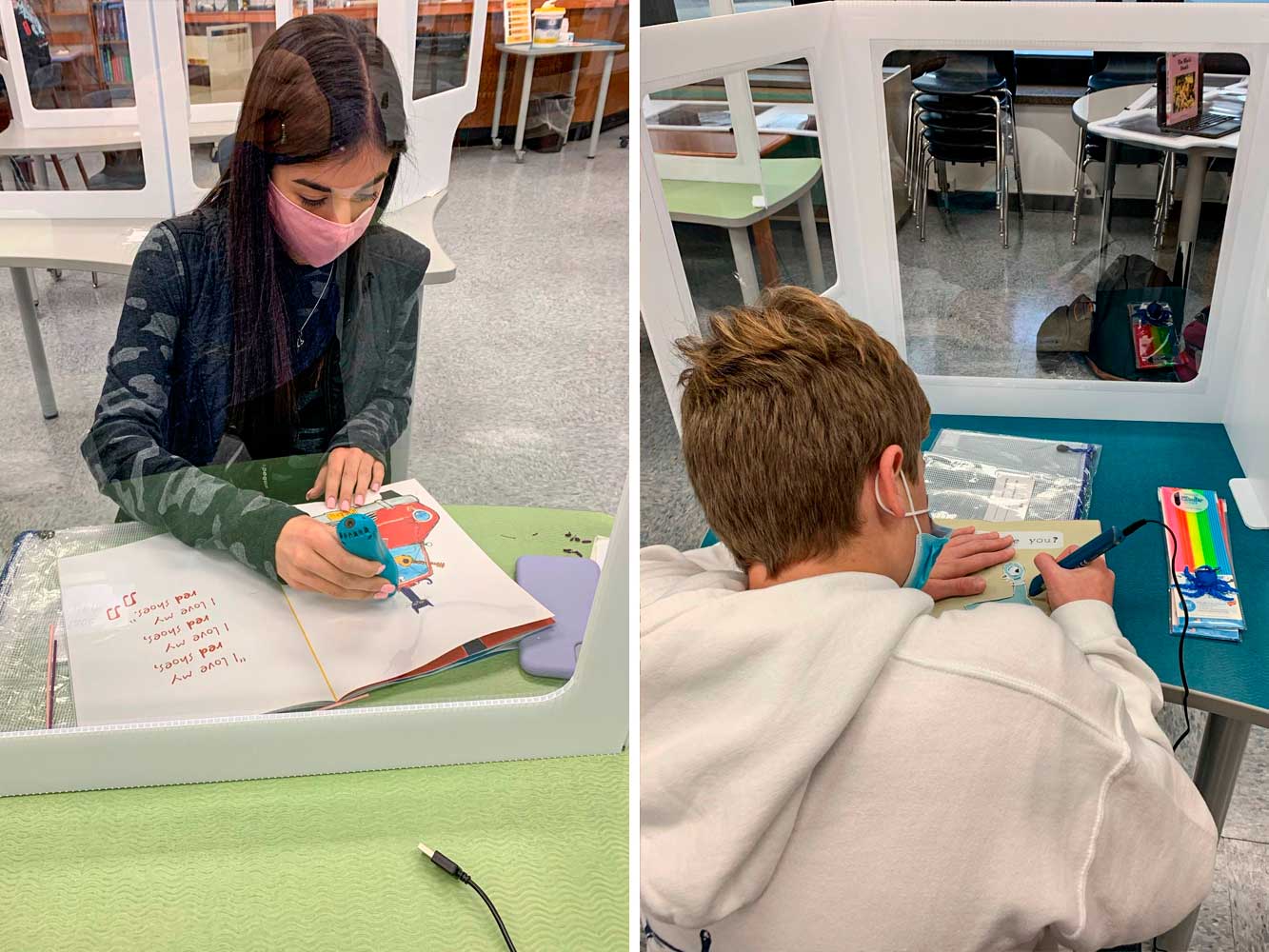
More from Eden Saadon:

Kay, Customer Experience Manager

Work: Nissan Qashqai
Artist: Grace Du Prez and Team

Grace is one of the most creative and skillful Doodlers I know. I’m in awe of how this was conceptualized and executed to perfection. This creation brought out something NEW and BIG out there!

Other artwork by Grace Du Prez:

Faraz, Creative Director

Work: Hong Kong’s Skyline
Artist: Rachel Goldsmith

I love how Rachel used layers of Doodling to create depth both within each building and throughout the entire skyline itself. It’s as if the city is ‘alive’ and gives it a very organic feel.

More of Rachel Goldsmith’s pieces:

Erin, Junior Designer

Work: Galata Tower
Artist: Kalpten Dönmez

I love that Kalpten has turned her skills for wire art into something as flexible as these works with the 3Doodler. Looks like 3Doodler has given her the freedom to add different colors too. Also the amount of detail she is able to show in these small works are amazing. Her detail to light and dark is something to note.

More from Kalpten Dönmez:

Max Bogue, Co-Founder and CEO

Work: Ens Reale
Artist: Marc Buehren

Marc’s work is very cool and contemporary. I love how he uses the filament strands to create a very drapey and mysterious looking effect for his work. His work tends to be formed of outlines, which allows the audience to look through it and see the shadow of the shape on the wall.

Other pieces by Marc Buehren:

4 Ways We Gave Back In 2017

Dear 3Doodler Community,

First of all, I’d like to say a huge thank you to you for another fantastic year. As 2017 comes to an end, I’d like to take this opportunity to share some special community highlights with you.

3Doodler strives to be a company that inspires and enables you to make. Our products and activities reflect our ongoing commitment to our community of innovative Doodlers, talented artists, and last but not least, inspirational teachers and students. I hope these examples will place the spotlight on some very meaningful charities and talented individuals, and bring awareness to the difference they are making every day.

– Daniel Cowen, President & COO of 3Doodler

1. Adapting Our Product For All Users

Ever since we launched our first pen in 2013, we’ve received interest from members of the blind and low vision community, including teachers and students, all envisioning ways to use 3Doodler pens to create instant tactile graphics they can touch and feel. 2017 saw a breakthrough in this area, which we hope paves the way for blind and low vision users to create in entirely new ways.

Partnering with RNIB, UK’s leading charity supporting blind and partially sighted people, we adapted the 3Doodler Start with new features to make it easier for people with sight loss to use. These features include tactile markings on the pen itself, and audio instructions on our website, all aimed at helping users get started and orient the pen for 3D drawing.

See what BBC News reported

2. Encouraging Hands-on Learning in Classrooms

From Nov ‘16 to Feb ‘17, we partnered with DonorsChoose.org to help teachers make creative tech a reality for their classrooms. The US based non-profit organization enables donations directly to public school classroom projects. As part of our commitment to this,3Doodler matched each donation to classroom projects requesting a 3Doodler EDU Bundle. In 2016, 283 projects were fully funded, raising a total of $200K.

One year later, in Nov 2017, we launched a second campaign. At the time of writing this article, we’ve raised $65,263 and counting. We also allocated extra funds for special education teachers, and the response has been phenomenal. The message is clear: making our products easy to access for all types of learners will be one of our main focuses as we enter 2018. Watch this space!

3. Supporting Creators in all Shapes & Sizes

  • 3Doodled woman with netted body sitting on floor - Eden Arafed

In 2017, there has been no shortage of creative talent. We’ve discovered, and been approached by, professional sculptors, fashion designers, art teachers, jewellery designers, as well as countless creators from different backgrounds, who all use the 3Doodler in ways we never imagined.

Sometimes creators need a little boost to shoot for their particular moon. We’ve offered feedback and advice to those who have asked, sponsored and encouraged artists to hold their first ever exhibition, and supported creators with 115 pens and 11,560 strands of filament… In return, we’ve seen creations that made our jaws drop and our eyes ogle. ROI = priceless. These moments and collaborations give us the inspiration we need to do our best every day.

Some Artists We Worked With

4. Making Magic with Toys & Play

Play forms a huge and integral part of a child’s growth. We are a strong believer of Toy Industry Foundation’s mission to provide joy and comfort to children in need through the experience of toys and play. The Foundation makes play possible for families struggling in poverty, military families, kids undergoing cancer treatments, children with special needs, and many more.

We donated to the charity to help bring even more smiles and laughter to the lives of some very special kids.

With these efforts (and many more to come), 3Doodler is helping build a more innovative and caring world; supporting kids and adults who dare to imagine and create. back to top image

3Doodler Stems The Gender Divide

While some of the girls in my elementary classroom will become engineers, designers, coders and software programmers, I don’t expect them all to become the next Millie Dresselhaus. No matter where their lives’ journeys lead them, the lessons they are learning in our classroom will serve them as critical thinkers, innovators, risk-takers, collaborators and leaders.

A recent Microsoft study indicated that a girl’s level of interest in STEM (science, technical, engineering, and math subjects) is on a steady rise until age 11, and then declines, most markedly, by age 15. I refer to these as the “Wonder” years, because I wonder why more people haven’t noticed and/or done something about it!

Girl's interest in STEM diagram by Ellen Gallagher - 3D pen art

One of the best tools in my teaching arsenal is the 3Doodler Start. I’d like to “draw” upon my own success with the 3Doodler and share why it’s an important technology tool for all of your students, but especially your young girls. The 3Doodler is a way to inspire and engage our girls in STEM at an early age, while cultivating a platform that will sustain their interest throughout higher education and life. Learning with a 3Doodler nurtures creative thinking, as students design original works or repurpose information and ideas into new creations. It is an artistic form of expression that appeals to girls, while developing their voice not only within the design community, but in our world at large. Being a flexible, fluent thinker is a valuable commodity in any field or endeavor they may pursue.

Through using the 3Doodler in the classroom, students practice “design thinking”, a process of iteration, beginning with asking questions, brainstorming, planning, testing and retesting. This logical thought process is effective and visually concrete with the 3Doodler. A larger design problem is broken down into smaller, more manageable, sub-problems.

3D pen creates intricate 3D drawing

In our classroom, you will see girls designing plans, sketching models, drawing flowcharts, building, and playing with ideas not only in their minds, but with their hands, as well. They make predictions. They make inferences. They make repairs. They cultivate strong visual-spatial abilities, because their thought processes are being enacted right before their eyes. And all of this happens as they are “playing.” As girls enter adolescence with its rapid changes and choices, the dramatic effects of a strong thought process are witnessed by an improved ability to make important decisions, ones that may alter life outcomes.

With the 3Doodler, girls get practice in solving problems, making mathematics calculations and taking risks within open-ended challenges that allow for more than one solution.

Sign up to receive more news and features from Upwards
Stay In Touch

They cultivate a tolerance for ambiguity and build perseverance. They develop what my grandfather used to refer to as “true grit”, a kind of spunk and resilient nature best cultivated through experience with failure. Psychologist, Carol Dweck, coined the term “growth-mindset” as the ability to reframe failure as an opportunity for learning. With the constant barrage of perfection displayed by the media, our girls are in danger of becoming complacent rather than risk making mistakes. The 3Doodler draws new pathways that embolden girls to dare, to try again, to go out on a ledge, knowing that the only true risk they face are the lessons lost by quitting.

Artful creation, such as with the 3Doodler, does not demand perfection, it celebrates inspiration born through determination. It makes us smile, even as we’re trying again and again.

Beautiful 3D pen art: Person with a mouse.

And somewhere along the line, they begin to realize that they can solve most of life’s problems if they can see the “shapes” and “patterns” within it, which take the form of problems, ideas and choices. The 3Doodler nurtures the ability to problem-solve through analyzing, synthesizing and transferring knowledge to abstract learning. The 3Doodler is a valuable tool for all students, but for our girls, it is the shape of things to come.

Go ahead, check out our new Lesson Plans on our site now!

Get Started

Julia Dweck is a public school teacher who works with students in grades K-5, focusing on the importance of creative and open-ended thinking. Julia is the 2016 winner of the Da Vinci Science Award for her innovative integration of technology in the classroom.

She serves as a school resource and exemplar for inventive implementation of the arts and sciences. Julia encourages her students, friends, and peers to take risks, whenever possible, in order to grow. Follow her on Twitter @GiftedTawk

Transforming Nature into 3D Art with Cornelia Kuglmeier

Woman with glasses doodling 3D pen art

Who is Cornelia Kuglmeier?

Cornelia (or Connie for short) is no stranger to the 3Doodler community. Crowned the “2016 Doodler of the Year”, Connie has created so many stunning 3Doodled pieces that we have lost count of exactly how many there are. In October this year, Connie took her hobby a step further and hosted her very own exhibition in Germany, titled “Metamorphosis”.

Why Metamorphosis?

Butterflies have always fascinated Connie. As an Art teacher, Connie has an exceptional eye for beauty and details, and Butterflies had always been one of the themes she wanted to work on. Being delicately small, it’s easy to overlook the extraordinary beauty of these creatures. Connie decided that she wanted amplify this beauty for the world to see, and so, “macro” became the theme of her exhibition.

Connie’s exhibition spanned over 3 storeys with a red thread leading through the exhibition. It was a perfect layout for telling a story. And what better story to tell but the magical transformation of a humble caterpillar to a majestic butterfly?

Take a walk with me

Photo Credit: Doron Sieradzki
  • 3d pen art caterpillar insect by Cornelia Kuglmeier
  • 3d pen art caterpillar insect by Cornelia Kuglmeier
  • 3d pen art caterpillar insect by Cornelia Kuglmeier

1/F: The Caterpillar Room

Welcome to the Caterpillar Room. Here you’ll be greeted by a giant caterpillar with plants that it feeds on, such as dandelions, nettles, daisies, and so on. The supersizing of the caterpillar and the dandelion head gives you a closer look at some astonishing details of its short-lived beauty, details which normally go unnoticed.

DANDELION HEAD: Made of Nylon and PLA filament using the 3Doodler PRO.
CATERPILLAR: Made of ABS for the structure and PLA for the details using the 3Doodler Create.

Photo Credit: Doron Sieradzki
  • 3d pen art cocoon insect by Cornelia Kuglmeier
  • 3d pen art caterpillar insect by Cornelia Kuglmeier
  • 3d pen art caterpillar insect by Cornelia Kuglmeier

2/F: The Cocoon Room

This floor holds the second stage of the Metamorphosis cycle – the cocoon! Drawn completely free-hand, the fine strands perfectly illustrate real-life cocoons spun from layers of silk. The incompleteness of the cocoon hints that this is merely a temporary phase, to hide the mystery of the transformation. A beautiful butterfly swarm and a wall decorated with daffodils adds to the natural habitat scene. Now slow down, take a look around and enjoy the view.

COCOON: Made of Silver ABS filament using 3Doodler Create.

Photo Credit: Doron Sieradzki
  • 3d pen art butterfly insect by Cornelia Kuglmeier
  • 3d pen art butterfly insect by Cornelia Kuglmeier
  • 3d pen art butterfly insect by Cornelia Kuglmeier
  • 3d pen art butterfly insect by Cornelia Kuglmeier

3/F: The Butterfly Room

Finally we are at the most stunning part of the exhibition, the Butterfly Room! These three gorgeous species are the Peacock butterfly, the Swallowtail, and the White Admiral. You can also see a huge swarm of majestic butterflies flying across the room in the background. Take a minute to appreciate the mesmerizing beauty and colors of these creatures.

BUTTERFLIES: Made of PLA filament using the 3Doodler Create and the Nozzle Set (mainly the ribbon tip).

Red dress woman holds butterfly with red wing 3D pen art.

“I felt very proud and uplifted – and am still feeling very proud weeks after. The exhibition opened during an event called “Art Night” and the place was packed with people looking at my work. It was overwhelming (but in a good way) standing amidst that crowd and seeing the reactions on their faces. I couldn’t help but also eavesdrop on their conversations about my work (shhh…don’t tell anyone!).

Without the encouragement from my family and friends (including you guys at 3Doodler!), I would never have dared to set this exhibition up. Never. "Because when you are showing your art, you’re also showing yourself. That’s a very personal thing to me, and seriously, I was scared out of my wits!" Share

It’s a very different experience when complete strangers approach you and tell you how much they like what you do, ask you how you made it, and tell you that they’ve never seen anything like it. I also loved hearing people tell me which is their favourite piece – it seemed like every piece in the exhibition was someone’s favourite!

I definitely want to keep this work up and am looking for my next exhibition space already! I’m constantly looking for new ways to use the 3Doodler pens and have not yet failed to find something new to do with it.” back to top image

5 3D Pen Craft Activities Your Kids Will Actually Love!

Become the coolest parent in the neighborhood with these easy 3D printing pen projects!

We all know that spending some quality playtime with the family is crucial for kids to build better bonds with their parents, spark creativity, and more importantly for everyone to have lots of fun! Having said that, enticing kids to put down their digital devices and willingly take part in some good old craft projects can often be a challenge… Here’s a tried and tested tip: bring up the magic words “3D printing pens!” and voila, you’ve got their attention.

  • 3d pen kids flashlight activity
  • 3d pen kids flashlight activity
  • 3d pen kids flashlight activity
  • 3d pen kids flashlight activity

1. Bring bedtime stories to life!

Let your child be the creator of their own bedtime stories with these DIY flashlight stencils. The end result creates beautiful visuals that make storytelling so much more captivating and fascinating!

Download Stencil

Steps

  1. Print out the Stencils or find/draw your own.

  2. Doodle the outer shape and keep Doodling to fill it in, but leave the desired shape (e.g. the dragon’s head) empty.

  3. Position your Doodled Flashlight Stencil against a flashlight, turn it on and voila you have your shadow art!

Materials:
Tips:
  • We recommend Doodling inversely in the stencils.

  • Customize your stencils based on themes, such as Halloween, Christmas, favorite book characters, etc.

  • 3d pen kids food activity
  • 3d pen kids food activity
  • 3d pen kids food activity

2. Bake sweet-looking treats

Baking is a great opportunity to engage everyone in the family. Involve your child in every step of the process, from Doodling your own customised cookie stamps to placing the imprinted treats in the oven. What better way to make fun memories and have a sweet result?

Download Stencil

Steps

  1. Print out the Stencils or find/draw your own.

  2. Doodle the shape first. Next, follow the lines of the pattern and Doodle several layers on top of the lines to create a protruding surface.

  3. Create a variety of stamps with different shapes and patterns using the same method.

  4. Roll out and flatten your dough, then imprint them using the cookie stamps.

  5. Carefully remove the extra bits of dough on the edges. Place your dough on a tray and bake!

Materials:
Tips:
  • Start Filament is completely safe to use with food!

  • Doodle handles to the back of the cookie stamps to make stamping easier.

  • This project idea works best with sugar cookie dough.

3. Bring all the birds to your yard!

Build the best bird feeder in the neighborhood with this fun family-project. Did you know that bird feeding relaxes, educates, and is an excellent way to increase outdoor recreational activities for kids?

Watch Kelley Powerpuff Herself here:

Download Stencil

Materials:
Tips:

4. Make customized prints

Decorate your child’s t-shirt, bag and more with your own Doodled symbols, characters and phrases! With the versatility of the 3Doodler pen, the personalization possibilities are endless.

Download Stencil

Steps

  1. Print out the Stencils or find/draw your own.

  2. Doodle and fill in your desired shape (e.g. a star) to create a stamp.

  3. Dip your stamp in some fabric paint, then carefully stamp the shape onto your t-shirt/bag.

  4. Wait for the paint to dry.

Materials:
Tips:
  • It’s always best do some test prints on paper first.

  • If you decide to do a line drawing instead of filling your stencil in completely, make sure your Doodled lines are thick enough, to get a cleaner printed result.

  • Wash your stencils when you’re done and reuse them for other crafty projects.

  • 3d pen stars science activity
  • 3d pen stars science activity
  • 3d pen stars science activity

5. Reach for the stars (and more)!

This DIY solar system project is not just educational, it’s also a great way to decorate your child’s bedroom. With Glow-in-the-Dark stars and Doodled planets, you’ll find your child marvelling at the beauty of the universe at night!

Steps

  1. Blow up some balloons into different sizes, to match the relative sizes of the planets in the solar system.

  2. Take one balloon, using a marker draw a line along the center and go all the way round the balloon.

  3. Doodle half of the sphere up to the line you’ve drawn, then peel off the filament. Repeat with the other half of the sphere.

  4. Doodle to join the two halves together.

  5. Doodle some stars with Glow in the Dark filament .

  6. Connect the star and the planet by Doodling a line.

  7. Repeat steps 2 – 6 with the other planets.

  8. Use Blu-Tack or Command Strips to attach the stars to the ceiling.

Materials:
Tips:
  • Play a space themed trivia quiz with your child. For every question they get right, they get to add another Doodled star to the ceiling!

We hope these projects sparked some inspiration for activities to do with your family! The most important thing is to use this opportunity as a way to spend more quality time with your children. Being entirely present with them and using these everyday moments as a way to help your children grow and learn will create priceless memories and a stronger bond between you and your child. The possibilities are endless.

Happy Doodling!back to top image

The Top 10 Reasons 3Doodler Inspires Zen in the Classroom

I always got a chuckle from David Letterman’s Top 10! lists. Sure, they were funny, but there was always a kernel of truth. The 3Doodler is similar. It’s a funny little tool, but it offers so much value. I’ve already written about its academic benefits, but did you know that it’s also a great tool for inspiring Zen inside your classroom? Here’s a list I crafted to share the top 10 reasons why.

3D piggy bank and mouse toy on white surface (3D pen art)

10. It’s affordable.

Therefore, teachers do not need to feel stressed about tapping into their own budgets to score a top-notch technology tool that packs a lot of power for the punch.

9. It’s as simple as drawing with a crayon to get started.

No need to read a long list of instructions or attend long hours of professional development. You can dive right in and so can your students. That should take a load off your mind.

8. It will keep your students engaged.

Your students will be so quiet when they doodle, that you’ll be known as the teacher with the most well-behaved students in the school! The 3Doodler can actually alter your students’ physical and emotional experience, allowing them time for introspection, possibly leading to improved decision making. A teacher can dream, can’t she?

7. It is truly child-friendly.

Time working with the 3Doodler is time spent away from digital devices that may bombard and overstimulate your students. Plus, unlike using a laptop or tablet, you don’t need to be on hyper-alert, patrolling computer screens in case students have wandered off-site.

6. It keeps everyone happy.

The 3Doodler is an effective tool in improving students’ moods, as they happily create and discover while learning. And, happy students mean a happier teacher! Right?

5. It may help reduce stress levels.

Researchers have discovered that doodling inspires wellness, which quiets the brain and may lead to decreased levels of adrenaline incited by recess and missing homework assignments. Ugh!
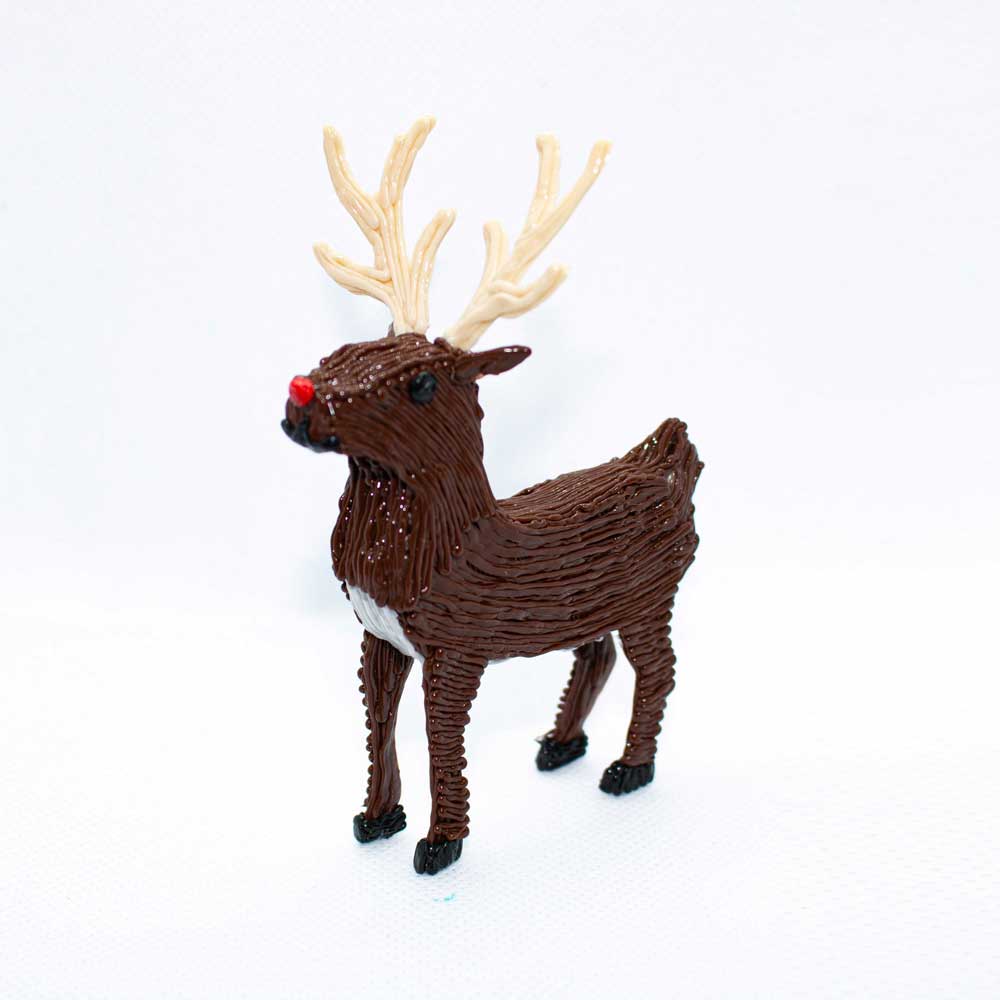
4. It creates “Aha!” moments.

The 3Doodler is inspirational. As students use it, they make connections that lead to insights. This kind of inspiration is contagious and will spread throughout your room. What a marvelous thing!

3. It embraces all types of learners.

It’s one size fits all. Doodling is a universal. We all doodle. With this type of lowered level of expectation, students have happy accidents that are needed for new learning.

2. It silences the inner-critic in all of us.

In fact, the word “doodle” sounds so silly and humorous, that students will feel relaxed enough to try new things, take risks and make mistakes. This will make your classroom a more productive place to be.

3D pen art: Three orange cell phones on white surface.

1. It’s just fun and relaxing.

And the top reason why the 3Doodlers will inspire Zen in your classroom is that a relaxed mind is better equipped to solve problems. So, instead of plying your students with sugary mints before their next exam, bring out the 3Doodlers.

Remember these tips the next time you or your students are feeling stressed, overwhelmed or need inspiration and pass out the 3Doodlers. It’s on the shelf right next to that bottle of aspirins and a lot healthier for everyone!

Julia Dweck is a public school teacher who works with students in grades K-5, focusing on the importance of creative and open-ended thinking. Julia is the 2016 winner of the Da Vinci Science Award for her innovative integration of technology in the classroom.

She serves as a school resource and exemplar for inventive implementation of the arts and sciences. Julia encourages her students, friends, and peers to take risks, whenever possible, in order to grow. Follow her on Twitter @GiftedTawk

Check out new Lesson Plans live on the site now!

View Lesson Plans

7 Ideas for Day of the Dead

Day of the Dead, also known as Día de Muertos, is a Mexican holiday from Nov 1st and 2nd, to pray for and commemorate friends and family members who have passed away. It is believed that the spirits of the deceased children will reunite with their family on Nov 1, and Nov 2nd is when the spirits of adults are allowed to visit.

Colorful Altars for Colorful Lives

To welcome and honor the departed, altars are set up inside homes, displaying a Sugar Skull, flowers, candles, food, and once owned possessions. Inspired by photos of these beautiful and meaningful altars, our talented Artist, Cornelia Kuglemeier created an (almost) entirely Doodled version of it, made up of some of the most symbolic décor pieces for the festival.

For example, the Papel Picado is a form of Mexican paper cutting art, which is often seen during important festivals like Day of the Dead and Christmas. To make things even more interesting, you can try make a doodled version of it!

The Sugar Skull (Calavera) is another important symbol used in this Mexican celebration. Traditionally, sugar was used to form the mold because it was readily available and cheap. The Skulls are placed in the altar to recognize the person who has passed. The name of the deceased is written on the Skull’s forehead, then the rest of the surface is decorated with icing, ribbons, and other colourful adornments.

Here’s How To Make Them:

Papel Picado

Blue & yellow cross-stitched 3D pen placemat on red table.

1. Print or acquire a piece of grid patterned paper, or draw your own on lined paper.
2. Draw your designs.
3. Cover the paper with a layer of Masking Tape.
4. Use FLEXY filament to Doodle on top of the tape, following your patterns and the grid pattern.
5. Peel the design off, and you’re done!

Sugar Skull

1. First, doodle over the Skull Canvas in Polar White ABS filament.
2. Add some decorative flowers and “sugar” using a variety of colored ABS filament. The more colors the better!
3. Use Glow in the Dark filament on parts you want to make look extra spooky in the dark.
4. To make the doodles look like sugar writing, experiment with different Nozzles to achieve a variety of interesting effects.

Candle Holder Skull

Brightly colored sugar skull with red light - 3D pen art. (59 characters)

1. Cover the entire Skull Canvas with Masking tape.
Doodle over it with Clearly Clear PLA filament, leaving a gap in the centre, so you can peel off the doodled skull in two halves later.
2. Doodle the entire Canvas leaving the top of the skull open, this is where you will put in the candle.
3. Remove the two parts of doodles from the Canvas, then join them together by doodling along the gap to join.

Flower Garland

Filament flower necklace made with 3D pen art

1. Draw petal shapes on a piece of paper to use as a stencil, then doodle over them with ABS filament.
2. Peel the petals off from the paper.
3. To give them a curvy shape, use a hot air gun or a hair dryer to gently heat the filament, then shape it with your fingers.
4. Doodle to join the petals together to form a flower.

Flower Vases

3D pen art: Three vases with flowers on table

1. Draw some patterns on a piece of paper to use as a stencil.
2. Roll up the paper and put it inside a Vase Canvas, then tape down the paper to hold it in place.
3. Doodle directly on top of the Canvas to make beautiful customised Vases!

La Calavera Catrina

Calavera Catrina - doll holding candle with skull - 3D pen art

1. To make the body, use a bottle as the base to build the shape of the dress.
2. Doodle two arms and attach them onto the body, positioning them so that it leaves a gap in the middle for the candle.
3. For the head, scrunch up some paper to make an oval shaped ball, then doodle on top of it to make the head.
4. Finally, add a hat on the head, then join all the pieces together.

Box Candle Holder

Lit candle next to small box - 3D pen art

1. Use a Box Set Canvas as the base.
2.Measure one side of the Canvas Box, cut out a piece of paper, then draw some patterns (e.g. skulls and flowers) on it to use as a stencil.
3. Place the stencil inside the Box and tape it to one side.
4. Doodle directly on top of the Box, following the stencil outline to create a unique and interesting design.
5. Repeat on the other sides.

To create a balanced and Instagram-worthy display, place the shorter pieces like the Sugar Skull and Papel Picado in the centre. Then surround these with the taller pieces like the flower vases and the La Calavera Catrina. For some final touches, complete the altar with some food, a bowl of salt, and some scattered flowers. And there you have it, your own Doodled Day of the Dead altar.

Sources:
https://www.mexicansugarskull.com/support/dodhistory.html
https://en.wikipedia.org/wiki/Day_of_the_Dead

Application of 3D typography

A few stunning examples from the 3Doodler team.

Quote written book on table, 3D pen art.

1. Grace Du Prez

Profession: Marketing Coordinator
Design style: Words that form the shape of the object it symbolises.
What I love about 3D typography: I love the freedom that 3D typography offers! With 2D typography, if I wanted to create a shape or shadow out of the words I chose, I can draw that effect, but ultimately everything is flat. With 3D typography, I can literally make the words take up the form of the shape, and even hold the typography in my hands or turn it into something functional (in this case, a crown!)
What I’d like to try next: I’d like to transform typography into more fun and functional pieces like book ends, bracelets, etc.
Tips for Doodled Typography: Don’t be afraid to explore the limitless possibilities of this unique medium. I would suggest to doodle your piece freehand instead of sketching it out first, as sometimes new ideas may appear once you start creating your piece in 3D.

Giraffe dog with crown on couch - 3D pen art

2. Apple Ko

Profession: Marketing Coordinator
Design style: Words that form the shape of the object it symbolises.
What I love about 3D typography: I love the freedom that 3D typography offers! With 2D typography, if I wanted to create a shape or shadow out of the words I chose, I can draw that effect, but ultimately everything is flat. With 3D typography, I can literally make the words take up the form of the shape, and even hold the typography in my hands or turn it into something functional (in this case, a crown!)
What I’d like to try next: I’d like to transform typography into more fun and functional pieces like book ends, bracelets, etc.
Tips for Doodled Typography: Don’t be afraid to explore the limitless possibilities of this unique medium. I would suggest to doodle your piece freehand instead of sketching it out first, as sometimes new ideas may appear once you start creating your piece in 3D.

Close up of black & white 3D handwritten phrase - 3D pen art

3. Kira Alba

Profession: Junior Designer
Design style: Small blackletter 3D mural
What I love about 3D typography: I like how having the ability to draw in 3D allows me to rethink the usual, two dimensional calligraphic process. Of course you could cut your letters out of paper to build the words in 3D, but the 3Doodler enables me to build without losing the element of ‘writing’ the letters. The process is unique because it feels like you’re both drawing and sculpting at the same time.
What I’d like to try next: I’d like to try the different nozzles and the smoothing tool for the Create pen and experiment with textures.
Tips for Doodled Typography: If you’re creating 3D letters with finer extruded elements I recommend using ABS filaments so your doodles can dry faster and provide a better hold.

Blue toy on white paper 3D pen art

4. Faraz Warsi

Profession: Creative Director
Creative outlet: Small blackletter 3D mural
What I love about 3D typography: I love typography. Who doesn’t? Designer or not, you have to appreciate the way people interpret and redesign our 26 letters of our alphabet. Usually whenever I’m hunting for inspiration I spend a good amount of time digging through typography examples… most of those cases, it’s usually through a screen or print. With the 3Doodler in hand, you’re experimenting in 3 dimensions. For the first time you can quickly experiment with depth, and in this example, literally bring your typography to life and bring your Doodles off the page!
What I’d like to try next: Textures and touch.
Tips for Doodled Typography: Experiment. There are so many possibilities and most of them haven’t even been thought of yet! Think about it this way, you’re one of the first people ever to experiment with typography with a 3D pen… There’s something special in that.

3D pen art: Someone holds up a 'New York' sign in cityscape design.

5. Erin Song

Profession: Junior Designer
Design style: Brush Script Calligraphy
What I love about 3D typography: As a designer I am obsessive about the use of typography. I work on a lot of print or web and I sometimes miss the handwritten element of traditional typography. The 3Doodler allows me to create a clean and sturdy 3D typography but still keeping that handwritten look and (literally) feel.
What I’d like to try next: BIG typography. You know those people who have nice quotes on their walls? I’d love to make that WITHOUT the paper and the expensive frame. It’s great that with the 3Doodler, there aren’t paper sizes to limit me!
Tips for Doodled Typography: It’s not only about how you write it, but also how you show it. I do a lot of photography on the side and I have to say that you can get really creative when you can actually hold and place the 3D typography you just 3Doodled! Make sure to think about the space, shadow and colors (we have over 60 colors for you to choose from)!

The Benefits of Drawing on Imagination with 3Doodler

Our students come to us ripe with imagination. Every teacher has been an audience to the fantastic tales spun by a kindergartener. I recall one tiny, freckled girl who came to class each day wearing a Wonder Woman cape and snow boots, even in May.

She earnestly nodded her head, as she promised me that fairies really did make her lunch. I asked her mom if she had shared this creative fib in order to get her daughter to eat. She smiled and shook her head no, explaining that this was all her daughter’s idea, along with her “eclectic” fashion sense.

Research indicates that from an early age, strong-willed creative thinkers have the potential to become the leaders and innovators of tomorrow. So, how do we resist standardized teaching methods, and, instead, cultivate and enhance our naturally creative thinkers? Last year, I added the 3Doodler to my list of back-to-school supplies and the results were astounding.

Any teacher who has worked with primary students can share their limited attention span. To go over 30 minutes lecturing, you risk them turning on you. There is nothing sadder than witnessing a novice teacher who has lost her audience, desperately flailing about to recapture their attention. The 3Doodler not only engages elementary students, who are naturally doodlers; it captivates and sustains their attention. Have you ever watched a student get lost in thought? It’s a wonderful thing.

Try out one of Julia’s new 3Doodler lesson plans with your own students.

Get Started

This is where learning naturally happens. While directed learning is necessary, it can sap the joy out of doodling. The most fantastic ideas can result from free exploration. Like the child who proudly displayed her “tooth-pulling machine,” she’d designed with her 3Doodler, as she wiggled her loose front tooth with the tip of her tongue. She told me that this idea had been “hidden in her head for a long time.” This invested focus, allows students to creatively solve problems that are meaningful to them.

In directed learning, students are much more likely to enjoy adding and subtracting when they can create their own counting sticks or doodle illustrations for touchable word problems. The creative thinking that stems from self-directed discovery, solidifies learning. Students’ doodles make their thought processes visible to their teacher, even when their literacy skills are limited.

When 3Doodling, students’ hands-on free-associations may trigger acquisition and enhance retention of knowledge. According to Bloom’s Taxonomy, transferring learned concepts to abstract or novel applications is considered the highest level of learning. The 3Doodler naturally inspires this type of imaginative transference with very little effort on the part of the teacher. Great ideas stem from the seeds of imagination. What appears to be a frivolous doodle of a tic-tac-toe game, may lead students to develop creative and complex mathematical strategies.

The creative mind promulgates a sense of pride and self-esteem, as students become true makers and innovators. The 3Doodler allows students to share their ideas in concrete and visuals ways. What a powerful thing imagination can be when allowed to come to fruition in the hands of a child. Students are no longer told that their ideas are impossible.

"What a powerful thing imagination can be when allowed to come to fruition in the hands of a child. Students are no longer told that their ideas are impossible. Instead, they are encouraged to try them, modify them, and test them." Share

Instead, they are encouraged to try them, modify them, and test them. Einstein was a great visualizer. In his mind’s eye, he could “play” with ideas. This led him to some of his most amazing discoveries and theories. Not all of us are as fortunate to be as innately inclined to mentally play with ideas as Einstein. The 3Doodler inspires this type of visually creative thought. And, it is this coupling of ideas with hands-on modeling, which inspires confidence–a sense of what I like to call, “Look-what-I-made-pride.”

According to experts like Daniel Pink and Sir Kenneth Robinson, creative thinking is the most important skill for success in the 21st century. The world is a complex place, with needs that cannot be met through replication of standardized thought patterns. Now, more than ever, we need thinkers who can “draw” upon their imaginations to design new paths.

It is incumbent upon each of us as teachers to make the time and share the tools that will allow this type of fluent and flexible thinking to flourish. So, how do you know if your students are ready for the 3Doodler? Can they hold a crayon? That’s a good start. It all begins with a doodled line and where it ends, who can imagine?

Julia Dweck is a public school teacher who works with students in grades K-5, focusing on the importance of creative and open-ended thinking. Julia is the 2016 winner of the Da Vinci Science Award for her innovative integration of technology in the classroom.

She serves as a school resource and exemplar for inventive implementation of the arts and sciences. Julia encourages her students, friends, and peers to take risks, whenever possible, in order to grow. Follow her on Twitter @GiftedTawk

The New 3D Adult Coloring Book – Say Hi to Create Canvases

An easy starting point for beginner or seasoned Doodlers to create stunning results

I’m Kelley, Marketing Director at 3Doodler, and dare I say it, a timid Doodler.

Of course, like millions, I invested in the adult coloring book craze, the major draw being able to create something “artistic” that I was proud of – without fear that the final piece would fall far short of the creative vision in my head.

I’m not ashamed to admit that I am bit intimidated by a blank page. But armed with a template, where all I need to do is select colors and fill in the shapes, I have just the right amount of creative scope. And that’s OK.

It’s that same thinking that started us down the path to our new Create Canvas Series. What began as a brainstorm to help beginner users create complex items quickly and easily, soon led to a range of enticing ready-made shapes that could serve as a “canvas” to anyone’s unique creative potential.

In the lead up to launch we left some blank Canvases in the hands of a couple of seasoned Doodlers to see what they’d create – I think you’ll agree the results offer some decidedly non-intimidating and eye-catching ideas!

Cornelia Kuglmeier

Tell us about your design
My idea was to make functional items. I repurposed the skull Canvas into a popular symbol it represents – a pirate with a hat designed so the hollow pirate skull serves as a piggy bank – as pirates usually hide treasures.

For the Gnome, I transformed it into something unexpected, a dwarf queen! These would look cute in a group, with dwarf king, queen and maybe kids and citizens – create your dwarf community.

TIP:
  • To create a hollow skull or Gnome, cover the canvas with tape and Doodle the front and the back, peel these off, and then join them together.

What did you like about the Canvas Series and what would you try next?
What I like is that the Canvas provides a shape that you’ve got to make yourself otherwise. It’s neat and white, you can doodle directly onto it, and also add to the shape (like adding hair, ears, etc.).

I’d like to try turn the skull into a little self-portrait. I think that would look cool! As I wear glasses, I might make the skull in a way that it can serve as a storage spot for my glasses! I’d also love to use more colours on it.

Who do you think the Canvas Series is good for? 
I think the Canvases are perfect for new, young or hesitant doodlers. You can create decorative or useful (or both) items for your living room, your own little piece of art or customized presents. Also, for students it’s an awesome tool to work with – students don’t have to spend time making molds or shapes with paper and tape, but can start doodling instantly.

Grace Du Prez

Tell us about your design
The design I made for the Skull Canvas is quite simplistic but I’m really pleased with how it looks. I used clear PLA and it really sparkles in the light. A little bit of Damien Hirst, Indiana Jones and Elsa!

What did you like about the Canvas Series and what would you try next?
I like the Canvases because it’s really easy to use and you can achieve great results. The next thing I’d like to make with the Skull Canvas is a Halloween headdress.

Who do you think the Canvas Series is good for? 
I think the Canvases are a great starting point to spark inspiration. They’re a perfect way to give a helping hand to an ambitious doodler.

Kira Albarus

Tell us about your design
The vase design I went for is a modern geometric pattern in a contrasting, simple color palette. I like this design as it looks pretty slick and fits well into any modern home.

The box set is also a minimal design approach with a simple color scheme of black, white, silver and gold. I liked the idea of using the boxes to separate different types of jewelry – they’re the perfect size for it!

TIP:
  • The Box and Vase Canvas Sets are made from a transparent material, so you can print or draw a design on paper, line the inside of the canvas and trace the outside surface with the 3Doodler.

What did you like about the Canvas Series and what would you try next?
Using a printed stencil on the inside of the Canvas worked really well with these two pieces! In the future, I would love to try something more playful and add more 3-dimensional parts to the canvas, maybe a scary Halloween skull with an eye-ball hanging out.

Who do you think the Canvas Series is good for? 
The Canvas series is great for anyone creative who loves adding a personal touch to their home decor. It’s also a nice project if you are just getting started with the pen, as it doesn’t require building complex 3D shapes.

#WhatWillYouCreate?

Watch How You Can Create it Your Way with 3Doodler Create Canvas Series:

3 Million Dimensions: Part One

Sometimes, inspiration comes in the form of a misprinted dinosaur.

Troody, a robotic dino toy Troody, a robotic dino toy

In 2011, WobbleWorks was developing Troody, a robotic dino toy. At the time, the company’s business model was to develop toy ideas to sell to other companies. Maxwell Bogue and Peter Dilworth, founded the company together in 2010. They were using 3D printing to rapidly develop prototype toys. Unfortunately, the technology had some serious limitations.

A minor error caused the printer to leave part of Troody’s leg “blank.” Filling in gaps left by the printer should have been a minor problem, but at the time there was no easy solution. It was up to Bogue and Dilworth to come up with one.

“’Hey, it’s too bad you can’t just take the nozzle off [the printer] and use it to fill in the missing gap,’” Bogue remembered Dilworth saying. “And then we realized that you could totally do that.”

" ’Hey, it’s too bad you can’t just take the nozzle off [the printer] and use it to fill in the missing gap " Share

The pair quickly confirmed they were the first to have this idea, and then in only a few days put together a “quick and dirty” prototype of what would ultimately become the 3Doodler. Those prototypes grew more refined and in a short time, WobbleWorks transformed itself from a small toy company into the force behind the world’s first 3D printing pen.

Bogue and Dilworth knew they had a winner, but needed help launching the product via Kickstarter to enter fullscale production. As luck would have it, a willing partner materialized at the perfect time: Daniel Cowen, a lawyer turned entrepreneur Bogue had met years earlier in Hong Kong. Cowen happened to be in town, crashing on Bogue’s air mattress.

"‘Yeah. This is the next Crayola,’” he said. “Who wouldn’t want to help launch that? " Share

Cowen and Bogue had met in Hong Kong while Bogue was working for an established toy company and Cowen was a young lawyer completing his legal training at an international firm. Both had varied careers in the intervening years, but Cowen had caught the entrepreneurial bug, which took him to North America to launch a software company. Frequently in and out of New York, Cowen had become a frequent houseguest of Bogue’s.

For Cowen, switching gears to help launch the 3Doodler via Kickstarter was a no brainer. “I was like, ‘Yeah. This is the next Crayola,’” he said. “Who wouldn’t want to help launch that?”

A million 3D printing pens later,spoke with Cowen and Bogue about creating the 3Doodler, and the secret to their success. The most important ingredient to creating a new artistic medium? Building a community.

Where do you think the company will be when the billionth pen is sold?

Bogue: It’ll be as ubiquitous as the glue gun, envisioning a time when upcycling and self-repair is the norm. Actually, even more common, because you’re able to do more with it than what you’re able to do with a glue gun.

Cowen: What do we want people to think when they pick up the 3Doodler? “Nothing” is the ultimate answer. Ubiquity and invisibility go hand in hand. What do you think about when you pick up a pencil or a crayon? You don’t think much at all; you just reach for the perfect tool to do what you need.

What was it like in the earliest days of the company? Tell us an anecdote.

Bogue: I did all of the repairs of all the pens out of my New York office, which was also my apartment. For example, Rachel Goldsmith [one of the most prominent early 3Doodler artists], the first time we met, she said she lived in Brooklyn and I said, “Oh, well I’m over in the East Village. If you want to meet me in a coffee shop, I’ll come and fix your pen.”

I’ve done that with a lot of people who happened to be in the city. I was like, “If you want an instant fix, you can meet me at The Bean on 1st Avenue between 10th Street and I’ll come and I’ll fix your pen right there.”

You were really in the trenches and built a powerful community and committed team. How have you adapted and grown over time?

Bogue: Being in the trenches wasn’t exactly optional. But I don’t think any of us begrudged or minded doing it at any point. That has more to do with our personalities in general, that we like to be involved and understand what’s going on. Then it makes us better at helping everybody else in the company figure out what needs to get done and how it happens and how to help make it happen.

Cowen: A quarter of the company is now in some way devoted to either customer service or community building. We touch base once a week with everyone involved. It makes us a better team and a better company. If we’re not producing a product that’s great for our users, then something’s going a bit wrong. We’ve seen people come into the market trying to copy us and one of their biggest failings is a lack of quality and their attention to that.

Today, many startups you see tend to be software focused, and you both have some background in that field. But the 3Doodler is a physical product. Is that significant?

Cowen: I was never doing the coding of the software. I don’t have that skill set. I knew what the product was meant to look like, how it was meant to feel and work, but I wasn’t the one getting it there, which was often frustrating. Law is similar in some ways, you’re just the one doing the paperwork in the middle, not making things happen, which was one of the reasons I left.

Moving into physical product in many ways was a huge relief because we knew what it was meant to do. Max had a prototype and we knew how we wanted to improve it, and you can understand the physical a lot more quickly and easily. I had the benefit of coming from a family that did a lot of manufacturing. Both my parents and my stepdad had come from manufacturing backgrounds, so even though I hadn’t actually been in physical product creation before, in many ways it felt more familiar and it felt a lot more tangible and satisfying.

That said, you lose a lot of the huge benefits you have with software. You can’t just push an update and fix a problem that goes wrong. Once you’ve shipped tens of thousands of products, you’re stuck with the results of that no matter what, because recalls are expensive, and which thankfully we’ve never had to do.

How important is building a community of creators to the success of the 3Doodler?

Bogue: We work very closely with a lot of artists and support them as much as we can, because they’re the ones that are making truly amazing things with our product. We want to see how much further they can push this stuff using our tool. This is… a new industry, it’s a new concept. 3D pens didn’t exist until we brought them into the world in 2013.

Cowen: That last comment from Max really hit it on the head. Always front of mind from the very first days of Kickstarter all the way through to now was that this is a product and a market in its infancy, and if we don’t get it right, we would not only be ruining it for our own company but we’d be ruining for the whole medium.

Our best advocates are going to be our own users having a good experience with this the 3Doodler pen. So, we pay very carefully attention. That helps the product get better and helps the community grow, and in turn justifies the efforts.

Looking for more?

You can listen to Max & Daniel’s full interview here:

This article is the first in a series of conversations on the 3Doodler, its history, and its future between the people who know it best. Visitagain for more.

Here you can find our second piece with Creative Director Faraz Warsi and Junior Designer Erin Song.

Here you can find our third piece with artists & early adopters Rachel Goldsmith and Louis DeRosa.

3 Million Dimensions: Part 2

A Million Pairs of Hands: Q&A with 3Doodler Designers Faraz Warsi and Erin Song

When new design interns join 3Doodler, their first challenge is to teach themselves how to use the 3D printing pen. But “figuring it out” is more than a rite of passage at the startup, it’s a way of life.

Faraz Warsi, 3Doodler's Creative Director Faraz Warsi, 3Doodler's Creative Director

Experimenting with different ways to use the category-defining tool – and articulating those uses to the market – has been central to 3Doodler’s evolution. And the company’s design team, including Creative Director Faraz Warsi and Junior Designer Erin Song, has been instrumental in leading that charge.

From testing new applications to building new products to growing the community of 3Doodlers, Warsi and Song have played integral roles in helping Wobbleworks hit its one million milestone. Here, the two designers reflect on the company’s growth and share their thoughts on its future.

Are we close to realizing the full creative potential of the 3Doodler? Or are these still the “early days?”

Warsi: I’d say we’re we’re just scratching the surface right now.
Song: 3D printers have been around since the 1980’s, but the technology has grown so much, and it’s only now that it’s become more consumer-ready.

Warsi: The way I see it, people are still creating so many beautiful pieces on a 2D surface with a regular pen or paintbrush. Add a third dimension to it, and everything changes. Education, home decoration, even small things like, fixing the battery cover on a remote control. The 3Doodler is intuitive like a pen but has uses we haven’t even thought of yet.
Just when I thought I’ve seen everything, there’s something new and incredible being done with it. I’m constantly impressed.

At a time when so much has moved to the screen, what’s the significance of creating “by hand” with the 3Doodler?

Erin Song, 3Doodler's Junior Designer Erin Song, 3Doodler's Junior Designer

Warsi: Back in the day, people used their hands more. Nowadays, you just go buy what you need, or there’s an app for that. Even when it comes to making a list on a piece of paper, people don’t do it. They have a calendar, or a to-do list app.

Song: As a modern day graphic designer, I mostly work on screen. However, I have always preferred to use pen and paper first for coming up with new designs. The reason is because programs have too many tools and makes the creative process harder to concentrate on. Only once I’ve finished this process, I refine everything on screen, using graphic software.

Deriving from this, I think using the 3Doodler for certain projects is more significant than pen and paper since we can think in dimensions without using a complicated software. You get to see the results right away. There are no page or size limits to what you can create with the 3Doodler.

What are some of the most interesting ways you’ve seen people use the 3Doodler?

Warsi: Honestly, every week, through Twitter or social media, we hear about someone who picked up this pen and is doing something brand new that we never thought was possible.

Song: I think the biggest one was that the 3Doodler became a tool where someone was able to use it to help people those who are visually impaired (Read more about it here)

Where would you like to see the 3Doodler go next? What does its future look like to you?

Warsi: I want to get it in more people’s hands. Right now, it’s obvious, the users are home decorators, architects, artists …

The other thing is, right now, you can doodle in filament, you can doodle in bronze copper, polycarbonate, nylon … but I would love to be able to doodle in anything. Why not doodle in beef jerky? Why not doodle in cheese? Why not doodle in sugar? I’d like to doodle in every single material.

What does it mean to you that there are 1 million 3Doodlers out in the world?

Song: I remember reading about how we sold our 100,000th 3D printing pen back in 2014! And now we’re on our 1,000,000th pen, we must be doing something right. There must be people that are definitely interested, and I think a lot of users are drawn to our EDU, our 3Doodler education system.

Warsi: The number’s obviously huge, but it’s not like 1,000,000 in only America. They’re all over the world – Hong Kong, Japan, Korea, Thailand, Germany … and they’re part of all these different cultures. Art and music are universal languages … and now people are creating things with our tool, and connecting.

I think, for me, a million conveys a sense of community. At the end of the day, it’s a tool – but it’s one that affects people and changes lives. That blows my mind.

This is the second in a series of conversations about the 3Doodler with the people who know it best.
Here you can find our first piece with co-founders Daniel Cowen and Max Bogue.
Here you can find our third piece with artists & early adopters Rachel Goldsmith and Louis DeRosa.

3 Million Dimensions: Part Three

Two Distinct Artists Break New Ground with 3Doodler

In the art world, there are hundreds of mediums you can use to express a creative concept conceived in the mind. Some people pick paint; others turn to clay and still more are constantly looking for a new way to express the designs they yearn to create.

Rachel Goldsmith is an artist who used to work mainly with water-based paints and permanent inks.

Louis DeRosa is an animator who specializes in illustration. These two creative minds each produce profoundly different work, yet both found their stride in recent years with a new tool: the 3Doodler, the world’s first 3D printing pen.

Both Goldsmith and DeRosa developed a passion for the 3Doodler within minutes of first picking up the pen.

Rachel uses the tool to develop intricately “woven” pieces of fine art and Louis uses it to create unique figurative objects, built up layer by layer.

The different ways these artists utilize the pen speaks to the product’s potential in the maker’s space. There’s no limit to what creations can emerge from imagination and steady supply of filament.

Today, Goldsmith works as an artist that creates pieces with PLA filament.

DeRosa is an advocate of the 3Doodler pen, traveling on behalf of the company to present live demonstrations of the tool and teach people how to use it. Both work closely with the 3Doodler founders, Maxwell Bogue, Daniel Cowen and Peter Dilworth, advising on educational materials, testing new product upgrades, and creating content for 3Doodler marketing materials.

UPWARDS sat down with the two artists to learn more about the unique ways in which they use the 3Doodler, and how it has shaped their artistic endeavors.

How did you first learn about the 3Doodler?

Louis Louis

DeRosa: I was finishing up my last year of college for animation, and I was pretty interested in the whole maker movement and 3D printing, but it was not exactly something I could afford to just get into. I saw a Kickstarter ad pop-up for a handheld 3D printer, and decided to back the project right away.

What made it a no-brainer for me, was my interest in drawing. I always had a sketchbook with me. The notion of taking that new frontier of 3D printing and having it be handheld really appealed to me.

Goldsmith: I came about the pen having no knowledge of filament or 3D printing. As an artist, I always had a sketchbook—like Louis did—and I was drawing constantly. When the 3Doodler Kickstarter launched, one of my good friends, as well as my dad, said “You need this.” And my dad immediately backed the project for me.

What was your first experience like with the 3Doodler?

DeRosa: Interestingly, the very first thing I doodled was a human figure. My approach was trying to be like a 3D printer. I had seen the way 3D printers worked—how they go layer by layer, building upwards—and tried to replicate that. I quickly realized that the pen could do way more than a 3D printer could do because the design was completely up to me.

Goldsmith: My first instinct was to use the 3Doodler directly on a canvas in the same way I’d use paint. I was “painting with filament”: cross-hatching the lines so the colors would blend, thus expanding the limited color palette and playing with different textures. To this day, my work is still focused around the many ways of using the 3Doodler to create color and texture.

How did you first get involved with the co-founders, Max, Dan and Peter?

Rachel Goldsmith Rachel Goldsmith

Goldsmith: I posted the first piece I did with the pen on Twitter, and Dan reached out to me to ask if I was interested in helping them create a piece for the MoMA design store window display. I kind of lost my mind with excitement over the opportunity.

DeRosa: I had called customer service about the pen and, lo and behold, I was speaking to Max Bogue. That in, in and of itself, was awesome…that he was so involved.
Shortly after that, like Rachel’s experience, I had a little doodle of my dog that I posted on social media. Dan saw it and they extended the same invite to me: to come and be a part of the demonstration at not only the MoMA store, but the Kickstarter headquarters, which was beyond exciting.

Can you speak to the very distinct and different ways you each use the pen in your creations?

Goldsmith: I find these differences really interesting. Louis thinks of everything in a 3-dimensional way. For example, he thinks of the surface area, whereas I think of the contours, so it’s fascinating to me how differently we interpret the same idea.

DeRosa: I can say from an outside perspective, that Rachel occupies a very unique space. She’s solely responsible for elevating to fine art what you can do with the 3Doodler. As much as I would like to claim that what I’m doing is fine art, it’s not immediately perceived that way because a lot of what I’m making is mimicking things that you find in the real world—like action figures or little functional things. To me, I handmade it, so that’s exciting, but to the untrained eye it looks like something they’ve seen before.

Why do you think the 3Doodler is so revolutionary?

Goldsmith: I remember thinking “I’m creating a new form of art.” It blew my mind that I was one of the only people in the world doing something like this. It’s beyond amazing to me how many people are using it now. There’s so much talent.

DeRosa: It’s amazing to see this new, creative, technical tool for the first time, and seeing people use it in ways I hadn’t thought of yet. That aspect of it has been maybe the most exciting. To sort of be on this journey with people all over the world that are trying out something new.

Do you think we are anywhere near seeing the full creative potential of the 3Doodler?

DeRosa: The pen and pencil have existed for hundreds of years, and I believe that’s a medium that is still being pushed. So, I don’t think we are going to see the boundaries of what this device can do in our lifetime. Even the current iteration, I’ve spent so many hours using it, and even when I’m not using it, I’m thinking about new ways to use it. Then still, I see somebody doing something that I hadn’t thought of yet. I believe that as more individuals experience it, more intentions will come to light for it.

To see more of Louis’ work, check out his Instagram
To see more of Rachel’s work, check out her Instagram

This is the third in a series of conversations about 3Doodler with the people who know it best.

Here you can find our first piece with co-founders Daniel Cowen and Max Bogue.
Here you can find our second piece with Creative Director Faraz Warsi and Junior Designer Erin Song.

Transforming the Fashion Industry with Eden Saadon

When you think of fashion, the first thing that pops up in your mind probably isn’t 3D printing.

Although technology and fashion may seem like an unlikely pair, Eden Saadon, a young and talented textile designer from Israel, has used 3Doodler, the world’s first 3D printing pen, to challenge convention and push forward innovation in the world of fashion.

"It is like a magical moment when the drawing transforms into an article" Share

Styles and trends constantly come and go in the fashion industry, yet the materials and techniques used to create those styles often remain stagnant. By combining the functional versatility of a 3D printing pen and her passion for fashion, Saadon has been able to add a personal twist to her textile creations. “It is like a magical moment when the drawing transforms into an article, and gets a new meaning,” she says.

Photo Credit: Doron Sieradzki Photo Credit: Doron Sieradzki

Eden’s Doodling journey began last year when she came across an Internet commercial for 3Doodler. She states, “The simplicity of producing a 3D structure demonstrated by the little girl in that commercial struck me. I ordered that pen and started experimenting with it.” Some of her first projects include Doodling a glove and a bra, where she utilized the 3Doodler Create’s ability to create a small article of clothing that could maintain shape, have flexibility, and fulfill a functionality.

"produce surfaces that had textile qualities, such as draping, movement, flexibility, and lightness" Share
From those first few projects, she later fell in love with FLEXY, which is a specific filament from 3Doodler that allowed Eden to “produce surfaces that had textile qualities, such as draping, movement, flexibility, and lightness by drawing a 3D structure of varying density.” These discoveries were incredibly exciting as she realized that she could apply the techniques that she learned from her classes and integrate them into her art creations. A few examples of the techniques Eden has used are lace knitting, embroidery, and Jacquard weaving.

However, this was only the beginning.

Over the course of approximately 1 year, Eden used her talent and creativity to create an entire collection of delicate lace feminine garments titled “Flexy Black,” which was inspired by the name of the 3Doodler filament she used to develop the designs (FLEXY).

Woman in white dress, depicted through 3D pen art.
Photo Credit: Doron Sieradzki Photo Credit: Doron Sieradzki
Photo Credit: Achikam Ben Yosef Photo Credit: Achikam Ben Yosef

Her work has not gone unrecognized.

With leaders of the industry interested in her work, Eden has been presented with numerous opportunities, such as being invited to exhibit her designs at New York Fashion Tech Week, participate in New York Textile Month, and even have her designs published in the September NYTM grand publication.

The novelty of Eden’s designs comes from the fact that 3D printing pens are able to create and design the fabric seamlessly (no pun intended!). There are no stitches, and the garments are truly personalized and custom-made for the user, without the need for a layout.

In addition, fashion designers using 3D printing pens are able to comfortably explore bold ideas and trends due to the versatility of the pen. There are countless design possibilities that can be made with the 3Doodler Create, with the huge variety of filaments available, such as Glow-in-the-Dark and transparent, all of which may be more difficult to replicate when using traditional fabrics. From a practical standpoint, users can Doodle on any extra features to the design even at the last minute..

Photo Credit: Doron Sieradzki Photo Credit: Doron Sieradzki

Though for Eden, she says she is just getting started. Eden’s next project is Doodling shoes for the NYFT Week Running show; in addition, she will start trying out the 3Doodler PRO and experimenting with different PRO filaments, such as wood, metals, and other materials, to integrate new materials into her designs.

"Practice and research on new designs for hours every single day. " Share

“This is a fantastic opportunity for me to get exposure in this great production,” she states.

Her advice for beginning Doodlers is “Don’t give up. Practice and research on new designs for hours every single day. Find some nice picture you would love to see come to life!”

From being a young graduate in Israel exploring the beautiful nexus of fashion and technology to being a recognized textile artist presenting in New York, her story inspires us to think outside the box (or fabric, in this case) and challenge convention. In transforming something from filament to fantastic, Eden is a fierce living example of the endless possibilities that are possible.

Downloadable database of Eden Saadon’s designs

Click download to take a closer look at the details of Eden Saadon’s beautiful designs:

  • 3D Pen designed lace knitting dress by Eden Saadon

    Eden Saadon 01

    Photographer Doron Sieradzki | Download
  • 3D Pen designed lace knitting dress by Eden Saadon

    Eden Saadon 02

    Photographer Doron Sieradzki | Download
  • 3D Pen designed lace knitting dress by Eden Saadon

    Eden Saadon 03

    Photographer Doron Sieradzki | Download
  • 3D Pen designed lace knitting dress by Eden Saadon

    Eden Saadon 04

    Photographer Achikam Ben Yosef | Download
  • 3D Pen designed lace knitting dress by Eden Saadon

    Eden Saadon 05

    Photographer Doron Sieradzki | Download
  • 3D Pen designed lace knitting dress by Eden Saadon

    Eden Saadon 06

    Photographer Doron Sieradzki | Download
  • 3D Pen designed lace knitting dress by Eden Saadon

    WEden Saadon 07

    Photographer Doron Sieradzki | Download
  • 3D Pen designed lace knitting dress by Eden Saadon

    Eden Saadon 08

    Photographer Doron Sieradzki | Download
  • 3D Pen designed lace knitting dress by Eden Saadon

    Eden Saadon 09

    Photographer Doron Sieradzki | Download

Don’t let the possibilities end with fashion. Check out how to use your creativity for college dorm decor by clicking here. Let Eden’s story touch and inspire you to dream unlimitedly and create boldly.

For a library of images in this blog piece plus more images of Eden’s work, click here. Learn more about Eden and her work on Facebook and Instagram.

Create Your Own Superhero

Your childhood dream has been realized: you can now Powerpuff Yourself in 3D!

Three cartoon characters on white - 3D pen art

Lift your Powerpuff Yourself avatar off the screen and into your hands with the all new Cartoon Network themed 3Doodler Start Powerpuff Yourself Pen Set!

Cartoon Network’s The Powerpuff Girls captures our hearts with its empowering messages, sisterly bonds, and action-packed adventures.

In 2016, Cartoon Network celebrated the new reimagined series by launching Powerpuff Yourself, which allowed fans to create and customize powerpuff avatars in their own image. Unsurprisingly, this became an instant internet craze, and #PowerpuffYourself was the number one Twitter hashtag at the time!

Doodle 3D pen figurine

You can’t just buy superpowers

But you can buy a pen to create some.

Powerpuff Yourself enabled fans to engage with Blossom, Bubbles and Buttercup and empowered them to unleash their creativity – while having a lot of fun in the process. This is exactly the kind of experience (and more!) that we would love our community to have while creating with our pen. Prepare yourself for hours of addictive fun, equipped with a special edition ‘black sparkle’ 3Doodler Start Printing Pen, The Powerpuff Girls DoodleMold, so you can shape the perfect head & eyes every time, and themed DoodleBlocks for any must have clothes and accessories. Don’t forget to clear your shelves for those adorable powerpuff characters to be displayed!

Two girls creating 3D pen art with small toys at a table.

We shouldn’t judge people by what they look like

But everyone wants to look good.

When we got our first Powerpuff Yourself sets in the office, the team were beyond excited about the process of designing and making their own mini-me Powerpuff Yourself characters. And using the Powerpuff Yourself avatar update from last Fall, we also chose a superpower to go with our characters, because why not. Here are a few cool ones:

Kira, Junior Designer

Superpower: Super fierce
Why: I didn’t choose my power. My power chose me!

Doodle 3D pen figurine

Jim, Product Manager – Ecommerce

Superpower: Friend Defender
Why: Friends and family first!

Doodle 3D pen figurine

Sceroz, Senior Designer

Superpower: Bighearted
Why: Because kindness matters.

Doodle 3D pen figurine

Daniel, Co-President & COO

Superpower: Injustice Destroyer
Why: Justice = Cool

Doodle 3D pen figurine

Kay, Customer Experience Manager

Superpower: Injustice Destroyer
Why: Err…I like sweets!

Doodle 3D pen figurine

Faraz, Creative Director

Superpower: Selfie Smasher
Why: Makes me feel young again.

Doodle 3D pen figurine

Honestly, we all had so much fun in the office making these characters, only to look around and find other members of the 3Doodler team shamelessly demanding “make me, make me!”. The bottom line is, even without Chemical X, you can still create your very own piece of sugar, spice and everything nice when you let your creativity flow.

Can’t wait to Powerpuff Yourself in 3D? You can get your own 3Doodler Start Powerpuff Yourself Pen Set today! Already got a 3Doodler Start Pen? Then grab the 3Doodler Start Powerpuff Yourself Activity Kit.

Watch Kelley Powerpuff Herself here:

5 Reasons Why You Should Raise a Wimpy Kid

The story of Greg Heffley’s struggles has inspired millions, and it all started with a diary.

Research shows that active storytelling and creativity has long-lasting impacts on children’s development that carry on well into adulthood, meaning the stories they tell now can have a positive impact on shaping the adults they’ll eventually become.

Does your kid have what it takes to be a Wimpy Kid with great storytelling? Here’s why you should help them get there:

  • 1. Wimpy Kids Solve Problems

    Storytelling and engaging in creative fiction also helps children develop problem-solving skills for real-life situations. What happens in their stories may not be true, but by working through fictional problems kids’ brains learn to apply the same thought process to obstacles they may face in their day-to-day life.
  • 2. Wimpy Kids Get Along Better

    Children who engage in fiction—either from reading, writing, or having stories read to them—find it easier to understand other people. This helps them form better social connections earlier in life.
  • 3. Wimpy Kids Show Empathy

    By engaging with the reactions of characters in stories, kids develop the ability to grasp the thoughts and feelings of others. This means even outside of stories, kids can learn how to show empathy for those around them, whether on the playground or in the classroom.
  • 4. Wimpy Kids Create

    Aside from writing and making up new stories, creating tangible characters that kids can move and see interacting enhances stories for kids, and helps stimulate learning, engagement, and brain activity even more.
  • 5. Wimpy Kids Play

    Creating characters and writing their own storylines gives kids a head start for wide range of artistic pursuits, which plays a big part in being a well-rounded student (you can read more about how art plays a role in academics here). Kids can apply the thinking and engagement they get from storytelling to theater, movie-making, writing, or other art forms.

For a limited time, you can get a free 3D Diary inspired by Diary of a Wimpy Kid along with a free pack of 3Doodler Start Filament with every purchase of a 3Doodler Start Essentials or Super Mega Pen Set and give your kids a guided way to help inspire them to create and tell their own stories, while creating touchable and permanent characters that they can use for endless future story combinations.back to top image

A Creative Wedding with a Personal Touch

When it came time for Geert de Coninck and Michelle Mortelmans to choose their wedding rings, they ran into a major problem.

None of the rings they saw were right for them. “We visited some jewelry designers but every visit ended the same,” Geert says. “They all only had standard rings that didn’t reflect our personality.”

As a creative designer, Geert and Michelle wanted their rings to be unique, and to symbolize their passion for creativity. “As creative people, we wanted to have a less conventional ring,” he says. And that’s when inspiration struck.

“I’d started to use the 3Doodler Create pen after getting it as a new year’s gift,” Geert says. “It’s a nice way to play around with shapes. Clients love to see the creations standing on my desk and play with them.”

"As creative people, we wanted to have a less conventional ring." Share

Looking at the creations he had made, Geert had an idea. “Michelle was following a course in jewelry design. I asked her if her course master could help us to translate a 3D-sketched ring into a gold version,” he explains.

The concept was to create their own rings in filament using the 3Doodler pen, which could then be cast in gold using the lost-wax technique.

“We did not have any guarantee that this would work,” Geert admits, “but we all got excited about this and took the risk of not having the rings finished before the wedding.”

The couple used a cylindrical ring holder to create tests of their rings in the correct size. “We made a lot of prototypes because the idea was to avoid sharp edges and not have double layers to keep the size from getting too thick,” Geert says.

The result was perfectly cast rings that matched the couple’s personality, and were—quite literally—made with love.

“My ring is a little more chaotic and has more ripples,” says Geert. “My wife’s has multiple smaller rings and a more simple and clean look.”

The rings were ready on schedule, and provided the perfect symbol for a union built on creativity.back to top image

How Two Artists Shared a New Point of View

Art allows us to see the world from the point of view of the artist as they show their own experience and perspective in their work.

For two Korean artists, the 3Doodler provided a new way to express themselves through their art.

“If I could have anything in the world, I’d want to stand and walk on my own two feet and dance,” says Kim Hyung-hee. The 47-year-old painter was paralyzed in a traffic accident, and knows just how important art and creative expression can be in aiding in recovery and mental health.

Kim now works as a clinical art therapist, and discovered the 3Doodler as a new way to bring dimension and life into her artwork.

“I drew a three-dimensional flower on canvas,” she says, recalling her first Doodle. “In contrast with common drawing and painting, I can draw everything in new ways, and it’s new to be able to draw in three-dimensional ways.”

Hyung-hee has had private exhibitions of her work, as well as showcased how the 3Doodler can be used as a creative therapeutic aide in festivals and and shows around Korea.

“There are so various and beautiful colors in 3Doodler filaments,” Hyung-hee says, “and I can draw everything in three dimensions and unique ways.”

Weon Jea-hyun is a 27-year-old artist who specializes in kinetic sculpture, focused on combining movement with art.

Jea-hyun was instantly drawn to the 3Doodler and the new possibilities a 3D printing pen could offer.

“The first thing I tried Doodling was my name. It was very strange but awesome that my handwriting was realized into 3D immediately,” Jea-hyun recalls.

As an extension of work from an 2013 solo exhibition titled Observation, Jea-hyun used the 3Doodler to create a layered piece meant to showcase a shift in perspectives.

“People observe each other’s daily life. Someone can observe me, and I also can observe someone,” Jea-hyun explains. “Someone’s routine can be interesting for the other, and this metaphorical change of viewpoints can be a mechanism which assigns variability and interest to routine life.”

Jea-hyun’s own cat was the source of inspiration and the piece shows a layered crowd of attentive felines staring out at the viewer.

“In this work, cats can be interpreted as the projection of people,” Jea-hyun explains. “They observe others—the viewers—but also the viewers observe them—the cats.”back to top image

Making Physics Physical

What is the best way to learn the physics behind bridges? By building one.

To build a functional bridge, it’s important to have a strong backing in the basics of physics, Newton’s Laws, the properties of matter, and other rules and facts that describe our world—but it can be hard to see how they all work together at the same time. The best way to learn about bridges is to build them. And that’s just what they do in Glenn Couture’s class.

Getting the Drop on Science

Couture teaches Honors and AP physics at a high school in Norwalk, Connecticut. During the school year he guides students through a wide range of topics that make up physics. These include kinematics, the relationship between work, power and energy, waveforms, thermodynamics, fluid dynamics, electricity and light.

Glenn Couture creates physics models using the 3Doodler Create. Glenn Couture creates physics models using the 3Doodler Create.

A key part of teaching these topics is taking abstract descriptions of how physics work, and letting students experience them first hand.

"Small changes to the project can prove to be outsized challenges that send students back to the drawing board." Share

Getting through those disparate topics can take a good chunk of time, but Couture caps off many of the units with physical projects. These let students apply what they’ve learned in class to a real-world problem, demonstrating that they haven’t just learned information, but they have an understanding of how to use it.

We gave Couture a 3Doodler Create and asked him to come up with exciting ways he could incorporate it into his lesson plans. One of the first things he looked at was the classic “egg drop” experiment.

Extreme Packaging

“In the current rendition of the egg drop, the students are only allowed to use filament drinking straws, any sort as long as there’s no paper on them, masking tape, and one raw, uncooked, uncoated, unpainted egg. The idea is to have the egg land without breaking,” Couture said.

When it comes to the actual design of the project, he has only one limitation: “It has to fit through the door of the classroom. I’ve had students come close with that depending on how many straws they’re using.” The eggs and their straw enclosures are then brought to the school’s roof and dropped 55 feet to the ground. Only those students who have eggs survive the fall receive an A.

A prototype of a Doodled egg cage. A prototype of a Doodled egg cage.

Couture wants to attempt a variation on that project using the 3Doodler, with some new constraints. “This could be done on a smaller scale, directly in the classroom,” Couture said while examining a prototype 3Doodler egg cage. “I don’t think that it could work the full distance of 55 feet, but 16 or 18 feet would work.”

He envisions a second round of testing, while providing only a limited number of rods to students. This would add a component of “cost effectiveness” to the project. In the real world, engineers often have limited materials to work with, and need to find ways to balance competing goals.

“We had a chance to visit with the packaging engineers at a [cookie manufacturer] where they have to package things to be in trucks and things like that. So there’s that application of what they learn in the egg-drop, where they keep a product from breaking up, but we can also go bigger and look at the failed Mars Climate Orbiter of the 90’s where the probe was lost because of an error translating metric and imperial units.” Small changes to the project can prove to be outsized challenges that send students back to the drawing board.

Model Atomic Behavior

Other projects that Couture was able to develop during his time with the 3Doodler include more illustrative of processes in physics. He built a prototype model of a side-face molecule placement crystal.

A Doodled visualization of molecules in a crystal lattice. A Doodled visualization of molecules in a crystal lattice.

“In chemistry, solids form crystals,” he explained while showing off the cube, a helpful tool for visualizing the relationship between molecules in a crystal lattice.

"I sometimes find that students have difficulty taking a concept from 2D to 3D and vice versa." Share

The 3Doodler offers an advantage for these models by producing long lasting models which illustrate the stability of various crystal types. Couture said that he would like to let groups of students work on different crystals and build up a collection of varieties over time.

“I sometimes find that students have difficulty taking a concept from 2D to 3D and vice versa,” Couture added. He feels that the 3Doodler is a unique opportunity to bridge that gap, as well as more literal ones.

Building Bridges

Another physical project that Couture’s students engage in is called “Quakertown.” Students create buildings out of folded paper that must withstand both the addition of weights and a mechanically shaken table to simulate both static and dynamic loads.

A Doodled Parker Truss bridge. A Doodled Parker Truss bridge.

Students in his classes could one day create bridges using the 3Doodler to understand the how these complex structures operate, and compare the strengths and weaknesses of different designs.

"On the page, it’s easy to understand the X axis and the Y axis, but having it in 3D really helps you grasp the Z axis." Share

Couture put together a Parker Truss bridge, using a template from online. He chose the design because its gentle curve would be hard to replicate using other craft methods. However, Couture felt the 3Doodler was easily up to the task, especially after he had cut his teeth putting together other projects.

Teaching in 3 Dimensions

The last of the four samples he produced was a model of the orbitals which describe where electrons orbiting the nucleus of an atom might be found.

A Doodled orbital model. A Doodled orbital model.

“On the page, it’s easy to understand the X axis and the Y axis,” Couture explained as he put the finishing touches on the model, “but having it in 3D really helps you grasp the Z axis.”

After spending some time exploring the possibilities of the 3Doodler, Couture describes himself as interested in finding even more uses for the tool. It opens up unique opportunities to explore the world of physics. And those opportunities extend beyond his own classroom.

“My wife teaches seventh and eighth grade science, and she’s interested in it too. They do a bridge project using toothpicks and glue. The problem with that is it takes so long for the glue to set but this is practically instant.”

New STEM fields are emerging all the time, and rising to those challenges will require a mixture of hands-on experience, creativity, and intuitive knowledge. Couture’s time with the 3Doodler has shown just a few ways that it can help provide just that.back to top image

Looking for more ways to bring 3Doodler into your classroom?
Check out our dedicated EDU section for classroom tips, lesson plans, and exclusive EDU bundles for educators.

A Whole New Way for the Blind to Create

“I always felt that if I could see, then I would enjoy painting.”

Margaret Wilson-Hinds, age 67, is participating in a special workshop at the Royal National Institute for Blind People (RNIB) main office in Peterborough, England. Along with several other blind and partially-sighted participants, Margaret has just tried the 3Doodler Start for the first time.

Beginning with the launch of the first 3Doodler in 2013, members of our community reached out to us to explore opportunities for using the 3Doodler to overcome a variety of learning obstacles. We spoke with community centres, teachers of non-traditional learners, physical rehabilitation specialists, and teachers of the blind—all of whom thought the 3Doodler could be used to make a real difference in individual lives. As our company has grown, so has our ability to focus on these needs, with our first challenge being to adapt the 3Doodler Start for the blind and partially sighted.

“The original thinking with the first version of the 3Doodler was that it could be used by teachers of the blind and partially sighted to make tactile learning aids,” explains 3Doodler President, Daniel Cowen. “This could include raised line graphing, maps and directions, shapes or objects a student could feel, quick braille markings, feeling handwriting, and more.”

"The real goal was to create a pen that blind and partially-sighted users could use themselves." Share

Daniel and 3Doodler CEO Maxwell Bogue took note as feedback came in from those who saw how a 3D printing pen could fill a gap amongst learning aids, and provide support for the blind.

“From our earliest discussions with interested community members, we also learned that existing aides, like swell paper, were expensive and could be inadequate for these needs,” says Daniel. “The 3Doodler offered a robust way to draw touchable learning aids.”

However, there was one significant shortfall—up until that point most of the discussions had been with teachers for the blind and had been focused on educators using the pen to make tactile learning aids for their students. The real goal was to create a pen that blind and partially-sighted users could use themselves—placing the joy and accomplishment of creativity and learning directly into their hands.

Three years later, the launch of the 3Doodler Start provided the pathway to make this possible. With no hot parts and a filament cool enough to touch, we finally had a 3D printing pen that was safe for all users.

Shortly after launching the 3Doodler Start, our team began the process of understanding what changes would be needed to create a meaningful experience for blind and partially-sighted users.

“RNIB wanted to test the product because the whole idea of 3D printing is a revolution,” explains RNIB Head of Strategy Steve Tyler. “But this take on it is particularly interesting because it’s portable, it’s hand-held, and it’s a whole new way of being able to allow children, young people, and anybody who is vision impaired to be creative.”

With a proactive approach to new tech and how it could be applied to helping the visually impaired, RNIB was a natural fit for a collaboration with 3Doodler, and would ensure rigorous testing and feedback so that the product could be adapted and enhanced in a meaningful way.

Conversations with RNIB provided the 3Doodler team with useful preliminary advice—such as incorporating tactile markings on the pen instead of braille, and the importance of audio instructions for blind users.

Now, after a year of feedback and testing—which included individuals, as well as two schools for the blind and partially sighted—the 3Doodler Start has been given the official RNIB product endorsement, a quality assurance mark for products identified as “easy-to-use” for those who are blind or have sight loss.

And opening new avenues for the blind to express creatively isn’t just about innovation, it has a direct personal impact on people’s lives.

“Being able to draw, and being able to feel what you’ve drawn, or being able to create a product using this kind of manual 3D printing method is really new and innovative,” says Steve. “I’ve got a 5 year old son, and I spent an hour with him yesterday. A sighted son, and me as a blind father, and we were able to enjoy the 3Doodler together.”

"It’s a whole new way of being able to allow children, young people, and anybody who is vision impaired to be creative." Share

Back at the RNIB office in Peterborough, Roger Wilson-Hinds admits he was reluctant to participate in the 3Doodler workshop. “I came thinking I couldn’t cope with this kind of stuff, I had to persuade myself to come,” he says. But after experimenting with patterns on cups and forms, and creating a ring for himself, he’s glad he stepped out of his comfort zone. “I’ve come away with the idea that [the 3Doodler] could be really good, this could be good for lots of people.”

The official RNIB case study put the 3Doodler Start into the hands of both young students and adults, with participants aged between 8 and 78 and with varying degrees of sight loss and vision.

Through participant feedback as well as recommendations from RNIB, the 3Doodler Start now has tactile buttons, new audio instructions to help users get started, and will soon have full instructions in Braille.

“For me, I always enjoyed art but I could never fully see what I was doing,” says Mark Evans, at the RNIB workshop.

“And I’d have the idea in my head, and I’d draw it on the page, and it’d look awful! Because I’m not a great artist,” he laughs.

But with the 3Doodler, Mark didn’t feel the same sense of frustration he’d had in the past with traditional creative tools. “This would enable me to do things and be creative and produce a better quality of work and enjoy art a lot more,” he says.

Everyone at 3Doodler is immensely proud of the work done with RNIB, as well as the impact these product changes will have on the creative lives of our users. We want to thank everyone who has been involved in this project to date, and underscore our commitment to creating a world where every person, regardless of ability, can have access to the tools they need to create and learn.back to top image

To learn more about 3Doodler EDU products, click here:

LEARN MORE

Visit the official RNIB website to learn more about their work in supporting the blind and partially sighted.

The Best Creative Toys for Summer 2017

School’s out for summer, but that doesn’t mean learning and creativity has to stop!

It’s no secret that 3Doodler is a big fan of tactile learning and imaginative play. And we’re not the only ones—the toy trends for 2017 show a strong focus on STEM and STEAM, promoting creativity and making education and discovery more fun.

Now that summer has finally arrived, here’s our recommendations for the top 11 toys to help kids continue to learn, explore, and create all summer long:

  • Get Your Move On

    Summer is the time for kids to seize the opportunity to get out of their classrooms and get their bodies moving with some outdoor play. Combining engineering and technical exploration with movement is a great way to do that! That’s the idea behind the Mover Kit from Technology Will Save Us. Kids build their own mover wristband, and then custom program it to react to all kinds of movements with different flashing lights. Kids can come up with new games and sequences to program into their movers to keep them engaged all summer long.
  • Take It Outside

    For kids who like to build and create, Flybrix lets you make your own drone using LEGO bricks. Kids can explore the different intricacies of drone flight with these kits designed for trial and error. Once completed, they can take their creations to the skies and see their creativity in action! Perfect for kids looking to jump start their career as a drone operator.
  • Tiny Tech, Endless Exploration

    When it comes to tiny tech, it doesn’t get much smaller (or cuter!) than the Ozobot. This pocket-sized robot comes to life with easy-to-use color codes that kids can draw.  There are also printable games and interactive missions and adventures through an app. The interface teaches kids the basics of coding and programming through fun, engaging games.
  • Lights, camera, action!

    For kids with a story to tell, there are several creative options which let them take the director’s seat for their own animations! StikBot Zanimation Studio helps kids create their own videos with creative characters and stories of their own design. Even in small spaces, kids can create scenes as boundless as their imaginations!
  • Light It Up

    Creating circuits is now as easy as drawing with the Circuit Scribe conducive ink pen. The included magnetic modules snap onto the circuits kids draw. Make simple or complex circuits or get creative and add lights, motion, or sound to your drawings!
  • Flex Your Imagination

    Bend, zip, connect, and snap to bring your imagination to life with Magnaflex. In these connectable kits, magnetic pieces connect in creative construction kits to help kids create everything from animals and vehicles to wearable accessories.
  • Be a Mini Mad Scientist

    Encourage your inner mad scientist with innovative tech toys that get kids looking at engineering in a completely new way. Turn a banana into a piano, or your favorite candy into a game controller with Makey Makey. The small circuit board can connect your computer with anything you can think of. With different apps and customizable programs, you can create your own drum kit with your leftovers from lunch, making learning about circuits and connectivity engaging and fun!
  • Creativity is a snap!

    Ready to ramp up your robotics, create your own connected devices, or take your engineering to the next level? The connecting blocks from littleBits offer 60 modules for combo creation, so kids can make their own gadgets to suit any purpose. Different kits let kids focus on smart home solutions, programming moving vehicles, and making music through tech. With tons of combinations, kids can explore how they can use technology in any setting.
  • Build It Your Way

    For budding architects who want to bring their fantasy house designs to life, Arckit lets you design, plan, and construct your own detailed building models. These free-form model kits let kids physically explore their design ideas and create realistic houses and building structures.
  • Turn Can't into Kano

    Create and code your own computer from scratch, build your own speaker, or construct a working camera. With the computer and coding kits from Kano, kids get hands-on experience on building, connecting, and coding as an easy and fun introduction to computer programming.
  • Do More With Doodles

    Of course, no toy list that focuses on tactile tech and creativity would be complete without our own 3Doodler. Our new 3Doodler Start Themed Kits let kids explore robotics, product design, and architecture while their imaginations are at their prime! For teenagers, the 3Doodler Create has endless possibilities for creative projects.

Looking to use this guide as a handy reference? Get the full guide as a PDF here.

The Future of EDU

Education has always been a key focus for 3Doodler. With a new Head of Education for 3Doodler EDU, and with another successful year at ISTE 2017, we’re looking to the future of education and tactile technology.

With a commitment to learning and classroom integration, we’re continually learning how we can improve accessibility and usability, to get more 3Doodlers into more classrooms and into the hands of more students.

A Focus on Education

As 3Doodler EDU grows and learns, we’ve expanded our education department with aerospace engineer and logistics and supply chain specialist Leah Wyman as our new Head of Education.

“We know the appointment of an aerospace and project engineer with supply chain experience to lead our education efforts may look unusual on paper,” admits 3Doodler Co-founder and CEO Maxwell Bogue. “But Leah’s engineering background, experience in data-driven strategy, and her lifelong love of learning make her the perfect fit for 3Doodler EDU.”

“Leah, as well as having an education background, also has a strong background in operations and management, and for us, in a way personifies STEM,” agrees 3Doodler Co-founder Daniel Cowen.

As a life-long leader in the push for gender equality in STEM subjects, Leah brings the experience and knowledge vital to helping 3Doodler’s own efforts in closing the gender gap.

“Having done engineering at school, and part of the minority of women in that field, Leah gives us an insight that allows us to help level that playing field even further,” explains Daniel.

Leah’s current focus is a close examination of the end-to-end experience of 3Doodler EDU. From first discovery to integration in the classroom and returning feedback to the company, Leah’s primary concern is providing the resources and accessibility that helps educators get the most out of their EDU bundles. But more than anything, she wants to be able to help teachers and students discover the joy of learning.

"Learning should be fun, and this is a way to help teachers achieve that." Share

“One of my goals is to really illustrate how learning is fun,” Leah explains. “Learning should be fun, and this is a way to help teachers achieve that. Teachers want that, and so do the kids.”

Leah says that having fun and engaging in the learning process is key. “I was lucky that I enjoyed learning when I was growing up, and that helped shape who I am today,” she says. “All kids deserve that opportunity, and 3Doodler can really help bring lessons to life in a fun way.”

Building Creative Classrooms

Integrating 3Doodler into education has always been a part of our mission.

“From the very early days of 3Doodler there was a keen interest within the education sector in what we were doing,” recalls Daniel. “And we saw this coming from a lot of different groups—special needs groups as well as just educators generally.”

While one of our initial concepts for how the 3Doodler could be applied in an educational setting was for STEM—Science, Technology, Engineering, Math—subjects, it soon became clear that there were no limits for how the 3Doodler could help students learn.

We’ve seen creative teachers use the 3Doodler to teach any combination of subjects, like creating a model town to help students engage with history and English. Educators across the country have found that the 3Doodler is the perfect tool for integrating art into the typical STEM subjects, to create STEAM for a well-rounded curriculum.

Other teachers have found that a tactile learning tool like 3Doodler helps students with learning disabilities engage better in the classroom.

For Leah, that hands-on learning opportunity is what makes 3Doodler so special. “I think every student can benefit from having that hands-on experience with learning,” she explains, “but there are other students who don’t learn in a traditional way who can really benefit from this. They might think they’re a bad student, but when you put something like the 3Doodler in their hands, then they realise they can do it, but just in a different way.”

“If we can help students who are more visually or tactile oriented progress quicker than they would have otherwise, then that’s a great thing,” Daniel agrees. “It levels the playing field. And every study we’ve done has shown that students that otherwise might have been at a disadvantage because they’re not textbook oriented have thrived with a tactile tool like the 3Doodler.”

"If we can help students who are more visually or tactile oriented progress quicker than they would have otherwise, then that’s a great thing." Share

With EDU bundles for both the 3Doodler Start and Create, we’re looking to a future of integrated tech in classrooms all over the world. And as we continue to seek new ways to design our products, website, and materials to be more classroom friendly, we’re also looking at ways to make the 3Doodler accessible for any teacher or student.

Initiatives like our partnership with DonorsChoose.org opened up creative possibilities for students across the country.

“The dream is to have this in every school, whether private or public, and to have 3Doodler accessible to every student, no matter their income level or where they are in the world,” says Daniel.

Read about how teachers Connie and Blair and Patricia and Christy funded their DonorChoose.org projects and integrated 3Doodler into their classrooms.

3Doodler at ISTE 2017

ISTE 2017 marks 3Doodler’s third year of participating in the education conference that brings thousands of teachers together to share and celebrate their ideas for STEM innovation and tech.

“For us, ISTE is as much showing off our wares as it is about absorbing the thoughts from thousands to tens of thousands of teachers on what we can be doing to improve the classroom experience and to take 3Doodler and adapt it and our materials so the students can gain even more from it,” explains Daniel.

Leah agrees. “It was great to be able to interface with the teachers and also some students that were there to really understand their ideas for the product,” she says. “Especially the teachers who already had 3Doodler EDU bundles and could explain some of their lesson plans. I’m so impressed with how teachers have been able to integrate the pens into their classrooms already.”

One teacher explained how she had used the 3Doodler to give her health students a clearer concept of disease and how different sicknesses affect the body. In pairs, one student would use the 3Doodler to create a model of a healthy organ, while the other was tasked with Doodling the same organ but with a specific illness.

In other cases, teachers and students discovering the 3Doodler for the first time discovered new applications that hadn’t considered before. “We have a fully articulated Doodled hand that we bring to every show and it sits on the front table,” says Daniel. “This year, a deaf student and teacher with their sign translator came by the booth, and saw the hand. Mid-conversation, the sign translator started using the articulated hand to make sign gestures.”

It was something the team had never seen before, and were immediately struck with how something like a Doodled hand could be used to teach sign language in a tactile way.

"ISTE is as much showing off our wares as it is about absorbing the thoughts from thousands to tens of thousands of teachers." Share

Other discoveries for the team came from concerns from teachers who were able to picture exactly how their kids might use—or try to misuse—the pens in the classroom.

This year, 3Doodler was proud to feature EDU bundles for the 3Doodler Start and showcase how younger learners could benefit from tactile technology in the classroom. One teacher was concerned about whether the 3Doodler Start filament would come out of carpet.

“The teacher said they could just picture the students sitting on the floor of the classroom and Doodling into the carpet,” Daniel says. “So we decided to find out!”

He immediately sat down with a 3Doodler Start on the carpeted floor of the ISTE convention hall and brazenly Doodled as an elementary student might.

Fortunately for everyone involved, the Start filament came right off, and ISTE 2017 was able to continue with more teachable moments.back to top image

5 Pieces of Real Life Star Trek Tech

It’s been over half a century since Star Trek first aired and amazed fans with a look into the possible future of technology.

And while Star Trek tech was only science fiction at the time, a huge range of the items used aboard the Enterprise are now commonplace today. Cellphones, bluetooth headsets, and tablet computers were all predicted by the futuristic series.

But while we’re still several hundred years away from James T. Kirk’s famous five-year mission of 2265, recent breakthroughs in technology have gotten us closer to a Star Trek reality than ever before, and in surprising ways:

1. Replicators

The replicators on Star Trek: The Next Generation synthesized foods for meals on demand, produced medications, or manufactured spare mechanical parts.

Today’s 3D printing technologies have made this Next Generation tech a current generation reality. Our own 3Doodler is a hand-held version that prints not only in filament, but also metal, nylon, polycarbonate, and wood.

And current technology is working toward making real life even stranger than fiction. While the replicators of Star Trek could not produce living organisms, advancements in medical 3D printing are leading us in that direction. It is already possible to 3D-print bone, cartilage, tissue with blood vessels, and even heart valves, and scientists are even honing in on the process for printing human skin.

2. Hypospray

Medical tech is often where the sci-fi future envisioned by Star Trek meets reality.

When the medical officers of Starfleet’s science division needed to administer liquid medicines, they were able to do so without needles, blood, pain, or injection sites by using the hypospray.

Now, researchers at MIT have developed a similar method of jet injection which mimics the sterile, needle-free technology of the hypospray. Jet injection shoots a very thin and fast jet of medicine straight through the skin and into muscle. The jet is so fine that it won’t cause any pain, and the mechanics are precise enough to administer the correct doses for different patients.

3. Universal Translator

With a mission to explore strange new worlds, to seek out new life and new civilizations, to boldly go where no one has gone before, the crew of the starship Enterprise made frequent use of various universal translator technologies, allowing them to freely interact and converse with aliens from all reaches of space.

In our current digital age, communication is key. Which is why companies all over the world, from Japan to The Netherlands, are creating tech that lets us talk across languages.

Other more accessible tech takes translation to the page, with apps like Google Translate becoming more sophisticated all the time, allowing you to read foreign languages through instant scan-and-translate functions on your phone.

4. Bionic Eyes

Born blind, Geordi La Forge got his first VISOR—Visual Instrument and Sensory Organ Replacement—for his fifth birthday.

The Next Generation VISOR technology in Star Trek was worn like a pair of glasses, and detected and transmitted electromagnetic signals to the brain through neural implants in the temples, letting the user “see” in infrared and ultraviolet.

Now, advancements in medical tech have made impressive strides in visual prosthesis—more commonly referred to as bionic eyes. These surgical implants connect a digital camera mounted on glasses (a similar concept to the VISOR) which are then sent through a wireless processor and implant in the retina. The implant—an array of 60 electrodes—emits pulses of electricity which bypass the damaged photoreceptors to stimulate remaining cells within the retina and transmit visual information to the optic nerve and brain.

5. Impulse and Warp Drives

“Set engines to Warp Factor 9! Engage!” When it came to going faster than light, the Enterprise relied on its Warp drive to send it further and faster.

While FTL travel hasn’t quite been reached yet, new electromagnetic drives being developed in both China and by NASA are getting us one step closer. These EmDrives are propelled by electromagnetic radiation held within a microwave cavity, and therefore use electricity instead of fuel to generate movement—unlike traditional engines that expel mass to generate thrust. EmDrives are still undergoing testing, but are now making the Star Trek Warp drive look more like reality than sci-fi.

And when it comes to less interstellar and more interplanetary travel, scientist are catching up to the Enterprise even faster.

The impulse drive was the main form of propulsion for the Enterprise and other Star Trek starships when travelling below the speed of light, using fusion reactors to drive the ship forward efficiently.

The Neumann Drive is an ion engine that promises to transport a spaceship from Earth to Mars and back on a single tank of fuel. While the previous record for specific impulse was held by NASA’s High Power Electric Propulsion with 9,600 seconds, the Neumann Drive nearly doubles this efficiency with recordings of 11,300 seconds.

While the Neumann Drive certainly operates at slower speeds than the EmDrive (a trip to Mars and back would take an estimated three to five years, but only use 20kg of fuel), it takes us one step closer to the interplanetary exploration of the Enterprise.back to top image

Looking to get your hands on your own piece of Star Trek tech? Go to Kickstarter to get your own limited edition Star Trek “Crew Edition” 3Doodler Create!

6 New Themed Kits for 3Doodler Create

Decorate your home, cater a party, or recreate architectural masterpieces in meticulous detail.

Introducing six new project kits for 3Doodler Create. With a wide range of activities to choose from, these kits have everything you need to create, including detailed stencils, step-by-step instructions, and specially selected filament.

Doodled Designs: Tiffany Candle Holders

Colorful 3D pen art: Tiffanycandleholder Life Squared with 3 small vases.

Louis Comfort Tiffany first pioneered his Art Nouveau Tiffany Lamp glass designs in 1878, taking inspiration from Roman and Syrian medieval glass techniques to create a new type of glass known for its brilliant colors.

Now you can recreate the detail and magic of Tiffany’s glass with a kit inspired by his designs.

The Tiffany Candle Holder brings the Art Nouveau style to three original nature scenes. The square Hummingbird Field, the round Koi Pond, and the Fall Butterfly with a multi-level edge and 3D butterfly attachment.

Lifelike Doodling: Flower Bouquet

Colorful flower bouquet in vase - 3D pen art.

Bring the fine art of flower arrangement into your home with a bouquet that will never wilt.

Create endless array of possibilities by balancing large blooms like Gerbera Daisies, Roses, and Sunflowers with the delicate accents of Baby’s Breath, Queen Anne’s Lace, and Ferns.

An entire garden is at your fingertips to create a unique arrangement for every room.

Festive Functions: Party Decor

Looking to throw a picture-perfect party that shows off your creative side?

Whether you’re hosting a fun birthday bash, cozy holiday celebration, or upscale dinner party, this collection of party accessories lets you customize your decor to suit your event.

With baubles, napkin rings, place cards, cupcake toppers and more, you can be sure to throw a party to remember.

Cultural Icons: Tuk Tuk

Recreate a staple of Southeast Asian street life, and take on the Tuk Tuk.

Imagine yourself barreling down the streets of Bangkok or ambling through the ruins of Angkor Wat in the back of these iconic motorized vehicles.

Moving parts and minute details in the project kit stencils let you bring a piece of modern history to life.

Amazing Architecture: Fallingwater

Frank Lloyd Wright's Fallingwater Frank Lloyd Wright's Fallingwater

Celebrate Frank Lloyd Wright’s 150th birthday with a carefully crafted recreation of one of his most famous buildings.

Fallingwater showcases Wright’s ideals of creating harmony between architecture and nature.

In collaboration with the Western Pennsylvania Conservancy, the Licensed Project Kit includes detailed stencils created from the original Fallingwater floor plans, so anyone can create Wright’s masterpiece in miniature scale.

Modernist Masterpieces: Farnsworth House

Ludwig Mies van der Rohe's Farnsworth House Ludwig Mies van der Rohe's Farnsworth House

Apply your modeling skills to the modernist movement, with this recreation of Ludwig Mies van der Rohe’s most iconic structure.

The simple geometric construction of The Farnsworth House makes modeling it an exercise in precision, as the smallest details and lines can affect the end result.

Honor this National Historic Landmark with this Licenced Project Kit, created in collaboration with the National Trust for Historic Preservation.

All six of these new 3Doodler Create Project Kits are available now, exclusively from our online store. What will you create?back to top image

A Model for Modernism

At a dinner party in 1945, famed architect Ludwig Mies van der Rohe was approached with an offer.

Prominent Chicago nephrologist Dr. Edith Farnsworth wanted Mies to create a weekend getaway along the Fox River in Plano, Illinois. The offer was for Mies to design the house as if it were for himself.

The result was the culmination of the unique take on modernist architecture for which Mies became an icon. With the launch of a new 3Doodler Create themed kit for the Farnsworth House, we take a look at the inspiration and architectural movement behind this stunning example of modernism.

A Higher Unity

While many modernist architects believed architecture should be used to socially engineer human behavior and guide occupants to higher ideals, Mies used his buildings differently.

Farnsworth House by Ludwig Mies van der Rohe Farnsworth House by Ludwig Mies van der Rohe

His architecture still represented his ideals and aspirations, but instead of constructing in a way to carefully engineer a result, Mies instead focused on freedom of movement and use. With a minimal framework and expressed structural columns, his buildings offered and open space in which inhabitants could express their own spirit—something he saw as crucial to elevating the harmony between architecture and humanity.

"In its simplest form architecture is rooted in entirely functional considerations, but it can reach up through all degrees of value to the highest sphere of spiritual existence into the realm of pure art."-Ludwig Mies van der Rohe Share

Mies often reflects the industrial culture he saw as growing in the United States within his own architectural aesthetic, and uses this to offer occupants a flexible and unobstructed space.

His ultimate purpose was to join together natural elements with culture and construction. “We should attempt to bring nature, houses, and the human being to a higher unity,” Mies once said, and he reflected this ideal through designs featuring glass walls and few solid exterior walls.

Part of a Larger Whole

Constructed in a pastoral setting, the Farnsworth House is a clear culmination of the modernist ideals Mies sought to bring together in his designs.

"If you view nature through the glass walls of the Farnsworth House, it gains a more profound significance than if viewed from the outside. That way more is said about nature—it becomes part of a larger whole."-Ludwig Mies van der Rohe Share

The singular geometric form of the house is simple in the extreme, constructed of steel and glass with a minimal form. The one-room rectangular structure sits parallel to the Fox River, with a perpendicular cross axis directly facing the river and nature.

Elevated 5 feet and 3 inches above the ground, and with floor-to-ceiling glass as the outer walls, the Farnsworth House appears to be floating within the natural landscape around it.

The glass walls encircle an open floor plan with a core wooden block containing the toilet and kitchen—a wooden room nesting inside the larger glass rectangle. Each area of the living space—areas for sleeping, eating, sitting, and cooking—is suggested by the arrangement, but ultimately the inhabitant is free to decide the use of space as they desire.

  • 3D pen art: Glass-roofed, covered porch Farnssslider arafed house
  • White house with large tree in yard—3D pen art
  • Farnsslider creates room with abundant windows and chair using 3D pen.

An Icon of Modernism

To honor this National Historic Landmark and icon of modernist architecture, 3Doodler is pleased to present a unique Farnsworth House theme kit for 3Doodler Create.

The 3Doodler Farnsworth House Kit The 3Doodler Farnsworth House Kit

In collaboration with the National Trust for Historic Preservation, the Licensed Project Kit includes detailed stencils created from the original Farnsworth floor plans, so anyone can create this modernist masterpiece in miniature scale. The kit also includes a visual step-by-step guide and four packs of ABS filament to replicate the original structure. Learn more about the the making of this kit here.

The Farnsworth House Kit will be available alongside Frank Lloyd Wright’s Fallingwater Kit. Sign up for notifications on the release of these new kits:

A Power Up for the 3Doodler Community

We began with a Kickstarter. Four years later, we’ve grown into an international community.

When we first launched 3Doodler, there was no way we could have anticipated the creative passion our backers would have. Before we knew it, Doodlers from all over were sharing their creations, experimenting with the pens in ways we had never thought of, and pushing the innovation to new heights with projects that left us inspired and awestruck.

Launching the way we did, directly to our users, community became an inevitable part of our DNA from Day 1. We’ve kept our ear as close to the ground as we could since then. Four years later, that community stretches across the globe, and continues to find new ways of reminding us how limitless creativity can be with the right tool. Some members of the community have even become full-time members of the 3Doodler team!

As Doodlers took on bigger and more ambitions projects—like complete basilicas, full-size cars, and high-end fashion—we wanted there to be a way for artists to share their expertise and help each other improve and innovate, while also helping the wider community.

And so we established the Power Doodlers. This group of creative thinkers are as passionate about Doodling as we are, and have shown they have the innovation and skill to bring their ideas and creations to life.

Our Power Doodlers are dedicated to art and creativity, and see Doodling as the perfect outlet—whether as a hobby, an educational tool, or even at a professional level. And they want to share their skills with the world through tutorials, workshops, and exhibitions to help bolster and expand the 3Doodler community.

Here’s a closer introduction to four of our amazing Power Doodlers, each with their own unique vision for creativity:

Grace Du Prez

Grace is a veteran Doodler based in London who hosts regular workshops for beginner Doodlers.

3d Pen artist Grace DuPrez

“The first thing I ever Doodled was a hat. A company called Maplin commissioned me to make something for Ladies Day at Royal Ascot in 2014. Designing it was a challenge as I wasn’t sure how strong or flexible the filament would be, but it was also exciting to be trying something new.

"Doodling allows you to work in a very experimental and organic way. You can have an idea and then immediately try it out." Share

I think I have improved since then by exploring different techniques and trying to push the boundaries of what’s possible.

I like that Doodling combines modern technology with something hand made. My background is in textile design and I have always enjoyed the making process as well as designing. Doodling allows you to work in a very experimental and organic way. You can have an idea and then immediately try it out.

I’ve been described as a ‘Marathon Doodler’ which I think sums me up quite well. My projects often take a long time to make and can involve lots of preparation.”

See more of Grace’s incredible work by following her on Instagram.

  • 3d pen home decor by Grace Du Prez
  • 3d pen home decor by Grace Du Prez
  • 3d pen fashion by Grace Du Prez
  • 3d pen fashion by Grace Du Prez

Judith Tarrés

Hailing from Barcelona, Judith won the 2016 3Doodler Micro Award with a trio of adorable Doodled squirrels.

“As an artist, Doodling in 3D has changed my perspective of creating. Everything is possible with a 3Doodler in your hands—whatever you can think of, it can be made.

"As an artist, Doodling in 3D has changed my perspective of creating." Share

My first Doodle was so easy to do because I started with some basic projects that 3Doodler offers on their site, and with a few steps I learned a lot. Later on, when I knew how to use the 3Doodler better, I let my creativity fly and now I’m finally able to Doodle everything my mind is capable to create.

This tool has given me lots of opportunities to create, and I love how quickly you can shift your art from 2D to 3D. It’s also really easy to learn to use, and I am very happy with all the possibilities it has.”

Follow Judith on Instagram to see more of her projects.

  • 3d pen artist Judith Tarrés 3d pen design
  • 3d pen artist Judith Tarrés 3d pen design
  • 3d pen artist Judith Tarrés 3d pen design

Heather Baharally

Based in Canada, Heather’s masks and her unique Doodling style certainly turned heads.

“After receiving my first 3Doodler from the Kickstarter campaign, I was delighted by the immediacy of the filament extruding pen. I can think of something and minutes later create a model of it. The variety of materials has such possibilities for wearable art, cosplay, sculpture and adds incredible dimensions to my 2D artwork.

"The 3Doodler has opened up so many options to express my ideas." Share

I have a connection with the great Rocky Mountains and nature, as seen in my work which largely consists of animals made with variety of techniques.

I’ve been studying different materials for use in my artwork. It has been an amazing experience to use the 3Doodler to enhance my existing style of work and it opened up so many options to express my ideas.

I fell in love with the medium and I am excited to see where this artistic journey takes me next.

Follow Heather on Instagram to see more of her incredible masks and nature-inspired artwork.

  • 3d pen costume art by Heather Baharally
  • 3d pen costume art by Heather Baharally
  • 3d pen costume art by Heather Baharally

Sydnee Davidson

Californian Syd impressed us with her entries in our regular Doodle-Offs where she combined Doodling with other design skills.

“I am a graphic designer by day, and mixed media artist by night.

"The biggest struggle I encounter is having the perfect plan built inside my head, but then having to improvise and let the pen tell you how it should be built." Share

I’ve been using the 3Doodler since the day it was shipped after its first Kickstarter campaign in 2014. Once I saw what it could do I knew I had to have one.

Ever since then, I’ve made several figurines based on my favorite animals and pop-culture characters. It’s a great tool to experiment with, and recently I have been incorporating Doodles into my mixed-media art pieces, which have also included use of LED lights.

My light-up beehive is a good example of how Doodled additions fit in with other media. It features 13 Doodled bees (including a queen), 96 3D printed honeycombs (some filled with Doodled honey), and 100 LED lights.

The biggest struggle I encounter is having the perfect plan built inside my head, but then having to improvise and let the pen tell you how it should be built. The results still surprise me!”

Follow Syd on Instagram to see more of her mixed-media creations.

  • 3d Pen insect art by Sydnee Davidson
  • 3d Pen insect art by Sydnee Davidson
  • 3d Pen insect art by Sydnee Davidson

Do you have what it takes to be a Power Doodler? If you’re interested in joining our team of dedicated Doodlers, contact us for more details. Be sure to follow us on Instagram and subscribe to our mailing list for regular updates!back to top image

A Doodle a Day

Just as “an apple a day will keep the doctor away,” creating something every day can have measurable benefits.

Art may not keep the doctor away, but it can still improve your life, your motor skills, and even your mental health. We spoke to an expert about just what shape these benefits take, with a focus on what art can do for students.

An exceptionally wide variety of people can benefit from creating art, according to Dawn Gilbert Ippoliti. Ippoliti is a licensed, board certified, and registered art therapist in New York City who has been in practice since 2003. As an art therapist, she develops ways to use art with clients of all ages to achieve goals that can range from gaining insight into a client’s psychological state, to exercising their minds through engaging in a creative process. She has also engaged in art therapy with children in New York City’s public schools.

"Creativity promotes productivity while reducing stress, anxiety, depression, and really just makes you function better overall and feel better as a human being." Share

Art therapy is becoming an increasingly popular field, which Ippoliti believes is in large part due to recent research into the concept of “neurofilamentity,” the ability of the brain to reorganize itself and form new connections.

Forming new connections is critical to STEM (science, technology, engineering, and mathematics), which is gaining prominence in many education circles. With the emergence of a high-tech economy, educators are realizing the importance of emphasizing subjects that help students master and enter these new fields.

But a simple mastery of numbers is not enough to excel in many STEM jobs. This includes brand new jobs that didn’t exist 10 years ago as well as traditional ones such as engineering and programming. To truly excel not just in these fields, but in life as well, people need a healthy dose of creativity. Combining art with the more technical fields yields STEAM, a more holistic approach to preparing students for the future.

“When people engage in art making,” Ippoliti says, “they’re really tapping into the right side of their brain, they’re getting those creative juices flowing and they’re stimulating the side of the brain responsible for creation and emotion, an abstract way of thinking as opposed to the left which is more rational.”

Getting both sides of the brain working in concert, what is known as “whole brain stimulation” is very beneficial according to Ippoliti. “There is research that indicates that creativity promotes productivity while reducing stress, anxiety, depression, and really just makes you function better overall and feel better as a human being. Art therapy’s goal is to provide that stimulation.”

Ippoliti sees the 3Doodler as uniquely suited to providing that whole brain stimulation. “Using something like the dinosaur stencils on the website you can use the pen to make all the little bones and put it all together. So you’re not only being creative in terms of picking the design you want or the color that you want, you’re creating something, but then you’re putting it together like a puzzle and really engaging in whole brain thinking.”

The 3Doodler is unique in that it can provide familiarity with a high-tech material like extruded filament while also encouraging a tactile feel that relies on an individual’s motor skills. There is extensive evidence that there are numerous benefits for children to work with art. There are obvious advantages to fine motor skills and spatial thinking, but being able to express themselves in any medium can lead to more confidence and more capacity for critical thinking.

The ability of the 3Doodler to fuse these different types of thinking is particularly valuable.

“There are some schools of thought that students should focus purely on academics,” Ippoliti says of curriculums that don’t make room for art. “These types of academics will focus purely on engaging the left side of the brain, but you need balance to really get all the benefits of a growing brain. You need the symbiosis between the two hemispheres. You need to be constantly engaging both sides of the brain to grow optimally.”

"It can be hard to figure out where to begin with a project, and the 3Doodler is great for just getting your ideas out there." Share

Beyond the extensive benefits for growing individuals, creating art of all sorts has a real value for everybody. Some research suggests that there are both psychological and physical benefits to creating art, with certain kinds yielding different therapeutic values. And one of the most significant perks of creating art is that getting the benefits is as simple as picking up a tool and getting started. That’s why Ippoliti loves the name of the 3Doodler.

“It can be hard to figure out where to begin with a project, and the 3Doodler is great for just getting your ideas out there. The name, ‘3Doodler’ means it doesn’t have to feel like you’re creating a masterpiece from the start. The name says ‘let’s just get it out there,’ and in art therapy getting the process started is often one of the most important parts.”back to top image

Fan Creations: Horns You Can Toot About

Passion inspires great artwork, especially in fans. That’s why we let fan creators loose with 3Doodlers for a project of their choosing.

Previously, we recorded Gina B’s initial impressions of the 3Doodler and the early stages of her project. Now, we take a look at the finished product!

Gina B wound up executing her vision of believably organic horns, complete with a headband to make them easily wearable. By mixing two shades of filament she gave them a natural look and a more pronounced texture. She’s quite pleased with the outcome, but found that her project presented some unique challenges.

“It was more difficult and more easy for a couple different reasons,” Gina says of her project. “Using the device itself was insanely more easy and proves that all the issues I had with the first horn just came from my inexperience. I’d say that if you tinker about with it for a couple of trial pieces then you’ll feel a lot more confident when you venture out and try something on your own.”

In attempting to get the symmetry of the horns just right, Gina found some new wrinkles in horn production. “It was a lot more difficult in one sense because I was trying to replicate the mirror image of a geometric shape. I started out the same way as before, but the shape wasn’t exactly the same although I used the same pattern. I actually found it easier to follow the pattern, but the first horn kind of developed a shape of its own that looked really organic and natural.”

"If you tinker about with the 3Doodler for a couple of trial pieces then you’ll feel a lot more confident when you venture out and try something on your own." Share

That unintentional change in the first horn meant that the better execution the second time was actually a drawback. So Gina got creative.

“First I tried to build it up with extra filament, to try to alter the shape, but the structure underneath was actually wrong. So I sat down, thought about it, prayed to the crafting gods, and had an epiphany: the whole thing is filament, so what if I hit it with a low heat setting from my heat gun to make it bend to the shape I want?”

Gina experimented with different heat settings and was able to make the second horn malleable enough in the right sections to give it the same curve as its partner. A hot glue gun and some fabric to increase the surface area allowed her to easily attach the horns to a headband, making for a ready-to wear accessory for a horned character. Making, modifying and attaching the second horn took her two and a half hours, for a total project time of five hours.

After working with the 3Doodler, Gina is convinced that it is able to fill certain niches in cosplay design, with the potential for brand new use cases. “It’s something to explore, all new mediums have unique cases where they fit really well.”

Gina says she enjoyed exploring how to create a 3Dimensional shape that was largely freehand. In the future, she will look into using the 3Doodler in more fine-detailing roles.back to top image

Falling for Frank Lloyd Wright

The father of organic architecture turns 150 years old in June. The impact of interior designer, architect, writer, and educator, Frank Lloyd Wright can still be seen today.

Having designed over 1,000 structures in his lifetime, the work of Frank Lloyd Wright has made a lasting impact on architecture and design. In celebration of his 150th birthday, we are pleased to present a new 3Doodler Create Project Kit for Wright’s signature example of organic architecture, Fallingwater.

Celebrating 150 Years

With 532 completed structures over the span of a 70-year career, Frank Lloyd Wright has become an icon of American architecture. Twelve of his buildings are listed amongst Architectural Record’s hundred most important buildings of the century.

"We are all here to develop a life more beautiful, more concordant, more fully expressive of our own sense of pride and joy than ever before in the world."-Frank Lloyd Wright Share

Wright firmly believed that architecture was “the mother of all the arts,” and approached each design with this intensity of conviction. His aim to was to reflect the landscape, people, culture, and feel of America within his own designs and architecture.

With dramatic new shapes and designs, Wright developed what he called “organic architecture”, representing what he saw as the harmonious connection of the citizens of the United States with both each other, and to the land they call home. As such, his homes center around shared spaces such as the dining table, music rooms, and terraces to encourage a sense of community and closeness to both family and nature.

  • 3d pen architecture design Frank Lloyd Wright house
  • 3d pen architecture design Frank Lloyd Wright house
  • 3d pen architecture design Frank Lloyd Wright house
  • 3d pen architecture design Frank Lloyd Wright house

Fallingwater

None of Wright’s structures reflects the harmony between architecture and nature better than Fallingwater.

"The making of a good building, the harmonious building, one adapted to its purposes and to life, [is] a blessing to life and a gracious element added to life, is a great moral performance."-Frank Lloyd Wright Share

Constructed between 1936 and 1939, the residence was designed for the Kaufmann family in southwest Pennsylvania. Stretching over a 30-foot waterfall, the house is a shining example of Wright’s commitment to a unique architectural design that integrates family life with natural surroundings.

While the Kaufmanns had requested a house with a view of the waterfall, Wright wanted them to instead live with the water itself, and to make the falls an integral part of their everyday life. His organic design was detailed down to the colors, with only two distinct colors used in the final building, both tied closely to the materials used—the light ochre of the concrete, and Wright’s own signature Cherokee red on the steel.

Since Fallingwater first opened its doors to the public in 1964, over 4.5 million visitors have come to see Wright’s architectural masterpiece first-hand.

Recreating a Piece of History

To honor this National Historic Landmark and icon of organic architecture, 3Doodler is pleased to present a unique Fallingwater theme kit for 3Doodler Create.

  • 3d pen architecture design Frank Lloyd Wright Fallingwater
  • 3d pen architecture design Frank Lloyd Wright Fallingwater
  • 3d pen architecture design Frank Lloyd Wright Fallingwater
  • 3d pen architecture design Frank Lloyd Wright Fallingwater
  • 3d pen architecture design Frank Lloyd Wright Fallingwater

In collaboration with the Western Pennsylvania Conservancy, the Licensed Project Kit includes detailed stencils created from the original Fallingwater floor plans, so anyone can create Wright’s masterpiece in miniature scale. The kit also includes a visual step-by-step guide and four packs of ABS filament to replicate the exact colors of the original structure. Learn more about the the making of this kit here.

Celebrate Frank Lloyd Wright’s 150th Birthday by recreating one of the most powerful pieces of American architecture. Sign up for notifications on the release of this new kit at the3Doodler.com.back to top image

Fan Creations: Fabricating Your Own Figurines

For some, the adventure doesn’t end when the book closes or the credits roll. Fan Creators take inspiration from their favorite movies, games, comics, and cartoons and make incredible things. To see what that passion can produce, we gave some hardcore fans the latest 3Doodler Create for two weeks.

Finding a 6-foot tall panther with alligator scales and an 8-foot tale that ends in a stinger is tough.

Jon Giordano should know, he’s looked pretty hard. Fortunately, he isn’t searching the wilds for a nightmarish cryptid, he’s looking for a miniature for his roleplaying game.

At work, Giordano is a “numbers guy.” He teaches math and is working on a PhD in the subject. But while roleplaying games are known for their dice rolls and probability tables, what attracts him to the hobby is the ability to tell stories. Creating and exploring fantastic worlds with friends is the heart of the hobby, and as he has ventured into more obscure role playing games, Giordano has run into a minor hurdle that has nothing to do with storytelling or imagination: a lack of miniatures.

Miniatures are an important part of many role-playing games. Conflict and combat are common themes in these games. “Players will often get into situations and have to fight their way out of it, and make use of markers to keep track of the complexities of positioning in combat. That way you can look at the board and immediately tell that those two people are fighting against the giant robot in the corner, and those two are ducking behind trees.”

“If I were playing a standard medieval fantasy game,” Giordano says, “I’d be able to find tons of useful figurines. Ditto for sci-fi.”

That’s why Giordano was excited to get his hands on a 3Doodler. He wanted to be able to create custom figurines that heighten the experience for players in his role-playing games, like one campaign based on Native American mythology. The 3Doodler struck him as particularly useful for games that feature obscure monsters and creatures that may not be sold in stores. With the original 3D printing pen in his arsenal, Giordano believes that he can create fantastical beings that are even more obscure than the dragons found in your typical dungeons.

One of the major advantages of table top roleplaying games is that players can encounter anything that the game master can imagine. Personalized galactic warrior? Magical talking flowers? Mystic double-headed swan? All things that could appear as adversaries, or allies, in a tabletop game. Unfortunately, finding figurines for the more outlandish creatures can be just as hard as defeating them in combat.

"You’ll get that wow moment that a description just can’t give, the 3Doodler will really let me show players what I’m imagining for them without relying on theater of the mind." Share

Giordano was able to produce three figures with his 3Doodler. The first was a corrupted bird god, shaped like an egret but with plumage darkened by negative energies. As a sort of a counterpart, he also fashioned a Buffalo minotaur who watches over a herd. The Buffalo spirit was attached to a spare base from a standard miniature to provide more stability, but the bird could stand on its own. Lastly, Giordano created a mercurial river spirit by letting the “flow” of filament from his 3Doodler define the initial shape.

Giordano was really happy with how the figurines came out, and is looking forward to incorporating them into a future campaign.

“You’ll get that wow moment that a description just can’t give, the 3Doodler will really let me show players what I’m imagining for them without relying on theater of the mind.”

The 3Doodler is a great solution for anybody who wants to add a bespoke character to an encounter, or even modify an existing figurine. With imagination and a steady hand, almost any small-scale figurine can be crafted. The potential for crossovers, custom variations on existing figures, or anything else a game master dreams up are almost endless.

A 3Doodled figurine also has a few unique advantages over other miniature options. Imagine the personal connection you can form with a figurine you or a friend crafted by hand compared to a store-bought one. While paper cutouts are another way to create one of a kind representations of fantastic creatures, they aren’t very durable compared to solid filament. Combining pieces from multiple figurines in a kit-bash is another fun alternative, but if that’s your preference, being able to extrude extra filament from a 3D printing pen may come in handy as well.

Even mainstream tabletop game masters might want to consider using a 3Doodler. Dungeons and Dragons has over 40 years of published materials describing various monsters and enemies for players to encounter. Even without getting into many of the supplemental bestiaries published by other companies, there are hundreds of different creatures and monsters described in official materials. Some of the more obscure variations have figurines that are almost impossible to find, if they were ever made at all.

So next time you are planning an adventure and want to show off an obscure monster you found in a forgotten bestiary, the 3Doodler might be the perfect way to wow your players by conjuring one by hand. Or better yet, create something entirely new and give it a physical presence to match your own description.back to top image

5 Careers That Didn’t Exist 10 Years Ago

Technology is changing the world, sometimes faster than education can keep up! With new career options developing, students now have a wider selection than ever before.

We believe in the importance of getting kids used to new tech and educational advancements early on. After all, this is what will shape the landscape for future career and job possibilities later on.

This week, we take a look at five new in-demand career options for STEM and tech-savvy students to consider.

Genetic Counselor

One field that has seen great benefits from new advancements in technology is medicine. New understandings of genetics and the data now available has opened up specialized opportunities for jobs that would have sounded like science fiction not too long ago.

Genetic Counselling can cover everything from cancer treatments to prenatal care and family planning. Some Genetic Counselors even specialize in specific fields like cardiology, neurology, or fertility.

Counselors look at each individual patient’s genetics, and examine the data to try and predict and prevent medical disorders. But the main part of the job, of course, is the patient. Genetic Counselors need to know how to connect and support each patient, and help explain the complicated medical side of things in ways that are easy to understand.

To be a Genetic Counselor, you’d need a Master’s degree in genetics, and likely would also need some certification in counselling as well. For students who love science and data, but are also very people-focused, this would be a perfect field to explore.

Nuclear Medicine Technologist

The job title alone seems daunting, but the actual job is less scary than it sounds. This is another new field that has sprung up alongside technological advancements in medicine—specifically all the new machinery that modern medicine relies on.

Nuclear Medicine Technologists operate all specialized medical equipment, like CT and PET scanners, gamma cameras, and other imaging tools used to help diagnose medical issues. The technologists need to know how to care for and operate the machines, a vital task considering how closely technology and medicine are tied.

And as medical technology continues to grow and improve, so will this career field. Continual developments and innovation means a need for technologists who understand and can work alongside doctors and patients to help reach a diagnosis.

The job doesn’t require a medical degree, but does take good interpersonal skills and attention to detail, as the machines are often delicate and complicated. An interest in robots and engineering is important, and there are accreditation programs available for students looking to enter this field.

Sustainability Manager

When it comes to business, everyone knows it’s all about the green. No, we’re not talking about money! The new trend for businesses is environmentalism and sustainability, and more and more companies are realizing that going green is the way forward.

That’s where Sustainability Managers come in. This role means making sure a company is doing all it can to enforce the most environmentally-friendly practices possible, but at the best price for the company. This takes a lot of creativity, and excellent communication skills to get everyone on board and make your ideas a reality.

And it’s not just companies that are looking to fill this new role. Everything from corporations to universities, and even large cities need Sustainability Managers to create long-term plans to help them go—and stay—green.

A degree in Environmental Science and a passion for saving the planet is the way to go for students interested in pursuing a career in this field.

Drone Operator

Unmanned Aerial Vehicles sounds more like a code name for flying saucers rather than a new career field. But UAVs and drones are flying us into the future, with major companies like Amazon, Google, and Facebook looking to expand their drone teams.

Drone Operators are in high demand, and for a large variety of purposes. While Amazon is looking to expand drone use for package delivery, news and media companies are looking for operators with more artistic talent to capture aerial footage in photos and videos.

For this new job field, the sky is the limit when it comes to possibilities. Some experts expect drones to be used in everything from agriculture to public safety, oil and gas exploration, and even in the film industry.

Some universities are already beginning to offer specialized courses in drone operation and manufacturing, but as it’s still a new field there are a lot of different backgrounds that students can explore. Drone Operators should have an interest in robotics and engineering, but can supplement this with skills in photography and videography, or other personal passions and interests.

Data Miner

What’s more precious that rubies and diamonds? Data—for companies, at least. In our new digital age, customer information and behavioral patterns are crucial for businesses to stay on top of the game, and they need experts to make sense of all the data they collect.

Data Miners help companies deal with “Big Data”. They predict future trends based on current and past consumer behavior, all extracted from the world of data that businesses collect. Everything from transactions to complaints and even social media reviews gets picked through by Data Miners to find patterns and make sense of it all.

And there’s plenty of related jobs within this data-driven career field. Digital Marketing and Social Media Management are new roles that are also becoming increasingly necessary as consumers take to online platforms for everything from shopping to costumer service. Businesses are finding that having an online presence is vital, and they need people familiar with how social media works in order to get the job done.

As a brand new field, there are lots of educational paths students can take if they’re interested in a Data Mining or other digital careers. A degree in Library Sciences is great for Data Miners, while a background in marketing or writing is useful for other jobs within the social sphere.

For students looking for new career opportunities, imagination is really the only limit. We are constantly seeing new fields open up, often in places we never even thought of.

And of course, students always have the option to invent something completely new! After all, the 3Doodler didn’t even exist five years ago.back to top image

Looking for more ways to bring 3Doodler into your classroom?
Check out our dedicated EDU section for classroom tips, lesson plans, and exclusive EDU bundles for educators.

Facing the Future with Kim Hyun-Kyung

Kim Hyun-Kyung wanted to take her makeup artistry to the next level. “Of the various materials used in makeup, I was looking for something that could express a new and creative object.”

Hyun-Kyung, a 24-year-old makeup artist from Seoul, South Korea, turned to the 3Doodler. “I was able to create a three-dimensional design of various feelings through actual Doodling,” she says.

Using a 3D pen allowed Hyun-Kyung to explore more shapes and concepts in combination with visual effects and makeup. “It was interesting to me that I could embody the desired form in three dimensions without going through a complicated process,” she says, “and it was good that I could create a shape or figure imagined in my head as a solid itself.”

"I could embody the desired form in three dimensions without going through a complicated process, and it was good that I could create a shape or figure imagined in my head as a solid itself." Share

But just as with any new medium, Hyun-Kyung’s first attempt with the 3Doodler wasn’t as smooth as her stunning beauty shots make it seem. “I wanted to follow the demonstration video making a 3D square, so I turned on the power and drew a square on the paper,” she remembers. “However, I was so unskilled and had to struggle ten times to get it to look good.”

Now Hyun-kyung has been using the 3Doodler for over a year, and there is no sign of struggle in her creative makeup combinations.

Taking inspiration from costume and runway shows, Hyun-Kyung felt that three-dimensional additions could take the drama of the catwalk to a new level. “I devised a makeup design according to the costume used in fashion shows,” she explains. “After understanding the atmosphere and color of the fashion show first, I chose an outfit that might be the most eye-catching when combined with the 3Doodler, and made the work after drafting a design with illustration.”

A look inspired by Iris van Herpen A look inspired by Iris van Herpen

Hyun-Kyung was especially inspired by bold designers who freely explore new shapes and dimensions, like Alexander McQueen and Iris van Herpen, a leading designer of 3D-printed fashion design.

"I chose an outfit that might be the most eye-catching when combined with the 3Doodler, and made the work after drafting a design with illustration." Share

Inspired by van Herpen’s 2011 Fall/Winter collections, Hyun-Kyung created her first unique 3D-makeup look. “Looking at the costume reminded me of the feeling of splashing water in the bathtub,” she says. “It took about four hours to make this look, and I captured the outline with clear PLA to show the wavelength of the water.”

It’s one of the pieces Hyun-Kyung is most proud of. “It was a look that many people were interested in, when we were in the studio on the day we shot the 3Doodler makeup.”

For other designs, she found that the FLEXY filaments were the most practical for creating wearable additions to makeup. “It’s comfortable when attached to the face because the FLEXY material is elastic, so it’s possible to form it to fit the facial structure of a person,” she explains. “I like black FLEXY the most. Black is good for expressing a sophisticated, chic, and dramatic feeling.”

A look inspired by the 2016 earthquakes in South Korea A look inspired by the 2016 earthquakes in South Korea

“But not all of my works are inspired by fashion shows,” Hyun-Kyung adds. In 2016, South Korea was rocked by a total of 470 earthquakes and subsequent aftershocks reaching up to 5.8 in magnitude. “Many people were afraid,” says Hyun-Kyung. “These earthquakes occurring one after another were judged to be a warning from nature that we take life for granted.” To reflect the worry and concern of these natural disasters, she created a custom design inspired by the quakes. “It shows the cracks of the earth to raise awareness for the environment,” she explains.

Hyun-Kyung sees 3D printing and 3D pens like the 3Doodler as the way forward for all fashion, whether in makeup, runway shows, costumes, or cosplay. And she wants to help lead the way in the 3D trend. For her next project, she wants to blend the line between fashion, makeup and art. “I want to continue to use the 3Doodler in makeup to express three-dimensional designs which can show a variety of feelings when seen from various angles.”back to top image

Fan Creations: Cosplaying with the 3Doodler

For some, the adventure doesn’t end when the book closes or the credits roll. Fan Creators take inspiration from their favorite movies, games, comics, and cartoons and make incredible things. To see what that passion can produce, we gave some hardcore fans the latest 3Doodler Create for two weeks.

We talked to well-known crafter and modeler of fictional costumes Gina B as she unboxed the 3Doodler, and then checked back in a week later to see how her project was going.

Few fans are as dedicated as cosplayers. They spend long hours perfecting costumes that can involve incredibly elaborate feats of sewing, sculpting, and design to show off their passion for their favorite media. And Gina B is one of the best.

With more than 37,000 likes on her Facebook page, Gina’s creations are hugely popular. That’s a testament to the care and attention to detail she uses in producing loving recreations of some of the most popular characters from comics, cartoons, and anime. Whether she’s producing an exacting replica of an ancient Korean pole-arm, or she’s putting her own spin on the outfit of a classic character, Gina is always looking for new ways to bring her work to life.

That quest for perfection has given her a wide range of experience with a diverse set of materials. “I have a lot of experience working in fabric, I do a lot of custom body suit work, as well as elaborate armor based outfits. That’s anything from complicated headpieces all the way down to belt buckles and breastplates. In terms of materials, I’ve worked with things such as foam, styrene filaments, as well as fiberglass, and I’ve even tried thermofilament used in car dashboards.”

Gina B unboxing the 3Doodler for the first time. Gina B unboxing the 3Doodler for the first time.

As she first sat down with the 3Doodler, she says she thinks that the 3Doodler will offer her an opportunity to do the sort of fine-detail work that often relies on a 3D printing service to accomplish, and is excited by the prospect of accomplishing it with something that costs a fraction of a digital printer.

When Gina holds the unit, she immediately has ideas about what to make with it. “This has a very wide variety of use. It’s great for something small—if you have a detailed item like a belt buckle, it would lend itself really well. For existing armor, I could also do detailed overlay pieces. It would probably be easier than sanding out a product, like I usually do. Instead I could add a layer with this, since it’ll probably adhere to the filament.”

“Ultimately, I think I’m going to make something that’s in the cosplay department but isn’t super frequently seen, which is a horn item. There are a lot of different styles, whether it’s like a ram horn or a goat horn, or something sanded down like with Hellboy. I think this will work great because what I’m making, it’s really organic and not perfectly smooth.”

A week and an extra package of yellow filament later, Gina has a horn. It is hollow, and made out of two tones of yellow filament, one matte, and the other glossy.

The hollow horn took Gina two and a half hours to complete, including some time to learn the ins and outs of using the 3Doodler. She says that compares favorably to the time it takes to produce the item with other methods.

"The 3Doodler has a very wide variety of use. It’s great for something small—if you have a detailed item like a belt buckle, it would lend itself really well. For existing armor, I could also do detailed overlay pieces." Share

To construct it, she used the bottom of a bowl to provide a curved surface. She doodled an internal structure, than stitched the sides together rapidly in what Gina calls a “spider like” fashion to produce a tight chain of strings. Once the initial curved shape was done, she was able to repeat the process, building upon each previously extruded section.

She’s pleased with the results. The horn is immediately identifiable, and has even had passers by asking if it came off of a ram. Making it by hand gave it a natural look Gina’s pleased with. “I think that it has a good organic swoop.”

But her project isn’t over yet. She didn’t make a unicorn horn after all. “The biggest issue now is: can I create a second one?”

Gina B's horn created with the 3Doodler Gina B's horn created with the 3Doodler

In addition to crafting a second horn, Gina also plans to use some advanced crafting techniques to enhance the horns. Sanding, priming, and maybe even painting will give them a more advanced and literally polished look. She looks forward to sharing the outcome of her work after she’s brought the horns up to her exacting standards.

Tune in a few weeks from now to see the final outcome!back to top image

3Doodler x DonorsChoose.org: The Only Limit is Their Imagination

Late last year, a group of teachers in the US each got their DonorsChoose.org projects fully funded, thanks to a matching offer from 3Doodler. As a result, students in classrooms across the country got their hands on 3Doodler Start pens, and were able to unleash creativity in the classroom like never before.

In the second of our DonorsChoose.org teacher profiles, we take a look at two more educators, Patricia Dennis-McClung of Sonora Middle School in Springdale, Arkansas, and Christy Marta of Aspen Ridge School in Ishpeming, Michigan.

Ask Patricia Dennis-McClung what it is that motivates her as a teacher, and she’ll tell you that it’s the ‘aha’ moments on her students’ faces. “It’s seeing their faces light up,” she says, when they finally grasp a concept, or when they make that crucial connection from A to B. Throw the same question to Christy Marta, and she’d agree and say that her students push her to be a better person and a better teacher. “They are an inspiration to others even if they don’t know it yet.”

Sonora Middle School has a very diverse make-up, with about half of the students identifying as Hispanic and 15% as Marshallese. “Springdale has the largest Marshallese population outside of the Marshall islands.” Over 52% of students meet the low-income criteria, and 78% of the students enrolled at Sonora Middle School receive free or reduced lunch – “and that’s those that have filled out the paperwork and qualified,” Patricia adds, as many of the parents simply don’t know how.

Aspen Ridge School is, Christy says, a rural school in a remote community. “We have a large preschool-8th-grade population, and with the cost of basic supplies, curriculum materials, and intervention programs, it’s sometimes difficult to meet all current needs.” One of her main priorities is ensuring that her students leave her classroom with a lifelong love of learning. Key to that is having access to proper materials, like the 3Doodler Start EDU bundle successfully funded late last year.

Much like Blair and Connie, Christy and Patricia both came across 3Doodler via DonorsChoose.org. Patricia had wanted for some time to incorporate 3D printing pens into her 3D design classes, and when she saw the matching offer made by 3Doodler, she knew that they would be perfect for the gifted and talented program at her school.

"The pens have turned an everyday assignment into something amazing." Share

“3D printing is something that a lot of these kids are going to be working with in the future,” she says. “And that’s something that I don’t think people have really thought about at the moment.” The 3Doodler Create Half EDU bundle that they received earlier this year has given her students an opportunity to have a hands-on experience with technology that already shapes the way the world works – from Hershey’s Kisses to homes that have been printed entirely with 3D tech. “It’s just insane the way technology is moving, so I think that it’s important for kids to have exposure to it.”

For Christy, the reasons for choosing 3Doodler were a little simpler – after discovering the Match Offer, she did a little research on 3Doodler and what the pens could do, she realised that they would be ideal for use in her classes.

“I looked into them,” she says, “And loved what I saw. I thought I could use them to help my students visualise shapes in their actual 3D forms in math, make models of plants, cells and planets in science, and write stories and create characters through 3D modeling in language arts. I saw the students being able to bring their ideas to life, and I thought it would add fun and excitement to the curriculum.” It has, Christy adds, gone beyond that – her students absolutely love using the pens. The pens have “turned an everyday assignment into something amazing,” and her students have come up with any number of ways in which to use the pens, which they beg to be able to use every day.

"I’m always just shocked by the people that I don’t know that donate. It shows how important something like DonorsChoose.org is." Share

It’s clear that this enthusiasm for the pens is shared by Patricia’s students too. “They love them,” she says. “When they see them laid out, they get really excited. The first time we used them, it was in a 45 minute class, and I was just so impressed that they did so much better than I did.” Patricia’s students went from using the pens to weld 3D printed pieces together, to using them to create small-scale models of things they’d create on a 3D printer. “There will be more ways for the students to use the pens than what I’d initially anticipated. I’m going to be creating a makerspace so that more students from the school can use them. I want to be able to provide an opportunity for more students to use them than just my class.”

Both Christy and Patricia have said that the pens, and the use of tactile technology, have been very easily incorporated into their classroom work. “They’re a great motivator for kids,” Christy says, “and are an effective teaching tool. Students are allowed free time to use the pens after all their work is complete, and it has been very effective.” Her students are always thrilled to be able to use them, and whatever they create is only ever limited by their own imagination.

Unlike Blair and Connie, both Patricia and Christy shared their DonorsChoose.org projects openly with their students – Christy’s students are in fact begging her to do another project to get more pens or more of the refills. When it came to getting their projects heard, neither educator did all that much, other than post about it on social media. “Since we do have such an impoverished community, [the children and their parents] were not able to donate to it,” Patricia explains. “I have a classroom Instagram page so I put it on there, and I put it on Facebook too. I’m always just shocked by the people that I don’t know that donate. It shows how important something like DonorsChoose.org is.” Christy also shared her project on Facebook, and adds that this project had been fully funded by two donors. “Normally I’d have parents or companies to thank, but both of the donations were anonymous.”

As much fun as the students have been having with the pens (and both educators have plenty to say on that topic!), for Patricia it’s all about what they’ll take away from the experience of using them. “Are they fun? Absolutely,” she says, “but hopefully it’ll allow them to see things differently.” Tactile technology, and the benefits of hands-on learning with the pens can already be felt, mere months into use for both teachers. “I think they’re a bit more cooperative. There’s always someone that’s willing to jump in and help out another student, or they’ll swap pens and say ‘here, use mine and I’ll fix yours’.”

The possibilities are endless, agrees Christy, and it’s thanks to platforms like DonorsChoose.org, which has allowed educators access to materials previously inaccessible to them. “Every day, the students demonstrate that they are critical thinkers, leaders, dreamers, hard workers, and amazing little people.”back to top image

Looking for more ways to bring 3Doodler into your classroom?
Check out our dedicated EDU section for classroom tips, lesson plans, and exclusive EDU bundles for educators.

DIY Accessories to Customize Your Bicycle

At 3Doodler we’re always looking for new and innovative ways to try and DIY—Doodle it yourself. For our latest exploration into Doodled additions, we decided to take our show on the road.

Avid cyclist (and 3Doodler Marketing Director) Kelley Toy teamed up with 3Doodler Product Development Engineer Samson Wong to conceptualize and road test a series of Doodled solutions for two common cycling needs: a drink bottle cage, and an action camera handlebar mount. While these solutions were prototyped and tested on a road bike, all of the designs could easily be adapted for a mountain bike, touring bike, or daily commuter.

The Prototyping Process

“I started by borrowing a bottle cage from Kelley,” Samson says. In order to start the design process, Samson needed a jumping off point. Using common accessories that any cyclist might need was the first step to getting an idea for a customized design.

While a water bottle cage attachment may seem like a simple enough design concept, Doodling one from scratch is a more complicated task. Getting the tension and strength just right while having it fit the bottle snugly is important, all the while making a sturdy enough design that would hold up to actual use.

It was also important for Samson to understand how the piece would be attached to the bike. “I needed an actual bottle cage to trace the holes used for mounting it to the bike,” Samson explains. “I made a template based on the original so I could Doodle the holes at exactly the right measurements.”

For his first prototype, Samson used the same design concept as Kelley’s old bottle cage, with two “arms” coming from the mounting to grip the bottle. “After the first Doodled trial, I found that the arms were a bit too weak,” Samson says. His Doodled version needed the right balance of strength and flexibility.

"After the first Doodled trial, I found that the arms were a bit too weak." Share

In his next prototype, he knew better what improvements he needed to make. “The second design focused on reinforcing the two arms,” he says. “To make it strong enough I Doodled three layers of ABS, building up the filament to be roughly 5mm thick.”

When choosing which filament to use, Samson had to consider the different properties of ABS and PLA. “ABS is a bit more flexible,” he explains. “PLA is strong, it’s rigid, but it’s a little bit brittle. So for this type of project, ABS is a better choice, because the cage has to flex a little bit to get the bottle in and out.”

Testing and Re-working

Once Samson had a prototype in hand, it was time for biking veteran Kelley to test it out. After taking the new Doodled bottle cage through a variety of terrains, Kelley was pleased with the results, but still felt there were more improvements to be made. “The cage performed well and there was no sign the bottle was going to launch at any point, and it was very easy to get the bottle in and out while riding,” she says. “But I heard a small crack the first time I loaded the bottle into the cage, and the fit around the bottle was not snug and this reduced contact area with the bottle.”

As an end result, Kelley felt a sturdier design was necessary. “The bottle flexes the filament cage a lot, and I would ultimately not feel confident about the durability of the design,” she says. It was back to the drawing board for Samson. “I did some research, checking how other bottle cages look,” he says. “I found a few designs that had a whole ring around the bottle instead of the two arms.”

"At first I thought this design was going to be a fail, as off the bike it was tough getting a bottle in and out." Share

With Kelley’s feedback in mind, Samson thought this new design could provide the stability and tighter fit around the bottle that the first prototype lacked. “Molding the cage to the bottle, this one has got a lot of gripping power and a lot of friction, so the bottle won’t move anywhere when you’re riding,” he says.

“At first I thought this design was going to be a fail,” Kelley admits, “as off the bike it was tough getting a bottle in and out.” But Samson was confident this new design would be an improvement.

And Kelley was pleasantly surprised. “It is totally rock solid!” she says. “Once loaded on the bike—and with a small adjustment on my part on the angle—I loaded and unloaded the bottle while riding easily.” Kelley also found another bonus of the new prototype: “I also like the minimal look of this design on the bike.”

Creating concepts for practical DIYs requires a continual process of prototyping and testing, but Samson says that in the end you can wind up with some great results.

The first step, he recommends, is to copy. “Copy existing products, and then go from there,” he explains. “Modify it to fit your needs.”

Innovation for Creative Solutions

Samson used this same principal when creating an action camera mount for Kelley’s bike. After researching existing mounting solutions, he was able to better understand how he could begin to construct his own. “Some mounts have a hinge on one side for opening and closing,” he says, “but it’s kind of hard to make a hinge out of Doodled filament, so I made a whole ring in one piece, and made it a little flexible.”

Adapting a commercial design for custom use was exactly what Kelley was looking for. “While camera mounts for round handlebars such as mine are commercially available, I liked that the mount was custom designed for my handlebars and therefore I could place it exactly where I wanted so it didn’t get in the way,” she says. “Also the Doodled mount is considerably less bulky and lighter than the commercial ones available, which is always important for weight-conscious roadies.”

When designing the mount, Samson was faced with a new array of issues and problems to overcome. During the prototyping process, he says it’s important to experiment and take risks to find solutions. In this case, Samson found that mixing materials was the best fix for the mount. “I had to use FLEXY on the inside of the ring to provide grip,” he explains. “The inside surface was too smooth, and when it grabbed the handlebar it would still move a little bit even when you screwed the bolt really tight.” When faced with a problem, finding creative solutions is key. “I put the FLEXY inside basically to act like a tire tread to grip onto the handle bar,” he says.

And road-testing confirmed his mixed-filament experiment. “The addition of FLEXY provided excellent grip, and meant there was no rotation even when riding on rough bumpy surfaces,” Kelley says.

With DIY projects like this, Samson says it’s all about adapting designs to fit what you can do, while getting the results you want. “It might not be the best looking product, or be good for selling to the public,” he says, “but if it works, then it’s a good DIY project.”back to top image

Home is What You Create

“Change. Change is always hard, but good,” explains Leah Wyman, Head of EDU at 3Doodler. “I think mentally preparing for the stress and struggles and accepting that they will come but be worth it is key.”

The 3Doodler team knows a thing or two about change. With nine nationalities represented across our team, most of 3Doodler knows what it’s like to create a new life and find home in a different country.

Leah has called many countries home. She’s lived and worked in Germany, Iceland, Jamaica, Canada, and the Netherlands, and has now returned to the USA to join 3Doodler in our New York office.

In each place she has found ways create a sense of home, the same as many members of our team.

Daniel Cowen, Co-President and COO of 3Doodler, is a UK native who has lived in over six countries. “You start to look forward and work out how changes in your life will fit with the place you are in,” he explains. “In short, it’s about adapting, which at first is about friends, and eventually is about the deeper meaning of ‘home’.”

That deeper meaning and personal concept of “home” can mean something different to everyone, but in the end it all comes back to the basic senses. When finding familiarity, we rely on what we can see, feel, smell, touch, and perhaps most importantly, taste.

Food creates a strong sense of cultural identity, and is a major aspect of what we consider part of home. The smells and tastes of our childhood are often what connect us the strongest to that sense of nostalgia we associate with home.

"Like many people, taste and smells always trigger my best memories. I do my best to try and recreate my mom’s classic dishes." Share

“The first thing I try and do when I move to a new country is find the best Indian restaurant,” says 3Doodler Creative Director Faraz Warsi. Faraz holds Canadian citizenship, but still identifies closely with his Indian heritage. Having lived in the Middle East, India, Canada, Hong Kong, and the USA, he’s used to the shuffle and change of relocation. “They call us Third Culture Kids,” he says. “Identity crisis is sometimes more fitting.”

But through various countries and continents, Faraz has discovered a sense of home can always be found in the kitchen. “Like many people, taste and smells always trigger my best memories,” he says. “I do my best to try and recreate some of my mom’s classic dishes—the keyword being ‘try’. Sadly it’s never as good.”

Erin Song, 3Doodler Junior Designer, shares the same sentiment. A South Korean national who grew up in Hong Kong, Erin now works in the 3Doodler New York office. “In all honesty, I really miss the food,” she says. “I incorporate the food I would eat in Hong Kong by cooking a familiar dish whenever I feel homesick.”

“I am what I eat,” agrees 3Doodler E-Commerce Manager Jim Toernqvist, who emigrated from Sweden to join the 3Doodler team. “Sweden is very much a part of what I consider good in the culinary world.” Jim says he brings a bit of “home” into his new life by creating meals that remind him of Sweden. “Swedish cuisine is mostly simple and quick to make; my dinners are something to look forward to.”

But as Daniel said, change is all about adaptation. While the smells and tastes of home inspire nostalgia and make us feel more at ease in a new place, soon new foods become familiar and start to create a new sense of what it means to feel at home.

3Doodler Marketing Director Kelley Toy is a New Zealand native who now lives in Hong Kong. She says the new foods and tastes were the first things she found herself incorporating into her everyday life.

“Asian food is a pleasure to explore and experience,” she says, “and the convenience, all-hours availability and on-demand nature of food in Asia is something that is easy to adopt.”

But creating a sense of home doesn’t begin and end with what you eat, of course. Whether we’re aware of it or not, what we see every day ends up creating a pattern that we associate with home.

“For New Zealand, it’s a specific color palette combining sky, water, sand or dried grass, and green pastures,” says Kelley. “It’s a unique color palette that you don’t see anywhere else so I can always pick a New Zealand sky or landscape from these colors.”

“Yellow and blue is always my association with Sweden,” says Jim. “It’s the colors of the Swedish flag, and IKEA.”

“Grass. Green manicured grass,” says Dan. “It’s calm, trimmed, reliable, and there’s so much access to it through the incredible parks of London, which are what I miss most.”

“I really don’t want to sound cliché, but Chinatown really reminds me of home,” says Erin. “New York’s Chinatown has a very similar architecture and essence to the old areas of Hong Kong.”

For most of us who have moved our lives abroad, the concept of home is often oddly combined with reminders of change. Both become part of daily life as we continue to adapt and create something new.

Sometimes all it takes is one building to remind us of this. “When it comes to New York, it’s all about the Empire State building,” says Erin. “As much as I love the Chrysler building, the Empire State Building is the building I see every day when I walk to and from work. It is a constant reminder of how much my life has changed.”back to top image

3Doodler x DonorsChoose.org: What They Are Creating

Late last year, a group of teachers in the US each got their DonorsChoose.org projects fully funded, thanks to a matching offer from 3Doodler. As a result, students in classrooms across the country got their hands on 3Doodler Start pens, and were able to unleash creativity in the classroom like never before.

In the first of our DonorsChoose.org teacher profiles, we shine a light on two of these teachers, Blair Mishleau of Washington DC’s Kipp DC: Heights Academy, and Connie Bagley of Crockett Elementary School in San Marco, Texas.

Students at Kipp DC: Heights Academy get first-hand experience with the 3Doodler Start Students at Kipp DC: Heights Academy get first-hand experience with the 3Doodler Start

This wasn’t Blair Mishleau’s first DonorsChoose.org rodeo—the Washington DC-based teacher is a veteran of the crowdfunding website for educators, having raised more than $20,000, and with more than nine projects under his belt.

“I want to provide my kids with choice and voice,” he says. His school is a public charter school in Washington DC in one of the most historically underserved neighbourhoods of the state. The school has 450 students, and 99% of them are African American. Of that number, 90% qualify for free or reduced-price lunches—a pretty useful measure, Blair adds, of the socioeconomic statuses of the families of the students.

"The students could write with them, and then actually feel the shape of the letters." Share

Connie Bagley, a dyslexia reading specialist, has approximately 650 students at her school from Kindergarten through 5th grade. Over 75% of the students there are economically disadvantaged. It is student success that motivates Connie as a teacher—every day she works with dyslexic learners that advance best when taught through visual, auditory, and tactile/kinesthetic methods.

Connie Bagley's students make letters you can touch Connie Bagley's students make letters you can touch

“Seeing students learn to read, then read to learn is what makes this job rewarding.” That’s why Connie decided that the 3Doodler Start pens would be great for her students. “My first thought was that these would be perfect for multisensory instruction. My students learn best with a VAKT program: visual, auditory, tactile/kinesthetic.” The 3Doodler pens, would be very effective at fulfilling the tactile portion of the program. “The students could write with them, and then actually feel the shape of the letters.”

Both Connie and Blair came across 3Doodler in the same way—via emails from DonorsChoose.org that told them about a matching offer with 3Doodler. Any donations made by the public would be matched by 3Doodler, ensuring that the project would be fulfilled in half the time (or as quickly as possible!). That’s why, Blair says, websites like DonorsChoose.org are so important to his students, as it opens up access to tools for disadvantaged kids that they simply wouldn’t have otherwise.

Late last year, Blair’s project requesting a 3Doodler Start EDU Bundle for his technology classes was fully funded. The pens have been utilised in his 1st and 4th grade technology classes, which focus on tech literacy, computer programming, keyboarding, and “pretty much anything else that would be helpful in providing access and opportunity around technology”. And they have, for the most part, lived up to expectations.

"No kid has said ‘I can’t figure this out,’ or ‘I give up,’ with the pens. I can’t think of a tool that I’ve used where that’s been the case." Share

“I often find that a lot of tech projects are a lot more sexier and user friendly in videos and photos compared to when you actually get them, but once I got the pens, I realized how sturdy they were, and how easy they are to use.” Each one of his classes only gets to use the 3Doodler pens once a week, but they’ve already quickly adapted to using them. “No kid has said ‘I can’t figure this out,’ or ‘I give up,’ with the pens. I can’t think of a tool that I’ve used where that’s been the case.”

Students in Blair Mishleau’s class cooperate to create Students in Blair Mishleau’s class cooperate to create

Connie has found equal enthusiasm in her classes for her 3Doodler Start EDU bundle. “The students are begging to use them,” she says, although they’re still getting used to them for now. Connie’s students are taking full advantage of other objects around them, using small paper cups as bases to create things like rocket ships and towers, with stars and other shapes as decorations. Connie also plans to share her pens with fellow teachers who do lessons on architecture.

One thing that Blair has noticed is that his students have worked as a team much better than he would have thought they would using the pens. “I don’t have enough pens for everyone—just one per two children—but I’ve been pleasantly surprised by how kind they are. Not only do they work in groups, but I’ll see students—when it’s not technically their turn to use the pens—helping others.” Not only have his students been working better together, Blair has also found that they have been taking creative steps without his input—with some children building geometric shapes before he had even introduced them as a concept.

Both Connie and Blair chose not to tell their students about their DonorsChoose.org projects, as they did not want to have to disappoint them if they weren’t funded. “My students did not even know I had submitted a project,” said Connie. Blair did the same as he felt it was better to under-promise and over-deliver.

"I don’t have enough pens for everyone, but I’ve been pleasantly surprised by how kind they are. I’ll see students—when it’s not technically their turn to use the pens—helping others." Share

They needn’t have worried: although neither did much self-promotion to push their projects forward, anonymous donors from across the country were still willing to contribute to their cause. “Someone called Jacob donated, and I literally have no idea who it is,” Blair said, adding that someone else from the District of Columbia donated with a gift card. “Most of these people are people I don’t know.” Connie has had a similar experience—one of her donors left a comment saying that she was also a special education teacher and that she understood the need for something like 3Doodler in the classroom.

All in all, for Connie and Blair the 3Doodler pens have gotten off to a great start in their classrooms, an achievement that wouldn’t have been possible without incredible platforms like DonorsChoose.org, their vision for including innovative new tools in their schools, and the unwavering support of all the project donors out there.back to top image

Looking for more ways to bring 3Doodler into your classroom?
Check out our dedicated EDU section for classroom tips, lesson plans, and exclusive EDU bundles for educators.

Making Models True to Life

Creating scale models is all about detail. To create stunning replicas that remain true to the original takes careful planning and precise execution.

Cornelia Kuglmeier knows just how detailed a Doodled model can be. An artist and teacher with a passion for architecture, Cornelia has successfully recreated several detailed models of world-famous buildings. In addition to creating a scale replica of the Sagrada Familia basilica in Barcelona, she’s also worked on miniature versions of iconic Modernist architectural masterpieces like the Farnsworth House and Fallingwater.

Cornelia says that when using the 3Doodler to create scale models, all it takes to get started is an idea, a steady hand, and a lot of patience.

Not Every Building Has Four Plain Walls

“You can choose any type of building you like,” Cornelia says, “or invent a new one!” Style, period, or complexity of the structure aren’t as important as your personal interest and passion.

If creating a unique building of your own design, Cornelia recommends making a draft of the building using 3D software first. “Make sure you have all the walls, the roof and the floor,” she says. “Show every side to have a good idea on what it will look like when it’s finished.”

When creating a replica of an existing building, it may be easier to know how the finished piece should look—but this also means execution must be precise. Cornelia says when making models of famous buildings, she always begins by finding a floor plan. “This is crucial!” she says. The floor plan allows for better construction, even if your main concern is how the outside of the building will look.

"You need a stencil for every side of every element of your building. Walk around it in your imagination and count corners and spaces for every floor. " Share

In addition, Cornelia says it’s important to find photos, plans or drawings for every side of the structure. “I also hunt for detailed pictures that show decoration or any other special things,” Cornelia reveals, as often these small additions can provide the key to capturing the essence of the architecture.

Detail may also determine the size of the model. “The more detail you want to show, the bigger your Doodled building will be,” Cornelia explains. “If necessary, simplify forms or leave out details that are less important.”

With floor plans, reference photos, and a concept of size and scale, you can begin to create your stencils. “You need a stencil for every side of every element of your building,” Cornelia says. “Walk around it in your imagination and count corners and spaces for every floor. Not every building has just four plain walls.”

Plain Edges and Clean Corners

When recreating any piece of architecture, an awareness of materials can be just as important as understanding the structure. “Dots, short strokes, thin, medium or thick plain lines, checkered spaces, zig-zag or chevron patterns—all result in different surfaces which can mimic different materials,” Cornelia explains.

Frank Lloyd Wright's Fallingwater Frank Lloyd Wright's Fallingwater

When creating a scale replica of Frank Lloyd Wright’s famous Fallingwater, Cornelia had to test a variety of techniques in order to achieve all the different textures which came from various construction materials and the natural environment around the house. The trick when creating a model is to experiment and test what your 3Doodler can do. “Choose what looks most similar to what you want to build.”

But precision is key when it comes to model building. “Plain edges and clean corners are essential to create fine rectangular buildings,” Cornelia says. “It helps to draw the outlines first and then fill in the spaces.”

For curved areas, Cornelia recommends finding something to use as a mould rather than attempting to Doodle free-hand. “Think about hot-airing a flat Doodled piece around a bottle, vase, or whatever you have that suits the size you need,” she says.

Time and Patience

When constructing your model, relying on a scaled version of the original floor plan can help ensure the form and shape are correct. Cornelia recommends working from bottom to top, and inside to outside, which is what she did when creating her scale model of the Farnsworth House, designed and constructed by Modernist architect Ludwig Mies van der Rohe.

“Try as much as possible to Doodle your pieces together at invisible spaces,” Cornelia says, “from the inside, from underneath, and so on.”

Farnsworth House by Ludwig Mies van der Rohe Farnsworth House by Ludwig Mies van der Rohe

Cornelia says not to be afraid to use outside materials to clean up stray strands, like scissors, knives or other blades. When building any structure, having edges fit together is key to recreating an accurate portrayal of the final building.

But most important of all, says Cornelia, is time and patience. Precision is vital, and mistakes do happen. Enjoy the process, and keep the final result in sight. back to top image

If you’re looking to try your hand at creating scale models, 3Doodler will be releasing both of these amazing buildings as 3Doodler Create Project Kits in collaboration with National Trust for Historic Preservation and Western Pennsylvania Conservancy, so that anyone can re-create these eye-catching structures themselves.

Critic’s Choice: New Dimensions

In Critic’s Choice,speaks to members of the art world who explore what the 3Doodler means in a broader artistic context. Last week we spoke to New Media Art Professor Zhenzhen Qi.

This weekspoke to Kerri Gaudelli, an installation artist and educator at the prestigious Aldrich Contemporary Art Museum in Ridgefield, Connecticut. At the Aldrich, Gaudelli works to foster an understanding and appreciation of art in every visitor, through historical perspective and interpretation. She also organizes opportunities for visitors to explore their own creative impulses as inspired by the works they’ve seen at the Aldrich.

Kerri Gaudelli doesn’t believe she has ever seen anything quite like the 3Doodler.

That makes the tool particularly unique. In her time at the Aldrich Museum she has seen a wide range of modern and contemporary work created using an expansive array of mediums. The diversity of artists and work on display at the museum is extensive, and often includes work that crosses the boundary between two and three dimensions.

Gaudelli’s own art often involves converting a charcoal drawing into installation pieces, featuring pins and thread that interact with the space around them. As a result, she’s excited by the prospect of using the 3Doodler in her own work.

“The 3Doodler is a new way for artists to think about space,” she says. “It can let them expand and bring their work to life. Letting them bring it out of 2D and into 3D allows them to work on the canvas as well as the wall, or anywhere, really, and often with the same amount of skill.”

While Gaudelli has yet to see a museum display that evokes the exact same look or feel as the 3Doodled work she’s seen, she believes the pen’s ability to work across dimensions and mediums would fit naturally into museum spaces both as a medium and as a learning tool. Gaudelli was impressed by the painterly sculpture of Rachel Goldsmith, which clearly showcased the 3Doodler’s ability to enable a new exploration of space.

“I think it would be a great experiment. My own work has a lot to do with structure, building, and translating from 2D to 3D and back, which is exactly what this pen does.” Gaudelli also said she feels the 3Doodler would be an excellent tool to have on hand at the Aldrich, particularly for the educational programs she runs for children.

“I’m the Education Program Assistant at The Aldrich. Which means I help run and write content for our school programs,” Guadelli said. “I also foster the relationship between schools and the Aldrich, and do outreach to help get students into the Museum.” To be effective at her job, Gaudelli often has to interpret how students as young as 3rd grade might see the museum, and help design an engaging experience for that particular point of view.

The Aldrich is multi-discipline as well as multi-media, and routinely hosts STEAM education events. STEAM education—which combines Art with the Science, Technology, Education and Mathematics of STEM programs—combines the strengths of all five modes of thinking. The Aldrich’s “Full STEAM Ahead” events feature symposiums and presentations about STEAM principals in education and society, as well as practical opportunities for students to investigate the topics and materials directly.

“Our STEAM tours would be a great fit for the 3Doodler,” Gaudelli said of the 3Doodler as a potential educational tool at the Museum.

“These are programs that let kids explore the galleries and artists on display at the museum and try to figure out what the artists are inspired by and interested in based on the works themselves and STEAM thinking. We recently had an exhibit with a piece that consisted of a deconstructed 1976 John Deere combine harvester. The artist used it as a metaphor to show the interconnectedness of different parts of the environment. It’s a real chance for the kids to come to understand space, and the use of something comparatively high-tech would fit really well. I think students would take to it right away.”

Gaudelli believes that the 3Doodler could be a way to open not just new directions for drawing, but also for thinking about art. “It really is the ultimate STEAM tool because it combines so many different ways of thinking, different dimensions, as well as science and technology behind it, and it uses all of that to create artwork.”back to top image

From Classroom Dreams to Community Donations

In November 2016, 3Doodler joined with DonorsChoose.org to help make tactile tech a reality for classrooms across the USA.

Our pledge was to match each donation to projects requesting a 3Doodler EDU Bundle, dollar for dollar. We’re always looking for ways to encourage hands-on learning and tactile methods for teaching, and there’s no better way to do that than through the requests of teachers themselves.

Over the next few weeks we’ll be going into the classrooms that had their 3Doodler EDU projects fully funded through our matching campaign. We’ll speak with the teachers, and get an inside look at the difference DonorsChoose.org and 3Doodler has made. back to top image

Looking for more ways to bring 3Doodler into your classroom?
Check out our dedicated EDU section for classroom tips, lesson plans, and exclusive EDU bundles for educators.

Critic’s Choice: Drawing New Insights with Zhenzhen Qi

Artists and creators the world over recognize the 3Doodler as a powerful and revolutionary tool. But what impact do the critics, professors, and curators of the art world think the 3Doodler will have? In Critic’s Choice,speaks to members of the art world who examine and speculate about what this new technology means in a broader artistic context.

Our first perspective comes from Zhenzhen Qi, an adjunct professor who teaches new media art and interaction design. Originally trained as an applied mathematician at UC Berkeley, she earned a Masters in New Media Arts after feeling there was something missing from her undergraduate studies. Qi’s work is often interactive and fuses her analytical background with representations of emotion. As a professor, she is continuously searching for truth, and helping her pupils find it as well.

Scientist, mathematician, engineer, and artist, Zhenzhen Qi has taken a circuitous path to where she is today. Bringing it all together is an essential part of her quest for truth.

“I had a very typical science and engineering educational experience,” Qi said of her training as an applied mathematician, “but I felt it was lacking something very important to the kind of person I am. The way scientists and engineers are trained and educated made me feel like there needs to be something more.”

3D pen with filament strands background and a quote.

“I’m still not sure if art alone is the answer,” Qi admitted, “but I think there are a lot of interesting things happening in the space between art and science technology.”

The search for “something more” led Qi to the Interactive Art program at NYU’s Tisch School for the Arts. After graduation, she became an educator and currently teaches both graduate and undergraduate New Media Art programs across New York City.

“The numerical parts of science combined with the openness of art is what makes both what I teach and what I make more interesting than either on their own.” Qi’s exploration of the spaces where art and science overlap has naturally taken her to the world of 3D printing. And that’s part of the reason why she is excited about the 3Doodler.

3D pen art: Cartoon chair and lamp with quote

Qi’s statement is based on mathematician and computer scientist Seymour Papert’s design principal of “low floors, high ceilings.” When properly executed, this means you can create something with a tool as soon as it is picked up, but that the potential for more complex and involved creations from the tool is limitless. Although Papert was talking about his Logo programing language, Qi was referring to the relative ease of use of a printing pen, even though a practiced user can create truly incredible things.

But Papert’s thinking isn’t the only thing exciting Qi about the 3Doodler.

“I’m very familiar with 3D printing commercial technology. I’ve designed and printed a number of things with different hardware and materials,” Qi said of the emerging medium. But while she has been pleased with the results overall, she finds the process lacking something vital.

For Qi, 3D printing has meant that the act of creation ends when she saves the final version of the design file. The automated 3D printer removes the tactile element of creation and detaches her from the creative process. So, just as applied mathematics turned out to be only part of the equation, standard 3D printing techniques haven’t offered everything she is looking for.

Sign up to receive more news and features from Upwards
Stay In Touch

Qi believes the 3Doodler can provide a sense of creative ownership that automated printers simply can’t match. Executing the design by hand may provide artists with a new appreciation for the medium of molded filament. Shaping the work directly makes it possible to discover new aspects of the piece, and understand the medium directly. And while it does make mistakes or minor imperfections more likely, this introduces the possibility to learn and find serendipitous new ways to develop artwork.

The increased potential for discovery and creation, Qi feels, is at the core of the appeal of the 3Doodler.

3d puzzle piece missing in 3d pen art.

“The reason I thought a printing pen would be a great idea is because it reminds me so much of just regular drawing on a piece of paper. And drawing as a technology is probably one of our oldest forms of expression, one of the oldest technologies we have, and that’s because there’s so much creative potential with that tool.”

Qi envisions a future where the 3Doodler enables creators and students to easily create work that deftly blends dozens of disciplines. “This is a tool which can integrate fields that people are not used to seeing combined—for example, art, physics, material sciences and engineering. I think it’s more about integrating different fields rather than completely redefining any one field.”

And with that integration, perhaps she will find her greater truth.

Check out more of Qi’s work at zhenzhenqi.com.

Creating Connections with Shim Jeong-Sub

For South Korean artist Shim Jeong-Sub, everything is about making a connection.

A student at Hongik University, Jeong-Sub studies woodworking and furniture design. But artistry and design is all about innovation, and for Jeong-Sub’s latest project it was time to look beyond traditional construction materials.

Demonstrating the strength of a Doodled truss structure Demonstrating the strength of a Doodled truss structure

“While experimenting with different tools and materials during the starting process, I turned my eyes to 3D printing,” Jeong-Sub says. In order to make 3D-printed furniture a reality, it was important to consider the strength and durability of 3D printing filaments like PLA and ABS.

"The 3Doodler uses the latest technology, but it can apply a wide range of human creativity." Share

While using a 3D printer was a possibility, there was something more appealing to the hand-made nature of using the 3Doodler. “Unlike previous 3D printers which require a complex method and high cost, the 3Doodler allows users to draw in 3-dimensions while keeping the same basic process of an FDM 3D printer with ejected molten filament,” explains Jeong-Sub. “The 3Doodler uses the latest technology, but it can apply a wide range of human creativity.”

With a concept in place and new technology to make it a reality, the next task was to create the intricate structure which would successfully serve as functional furniture.

While most Doodled structures are created with standard horizontal and vertical lines, creating furniture required something different. “After judging that the thickness and the length of the filament would not support the weight of an average man, I experimented with various forms of structure,” says Jeong-Sub.

"I tried to pursue the natural and composite texture of connected filaments, creating a more coincidental impression." Share

After rigorous testing, Jeong-Sub finally found a solution. “I used a truss structure, which can support the most force,” he reveals. “By ejecting the molten filament and connecting them one by one, the work was produced.”

“Assuming the ability to sit, I first formed a structure which supports the weight of a person,” Jeong-Sub explains. “After judging that it can support the force, I tried to pursue the natural and composite texture of connected filaments, creating a more coincidental impression.”

The result was a full-sized chair and design masterpiece which Jeong-Sub appropriately named “Connect”. The finished piece took two full months to complete, with a total of 450 meters (almost 1,500 feet) of connected filament.

Jeong-Sub continues to explore how hand-drawn 3D forms made with the 3Doodler can be elevated to sculptural interior design pieces. His latest works follow the same concept as his Connect chair. He is currently putting the finishing touches on a pendant light and an electroformation, where Jeong-Sub created an underlying structure modeled with the 3Doodler which was then electroformed and covered with copper.

All of his work reflects Jeong-Sub’s own take on modern life. “This piece ‘Connect’ visualizes in detail the figure of modern people living with connections,” Jeong-Sub explains, “as well as focusing on showing the effect of coincidence when each connection creates a structure with more complexity and variations.”back to top image

Read additional coverage of Shim Jeong-Sub’s work at Dezeen

How tactile technology can help those with learning disabilities

One (teaching) size fits all? Experienced educators know that’s not how it works— especially when it comes to teaching students with learning disabilities. Not every student responds well to traditional, classroom-based teaching methods, and what makes one student’s eyes light up in understanding, might leave another as confused as they were before the start of class.

One in five children and adults in the US are affected by learning or attention issues, and approximately 8% of children aged 3-17 are reported as having been diagnosed with a learning disorder. While personalized learning for those with learning disabilities might be the ideal, adapting teaching methods to individuals can be difficult in a large classroom, and teachers don’t want students with learning disabilities to feel singled out.

Moving towards tactile technology

Many teachers are turning to tactile learning and evolving technologies as a way to engage students across different learning styles and needs. As part of a multi-sensory learning approach, tactile technology can help students across a range of skill development areas and a broad range of subjects. Such an approach is especially helpful for students with learning difficulties like dyslexia and similar impairments such as dyscalculia and dysgraphia—which affect math and writing understanding and abilities.

Assistive technology that plays to the student’s strengths and works around their challenges has already been making its presence known in the classroom—from interactive white boards, to the more recent addition of 3D printers.

More schools for students with learning disabilities are embracing technology, and makerspace tech like 3D printers, cameras and robotics kits can now be found in educational facilities across the USA and around the world. The results are clear: hands-on learning with physical tools helps students to understand ideas and concepts that are otherwise hard to grasp, enables interest in industries related to technology, and can be particularly effective in cultivating interest in STEM subjects. And there’s plenty of successful examples of this in practice.

The Benefits of Hands-on Learning

Tactile teaching—using physical, demonstrative, auditory or visual objects—can help keep students engaged and helps them focus their minds on the present. Tech that encourages people to physically be involved like the Raspberry Pi, 3D printers, and of course 3Doodler bring a new or relatively unexplored aspect of learning into the classroom.

Students who struggle with ADHD may vastly prefer tactile learning methods over auditory or visual learning styles. Having to create a diorama or a model might mean students understand better than if they were asked to simply imagine a spatial arrangement, the concept of geometry, or complex equations in their head. "When students are given the tools to physically create a model, they can see exactly how all the parts come together to function as a whole." ShareAsking a student to create a model of the Eiffel Tower, for example, demands much more due diligence than just getting them to sketch it out. It may be difficult for someone who has dyslexia or ADD to concentrate long enough on understanding why the tower’s structural integrity relies on many different factors, but physical tools would help engage them enough to grasp why certain shapes work better than others, how math factors into construction, and why some materials work better than others.

Teachers have found that using tactile teaching methods in subjects like biology can reap better results than when students are asked only to visualise a concept. When students are given the tools to physically create a model of a cell, for example, they can see exactly how all the parts come together to function as a whole. Consider if students who have dysgraphia are asked to explain why a beetle looks the way it does—if they can create their own beetle and physically point out why it has adapted to its environment, they stand a better chance of being able to contribute to a class discussion than if they are forced to fall back on writing it out.

Dyslexic students, who may have visual or auditory deficiencies, may find that they excel when they apply tactile or kinesthetic methods to their learning. People who have trouble reading words, letters or numbers could benefit from creative solutions such as making their own words, letters or numbers (handy for those with dyscalculia) on filament blocks helps them process sequences or equations better.

Across the board, in subjects that range from the arts to hard sciences, tactile technology has proven tremendously beneficial. When it comes to adapting for students with learning disabilities, it’s time to put down those pens and pencils and pick up a tool of a different sort. With new tactile tech, your students can have their hands (quite literally) full with tools to help them grasp the practical skills and knowledge that comes from innovative learning.

Get out there, and be creative. Your students will thank you for it.back to top image

Looking for more ways to bring 3Doodler into your classroom?
Check out our dedicated EDU section for classroom tips, lesson plans, and exclusive EDU bundles for educators.

Tiny Doodles Breathe Life into Tiny Spaces

Breathing life into an otherwise static scene is a challenge faced by every designer, architect or engineer in their daily work. “How can I convince my client that this town layout, building, museum or gallery will be enjoyed by real people going about their everyday business? And how can I bring hallways, auditoriums, and city streets to life with little more than an uninhabited scale model?”

To answer this question, Nikka Francisco, undergraduate at the Savannah College of Art and Design and 3Doodler design intern, takes us on a tour of a gallery teeming with Doodled life.

Blank Space

The gallery was created as a part of a course in 3D Design Form & Space, essentially a foundation course in how to think in 3D. The aim of the course is to think in different ways about installations and sculpture, creating models for presentation to others. Students have struggled to show how their ideas would work in reality, which prompted me to think a little differently, adorning the walls with the works of American Artist Alex Grey, and filling the gallery with a series of unique Doodled people.

Thinking Differently

Most of the time people purchase small sculpted models, but I wanted to make this my own personal work, even the people inside the gallery. The other problem with pre-made sculptures is that you can’t really change them – they are fixed and they aren’t designed for your specific space or experience.

  • 3d pen figurine easy doodle
  • 3d pen figurine easy doodle
  • 3d pen figurine easy doodle

Using the 3Doodler, things happen that you don’t always expect. You can’t always control the way the filament flows, but that lack of predictability can often be more realistic. In some parts of the gallery it looks like the people are actually in motion, reacting to things, and it gave a better sense of relationship between the person and the artwork they were looking at.

  • 3d pen figurine easy tiny doodle
  • 3d pen figurine easy tiny doodle

All the right moves and all the right places

I didn’t plan out who would go where at the start. Instead I Doodled a small army of people and then placed them in different parts of the museum, in positions that fit best, moving them around until it felt right. On placing the people inside, it started to feel like an actual gallery, and that the space itself was possible.

  • 3d pen figurine mixed media
  • 3d pen figurine mixed media
  • 3d pen figurine mixed media

You have the two people in the lift peering out through the glass; your typical gallery poses – some people striding by, while others sit and stare at a painting for hours; and then those taking a time out out in the Cafe. Most of the people actually look like they’re dancing!

When I presented the work the reaction was surprise, but positive surprise.back to top image

3Doodler: Disruption & Reinvention Four Years On

Disruption is a word we hear more and more. Uber disrupted transportation, Airbnb changed the way millions of people book accommodation the world over, and social media has altered the way we interact with everything from friends to news. This theme of disruption and reinvention lives at the core of 3Doodler, a company that is built on the strength of our community and your never-ending support for our work.

As we hit our pen’s fourth birthday, we wanted to take a moment to celebrate with four stories of disruption and reinvention that made our journey possible, many of which started with you!

From one disruptive technology to another

3Doodler began with a mistake—a 3D print gone wrong. Back in 2012 we were a two-man band, inventing toys—anything that could be a hit—and licensing them to much bigger companies. Our go-to tool for creating new concepts was our 3D printer, an invention which is still disrupting industries large and small. The printer we were using missed a line in our print, leaving a glaring hole in our latest model. The print would have been unusable, wasting valuable time and materials.

That’s when inspiration hit: what if we just took the head of the printer off and filled in the gap?

And so, unexpectedly, disruption bred yet more disruption. The 3Doodler was born.

Community-led disruption

We had the idea, but without a community of users it would have ended there. Enter Kickstarter, and our community of visionary early adopters. Relying on the power of the internet, and our hope that you would recognize the potential of the 3Doodler (or just want to have fun with it!), we launched our campaign.

The result was one of the most-funded technology Kickstarters of all time, and a 25,000-strong community to join this amazing journey. A decade ago we would have been asking for money, pleading with retailers to take a chance on us, and most likely seen our dream end in disappointment. With community-led crowdfunding, this paradigm has been turned entirely upside down.

More than a passing fad

Disruption is only good until it is disrupted itself. We have made it a mission to ensure that whatever comes next, it comes from us. Most importantly, while we’re on our way there, we’ll do all we can to keep you engaged and inspired.

That very much speaks to our focus on growing a vibrant and engaged community (more on that soon!) as well as the wide product universe we have created around 3Doodler—ensuring you have every color of filament you could need, as well as all kinds of accessories to help bring your ideas to life. Now with three pens in our product range—the 3Doodler Start, Create, and PRO—there is a pen for everyone, ages 8 through 80, hobbyist or professional, and we’re not stopping there!

Taking “toy” to 3D

A special mention to the 3Doodler Start, the little pen that could. Three years in the making, and as a newcomer to the highly competitive toy market, we wanted to get this one really right.

To do that we had to develop our own filament, stubbornly insisting that it be eco-friendly, and melt at impossibly low temperatures. We were also going up against a growing tide of tech-connected toys with a pen that is entirely (and proudly) “unconnected”.

The result was amazing, with the award-winning Start kicking butt at retail, and our whole team glowing at the amazing things made by our new community of young creators. Bye bye screens, hello drawing in 3D!

It’s humbling to stand here after four years, with an amazing team of over 30 talented people around us, on course to hit our millionth pen in the next few weeks. Thank you all for helping us on this journey, and we hope to provide many more disruptions in the years to come.

Sincerely and with thanks,

Max, Dan & Pete

Co-founders, 3Doodlerback to top image

5 Lifesaving DIY Doodles for the Home

When it comes to the things we use most around the home, small breaks are bound to happen with the general everyday wear and tear of life. It’s unavoidable, but that doesn’t mean it’s not fixable!

With your 3Doodler in hand, you can DIY your own fixes and repairs for all sorts of breaks and damages that can happen around the house.

1. Broken Scissors Just Won’t Cut it

It’s tragic when an otherwise great tool is wrecked by one little bit of broken filament. That’s what happened to these scissors. While the blades are still fine, they won’t work properly when the filament handles are broken.

Fortunately that’s a quick fix with the 3Doodler! To fill in the cracks, PLA will create a strong, solid hold. You can also weld the filament together with the Create’s hot tip. Using a combination of both will give a lasting solution that will make your scissors stronger than ever.

A bit of extra filament and a little welding keeps your scissors snipping A bit of extra filament and a little welding keeps your scissors snipping

2. Saving a Stand for the Kitchen

When this cutting board stand started to crack, it looked like the end for this handy storage unit. What good is a stand that won’t hold up?

Luckily all it took was a bit of repair work with the 3Doodler to make it like new – and possibly even stronger than before! With added PLA filament which welded and reinforced the stress points of the stand, it can now continue to hold up under constant kitchen use.

3. Zapping a Problem Zipper

There’s nothing more frustrating than a broken zipper. Whether on a bag, jacket, purse or any other zip-able item, you need that zipper to do it’s job!

Fortunately, there’s this handy fix and video tutorial from Creative World to help you Doodle your way back to a fully functional zipper.

4. A Doodle DIY for Your Deck

A quick Doodled replacement makes this home repair a snap! A quick Doodled replacement makes this home repair a snap!
The filament ring that hold the umbrella in place on this deck table kept breaking. And a wobbly umbrella can upset the whole balance, and ruin an afternoon outdoors!

Fortunately, all it takes is your 3Doodler and a bit of measuring, and you can create your own custom ring that withstand even more wear and tear than the original. You can use ABS or PLA to create the ring, and could even add some FLEXY around the bottom and inside to give it a non-slip upgrade!

5. A 3DIY Fix for Your 3D Prints

It’s the repair that sparked the whole idea for the 3Doodler: what do you do when your 3D printer misses a line, or a 3D print breaks or cracks? Fill it in using your very own hand-held 3D printer, of course!

The 3Doodler is perfect for fixing damages or accidents that can happen to your 3D prints. Don’t waste the time and effort involved in 3D printing, just make a quick repair and you’re good to go.


With so many options to fix and repair, the 3Doodler can save not only your tools and home items, but can also save you lots of money by avoiding costly replacements!

Not sure where to start when it comes to using your 3Doodler around the house? Check out our Hot Tips section to get insider ideas on how get the most out of your 3Doodler, and have you Doodling like a pro.back to top image

Show us your 3Doodler DIY fixes by tagging us @3Doodler and using #3Doodler and #WhatWillYouCreate

7 DIY 3D Pen Hacks to Doodle for Your Camera

Whether you’re a professional photographer, photo-hobbyist, or like getting the perfect shot for your Instagram, you’ve probably invested time and money in your cameras and equipment. As with any investment, you want to protect your kit and make sure you get the most out of it.

With that in mind, we’ve put together these lifesaving hacks that you can DIY with your 3Doodler to extend the life of your gear. From top-of-the-line gear or a single point-and-shoot, we’ve got the fixes for you!

1. Repair a Cracked Lens Cap

A Doodled fix can save a cracked lens cap A Doodled fix can save a cracked lens cap
One of the most important components of any camera – and often the most expensive part – is the lens. Keeping your lens as pristine as possible is a necessity, but the lens cap can too often be lost or broken.

A cracked cap that no longer grips onto your lens is just as bad as a lost lens cap. That’s where adding filament with the 3Doodler, while holding the pieces together saves the day – and possibly hundreds to thousands of dollars for a new lens.

2. Replace a Lost Lens Cap

Lost your lens cap altogether? Doodle a new one to custom fit your lens!

Steps
  • Hold the lens flat on a piece of paper and trace the circular outer edge.

  • Using ABS or PLA, fill the inside of the circle with 3Doodled filament.

  • Tip: Make it smooth and solid by moving your hand in slow, steady, and consistent lines. Hold it up against a light when you’re done to see if there are any gaps or holes that need to be filled in.

  • Place some aluminium foil over the end of the lens and Doodle around the outer edge using FLEXY filament. Make sure that there are no gaps or holes in the cap so that no dust or dirt can get in.

  • Hold the flat circular piece you’ve created to the FLEXY ring and use some more FLEXY and Doodle the two pieces together. Add some FLEXY further down the sides of the lens to make sure that it stays in place.

  • Tip: Be sure to add lots of filament when connecting the pieces together, as you want them to be very solid and sealed up nice and tight.

  • 3D pen DIY hack to fix camera cap
  • 3D pen DIY hack to fix camera cap
  • 3D pen DIY hack to fix camera cap
  • 3D pen DIY hack to fix camera cap

3. Doodle Yourself a New Tripod

With a bit of patience there’s no reason why you can’t create a whole new custom tripod using the 3Doodler! We recommend ABS filament for the best rigidity. We whipped up this smartphone tripod, with adjustable legs and FLEXY feet to keep it standing right in place.

A custom tripod matches any model phone. A custom tripod matches any model phone.

4. Repair a Broken Tripod Adjustment Knob

Repair the grip, reattach the knob, or Doodle a new one. Repair the grip, reattach the knob, or Doodle a new one.

Whether you’re using a DSLR with a telephoto lens or your smartphone, the tripod is an invaluable asset. With all the adjustable parts, a broken knob can be a real pain! With your 3Doodler and your choice of ABS, PLA, or FLEXY, you can fix a broken knob, repair the rubber grip like in the photo below, or if it’s fallen off just Doodle a completely new one right on to the end of the screw. If your new Doodled piece is loose, simply add a little extra filament and adjust your tripod to the perfect angle for your next great shot.

5. Replace a Missing Tripod No-Slip Bed

FLEXY is perfect for creating a non-slip surface. FLEXY is perfect for creating a non-slip surface.

Got an old, but quality tripod with just a minor issue? Make it new again with a few Doodled repairs! The one below lost the rubber bed that the camera rests on – without it, the mounting screw won’t tighten and the camera remains loose. A fix that’s quick but lasting is to create a small washer with ABS or PLA filament which works as a perfect spacer to hold the camera firmly in place.

Want to take this fix a bit further? Using FLEXY, recreate the original piece and affix it back onto the tripod for good!

Tip: Place a piece of paper over the top of the tripod and sketch a stencil outline to work from.

6. Replace a Strap Adjuster

If you’ve got one camera, two cameras, or a whole bag full of them, chances are you’re dealing with a few straps, each one of them with at least one clip or adjuster. Breaking one can seem like the end of the line, but with your 3Doodler you’ve got an easy way to DIY your strap as good as new.

It's as easy as 1, 2, 3
  • Doodle a letter “E” with horizontal lines as long as the width of your strap.

  • Slide the “E” over the strap so the prongs are arranged like they were with the original piece.

  • Doodle a straight line down, connecting the the three points of the “E” and securing your straps in place.

  • Tip: Make sure to Doodle this piece nice and thick, and ensure that the filament really melts to itself so that it is sturdy and holds the straps in place.

  • 3D pen DIY hack to fix camera strap adjuster
  • 3D pen DIY hack to fix camera strap adjuster
  • 3D pen DIY hack to fix camera strap adjuster
  • 3D pen DIY hack to fix camera strap adjuster

7. Repair or Reinforce Cables

Cables, cables, everywhere! Whether charging cables or the cords for your lighting setup, these are the veins that power your gear. Your gear can’t work without cables, and neither can you!

That’s why it’s crucial to give them support when they show any signs of wear and tear. A bit of FLEXY around the stem of a damaged cable can reinforce it and make it even stronger than before.

A bit of fLEXY does the trick to keep your cables from cracking. A bit of fLEXY does the trick to keep your cables from cracking.

Repairing and replacing parts with the 3Doodler also serves as a way of customizing and identifying your gear in no time at all! Then again if you’re looking to keep things on the down low, you can match colors or use black filament so that your repairs won’t even be noticed.back to top image

Show us your DIY hacks by tagging us @3Doodler and using #3Doodler and #WhatWillYouCreate

Creative Couture in 3D

"And now, I’m just trying to change the world, one sequin at a time."-Lady Gaga Share

Sequins may not be what 3Doodler is all about, but just like Lady Gaga we’re looking to change things – one strand at a time!

Our community has shown us time and again how 3D elements can mix with fashion design to create something new and wonderful for wearable art. And the entries we saw for our 2016 3Doodler Wearable Award presented a runway of fashion-forward Doodles unlike any we had ever seen.

"Playing dress-up begins at age five and never truly ends."-Kate Spade Share

Fashion is a form of creative and personal expression. This is exactly what Carolyn Laing showed us with her incredibly detailed Doodled bra. The hot pink and black color combination, along with the rocker-chic style really shows off the creative personality behind this bra.

  • 3d pen fashion design bra top
  • 3d pen fashion design bra top
"Fashion should be a form of escapism, and not a form of imprisonment."-Alexander McQueen Share

And what better form can escapism take than with masks? These delicately Doodled masks by Heather Baharally showed the many different faces fashion can take. Starting with one basic pattern, Heather showed how creativity and imagination can lead to so much more when you think outside the template. With a designers eye, fashion can be transformative – just like with these masks which transform the wearer into something else completely!

Woman crafting fabric with 3D pen strands.
"People will stare. Make it worth their while."-Harry Winston Share

Erica Grey has shown us before how the worlds of fine art and fashion can blend with wearable works of art. For this year’s 3Doodler Awards, she showed us a different side to her Doodled collection. The golden headpiece and matching corset she presented looks fit for a queen, and is part of Erica’s new bridal collection. Wedding fashion is becoming increasingly daring as brides look for styles which reflect their own personalities, and Erica’s pieces show how customized 3D pieces can create the ultimate statement!

  • 3d pen fashion design bridal
  • 3d pen fashion design bridal
"In order to be irreplaceable one must always be different."-Coco Chanel Share

And different is always what we’re looking for. Seeing our creative community break boundaries and Doodle outside the lines is always exciting for us, especially when the results are as stunning as this.

Aikaterini Kedikoglou took inspiration from coral reefs, but the incredible necklace she created not only managed to capture the beauty of nature, but went beyond simple representation with it’s creative form and carefully matched colors. While each individual element may seem simple enough, the piece as a whole showed us a design and form we had never seen before – securing her the win for the Wearable Award.

  • 3d pen fashion design necklace
  • 3d pen fashion design necklace
  • 3d pen fashion design necklace
"Fashion is not necessarily about labels. It’s not about brands. It’s about something else that comes from within you."-Ralph Lauren Share

Creativity and fashion can go hand-in-hand, and while you can always look to the world around you for inspiration, a true unique style can only come from you.

So get creative, and show us what your inner fashionista can do!back to top image

How the Living World Inspires Creativity

Nature has been a source of inspiration for artists, writers, architects and designers for centuries. As Henry David Thoreau once stated, “we can never have enough of nature.” And it’s clear that our 3Doodler community feels the same!

The entries for the Living World category for our 2016 3Doodler Awards showed us not only the diversity of our community, but also how each person can take different inspiration from the same concept. From the ocean to the air, our Doodlers showed us the best of what the Living World has to offer, and the variety of ways the spirit of each creature can be shown through artistic expression with the 3Doodler.

Under the Sea

Inspired by the hundreds of different fish species that can be found at the Great Barrier Reef in Australia, our Living World Award winner Yuval Mor showcased the thriving ecosystem that can be found beneath the waves.

  • 3D Pen design Great Barrier Reef fish display by Yuval Mor
  • 3D Pen design Great Barrier Reef fish display by Yuval Mor
  • 3D Pen design Great Barrier Reef fish display by Yuval Mor

Yuval wasn’t the only one who dove deep to find creative inspiration. Mindy Nam’s wireframe octopus took a more minimalist and abstract approach to capturing the spirit of her subject. With clean lines and the stunning addition of glow-in-the-dark details, Mindy’s octopus shows off the sometimes hidden side of nature’s beauty.

  • 3d pen octopus design by Mindy Nam
"… I have nature and art and poetry, and if that is not enough, what is enough?"-Vincent Van Gogh Share

All Creatures Great and Small

Our community of Doodlers showed us that size isn’t what matters when it comes to inspiring subjects. Even the smallest spider, like the one below from Yuval Mor, or this grasshopper and lady bug from Eduardo Pires can be a source for creativity!

  • 3d pen designed spider by Yuval Mor
  • 3d pen designed lady bug by Eduardo Pires

But larger creatures can also leave a big impact. We saw many incredible creations inspired by the variety of life on land, like this elephant from Jonathan Breibart with artistic Doodled details.

  • 3d pen elephant designed by Jonathan Breibart
  • 3d pen elephant designed by Jonathan Breibart
  • 3d pen elephant designed by Jonathan Breibart
"Look deep into nature, and then you will understand everything better."-Albert Einstein Share

Fowl is Fair

But our community couldn’t be limited by gravity of course, and many chose to let their creativity take flight with winged subjects.

Diogo Nunes de Sousa chose two iconic birds of the rainforest to celebrate the colorful diversity found with our feathered friends.

And Levittown Public Library showed us the power of creativity in education with a carefully constructed peacock, which they named Rajiv.

  • 3d pen peacock designed by Diogo Nunes de Sousa
  • 3d pen peacock designed by Diogo Nunes de Sousa
  • 3d pen peacock designed by Diogo Nunes de Sousa
"Art is the child of nature in whom we trace the features of the mothers face."-Henry Wadsworth Longfellow Share

Gone but not Forgotten

Our world has been around for billions of years, and has seen creatures that may not be living now but were an important part of the history of life on our planet.

Paul Mahoney chose to take inspiration from the living world of long ago, with this Allosaur which he named “Allie”.

  • 3d pen dinosaur designed by Paul Mahoney
  • 3d pen dinosaur designed by Paul Mahoney
  • 3d pen dinosaur designed by Paul Mahoney
"To an artist, there is never anything ugly in nature."-Auguste Rodin Share

Inspiration is all Around

When looking for your next creative project, simply look to the world around you. From the ocean to the skies, our living world is filled with inspiring animals and creatures both in the present and the past.

Get creative, and find new ways to show the spirit of your subjects!

"It is the marriage of the soul with Nature that makes the intellect fruitful, and gives birth to imagination."-Henry David Thoreau Share

A New Way to Knit

‘Tis the season for hot chocolate, snuggling close to the fire, and of course festive holiday sweaters!

But being the best dressed during the holiday season doesn’t just end with the knitwear you pull out of the back of your closet once a year.

This year, extend your festive fashion to your best accessory. Now you can “knit” your phone its own seasonal sweater with the 3Doodler Start, a 3D printing pen that’s safe to use on electronics because it has no exposed hot parts. And the specially engineered Eco-Filament is not only environmentally friendly, but won’t stick to or ruin your phone!

Close-up of 3D pen knife and fork art on wooden table

These phone cases are designed in the style of traditional Fair Isle knitting patterns, so they’ll fit right in with you festive cold-weather clothing!

All you need is the 3Doodler Start, some of the Eco-Filament in holiday colors, and your phone.

Toothbrush 3D pen art on wooden surface.

And if you don’t know where to start or don’t want to go through the trouble of making your own pattern, 3Doodler helpfully offers 5 patterns ready to print and sized to fit your phone!

Because it has no exposed heating elements, the 3Doodler Start is totally safe to use on your electronics. So you can create a 3D printed, free-hand phone case customized to fit your phone perfectly.

Xmasstep drawing fabric with blue 3d pen

And because the Eco-Filament won’t adhere to the filament or metal on your phone, when you’re done you can snap the case off easily so you can switch it out or pass it around so everyone can admire your handiwork.

Xmasstep with cell phone on wooden table - 3D pen art

You can find the full set of instructions on the 3Doodler website, along with other helpful tutorials.back to top image

3D pen art: Knitted phone case with snowflake design

If you want to see more 3D printed creations and ideas, be sure to sign up for the 3Doodler and newsletter!

Forward Thinking Fashion

You may have seen the new video from 3Doodler, the maker of the world’s first 3D printing pen:

The video features a pen that can draw into the air.

And as it shows, you can make all sorts of neat stuff with it, from phone cases…

Man holding phone in hand creating 3D pen art

to planets…

Man holding toothbrush and toothpaste in 3D pen art.

to adorable doggie gifts!

3D pen art: Couple on couch with dog

But what everyone is talking about is this:

Woman crafting fabric with 3D pen strands.

An entire dress made just from drawing with the 3Doodler pen!

This gold dress (made by an Australian artist specially for the ad) is certainly a head-turner.

But it turns out that dress is just the beginning! Fashion designers and artists all over the world have started turning to 3Doodler to explore new ways to introduce 3D printing to the catwalk.

Most 3D printed dresses look great, but aren’t very practical.

But with the special FLEXY filament from 3Doodler, 3D printed additions (or even entire pieces of clothing) can bend and move just like fabric! This allows designers and fashion-forward artists to create stunning outfits that can be functional too: something you can wear, wash and zip up – just like any of your other clothes.

Other artists are hitting the runway with their 3Doodler designs.

Amanda Sekulow of Nashville, Tennessee, added 3D printed touches with the 3Doodler pens to her graduation collection, “Melt Into Spring”. Each dress had additions ranging from bold to subtle all made free-hand with the 3Doodler. The final showstopper – which featured 85 Doodled flowers and 119 crystals – took over 100 hours to complete.

  • 3d pen fashion wearable 3d pen art by Amanda Sekulow
  • 3d pen fashion wearable 3d pen art by Amanda Sekulow
  • 3d pen fashion wearable 3d pen art by Amanda Sekulow
  • 3d pen fashion wearable 3d pen art by Amanda Sekulow

These 3D details are to die for!

The talented Kitty Wong, from Hong Kong, recently graduated from Polytechnic University after creating a series of 3Doodled fashion masterpieces.

Kitty’s dresses have been worn by top music artists and and models on TV, as well as at other media events. Her work is focussed on the relationship between the natural and the digital, with 3Doodled embellishments specifically used to create eye-catching textures and shapes.

  • 3d pen fashion wearable 3d pen art by Kitty Wong
  • 3d pen fashion wearable 3d pen art by Kitty Wong
  • 3d pen fashion wearable 3d pen art by Kitty Wong
  • 3d pen fashion wearable 3d pen art by Kitty Wong

And these dresses are walking off the runway into the real world!

Hong Kong fashion house duo SHIGO took 3D printed dresses to the next level with a fully formed gown made with the 3Doodler.

SHIGO designed a dress based on seashells, weaving the shapes together with the 3Doodler to create the final piece. The dress is ‘split’ at the sides, with buckles, allowing it to slip on like a coat of armour. Their innovation made headlines and opened up 3D printed fashion to a new world of possibilities!

Now SHIGO is looking to release a line of clothing for retail with 3D printed additions.

Sign up for the 3Doodler newsletter to see more incredible 3D printed creations!

Sign up to receive more news and features from Upwards
Stay In Touch

Design Thinking at 3Doodler

“Why don’t you add Bluetooth? Or have an app? Or put more sensors in it? You can get in the Apple Store!”. But that wasn’t what we were doing, or what 3Doodler is about. Sure it’s tempting to adapt a product and add bells and whistles so that you can sell even more, but at what cost?

What we sacrificed was being able to say we were part of the Internet of things. What we gained was the ability for anyone, tech savvy or not, young or old, smartphone equipped or not, to use our pens.

The idea of a 3D pen is such a new and unexpected concept that it needed to be as simple and easy to learn as possible. A tactile experience, just like using a pen or a pencil.

We’ve stayed true to that philosophy for over four years, and even with the release of the 3Doodler PRO, our most advanced product, it’s all about getting tactile, and eradicating any barriers that might exist between a user and their ability to create what they want.

"It’s about connecting you and your movements with the pen, and there’s no better way to do that than with your hands"-Howard Share

If anything we’ve been on a mission to make our products even simpler, not more complex; and not more connected or virtual. For example, the PRO has dials where it could have had switches (or an app that communicates with the pen). As a user gently turns those dials the pen responds, raising the speed or the temperature the same way one would gently nudge up the volume on a sound system. It’s about connecting you and your movements with the pen, and there’s no better way to do that than letting people get hands on.

That same tactile experience has also driven much of what we do in education. Back in 2014 we started to work with teachers for the blind and partially sighted, using our pens to draw instant tactile learning aids. In 2015 we ran a case study with a UK-based school and found, conclusively, that the tactile experience of using the 3Doodler gave visual learners a welcome leg-up in class.

Now with the kid-safe 3Doodler Start, which is completely cool to the touch, the scope for getting hands on has jumped another level. Users can touch and mould their Doodles the instant they come out of the pen – and those same blind and partially sighted students now have a pen they can use safely without any concerns about hot filament.

So while the world is putting iPads in front of kids, or trying to connect everything to the big wide web, we’re putting down the screens and asking you to pick up, feel and craft; to rediscover what you can do with your hands in an unvirtual reality. We’re using the power of touch – and not the screen – to take you back to an era (not that long ago!) when creativity and play meant doing something with your hands.

And it’s working. As we near 2017 we’ll be marking our millionth 3Doodler, with users creating everything from curricular aids, to architectural replicas, 3Doodled dresses and cars, as well as art that is being proudly displayed in galleries worldwide. That’s a staggering win for the tactile, and the reason we’ll always strive for simple and accessible rather than overly-complicated.back to top image

Written by Daniel Cowen, Co-Founder & COO

Bring 3D tech to your Classroom

Tactile technology has a huge role to play in the future of education. Whether giving visual learners the tools they need to thrive, levelling the gender gap in STEAM subjects, or making classrooms more engaging places to learn, we want to contribute.

Today we are taking a giant step towards that goal, announcing a Matching Offer with DonorsChoose.org to make 3Doodler more accessible to teachers across the United States. Coupled with our dedicated 3Doodler EDU website, we’re supporting educators with all the resources they need to integrate 3D technology into their classrooms.

Here’s what you can do to help take learning to a new dimension.

What is DonorsChoose.org?

DonorsChoose.org makes it easy for anyone to support a classroom in need, ensuring students in every community have the tools and experiences for a great education.

Connecting the public with educators across the country, DonorsChoose.org lets teachers request materials for their classrooms, and showcases those requests on the DonorsChoose.org platform so that anyone can donate.

Donors can search through projects and choose the ones they want to donate towards. Once the project reaches its goal, DonorsChoose.org purchases the items and delivers them directly to the school, making classroom dreams a reality.

3Doodler & Donorschoose.org

3Doodler has partnered with DonorsChoose.org to double the impact of every donation to projects requesting 3Doodler products for classroom use.

When teachers and educators start a project on DonorsChoose.org and request a 3Doodler EDU bundle for their schools or classroom, 3Doodler will match every donation made to these projects – dollar for dollar.

This means more opportunities for students across the country to get hands-on with 3D tech.

3Doodler’s Place in the Classroom

Put simply, the 3Doodler helps students make physical sense of things that are otherwise hard to understand. What’s more powerful than that?

We’ve always believed that the 3Doodler will be an essential part of any STEAM curriculum, serving as an introduction to emerging tech, 3D creation, and most importantly, a tactile way to explore math and science. Be it Engineering, Art and Design, Computational Thinking, or Geometry, exploring concepts in a project-based and hands-on way enhances engagement and understanding.

Beyond STEAM, teachers and educators continue to surprise us with the array of applications they have found for the 3Doodler. Teachers like Eva Reilly have found ways to bridge subjects using the 3Doodler, like this historical project she introduced to her high school English class. Others are using it to pioneer tactile learning for the blind and visually impaired, creating adaptable learning aids on the fly.

We’re humbled and inspired by this, with educators continuing to show us how 3D technology can be applied to any subject and nearly any lesson.

"As teachers, we learn that hands-on projects help students apply what they learn in school to the world around us – predictable and unpredictable. Students learn that, in the end, everything we learn in school comes together – English, history, math, science, and technology."-Eva Reilly, English Teacher Share

How You Can Start a 3Doodler Project on Donorschoose.org

For teachers and educators in the United States who want to introduce 3Doodler into your classrooms, we’ll be matching every donation made to your DonorsChoose.org Project (while funds last!).

All you need to do is choose the 3Doodler EDU bundle that's right for your school or classroom:
  • 3Doodler Create EDU 12 pen bundle for larger classrooms with students aged 14+

  • 3Doodler Create EDU 6 pen bundle for smaller-sized classes and projects with students aged 14+

  • 3Doodler Start EDU 12 pen bundle for younger students aged 8+

Once you have chosen the right EDU bundle for you, get your project set up and started on DonorsChoose.org.

Each donation made to your project will have double the impact, with 3Doodler supporting you all the way, matching each dollar donated!

For educators outside the USA, 3Doodler EDU bundles are available from edu.the3Doodler.com, or contact us at edu@the3Doodler.com with any questions, or to find your local distributors and resellers.back to top image

A Model Town from a Model Classroom

We often discuss the classroom applications for 3Doodler in STEM subjects, or as a way for students to learn about emerging technologies. But the educational benefits of 3Doodler aren’t just restricted to math and science, as English teacher Eva Reilly shows.

Reilly challenged her high school English class to make a model of their home town – Phillips, Wisconsin – as a way to inspire proper research and learn how to find reliable and trustworthy sources.

The class constructed their eight-foot model of the downtown street as part of their non-fiction unit in their English curriculum. And as with any non-fiction project, the first step is research.

“They read and wrote reviews of articles, memoirs, letters from books, newspapers, periodicals, and the internet about Phillips,” says Reilly.

The students took note of notable historical events that had affected the town, and shaped how it looked – like the Phillips Fire of 1894.

This fire swept through the entire downtown area the students were recreating, levelling many of the original structures. In the rebuilding efforts, the major buildings were required to be made from brick as a fire-safety measure.

"History is not just about events of way back in the day; it is the making of our past, present, and future" Share

Knowing the history and events which resulted in how the town currently looks gave new meaning to the construction of the model. “After learning about the history of Phillips and its development, students picked business buildings downtown to reconstruct on a scale model,” Reilly says. “They didn’t realize how difficult the project would be at first.”

Students visited the buildings in person, taking photos to use in the construction of their model to make sure they could be as accurate as possible. They also talked to residents with first-hand knowledge of the buildings’ histories and how they had been renovated throughout the years, all while keeping notes in fieldwork journals to chronicle the project.

To create the models, Reilly introduced some cross-subject integration by having the student figure out the correct dimensions for each building using algebra and geometry. “They learned we need math in everything we do, not just in the classroom,” Reilly says. “Sometimes, quite frankly, they were confused as to whether they were in math, science, history, or English class, but the process sure kept them engaged!”

Using 3Doodler pens, the students got to work constructing their model town. They needed to refer to their notes, photos, and research to make the buildings accurate for a realistic model. “The students learned that English is not just reading about fiction or nonfiction material, but it is also a bit of a history lesson,” Reilly says. “History is not just about events of way back in the day; it is the making of our past, present, and future.”

"As teachers, we learn that hands-on projects help students apply what they learn in school to the world around us" Share

Reilly is continuing the project again with future classes. The model – which is currently on display at the Phillips Public Library – will continue to grow as students each year research a different area of the town.

“As teachers, we learn that hands-on projects help students apply what they learn in school to the world around us – predictable and unpredictable,” explains Reilly. “Students learn that, in the end, everything we learn in school comes together – English, history, math, science, and technology.”back to top image

Looking for more ways to bring 3Doodler into your classroom?
Check out our dedicated EDU section for classroom tips, lesson plans, and exclusive EDU bundles for educators.

Gaudi’s Sagrada Familia with Cornelia Kuglmeier

We have seen members from our creative Community do incredible things, from art to fashion to full-size cars. Cornelia Kuglmeier has been a dedicated member of our 3Doodler Community from the very beginning, and last year took on a project that required the precision, attention to detail, and artistic ability that only she could bring.

The Sagrada Challenge

“I like big challenges,” says Cornelia Kuglmeier. A school teacher from Germany, Cornelia has worked with 3Doodler on incredible artistic pieces in the past. But earlier this year, Cornelia completed her largest and most detailed project to date: a scale model of the Sagrada Familia.

Laying  out the facade Laying out the facade

Designed by Spanish architect Antoni Gaudi (1852-1926), the Sagrada broke ground in Barcelona in 1882 and remains unfinished to this day. In addition to the immense complexity of the building, the completion of the Sagrada was made even more difficult with Gaudi’s sudden death, after which his notes were lost for many years and then later partially destroyed by anarchists in 1936.

"I’m a big planner. I just don’t Doodle without a clue on how to begin and how to move on from each point" Share

To recreate the Sagrada, Cornelia researched Gaudi’s design plans extensively as preparation for creating her model with the 3Doodler.

“I’m a big planner. I just don’t Doodle without a clue on how to begin and how to move on from each point,” Cornelia says. “So I first did some very long and some very detailed research. Then I made myself stencils where I counted on heights and relations on the different parts, and even drew in some decorations to see how much space it would take.”

Immense Complexity

“Gaudi had a very unique idea of building and architecture,” Cornelia explains. “You basically have the outer structure of a Gothic church in the Sagrada Familia, but the sustaining structure on the inside is completely different from what we know of the Gothic epoch.”

Gaudi's hanging chain model Gaudi's hanging chain model

To add to the complexity, nearly every aspect of Gaudi’s architectural design was new and unheard of. “He designed the curved towers by building what he called a ‘hanging model’,” Cornelia says, describing how Gaudi hung ropes weighed down with sand bags to create curved lines for the shapes of the towers. “Their shape, modelled on parabolas, was Gaudì’s way of creating self-supporting structures that would overcome the faults of Gothic architecture.”

Innovative aesthetic twists also provided special challenges to the original builders. “The most difficult part of construction on the real Sagrada was the sustaining structure in the naves holding the roofs and towers,” she says. “Gaudi wanted the pillars inside the church to be shaped like trees with branches, supporting the arches and symbolizing the leafy roof of a forest. Such a system of pillars and arches had never been built before.”

Unwavering Perfectionism

Gaudi’s genius and innovation meant a slow construction process. “I think one of the reasons it is not finished now is because the technique was very different and they had to go step by step to invent it,” Cornelia says. “And it’s huge. It’s meant to be the tallest Christian church when it’s finished.”

"It was obvious back then that Gaudi would not live to see his project finished" Share

But Gaudi was never in a rush to see the Sagrada Familia completed. “It was obvious back then that he would not live to see his project finished,” explains Cornelia. “But when they told him that, and asked if he wanted to simplify some things or stick to knowledge they had already about architecture, he said he wouldn’t change anything because his client had all the time to wait, and wasn’t in a hurry. He meant God of course.”

144 Years in the Making

While the Sagrada Familia is planned to be completed in 2026 (144 years after it first broke ground), Cornelia’s Doodled model took only four months – although with its own unique challenges.

The first major challenge was researching the plans of Gaudi’s original design so the model could stay as close to his vision as possible. “The original ground plot and floor plan was essential,” she says. “Without it, assembling and planning would not have been possible. The main structure is a so-called “latin cross”, the church itself is some sort of modified Gothic style. As those are very strictly planned, the original ground plot studies were very helpful.”

But other parts of the design plans were more difficult to research.

Constructing the Facades

The finished Sagrada will have three detailed façades depicting different chapters from the life of Christ. Cornelia wanted to include as much detail on each façade as possible. “This was complicated though, as only one façade is fully built, the Nativity Façade,” she says. “I could not find a photo of the fully built Passion Façade, so I had to stick to models, which are sometimes slightly simplified.”

"The figures were so tiny. I had to simplify some areas, and reduce others. Some things I had to invent" Share

“The Glory Façade was completely built after model views. What made my work so difficult was that there are actually at least two models; one very colourful, highly decorated model, supposed to be made by Gaudi himself, but only available in very small picture sizes; and one white, rather even and slick 3D-printed model.”

assiduous attention to detail assiduous attention to detail

Staying True to Gaudi’s Vision

Sagrada Pre-assembly Sagrada Pre-assembly

Cornelia decided to rely as much as possible on Gaudi’s own model. “I chose to use green for the turrets in the Glory Façade instead of brown, as the model made by Gaudí himself showed the turrets in green,” she says. “I tried very hard to give every façade as much decoration as possible to give it its typical look; I also tried to put as much decoration as possible onto the towers, but this was limited with both, as the figures were so tiny. All in all I had to simplify some areas, and reduce others. Some things I had to invent, like the decoration of the apse – it’s not built yet, and there was no picture to be found that depicted it big enough.”

1,050 Strands, and Countless Hours

Working up to 10 hours a day, and eventually using 1,050 strands of filament, Cornelia’s Sagrada Familia model began to take shape.

“I didn’t count how many times I wanted to throw it against a wall,” Cornelia admits. Even when working with stencils and detailed research, mistakes can still happen, and with a project as precise as the Sagrada Familia, even a millimetre difference could throw off proportions and make assembly difficult.

“I Doodled all the parts first, put together the towers, the facades and the church naves and then started assembling from the middle – Christ’s tower – in each direction,” Cornelia says. “Having them all at the right height, sitting straight and at the right angles was very difficult; besides, as organic forms meet geometric forms, putting the pieces together was not always easy, or the form itself grew so edgy that my hand with the pen almost didn’t fit in.”

"It wouldn’t have that impact if it was just plain" Share

And sometimes Cornelia had to get creative to make sure the church came together properly. when assembling the towers, she found space too tight to Doodle from the outside, and the structure was too delicate to lay it on its side without risking damage. “So when I had to assemble this part, I gently pushed it half over the edge of my table – just enough so it wouldn’t fall down – and I kneeled under it and Doodled the whole thing upside down, like Michelangelo painting his Sistine Chapel,” she says. “It didn’t take me as long as Michelangelo though, and I didn’t go blind,” she adds, laughing.

Oven-baked windows Oven-baked windows

The Devil is in the Detail

For Cornelia, the most important part of her Doodled model was making sure to include as much decorative detail as she could, even when it came to creating the angels on the facade. “It wouldn’t have that impact if it was just plain or only had bits and blobs,” she says. “That was the most delicate work. I was sitting there and forming the hot filament with pincers to make them even thinner or make some sort of gap between the head and body to keep them as small as possible but visible.”

“I also oven-baked the windows, trying to give them their real colors, making them smooth and shiny in contrast to the brown and rough appearance of the church’s walls,” she says.

"I wanted to finish it. I saw it growing, and it was not in vain" Share

Despite the frustration and hours of dedication to both research and construction, Cornelia says that once the pieces began to come together she felt the whole ordeal was worth it. “I wanted to finish it. It was a big challenge, and I like big challenges,” she says. “I saw it growing, and it was not in vain.”back to top image

The Finished Sagrada Familia 3Doodle The Finished Sagrada Familia 3Doodle

To learn more about Cornelia, check out her profile at 3DoodlerPRO.com. For more images head to this fantastic piece on designboom.

A Qashqai Creation with Grace Du Prez

Over the past few weeks, we have featured artists who have used the 3Doodler as a creative outlet, made works of fine art, and even high fashion. Grace Du Prez went beyond anything attempted before when she led a team of 11 artists in creating a life-size Doodled Nissan Qashqai – the largest Doodle ever made.

Grace Du Prez Grace Du Prez

Grace Du Prez is not new to Doodling. “I first started using the 3Doodler about 3 years ago when I was commissioned by Maplin Electronics to make a hat for Ladies Day at Ascot,” she says. “I then got in touch with 3Doodler directly and made a few pieces including jewellery, a vase and some lampshades.”

But her latest project was bigger and more complex than anything Grace – or anyone else – had ever done before.

Grace was contacted about an ambitious new idea – to use a 3D pen to create an entire car. The project would be to Doodle a full-size Nissan Qashqai. “I was really excited as nothing had ever been made this size before and it sounded like a really fun project.”

"Nothing had ever been made this size before" Share

Based in London, Grace assembled a team of 11 artists and designers from the UK, and students from Kingston University. But before they could begin, they needed a plan.

“The initial conversations were mainly about feasibility and trying to estimate how long it would take,” says Grace. “We then had to plan all the logistics of how to make it and what the design would be.”

Stitching It Together Stitching It Together

With multiple artists, there were many different visions and ideas to consider, and different elements that had to be decided. “In the beginning planning stages, we discussed how it could be made and what the surface might look like. There were lots of meetings to discuss the different options,” Grace explains. “The whole planning took a couple of months.”

When it came time to start constructing the car, Grace showed the team how to use the 3Doodler. As Grace teaches regular workshops for how to use the pen, she was able to get the team Doodling quickly.

But when 11 artists are working on the same project, everyone needs to be on the same page. “Everyone had a slightly different style of Doodling – just like everyone’s handwriting is different,” Grace explains. “So to keep it consistent across the whole car we would get everyone to swap places every so often.”

  • Nissan arafed 3D drawing: man & woman by car
  • 3D pen art showcases Nissan cars in a unique style.
  • Nissan car with number plate 3D pen art.

And it was crucial to have open lines of communication throughout the project. “At the start of every day we would all have a chat and make a plan for which bits we were going to do,” Grace says. “We started off getting all the key lines, which were quite thick to give a bit of structure and support and also highlighted the design features of the Qashqai. Then we could start filling in the bigger areas with more of a web-like surface.”

No one had ever before attempted making a structure of this size using a 3D pen. “That was the biggest challenge for me; as it had never been done before, there was a little element of the unknown,” says Grace. “But that just added to the excitement of it.”

"Seeing the Doodled car next to the real life Qashqai really shows what an amazing achievement it all was" Share

And Grace and her team were prepared for the challenge. “I was always confident as we had planned it really well and thought of every eventuality,” she says.

Working 800 hours over 17 days, and using over 8,000 strands of PLA and ABS filament, this massive-scale project moved from concept to reality. “Seeing the final video for the first time, I was so proud of the team and how hard everybody had worked,” Grace says. “Seeing the Doodled car next to the real life Qashqai really shows what an amazing achievement it all was.”

The completed Doodled Qashqai is being transported to the Brand Innovation Centre in Barcelona, where it will be on display to the public.

“Working on the Qashqai in a team and creating something large scale as a group was a great experience,” says Grace. “I feel like now we have done this anything is possible so I’m looking forward to what the future has in store!” back to top image

See more of Grace’s incredible work here.

Creating Fine Art and Fashion with Erica Gray

Our 3Doodler Community is as diverse as they are creative. This month we’re featuring members who have inspired us with their body of work, incredible projects, or in the way they have brought their imagination to life using the 3Doodler.

Erica Gray’s futuristic creations combine fine art and high fashion into wearable sculptures – each with a focus on 3D technology.

ERICA GRAY ERICA GRAY
"It has been great to be able to form ideas and play with concepts in a spatial environment." Share

Erica’s artwork refuses to be neatly categorized. “The fusion of technology, fashion, the analogue, the digital combinations as well as a dash of animalistic imagery inspires much of my new work,” she explains.

Each new project Erica embarks on shows a new side of her futuristic creativity. A part-time graphics illustrator and sculptor from Australia, Erica got her first 3Doodler from our first Kickstarter campaign.

“Over time my spatial skills and confidence with the 3Doodler have grown allowing me to explore new structures and formation in my work,” she says. “It has been great to be able to form ideas and play with concepts in a spatial environment, and have it stay in place and be able to analyse it as an object rather than a series of sketches.”

Big Bang (to Being) Bra Big Bang (to Being) Bra

Erica’s work often combines 3D printing and design technology with hand-drawn 3D pen additions, as seen in Big Bang (to Being) Bra. This computer drawn and conceived bra combines digitally processed 3D printing with hand-sculpted additions made with the 3Doodler.

“It was a collaboration with my partner Zoran Zivanovic,” Erica explains. “He did all of the 3D printed parts, and I did the freehand Doodles, and we even added lighting to it. It was a fun project to work on.”

While the entire piece is mixed media, Erica says the majority is 3D technology. “And you can reprint it when it wears out,” she adds.

Erica is no stranger to large-scale wearable pieces made with a 3D pen.

“My first 3Doodled piece, Crystal Matrix, is my favorite,” she says. “It was a large piece to start with, and I went through an array of emotions whilst making it – mostly worry that it would never get finished, followed by a tremendous sense of satisfaction that it was indeed complete, and came out how it was designed to look.”

Now Erica is putting the finishing touches on her latest piece, Future Relic, which she will exhibit in a Fashion Technology display at the Telstra Perth Fashion Festival next month. “Over the last few years I have worked very hard establishing my professional art career,” says Erica. “In these last years, I have relied heavily on the 3Doodler to produce my sculptural and wearable works.”

Future Relic Future Relic
"The 3Doodler is also a great way of prototyping an idea in real-time." Share

For Erica, the combination of structural results with freehand design is what draws her to the 3Doodler. “It’s the combination of great materials and ease of use which has made my 3Doodler one of my favorite go-to art tools,” she says. “It is also a great way of prototyping an idea in real-time – this doesn’t balance right, cut it away. Redo that part, perfect.”

Erica says when it comes to Doodling, go big. “Get totally immersed, and don’t be afraid to start your project at a large scale,” she says. “Working in filament is very forgiving, and any little imperfections can easily be trimmed out and reworked.”back to top image

Mixed Media Creations with Ilma Wasty

We’re continuing our series of features focusing on our talented and creative 3Doodler Community members. From hobbyists to professionals, these Doodlers have taken their imagination off the page and into the world around them to create incredible bodies of work.

Ilma Wasty Ilma Wasty

“My first attempt at Doodling was almost accidental,” says Ilma Bushra Wasty. The 28-year-old recently completed her MA in Interior and Spatial Design at the Chelsea College of Art at the University of Arts in London.

Ilma recently finished a large-scale mixed-media project for her MA in interior and spatial design, combining the delicacy of Doodled pieces with industrial concrete. Her final project, titled Revealing the Pattern, combined delicate patterns made with the 3Doodler and concrete rocks, steps and tiles.
"Like the pen or pencil, the 3Doodler was a new tool to draw and express." Share

“I got my 3Doodler when I came to the UK for my masters,” says Ilma, who is originally from Pakistan. “I had intended to use it for recreational purposes.”

But in the first unit of her masters program, Ilma explored new concepts and mediums. “Like the pen or pencil, the 3Doodler was a new tool to draw and express,” she says. “I do not view the 3Doodler as one art form, but rather as a tool which can be customized according to needs.”

“The first thing I Doodled was tracing out a small cup. This was not very successful, as it was my first attempt,” she admits.

But Ilma improved quickly, and found that skills she had gained as a child helped her when controlling a 3D printing pen. “The 3Doodler for me is a drawing tool, which allows me to draw a pattern that is 2-dimensional and 3-dimensional at the same time,” she says. “The way the filament extrudes reminded me of henna pattern making when I was younger and I would draw patterns on other people’s hands.”

This bridge between traditional culture and modern life became the basis of Ilma’s final project in her MA. “Revealing The Pattern is inspired by old rundown buildings in interior Sindh, Pakistan,” she explains. “It had stemmed from a desire to develop a personal spatial expression rooted in culture.”

For this project, Ilma wanted to make craftsmanship a key feature of the final installation. “I used the 3Doodler to highlight the importance of hand craft and a contemporary interpretation of a very traditional craft from the Islamic patterned tiles,” she says.

“These tiles are proposed for an outdoor environment, where the cement has the opportunity to weather like at the seaside,” explains Ilma. “The pattern, therefore, reveals over time rather than being immediately visible.”

It’s this same sense of patience that Ilma says is the key to working with the 3Doodler. “Patience goes a long way,” she says, “but the beauty is also in the mistake. Doodles do not need to be perfect. Each mistake makes the particular object unique and beautiful.”back to top image

Creating a New Dimension with Matteo Magnabosco

To celebrate the creativity we see every day in our Community, we’re bringing you a series of stories featuring Doodlers who inspire us with how they’ve used the 3Doodler.

These Doodlers are from all over the world, with different styles, backgrounds, and creative concepts. But they all have one thing in common – they use the 3Doodler as their artistic outlet.

This week we head to Verona, Italy with 19-year-old Matteo Magnabosco.

Matteo Magnabosco Matteo Magnabosco

Matteo picked up his first 3D printing pen less than a year ago when he bought the 3Doodler. He knew right a way it was the creative medium he had been looking for.

“I saw a video on Facebook about the 3Doodler,” he says. “I was so impressed, at Christmas I bought it.”

“For me, drawing has always been a hobby,” says the 19-year-old from Verona, Italy. “Before the 3Doodler, I drew on paper with pencils.”

Working with the 3Doodler allowed Matteo to bring a new dimension to his careful line work. “My first drawing with the 3Doodler was an abstract line that intersected and formed three faces,” he remembers. Soon he was exploring all the possibilities that came with working in 3D.

"I chose to use the 3Doodler to be able to give shape to my designs." Share

“Drawings on paper cannot be used for other purposes,” Matteo explains. “The 3Doodler allows me to use my drawings to create useful items for everyday life.”

Matteo enjoys bringing his drawings off the page. “I chose to use the 3Doodler to be able to give shape to my designs,” he says.

Matteo especially enjoys creating Doodles in one strong color, like black or red. He makes sure to go slowly and carefully, to create clean and neat lines making his Doodles look like prints or drawings brought directly off the page.

“I’ve tried to practice a lot, and have gotten quite good results,” he says.

His meticulously detailed Doodles, from people to animals, are recreated by his own imagination mixed with things and characters from real-life interactions.

"Drawings on paper cannot be used for other purposes. The 3Doodler allows me to use my drawings to create useful items for everyday life." Share

“I am inspired by the things I see around me,” he says.

“My favourite thing I have Doodled is a woman who is smoking and in the smoke there is the face of a man,” Matteo says. “To do this drawing, I spent two hours.”

Matteo says this particular Doodle was an expression of his own thoughts on love and obsession. “When a woman is in love with a man, and when a man is in love with a woman, they are seen everywhere,” he says.

Matteo says that he hopes to bring his love of art and Doodler into a future career. “I’m still a student,” he says, “but I hope my work can tie together design and information technology.”back to top image

Getting Creative with Tanner Lamm

For the next few weeks, we will feature members of our community with a creative passion who have made the 3Doodler a part of their lives – whether as an outlet for creative energy, use as an artistic tool, or to create large-scale projects as part of a brand collaboration.

Every day at 3Doodler we get members from our Community posting or sending us the incredible artwork they have created. Whether on our Instagram, Twitter, or Facebook feed, or sent directly to us, we love seeing the creativity in our Community.

This week, we’re featuring Tanner Lamm, a longshoreman from Everett, Washington.

Tanner Lamm Tanner Lamm

“About four years ago, I got rid of my TV and became quite the YouTube nut,” says Tanner. “While on YouTube, I came across a video using the original 3Doodler. I instantly fell in love with the tool and needed to have it.”

The 35-year-old longshoreman from Everett, Washington donated to the 3Doodler Kickstarter campaign to get his first 3Doodler pen. “After messing around with the pen a little, I got straight to work and loved it.”

As with any new art medium, the 3Doodler took some getting used to. “I think I started with a few stick figures to get the flow down, then I made a small tree – which kinda fell apart,” Tanner admits.

But once he got the hang of things, Tanner’s imagination and his artwork took off. “I see inspiration everywhere and have more ideas than filament strands to use,” he says.

"I love to Doodle because it allows me to pull my drawings off the page and into the real world." Share

From wriggling octopi inspired by his work as a longshoreman, to geometric trees emerging from intricate skulls, Tanner has used his 3Doodler pens as an outlet for his creativity and imagination. “I love to Doodle because it allows me to pull my drawings off the page and into the real world,” he says.

“My favorite Doodle so far is my Hang Glider Island,” he says. “It’s a big purple tree on a floating island with tiny wooden platforms for tiny hang gliders. It also has bigger hang gliders that fly around the island on fishing string.”

Hang Glider Island Hang Glider Island

“My inspiration was my love for drawing trees and my old paragliding days,” Tanner says. “It took me about 20 hours to make, and I used about 75 strands of filament.”

Tanner says that when Doodling, it’s what’s inside that counts. “The best tip I can give is to make sure to pay attention to the inside structure of your Doodles,” he explains. Using a 3D pen is similar to 3D printing in this regard. “The bigger your Doodle, the more important structure becomes.”

As he continues to expand his creative work, Tanner plans to bring his Doodles to the next level with mechanical moving parts. “I want to see about getting some Doodles to move through wind power and cranks,” he says.

“The 3Doodler has been great for me,” he says. “I’ve used it no differently then if I were using a pencil. It feels like I’ve pulled my drawings right off the paper and then have the option to make them into so much more.”back to top image

Going PRO

With the release of the new 3Doodler PRO, we’ve taken the 3Doodler to the next level. More control, new advancements, and a wider range of materials make the PRO ideal for professional use in prototyping, art, and design.

Here are three creative professionals already exploring how the PRO can help them take their concepts further.

DYLAN BLAU

Co-Founder of #AllNaturalVines, freelance filmmaker and animator

DYLAN BLAU DYLAN BLAU

Dylan was studying Economics when first discovered Vine – and used it to clear his mind during finals. Three years later, and this past-time has become part of Dylan’s career as an animator with extraordinary stop-motion Vines. Dylan now works full-time on stop-motion animation, motion graphics, 2D cel animation, and 3D animation to create unique & stunning visual results.

“I’ve always been fascinated by platonic solids. In a lot of my videos, low poly paper craft shapes are used as part of the sets. What intrigued me with this project in particular was the ability to be able to see every edge and connecting point of the shape, since all that’s needed to hold it together is the wireframe.”

“With this project I wanted to show the very foundation of the PRO pen.”

“It is just as you expect, drawing in 3D space. By transitioning from a flat square to a cube, the goal was to illustrate that with the PRO pen, you literally ‘lift your imagination off the page’. And by implementing more and more complex shapes as the video goes on, the viewer realizes that the things you can create go beyond just the basics.”

"You can never get the same organic and crafty feel with computer generated imagery, that’s where I grab the PRO pen and turn my design into a piece of art." Share

“I like to draw on stencils first, which allows me to get the most accurate representation of the designs. Thanks to the ability to mold and weld the material with the tip of the PRO pen, edges and corners can easily be achieved, turning flat Doodles into 3D objects.”

“Usually it helps if I create a mockup in 3D software. You can never get the same organic and crafty feel with computer generated imagery though, and that’s where I like to grab the PRO pen and turn my design into a piece of art that you can actually grasp.”

“With speed and temperature adjustments right at your fingertips, the PRO pen is highly customizable, making it the most advanced 3D drawing experience yet.”

JONATHON HARRIS

Live artist, installation artist

Jonathon Harris Jonathon Harris

Jon Harris has been performing his own work for twenty years across 4 continents. Taking inspiration from the cultures around him, his own experience and the views and actions of others, he weaves together stories and images that are as unforgiving as they are emotive. The human form is always centre to Jon’s work, even when physical people are not present.

Jonathon is currently showing his exhibition “The Original Memory/The Final Act” from 25 August – 2 October 2016 at The Art Gallery of Ballarat.

“This exhibition is about revisiting fragmented memories and walking the fine line between fact and fiction. It really does depend how you remember it.”

“With voices recorded twenty years apart and on different continents, this is the original memory and a memorial – and at its center is a life-sized, hand drawn 3D drawing of the human form attached to a string of written and spoken thoughts.”

"I wanted to create a 3D drawing using my own 2D drawing style. The 3Doodler enabled me to do this directly onto a cast of the human body and not miss any detail." Share

“I wanted to create a drawing and shell of a human being that is both solid and fragile at the same time, using unexpected and emerging technologies. I wanted to create a 3D drawing using my own 2D drawing style. The 3Doodler enabled me to do this directly onto a cast of the human body and not miss any required detail. Once the cast was secured, different versions were made/drawn with the pen – enabling me to plan how different parts of the drawing could be joined and made whole.”

“Drawing the figure was a slow progress with 56 hour of drawing and 949 strands of black filament, but with careful planning, the drawing began to come together and inform the piece as a whole including its environmental and performative elements.”

“The 3Doodler’s creativity and its innate pushing of boundaries allows me to blur the line between drawing and sculpture.”

  • 3D pen art: Man's body with red lines.
  • Close up of a face in a net, 3D pen art.
  • Wire 3D pen art with hanging paper pieces by Jon.
  • Close-up of 3D pen sculpture with person.

WENDY FOK

Creative director and founder of WE-DESIGNS LLC and Resilient Modular Systems, PBC.

Wendy Fok Wendy Fok

Wendy’s designs draw on inspiration from mathematics, tying in principles from architecture, digital media, and design. Her design installations have been displayed around the world in Singapore, Paris, London, Dubai, Toronto, Shanghai, Athens and more. Wendy’s work aims to incorporate art and interactive spaces into city planning and architectural design.

“My work focuses on an exploration of geometric structures and how they can be applied spatially in sculptural installations or other various projects. This particular design takes pyramids and prisms and gathers them at a focal point, so that the angular prisms eventually form a circular structure.”

"The PRO is most useful when integrating finer details into a sketch model, and visualizing how the design could fit into a landscape or architectural setting." Share

“My design process relies on continual feedback. There must be a back and forth between mediums: paper, digital, glue, 3D printers, or whatever else. There is constant interaction between the objects at hand and the digital form, and I feel that the relationship between mediums, tools, and techniques are integral to the process of design and creation.”

“The PRO pen is especially useful in this communication between the digital and material. Most of my designs are first made in my sketchbook. Ideas are then transferred between the sketchbook and the computer and sometimes re-iterated through other forms of model making materials.”

“The PRO pen is most useful when integrating finer details into a sketch model, and visualizing how the design could fit into a landscape or general architectural setting.”

“Simply, the PRO allows the ability to build in 3D space that a traditional fountain pen or digital plan does not.”back to top image

Design. Elevated. Introducing the 3Doodler PRO

In 2013, we made the world’s first 3D printing pen a reality. In 2015, we upped our game with the 3Doodler 2.0. In 2016, we aimed higher with the 3Doodler Create, and introduced a new generation to the wonders of 3D art with the 3Doodler Start.

Now we’re taking 3D printing pen technology to the next level, with the world’s most advanced 3D printing pen designed specifically for creative professionals.

Note: The all-new 3Doodler PRO+ has dropped! Get the most advanced 3D pen here.

The 3Doodler Pro The 3Doodler Pro

Designed With Professionals In Mind

As the first professional-grade 3D printing pen, the 3Doodler PRO is a unique and versatile prototyping tool.

Modular Prototyping Modular Prototyping

Its wide range of materials and applications makes it perfect for architects, engineers, designers, artists and other creative professionals.

Bring designs and ideas off the page to create models and prototypes that can help enhance concept development and aid in communicating vision and direction.

“What really makes the PRO so unique is how the device and materials come together to answer the needs of professionals,” says 3Doodler CEO and Co-founder Maxwell Bogue. “When we started the 3Doodler journey back in 2013, we had world-leading architects telling us ‘I want to do this’.”

“With new materials like polycarbonate that dream is a reality. The high-performance PRO can be used for the most advanced purposes to bring concepts to life, and become an integral part of the creative process.”

More Materials, More Design Options

Along with 3Doodler’s extensive range of PLA, ABS, and FLEXY filaments, the 3Doodler PRO introduces a range of new materials to expand design potential.

Wood filament Wood filament

Metal
Made from real bronze and copper, the metal filaments create sturdy and heavier structures that can be polished or sanded for more shine.

Wood
Made from real wood fibers, these filaments can make both delicate and heavy-duty creations that can be sanded or stained in a variety of finishes.

Nylon
The nylon filament has a fabric-like feel, and can be dyed into different colors with fabric dyes.

Polycarbonate
This rigid filament has a high melting point, and so structures created with polycarbonate can withstand high temperatures without damaging.

Polycarbonate filament Polycarbonate filament

Total Control At Your Fingertips

Speed / Temperature Dials Speed / Temperature Dials

The 3Doodler PRO gives you complete creative control and the ability to fine-tune your work as needed while creating.

With adjustable dials, you control both speed and temperature and the LCD display ensures you always know exactly what temperature you’re using. The built-in, high-speed variable fan also gives you control over how quickly materials cool.

A revamped drive system keeps the PRO going longer even under intense use and is designed to handle the wide range of 3Doodler materials.

All of this encased in a sleek carbon-fiber shell.

3Doodler Pro Vase Design Series 3Doodler Pro Vase Design Series
At A Glance
  • Can handle ABS, PLA and FLEXY along with new range of wood, copper, bronze, nylon, and polycarbonate filaments

  • Temperature dial allows for adjustment from 100°C to 250°C

  • LCD display showing desired temperature and indicators for each level

  • Dial-controlled variable speed settings between 10% and 100%

  • Side switch adjusts cooling fan: Off, Low, High

  • Larger and more advanced drive allows for wider range of materials, and for prolonged intensive use

  • Carbon fiber shell

  • Priced from US$249.99

The 3Doodler PRO is available now from our dedicated website. See more PRO designs and concepts by following 3Doodler PRO on Instagram.

90’s Back In Style

Last week we looked at how 90s Nostalgia is in full swing, and could also be contributing to a new wave in creativity.

So we decided to get creative as we look at 90s inspired trends making it big in 2016! The 90s are back in style, and we’ve put together three Doodled outfits combining the best of 90s-chic, and modelled by our stylish trio of mannequins.

Just Jelly

Get The Look: killer shades, cropped sweater, mom jeans, and jelly shoes

Man with sunglasses, 3D pen art

“Mom jeans” got a bad rap after their heyday in the 90s, but 2016 is bringing comfy-lazy-chic back into fashion! Get creative and pair your mom jeans with a cropped sweater, baby-doll T or spaghetti-strap tank. Finish off the look with a shimmery pair of jelly shoes and killer shades for a total 90s throwback.

Blue-shirted man with a yellow tie - 3D pen art

Overall Fashionista

Get The Look: striped shirt, overalls, platform shoes

3D pen art: Wooden mannequin in blue overalls and sandals.

Every 90s cool kid remembers rocking overalls. Now the fashion world’s most utilitarian way to dress is back on trend! This is easily the most creative trend to get behind. Overalls are an artist’s dream, making easy cover-up for paint splatters and still showing your easy-going nature! Slouchy style, easy to match, and loads of pockets – overalls are leaving last year’s romper trend by the wayside.

Man with frisbee 3D pen art in grass

Grunge Chic Cute

Get The Look: fabric bow headband, Ray Bans, plaid shirt, ripped jean shorts, Dr. Martens

Wooden mannequin with sunglasses and plaid shirt - 3D pen art

The 90s were when fashion-conscious grunge rockers discovered that Dr. Martens are the perfect shoe for ANY outfit! Tortured musicians and other creatives know that whether it’s a plaid skirt, cute sundress, or even ripped jean shorts – there’s no better shoe for bringing back that 90s grunge style. Pair with a plaid shirt, and make it cute with a scrunchie or fabric headband!back to top image

Small doll with shoes beside wooden stick 3D pen art

Doodle up your favorite 90s trends in 2016 and be sure to tag us @3Doodler and use #3Doodler and #WhatWillYouCreate!

The Creative Nostalgic: Why bringing back the 90s is good for new ideas

From the resurgence of Pokémon, never ending movie remakes, as well as recurring trends in fashion and music, reminders of the 90s appear to be everywhere these days. Recent studies have shown that nostalgia has a positive impact on creativity and can inspire openness and new ways of thinking. 3Doodler investigates.

2016 is the new 1996

The X-Files and Fuller House are on TV, and the cool kids are wearing overalls. Blink 182 is selling out concert venues and the Backstreet Boys are back (and recording again). It’s 2016 but we may as well be partying like it’s 1999.

Man next to 3D pen art: paper cutout meets record

Den of Geek says there are at least 109 movie remakes and reboots planned for the next few years, and many of the titles will be familiar to a 90’s nostalgic audience. From Comedy with Ace Ventura, to SciFi with Stargate, and childhood favourites like Jumanji and Power Rangers, all these reboots will give audiences who love the 90’s plenty of reason to wax nostalgic.

Why We Love the 90s

“Every generation seems to long for their childhood and revels in the nostalgia of the pop culture of that time”, noted San Diego State University professor of Psychology, Dr. Jean Twenge in a recent interview. “Boomers did this for the ‘60s, GenX for the ‘80s.” It’s a common cycle to see. “Nostalgia is a powerful connection to a time when things at least seemed more innocent and simple.”

But why is 90s nostalgia hitting so much harder than past nostalgic trends, particularly for today’s Millennials? “The ‘90s were, arguably, the last good decade—the last time the economy was doing pretty well and the last time we weren’t worrying about terrorism,” Twenge argues. “Many Millennials experienced a ‘90s childhood of peace and prosperity, only to enter adulthood during the Great Recession. It’s like someone baited and switched them.”

Tumblr Teachings Tumblr Teachings

One user on Tumblr also pointed to the rapid advance of technology as an explanation for Millennial obsession with the “simpler” decade of their childhood.

Linking Nostalgia and Creativity

While the media loves to portray the Millenial generation as full of self-centered narcissists – what with their love of selfies and Instagramming each meal – there’s an argument to be made that this generation may end up being the most creative as well.

And it’s all because of nostalgia.

Psychologists from the University of Southampton recently published findings in the Journal of Experimental Social Psychology showing that nostalgia can have a positive impact on creativity.

The team, led by Wijnand van Tilburg, tested the effect of nostalgic memories, defined as a memory that triggers “a sentimental longing or wistful affection for the past” against both ordinary memories and happy memories as preparation for writing a short story.

The study showed that people who were asked to think nostalgically had more linguistic creativity in their stories, compared to other participants who were asked to think of ordinary or even happy memories.

Van Tilburg believes that nostalgia may help form a willingness to try new experiences, which is directly linked to creativity.

“One of the strongest personality traits that predicts creativity is openness,” van Tilburg says. “People who are very open to novelty are more likely to, say, play around with new ideas or create connections between things where others would not.”

Because nostalgia gives people a rooted sense of belonging and security, they then feel more of that sense of openness that leads to creative thought.

Old Vs New

University of Connecticut educational psychologist Jonathan Plucker has a different idea. He says the connection between nostalgia and creativity may come more from the juxtaposition of the old with the new. Because creative ideas often happen when two different concepts are combined or compared, nostalgia may spark the creative process because it requires thinking about past experiences in context with a person’s current life.

“The warm, fuzzy feelings we get from nostalgia may actually make it easier for us to use that older information,” Plucker says. “And if nostalgia is just a very efficient way of getting disparate concepts, then I would absolutely expect it to lead to more creativity.”

So when brainstorming your next project, don’t be afraid to go old school. Pop on an old episode of Captain Planet, crack open a can of Crystal Pepsi, load up Pokemon Go on your phone – and let the creativity flow! back to top image

Picture-Perfect Party Decorations

Everyone wants to throw a picture-perfect party! We’ve chosen 5 party ideas and upgraded them with Doodled variety to take your decorations to the next level. Doodle-IY your way to throwing a uniquely epic party.

Fresher Fruit Refreshments

Decorated mason jars are all the rage for a summer themed party. We’ve seen watermelon decorations all over! But why just stop with watermelon? Bring on a variety of fruity fun and vary your flavors with Doodled additions!

If you’re going to be Doodling onto glass, PLA and FLEXY are the filaments to choose! Both stick great to glass surfaces, so you can upgrade your glassware with any Doodled design you desire!

All That Glitters

There’s something about gold that gives a party that upscale, glamorous feeling. In our Doodled versions, the details really shine and you can show off your skills not only as host but as artist as well! Float like a feather, or make hearts flutter by adding some accents of color with a butterfly napkin ring with FLEXY flying wings.

Stir Things Up

Customized drink stirrers are full of class and elegance. And with your 3Doodler in hand, you can create your own and personalize them to make your party unique! Get specific with sayings perfect for your party theme, or Doodle ones with your guests’ names for an unforgettable party favor!

Looking for ideas on how to improve your Doodle writing? Be sure to check out our Hot Tips section for loads of quick ideas on how to get the most out of your 3Doodler!

Go Wild

When you’re looking for cuteness overload for your next party why not take inspiration from nature? Doodle up some animal details and dress up your fruit! Not only do they make adorable decorative accents, but these awesome animals can do double-duty as a healthy snack for your party-goers too!

All of our filaments are eco-friendly and recyclable. Our new 3Doodler Start eco-filaments even biodegrade in your home compost!

Let Your Imagination Take Flight

We love the idea of taking something ordinary and making it extraordinary with Doodled additions. With that in mind, we decided to wing it and created a flock of flawless cupcakes, complete with flamingos, swans, and peacocks!

If your next party is picture-perfect with Doodled decorations, be sure to show us! Use #3Doodler and #WhatWillYouCreate when you post!back to top image

Showing What’s Hidden with KIMONE

South Korean artist KIMONE shows the hidden side of human emotions with her digital art. Now she’s looking to push her art into a new dimension.

“The first thing I Doodled was my name on paper,” KIMONE says. But using the 3Doodler was different than other media she had used in the past. “Those words were written badly and I felt pretty awkward,” she admits.

But feelings and emotions, especially those related to insecurity, are what KIMONE’s artwork is all about. Her series “HIDE” was inspired by her experience in therapy.

“During therapy sessions, I looked at myself through the person sitting in front of me,” she says. “The enclosed area where I had the sessions was not a space for me to be comfortable in, but instead put me under pressure.”

Even though the therapy sessions were meant to encourage openness, KIMONE says that for her it made her want to cover up even more. “Every moment, I tried to hide,” she says.

With the 3Doodler and branching out into 3-dimensional art, KIMONE’s artwork turned from hiding to expressing. “I have been working on the natural human body and very basic human emotions,” she says. “I wanted to express the extended concept of a human face that shows abstract feelings and emotions.”

Using the 3Doodler allowed KIMONE to explore new avenues in her artwork. “Doodling enables me to represent all kinds of abstract images,” she explains. “And Doodling has a special virtue in that you can use mixed medium and vary from 2D to 3D.”

"Doodling has a special virtue in that you can use mixed medium and vary from 2D to 3D." Share

Now KIMONE plans to continue using the 3Doodler for bigger projects. “I would like to express the human body in more detail,” she says. “I look forward to creating structural sculpture by using parts of the human body.”

KIMONE says she recommends using Overhead Projector film paper for Doodling. “It’s good for practicing one’s writing and also the letters can be separated into pieces more easily,” she says.

KIMONE says her 3Doodled face was the most intense work she has done with exploring the human form in 3D. She worked on her sculpture for 10 days, working five to eight hours each day. “It is a great pleasure for an artist to feel emotion easily through their work,” she says. “This artwork made me feel this.”back to top image

3Doodler Create vs 2.0

We hope you’re as excited as we are for the newest addition to our family of pens, the 3Doodler Create!

While it might not look too different from the 2.0, the Create is a whole new pen! And just like your mother always told you, it’s what’s on the inside that counts. That’s why we’ve put together a handy comparison guide for you to get to know the Create better – from the inside out!

Mixed-Media Masterpieces with Barbara Taylor-Harris

Barbara Taylor-Harris creates mesmerizing mixed media artwork, combining traditional painting and sculpture techniques with new filament enhancements.

Barbara Taylor-Harris Barbara Taylor-Harris

“I am often told off in galleries. I always touch everything!” says Barbara. It makes sense. As a sculptor, it’s important to have a good sense of the way things feel and move. “Often the joy and knowledge of art comes from feeling texture, not just looking.”

Barbara’s work is all about texture. “I like people to be able to feel the magic and touch my work,” she says. “I started with watercolor, but I soon found flat paper uninspiring, so I decided to experiment with texture.”

Barbara began experimenting with a variety of materials, and came across the 3Doodler. She found that by creating texture with Doodled additions, her mixed media works of art were able to hold up when curious art admirers want to feel for themselves.

But it wasn’t always so easy to make her Doodled creations a reality. “My first project was a dancer, but I struggled to make it stand up,” Barbara remembers.

"Often the joy and knowledge of art comes from feeling texture, not just looking" Share

As she became more familiar with the 3Doodler, Barbara was able to hone her skills and create larger and more detailed pieces. “My last Doodles were creating magical forests,” she says. “I was exploring the use of supports with the 3Doodler.”

Now Barbara wants to take her mixed media experimentation even further. “I want to create 3Doodled sculptures which are designed to be lit from inside,” she says.

Barbara sees her 3Doodler like a brush or palette knife. “The pen is now another tool and filament relief another material for my paintings,” she says. “In both cases, the 3Doodler allows me to do things I often can’t do or do as easily with traditional materials.”back to top image

Forming High-Fashion

As a hand-held 3D printer, the 3Doodler opens up a world of possibilities, uses, and applications. This week we look at how the 3Doodler hit the runway with high-fashion wearable forms.

Artist and creator Erica Gray’s Forms Organic demonstrates how free-hand constructions with the 3Doodler can lead to incredible and unique creative fashion.

Forms Organic was made using the 3Doodler and ABS filament in combination with other materials to create a masked headpiece and torso section. The wearable sculpture is a bespoke one-of-a-kind artwork. The piece is inspired by organic figures and animalistic imagery, expressed using a skeletal structure, tails, teeth and claw-like elements.

“It took a few weeks to produce,” explains Erica. “I had a model booked and a deadline to work towards which helped me really focus.”

Creating a large-scale high-fashion piece was a new step for Erica. “While my work is essentially art based, Forms Organic is also a wearable piece, which meant it took a little longer getting the intricacies of the fit right for a moving subject,” she says.

Every aspect of Forms Organic was constructed by hand. “I pre-selected the elements I wanted to utlize within the piece,” Eric says, “such as the polymer teeth, claws and nylon tail – which I also sculpted from scratch.”

Once the additional pieces were created, Erica then got to work with her 3Doodler. “The main bulk of the piece is then 3Doodled around, through, or within those elements,” she says. “I used roughly sketched stencils for some of the joins, and once those parts were ready I just assembled the form, building up layers of filament over select areas to exaggerate and construct the skeletal ridges.”

"I usually work from sketches, however in this case I just let it evolve." Share

Erica was working only with a loose plan of where to go and how to proceed. “I usually work from sketches, however in this case I just let it evolve,” she explains. It was a process fitting for the nature of this piece and helped inspire the title of Forms Organic. “My sculpted works are often themed on organic forms and animalistic imagery, and this piece captures those fluid forms as well as some more rigid skeletal sections.”

Erica says the process helped inspire her for future works and opens up a new realm of possibilities for wearable, high-fashion projects. “I usually produce wearable pieces that stand as a whole, encompassing any accessories as a part of it’s whole,” she says. “Saying that, while I am not actively pursuing accessories as a direction it does have me intrigued. The idea would be to design individually stylised, fluid filament pieces for arms, legs, shoes, collars – art as accessories.”back to top image

Beyond Arts and Crafts with Esra Oguz

“Initially I didn’t plan to Doodle such a big and detailed piece of artwork,” says Esra Oguz. “I got completely lost in Doodling until someone stopped me to remind me it was time to submit before the Awards deadline!”

Esra won the 2015 3Doodler Interior Design Award with an intricately Doodled basket of flowers, which took a month to complete with Esra Doodling up to five hours each day.

“My first plan was to create a simple bunch of flowers,” she admits. “One by one I improvised each flower, put them together and it turned into a big bunch before I realized.”

Esra first picked up a 3Doodler at the end of 2013. She started by using it to trace 2-dimensional drawings, but soon wanted to try more complex projects.

"Since I have a personality that loves to be challenged, I kept on working at it." Share

“I had trouble imagining how to create 3D objects with soft, smooth, curved surfaces,” she says. But the challenge of learning a new medium didn’t hold her back for long. “Since I have a personality that loves to be challenged, I kept on working at it—in a week’s time I had made my cousin a bird on a swing. It didn’t look spectacular but it sparked my interest in 3Doodling which has continued since.”

Esra soon developed her own unique method and style for creating 3-dimensional forms. She first begins by creating a wireframe to plan the structure of her objects. From this, she creates a stunning variety of objects, from cars to creatures.

“I use a variety of objects to start a base,” she explains, “for example crumpled newspaper. Sometimes I draw the initial image to start building the wireframe or Doodle in 2D before I lift it up and start using it as a base for turning it into a 3D structure.”

"Creating a 3D object in this fashion is more like engineering." Share

The next step is turning a 2D base into a 3D frame. “I usually use ABS filaments for wireframes because it stays strong when I fill the surface,” Esra says. “I’ve gotten used to making them, but it’s still the most time consuming part of Doodling for me.”

Esra explains that most of the time she simply Doodles around a hollow 2D piece to create a frame around it. “The other technique I use is breaking an idea into pieces and then assembling them,” she says. “Creating an object in this fashion is more like engineering.”

The results are a stunning variety of sculptures, all with Esra’s own unique and distinguishable style.

One of the hallmarks of Esra’s style is the uniform appearance on the surface of her Doodles. The key for this, she says, is patience. “I try filling the surface without any space patiently and avoid Doodling in the same space more than once to ensure textural consistency,” she explains. “Another method I use is reheating the Doodle to allow the filament’s surface to become smoother, but the trick here is to do it without loosing the Doodle’s overall form.”

And just as with any artistic medium, practice makes perfect. “The more I Doodle the more comfortable I become with how the filament behaves, how to control the pen, and everything else,” says Esra.back to top image

10 Things to Love About the 3Doodler Start

Introducing the 3Doodler Start, the world’s first truly kid-safe 3D printing pen! We love the newest addition to the 3Doodler family. Simple to use, the 3Doodler Start makes creating easy, engaging, and fun! Here’s 10 reasons why we think you’ll love the Start too…

1. Totally Touchable

The 3Doodler Start has no exposed hot parts, which means no risks of burnt fingers! Not only that, our amazing Eco-Filament melts at super low temperatures, so it comes out of the pen at a totally touchable temperature.

2. Wonderfully Wireless

With the 3Doodler Start, you can Doodle anywhere, anytime! Charge it up and get 45-60 minutes of Doodle-tastic wireless use.

3. Ready to Reboot

Make your old toys last longer with Doodled repairs made with the 3Doodler Start. Doodle a new head or costume for an action figure, a ramp for toy cars to jump, or create entire scenes and accessories for imaginative fun!

4. Helpfully Hands-on

The 3Doodler Start’s incredible Eco-Filament is easy to mold and shape before it hardens into a permanent form. Get your Doodles looking exactly how you want them by fine tuning with your fingertips!

5. Without Waste

Our Eco-Filament is entirely environmentally friendly (hence the name!) and will decompose in your back yard or in any household compost! Mother Earth, you’re welcome!

6. So, So Simple

The 3Doodler Start has one temperature, one speed setting, and one button. Simply turn it on, insert a strand, and start Doodling!

7. Engaging Education

With the hands-on help of the 3Doodler Start, kids can develop the skills needed for design, planning, building, and spatial understanding!

8. DoodleBlocks for Building

Kids will love using the new 3Doodler Start DoodleBlocks to create beautiful, accurate Doodles across a range of themes.

9. Extending Exploration

One filament strand of our Eco-Filament can make Doodles up to 10 times its original length. How many Doodles can you make?

10. Undeniably Unique

In case you missed it, the 3Doodler Start is the first 3D printing pen that’s truly safe for kids aged 8+.

The 3Doodler Start is available now from our online store along with a full range of DoodleBlock kits, accessories and Eco-Filaments.back to top image

The 3Doodler Creates the World’s First Solid Gold Doodles

It all started with heart. “My friend Michael Husted sent us a heart made with the 3Doodler and asked me ‘David, do you think this will cast?’ The result of that piece is what launched us into the exploration of using the 3Doodler for designing more jewelry,” says David Cunningham.

David owns New York-based DGC Jewellers, and has had incredible success using the 3Doodler in an unexpected way: casting Doodles and turning them into pieces of fine jewelry.

After experimenting with his friend’s Doodled heart, David found it was not only possible to make casts of Doodles, but the results were organic forms that opened up a new realm of possibilities.

"The challenge wasn’t in how we were going to make it, but rather what we were going to design with it." Share

“There was a relatively short learning curve in learning how to control the pen,” says David. “But the challenge wasn’t in how we were going to make it, but rather what we were going to design with it.”

For his first piece, David decided to try a pendant design. “It was a kind of work in progress,” he says. “I used the triangle tip and printed almost like I was decorating a cake with frosting. This gave me a shape that I really liked, but I didn’t know what to do with it.”

  • real jewelry created with the 3doodler 3d pen
  • real jewelry created with the 3doodler 3d pen
  • real jewelry created with the 3doodler 3d pen
  • real jewelry created with the 3doodler 3d pen

As David experimented with the shapes and forms, the end result began to take shape. “I printed the swirl wire around it and cast it, but it wasn’t until I was looking at the cast piece that I decided to antique the pattern, and set an onyx bead at the bottom that completed the look,” he says.

"We tried to focus on what we could make with the 3Doodler that would be difficult or impossible using traditional methods." Share

Working with brightly colored filament made it challenging to visualize how the final piece would look once cast with metal. “We were surprised on several occasions how different the pieces looked after they were cast, compared to how they looked in green, yellow, pink, and blue filament!” David says.

What David was really looking for when using the 3Doodler was innovation. “We really tried to focus on what we could make with the 3Doodler that would be difficult or impossible to make using traditional methods of jewelry manufacturing,” he explains.

Of course creating the actual jewelry relies on traditional methods of casting. “When we have the piece ready for casting we invest it [surround it in plaster], then burn it out overnight, and then cast it the next day,” David says. “So this is a two-day process.”

Investment casting is a process all on its own, and David works with jeweler Rob Oakley to bring it all together. “We attach wax sticks (called sprues) to the pieces and attach the sprue to a large wax base called a button,” David explains. “The button is attached to a rubber base that a steel cylinder (called a flask) will fit into.”

  • real jewelry created with the 3doodler 3d pen
  • real jewelry created with the 3doodler 3d pen
  • real jewelry created with the 3doodler 3d pen
  • real jewelry created with the 3doodler 3d pen
  • real jewelry created with the 3doodler 3d pen
  • real jewelry created with the 3doodler 3d pen
  • real jewelry created with the 3doodler 3d pen
  • real jewelry created with the 3doodler 3d pen

Once everything is set into place, plaster is poured into the flask around the Doodled piece. Then when the plaster is set, it can go into the burnout oven, where it’s heated overnight up to 1550° Fahrenheit.

“When the burnout schedule is complete there is a negative cavity in the plaster in the shape of the Doodled piece, and the flask is held at 1000°F for casting,” says David. A special casting machine is used to inject molten metal into the space left in the plaster mold, taking the form left from the Doodle. “The cast piece then has to have the sprues cut off and cleaned up, sandblasted, tumbled, polished, and stones set if the design requires it.”

How long the finishing touches take depends on the complexity of the piece. “With most of these pieces we cast several of them at once and spent three to four days from start to finish to complete a group of them,” David says.

  • real jewelry created with the 3doodler 3d pen
  • real jewelry created with the 3doodler 3d pen
  • real jewelry created with the 3doodler 3d pen

While David was using a blend of old techniques and new technology, using a new tool meant it was important to find a distinct look that made the pieces unique. “We made a few pieces that we liked, but we decided that they could be easily made with metal wire or wax wire,” says David. “So we went back to the drawing board with them.”

What ended up making distinguishing the Doodled pieces ended up being the flaws in the process. “The organic look and variation of thick and thin, and even some of the little mistakes add to the interest and appeal of what we make with the 3Doodler.”back to top image

From Fantasy to 3D Pen Reality with Cornelia Kuglmeier

Cornelia Kuglmeier had planned every part of her final submission for the 2015 Doodle of the Year Award—or so she thought. She had drafted sketches, and carefully Doodled the two halves of a delicately detailed seahorse. “But when finally putting the two parts together,” she says, “I realized they did not match.”

Cornelia’s complicated designs and unusual techniques help her create stunning Doodled forms and sculptures, but it certainly doesn’t make things easy. “There’s a lot of trial and error,” she admits.

One of the techniques Cornelia often uses is baking Doodled pieces to give them a glassy surface, an idea she had after a trip to Venice, Italy. “I quite liked the look of Murano glass in Venice and was wondering if PLA could melt in layers too,” she says. “I mean, it melts at 160°-180°C, that’s a temperature my oven achieves.” After some trial and error, Cornelia refined her baking technique to create glassy flowers and decorative pieces.

  • 3d pen art baking technique by Cornelia Kuglmeier
  • 3d pen art baking technique by Cornelia Kuglmeier
  • 3d pen art baking technique by Cornelia Kuglmeier
  • 3d pen art baking technique by Cornelia Kuglmeier

When it came time to submit entries for the 2015 3Doodler Awards, she knew she wanted to use the same effect on her seahorse. “I first had to Doodle every single plate on its body as a flat piece, and had only a rough guess at what angle they’d be assembled after baking them,” she says. “After baking the pieces I Doodled all the plates and the head together in order to create the two halves of the body, making a nice hollow form.”

"When I finally held it in my hands I was so happy, seeing my imagination take form at last." ShareBut when trying to fit the two pieces together, Cornelia discovered they didn’t fit together the way she had intended. “Every plate was unique and had shaped itself a bit differently when baking,” she explains. “The completed halves of the Seahorse did not have identical curvy lines, with one side being curvier than the other.”

In order to fix the pieces and have them fit together properly, Cornelia used a hot air gun to adjust and bend each shape. “I quite like to use a hot air gun on PLA,” she says. “The heat allows the filament to bend quickly into shape; you can even heat it up until it gets glossy across its surface.”

Working carefully with the seahorse, she had to re-shape each individual plate to fit correctly. “I had to try hard not to destroy any of the pieces either by breaking or overheating them,” she says. “The work was so sophisticated that I was almost exasperated while making it!”

But in the end, it was all worth the effort. “When I finally held it in my hands I was so happy, seeing my imagination take form at last,” she says. She was even prouder when her seahorse was announced as the 2015 Doodle of the Year.

  • 3d pen art figurines by Cornelia Kuglmeier
  • 3d pen art figurines by Cornelia Kuglmeier
  • 3d pen art figurines by Cornelia Kuglmeier

When it comes to her Doodles, Cornelia is methodical in her approach. “Of course I make a draft of every 3Doodled figure,” she explains. “I usually draw the figure from one side view, roughly in its original size. After this, I divide the figure into its parts and plan out each one so that I can first create a skeleton of it, and then subsequently cover up the skeleton.”

This method allows Cornelia to create a frame to Doodle over. “In this way, the figures are all hollow,” she says. And while she uses references for some of her animals and flowers, she says her fantasy forms are all from her own imagination. “I don’t ever use references when making the more fantastical creatures.”

  • 3d pen art fantasy figurines by Cornelia Kuglmeier
  • 3d pen art fantasy figurines by Cornelia Kuglmeier
  • 3d pen art fantasy figurines by Cornelia Kuglmeier
  • 3d pen art fantasy figurines by Cornelia Kuglmeier
  • 3d pen art fantasy figurines by Cornelia Kuglmeier
  • 3d pen art fantasy figurines by Cornelia Kuglmeier

Cornelia feels like she was always meant to Doodle. “I’ve been drawing since childhood and I always loved neat detail,” she says. “So I guess, I’ve been practicing for my entire life.”back to top image

See more of Cornelia’s work on Twitter, Instagram, and her Facebook Page.

Fashion Focus with Patrick Tai

“I looked and looked for fabrics with repetitive lines, shapes, and unique textures,” says fashion designer Patrick Tai. “I didn’t have much luck, so I decided to improvise and sort of create my own texture.”

The search for something new was what led Patrick to the 3Doodler. A recent Fashion Design graduate from the Art Institute of Charlotte, Patrick was looking for a way to express his unique vision and aesthetic.

“My inspiration comes from geometric shapes, modern architecture, and unique textures,” he explains. “I want the texture of my garments to reflect my inspiration, and that presented a challenge.”

"I want the texture of my garments to reflect my inspiration, and that presented a challenge." Share

When he found the 3Doodler, Patrick knew right away it would be the perfect match for his designs. But it took some trial and error—and a lucky mistake—for him to discover the perfect mix of fashion and Doodling. “I originally started by experimenting with ABS filament to get familiar with the 3Doodler,” he explains. “I started running out of filaments, so I purchased more. I accidentally purchased the new FLEXY strands, and liked the flexibility of it more.”

As he Doodled more with the FLEXY filament, Patrick’s design began to take shape, and an entire dress was created using only the 3Doodler. “Most of the dress is made with FLEXY filament, with some ABS filament at the edges for support,” he says. “The dress made completely with the 3Doodler took me just under 100 hours, not including the accessories.”

From that first dress, Patrick expanded his line to include more wearable dresses and accessories with Doodled accents and additions. “I’ve been lucky enough to showcase some of my designs in NCFA (North Carolina Fashion Association), along with other Fashion Shows around Charlotte, North Carolina,” says Patrick. “I have also participated in a couple of charity Fashion Shows.”

Wherever his Doodled designs are shown, Patrick says the response is overwhelming. “The reactions that I have received from these 3D fashions have been nothing but positive,” he says. “People have been so supportive and full of compliments, some people couldn’t believe that the pieces were created by a pen.”

For Patrick, the 3Doodler allowed him to take his personal creative vision and make it possible, by creating textures and concepts that hadn’t previously existed.

Patrick’s work with the 3Doodler is crucial to his designs and fashion concepts. “I feel that giving your audience the chance to feel your designs whether it’s being seen in a photo or on a runway is important.”back to top image

The Doodle is in the Detail with Grace Du Prez

“I’m always drawn to trying new materials and I love creating tactile surfaces,” says Grace Du Prez. A mixed media designer based in London, England, Grace was drawn to the 3Doodler as an experimental new medium.

Grace is no stranger to using unconventional materials in her design pieces. “My previous work has involved lots of surface design techniques including digital embroidery and fabric manipulation,” she explains, “as well as the use of many unusual materials from leather to human hair, and even Mini Cheddars!”

With the wide range of colors available, and having the ability to control the final texture of the filament, Grace was immediately drawn to the 3Doodler. “It was really interesting to start working with filament as a medium and exploring all the different effects you can create,” she says.

"It was really interesting to start working with filament as a medium and exploring all the different effects you can create." Share

Her very first project—a Peacock Hat for Ladies’ Day at Royal Ascot—was certainly a head-turner, and earned her multiple headlines and accolades. “This was the very first time I had used 3Doodler,” Grace says, “so I learnt a lot in a very short amount of time!”

Peacock Hat for Ladies' Day at Royal Ascot Peacock Hat for Ladies' Day at Royal Ascot

The completed hat took over 60 hours, all Doodled in the span of a week. “There were also a couple of days spent doing the initial designing,” Grace says. “The hat was made up of three different size feathers, all with three colours in them. Each one varied from around 15-30 minutes to make.”

Whether Doodling fanciful hats or fancy jewelry, Grace says it’s not as simple as picking up a 3Doodler and drawing away. “My design process is quite experimental and there is always an element of trial and development,” she explains. “I often start with a mood-board and a brainstorm of ideas.”

Then Grace moves on to drawing out her concepts. “I will draw a few basic sketches of the silhouette and then work out the templates using CAD,” she says. “Designing on the computer works well for me as I can easily make alterations and work out the exact scale. I can also try out different colour options.”

From those plans, Grace then creates a paper model by printing the templates from the computer models. “At this point I can see if it will work logistically,” she says. “For the final part of the planning process, I Doodle a test piece to see how it will look and make adjustments where needed. This step can be repeated several times so that each part works perfectly.”

The results are stunning pieces that reflect her careful planning and meticulous execution.

  • 3D Pen fashion design by Grace Du Prez
  • 3D Pen fashion design by Grace Du Prez
  • 3D Pen fashion design by Grace Du Prez
  • 3D Pen fashion design by Grace Du Prez
  • 3D Pen fashion design by Grace Du Prez

Sometimes, Grace says, ideas from one project will inspire something completely different. “I’ve just finished a vase that is totally waterproof,” she says. “It’s made of multiple circular layers all joined together—the same principle as a bracelet I previously made.”

After creating the bracelet, Grace says she was inspired by the clear filament and the circular shapes. “It’s functional and the clear filament looks really beautiful through the water,” she says. “I applied a layer of clear silicon to the inside surface to make it watertight.”

  • 3D Pen sculptures and fashion design by Grace Du Prez
  • 3D Pen sculptures and fashion design by Grace Du Prez
  • 3D Pen sculptures and fashion design by Grace Du Prez
  • 3D Pen sculptures and fashion design by Grace Du Prez
  • 3D Pen sculptures and fashion design by Grace Du Prez

For Grace, the 3Doodler seems the perfect tool for her artistic and design ideas. “I like that the 3Doodler combines modern technology and yet is still very hands on,” she says. “The making process is integral to me as a designer and I like my work to have a hand made quality.”

And while Grace is now an expert at using the 3Doodler to its highest potential, she says there’s always more to learn. “I’m always getting new ideas for projects,” she says, “and there are still lots of techniques I’d like to try!”back to top image

See more of Grace’s work on her website.

Shaping the Surreal with Yudi Marton

One of the first artists to use the 3Doodler, Yudi Marton lives in Haifa, Israel and caught our attention with his incredible surrealist sculptures. No stranger to creative curiosity, Yudi was among the first to explore the world of computer generated digital artwork more than 25 years ago.

This same instinct is what initially piqued his interest in our original Kickstarter campaign. After backing the world’s first 3D printing pen, Yudi explored new and innovative uses for the 3Doodler, using multiple pens to produce incredibly creative and detailed sculptures.

Yudi spends 30 hours on average for each piece Yudi spends 30 hours on average for each piece

At 61 years old, Yudi has had a lifetime of creative experience to prepare him for new and emerging creative technologies.

"The 3Doodler is a natural drawing tool for me, it allows me to both draw and sculpt." Share

“I’ve been an artist for as long as I can recall,” he says. “For most of that time I worked with ball point drawings or sculpture using wood, soft stone, or clay. The 3Doodler is a natural drawing tool for me, it allows me to both draw and sculpt, transitioning into using it was an intuitive motion.”

Seated Couple Seated Couple

Yudi’s sculptures take on average 30 hours to complete, but more complicated figures can take much longer. “‘Seated Couple’ actually took almost 60 hours in total,” Yudi says. “This is the reasoning behind having multiple pens, it allows me to switch them out during longer sessions without losing momentum.”

While Yudi’s sculptures look like they come straight from his fantastic imagination, each one requires careful planning. “I build each project from many different parts which are then fused together,” he explains. “These parts are often made up of series of rings which are combined to create a wireframe of the intended character.”

And even with advance planning, Yudi says there’s always unexpected twists in the creative process. “More often than not, things don’t always go as I planned and I need to break, bend and twist before getting the forms correct,” he says. “For instance, ‘The Jump’ was done by breaking the figure many different times in order to achieve the sense of movement in the final product.”

The Jump The Jump

Yudi’s personal artistic style wasn’t always the same – it evolved over years of creative expression. “I became comfortable with my technique mostly through experimentation and persistence,” he says. “You need to have a lot of patience, but even the learning process is fun and ultimately rewarding.”back to top image

Yudi Martin's Crown Tower Trilogy Yudi Martin's Crown Tower Trilogy

To stay current with Yudi’s upcoming work and exhibition be sure to check out his home page.

Painting in Filament with Rachel Goldsmith

Rachel Goldsmith strikes a fine balance in her artwork between control and chaos. When creating her Doodled masterpieces, she is exacting and meticulous while unafraid of taking a wild leap off the beaten path when another flash of inspiration strikes.

This harmony between two seemingly opposing concepts is nothing new for Rachel. “My artwork is inspired by two sets of contrasts,” she explains. “In my environment, the contrast between man-made and nature; and in materials, the contrast between the control I have over the media and how the media naturally interact with each other. This inspiration manifests itself in my final pieces through contrasts in color, in line, shape and form, and in textures”

  • 3d pen art by Rachel Goldsmith using 3Doodler
  • 3d pen art by Rachel Goldsmith using 3Doodler
  • 3d pen art by Rachel Goldsmith using 3Doodler
  • 3d pen art by Rachel Goldsmith using 3Doodler
  • 3d pen art by Rachel Goldsmith using 3Doodler
  • 3d pen art by Rachel Goldsmith using 3Doodler
  • 3d pen art by Rachel Goldsmith using 3Doodler
  • 3d pen art by Rachel Goldsmith using 3Doodler
  • 3d pen art by Rachel Goldsmith using 3Doodler
  • 3d pen art by Rachel Goldsmith using 3Doodler

Based in Brooklyn, New York, Rachel collaborated with 3Doodler for the debut in MoMA’s design store windows with her Metamorphosis Lamp.

Metamorphosis Lamp Metamorphosis Lamp
But she had been Doodling long before that, creating mixed media masterpieces and exploring the properties of filaments in unique and unusual ways.

In person, Rachel is a whirlwind of life and laughter, and her artwork is detailed and brimming with energy. She has learned how to adapt and even harness the sometimes unpredictable nature of melted filament.

Sometimes she lashes it into shape, controlling the Doodled lines with a precise, steady hand. At other times she lets the PLA flow naturally, reacting and adjusting as its meandering motion takes her art in new directions.

Rachel allows her pieces to evolve in a very organic way. Some works, like the appropriately-titled experimental Frankenstein, start on a large scale, stretched horizontally across six feet.

  • 3d pen art Frankenstein by Rachel Goldsmith using 3Doodler
  • 3d pen art Frankenstein by Rachel Goldsmith using 3Doodler
  • 3d pen art Frankenstein by Rachel Goldsmith using 3Doodler
  • 3d pen art Frankenstein by Rachel Goldsmith using 3Doodler
  • 3d pen art Frankenstein by Rachel Goldsmith using 3Doodler

Over the course of a few weeks, the piece was folded, ironed, molded, cut, flipped and formed into a leaf-like form made of PLA, copper leaf, and brass foil.

Rachel’s mix of chaotic control reflects what Doodling is at it’s core: endless experimentation.back to top image

Exploring Space with the 3Doodler

“In my artistic work I am primarily concerned with the question of space,” explains design undergraduate Oktavia.

For Oktavia, the concept of “space” is at once familiar and nebulous. What she really wanted to focus on was how to create a clearer definition. “Is our environment created only with our perceptions in mind,” she asks in her undergraduate thesis, “or does it exist independently of us?”

“In my work I am looking for ways to visualize spatial ideas and create a wide range of works on this topic,” she explains. “Materiality and abstraction play just as important a role as variety and spontaneity do.”

When looking to expand on this concept and delve deeper for her thesis, Oktavia looked for new tools to help demonstrate her line of thinking. “When dealing with space, which is generally defined as consisting of at least 3 dimensions, the question arises, where do the limits between 2 and 3 dimensions lie?” she says. “Through this specific question, I came across the 3Doodler as a futuristic tool that could help me further.”

Unlike other more precise drafting or modeling tools, Oktavia was drawn to the imperfect nature of Doodling. “I determined relatively quickly that it was not always possible to draw with exact precision with the 3Doodler,” she explains. “But that’s exactly what makes the objects created with the 3Doodler so exciting. The small elements of coincidence make the difference. So I deliberately tried not to be the best technical Doodler, but to let myself be guided by the characteristics of the tool, making those elements the focus of my thesis.”

As she experimented, she found the 3Doodler was able to add structure and variation to her concept in a way no other tool had. “Because the lines of the filament thread seem uncertain, the 3rd dimension works to ‘dreamify’ the space-filled graphics,” she says. “The jump between drawing on the wall or canvas and drawing in space creates something fantastical and offers the viewer the opportunity to dream about further dimensional jumps.”back to top image

3Doodler for DIY

While the 3Doodler can be used to make incredible sculptures and works of art, it’s practical applications can’t be overlooked.

With a tool as diverse as this, the DIY options are endless. Here’s eight examples of simple fixes or DIY ideas for your 3Doodler.

1. Give Your Phone an Upgrade

Looking for a style switch up? Doodle yourself a new phone case. No need to look like everyone else, make yourself a case that will give your mobile phone some personal flair while keeping it safe.

2. Make Your Own Doodled Clock

Make a statement with your home decor and create your own interior design pieces with personal flare. For wall pieces, hard-setting PLA works great, and will help you Doodle pieces that will last.

3. Repair Snaps in a Snap

Instead of buying a new pair of glasses, fix them with your 3Doodler. PLA adheres to metal better than ABS, so it works great for quick fixes like this one. Simply join the two pieces and Doodle around the break point. This little fix makes for quite the talking point too!

4. A DIY That Holds Water

Repairing cracks in filament cups or soap dishes is easy with your 3Doodler. Both ABS and PLA work well for this kind of quick fix. ABS is excellent for filament-on-filament Doodling because of its higher melting point which helps weld filaments together, and PLA has naturally strong bonding properties. The PLA Clearly range also makes for more discreet fixes!

5. Doodle Your Own Wallet

Use FLEXY to create a hand-made filament wallet of your very own! For a more fabric-like look, push the nozzle of your 3Doodler flush with the surface you are Doodling on, moving it quickly to form a thin film of Doodled filament.

6. Repairing Your Home Appliances

3Doodler came to the rescue to fix the shell of this broken vacuum cleaner. A simple repair saves time and money, and gets your back on track with minimal fuss!

7. Lighten Things Up

Get creative and make your own lampshade. This lampshade was constructed for our display window at the MoMA Design Store. Made from over 50 small triangles, the pieces were welded together like a mosaic to produce this stunning lampshade. Pick your own colours and style – it’s simply a matter of joining the pieces.

8. Mix Doodling for Dynamic Projects

Louis DeRosa was able to combine a passion for electronics and the 3Doodler by using it to help make his own Hexacopter. As you can see, when you start to apply your imagination to 3Doodling, the sky really is the limit!


With so many options to fix and repair, the 3Doodler is your go-to DIY tool for any occasion!

Not sure where to start when it comes to using your 3Doodler for DIY? Check out our Hot Tips section to get insider ideas on how get the most out of your 3Doodler, and have you Doodling like a pro.back to top image

Show us your 3Doodler DIY fixes by tagging us @3Doodler and using #3Doodler and #WhatWillYouCreate

Making Patterns with Filament

Fashion-forward creatives have been finding new and exciting ways to incorporate 3D aspects into their designs. But Hong Kong fashion art house SHIGO went beyond Doodled additions and constructed an entire dress made entirely with the 3Doodler.

SHIGO love to break from traditional thinking and try new things. Led by two young Hong Kong fashion designers, SHIGO is meant to serve as a platform to express creativity and ideas through fashion. “No one has used the 3Doodler to produce clothing made completely from filament,” say SHIGO’s co-founders, who set out to do what no one had done before—make Doodled clothing a reality.

The duo began with a concept based from seashells. Taking two types of shell patterns, they wove the spiralling designs together to create an intricate design.

  • patterns used to make clothes with 3d pens
  • patterns used to make clothes with 3d pens
  • patterns used to make clothes with 3d pens

With this textile-like pattern, SHIGO then adapted the design to create a lace-like concept for the dress. The pattern was printed and applied to a base layer of heavy paper to test and fine-tune the form and placement before beginning work with the 3Doodler.

  • clothes made with 3doodler 3d pens
  • clothes made with 3doodler 3d pens
  • clothes made with 3doodler 3d pens

Using Blue Steel PLA and Diamonds & Pearls PLA, the final dress had a subtle shimmer which added elegance, sophistication, and enhanced the impressive 3-dimensional nature of the construction.

The final Doodles were peeled away from the paper base, leaving an intricate lace-like shell made of fine strands of surprisingly sturdy filament.

The dress was left split down one side, with buckle attachments to make it easier to put on and take off.

  • clothes made with 3doodler 3d pens fashion
  • clothes made with 3doodler 3d pens fashion
  • clothes made with 3doodler 3d pens fashion
  • clothes made with 3doodler 3d pens fashion
  • clothes made with 3doodler 3d pens fashion
  • clothes made with 3doodler 3d pens fashion

The end result was something completely new in both the worlds of fashion and 3D printing. With the free-hand nature of the 3Doodler, SHIGO had created the world’s first entirely Doodled dress.back to top image

Mixing Media with Sara Berti

When Sara Berti first saw the 3Doodler, she knew it would be an invaluable tool for her mixed-media art. “Who wouldn’t want to use this revolutionary new medium?” she says. “It’s the world’s first 3D printing pen!”

Sara is an Italian sculptor who spends her time living between Turkey, Italy and Hungary. She likes to work in parallel with new and old techniques and combine them in creative ways.

Just like her use of other materials and media, here too Sara aims to demonstrate the possibilities of creative freedom, but at the same time incorporate the experience of classical traditional art as the starting point.

She collects materials for her work from different places and occasions—like doily gloves or feathers from Hungary, or metal pieces from Italy.

Sara describes her artwork as “a kind of a symbolic summary of the network of the contemporary (art) world, where everything is extremely international and interconnected. In this way, the combination of natural and artificial materials— the two extremities composing our world—adds an inspiring transcendental dimension to the works.”back to top image

Breaking Free of 2D with Niki Firmin

Self-taught artist Niki Firmin had just finished a detailed realistic drawing of a calf in colored pencil. The piece was for an exhibition with the U.K. Coloured Pencil Society, and Niki was pleased with the result. But she still felt it wasn’t quite perfect.

“I just felt it was lacking depth,” Niki says. “So I decided I would try Doodling the nose to give the piece that depth.”

Niki had been working for a 3Doodler distributer, and was already familiar with how the pen could be used to bridge the line between the second and third dimensions.

The Doodled nose pushed her drawing into a new realm of mixed media art. “I was over the moon with the result!” Niki says. “I had been looking to find ways to combine the 3Doodler with fine art and the final result blended in so well!”

Niki created the nose of the calf with black and white PLA, and added some paint at the end to blend the colors and make the nose look more realistic.

"I don’t think I’m going to be able to go back to 2D anymore.”" Share

“The calf is looking through a fence, so I found a couple of pieces of wood to put at the top and bottom for the fence and then overlapped the nose over the top of the bottom fence,” Niki explains. The final result was an engaging and entertaining piece which Niki playfully named “Moodle.”

Since the creation of “Moodle”, Niki has explored more animal portraiture with Doodled additions.

“I don’t think I’m going to be able to go back to 2D anymore,” Niki says. “2D-3D is the way forward for me, and I’m hoping it will make my work stand out in a very competitive market.”back to top image

Ram-a-Doodle Ram-a-Doodle

3D Fashion with Amanda Sekulow

When it came time for Amanda Sekulow to create a collection for her graduation from O’More College of Design, she knew exactly what she needed. “Every day I prayed that my 3Doodler would arrive,” she says.

Amanda had backed the 3Doodler Kickstarter, and was anxiously awaiting its arrival. But the clock was ticking. “I began in the autumn of 2013 by creating the concept and illustrating the basic garments,” she says. But she didn’t want to start final creation until she had her 3Doodler in hand. “I was determined to wait, as I wanted to use the 3Doodler in my designs.”

As she waited, the Melt into Spring collection took form as a series of white dresses combined with wearable art. The sophisticated dresses would use a variety of woven materials, with 3-dimensional additions created with the 3Doodler.

And soon the wait was over, and the pen arrived. “It showed up, quite literally, just in time,” Amanda says. “I was able to go back to school in January ready to get down to business!”

She spent the next four months creating, embellishing, and perfecting a total of 10 dresses before her final runway show.

.
“There is more than 1,000 feet of ABS filament in these pieces,” Amanda says, “along with 600 Swarovski crystals, and 810 work hours in total.”

"There are some dresses with intricate sculptures on them, others I let the fabric and filament do their own thing." Share

While they stand together as a collection, Amanda made sure each dress made a statement on its own. “Each piece is so different, and has its own story to tell,” she says. “There are some dresses with intricate sculptures on them, others I let the fabric and filament do their own thing. Some of the looks are polished and refined where others look messy and organic.”

And while the entire collection was a labor of love, Amanda says one piece stands out above the rest.

“My favorite piece was the finale piece in the show,” she admits. The dress in question has a high neckline with a chest and shoulder piece with attached apron made entirely from Doodled ABS. With 85 Doodled flowers and 119 attached crystals, this dress alone took over 100 hours to complete.

“I made the neck piece and bodice portion of the apron directly on a body form, so that it would fit close to the model’s body,” Amanda says. It was a risk, as the fit of the final piece would depend on the model who would wear it. “It ended up fitting her perfectly.”

Amanda says watching her final piece during the show was her proudest moment. “I have never been more excited to see anything walk down a runway,” she says, “and everyone else seemed to love it just as much as I do.”

Amanda says the final result of Melt into Spring is a culmination of all the work she has put into design and fashion. “The entire collection is a reflection of my feelings, motivation and life experiences in the moments when I created them.”back to top image

Exploring Doodling with Louis DeRosa

“One of my favorite things about the 3Doodler is that every time I use it I come up with new methods to get the results I’m looking for,” says Louis DeRosa. “I don’t anticipate that exploration ever ending with this product.”

After only a few days after receiving his pen, Louis caught the eye of 3Doodler when he posted an adorable Doodle of his dog Bindi on social media. Impressed by how easy Louis made Doodling look in such a short time-frame, "The freehand ability offered by the 3Doodler makes it even more versatile than a conventional 3d printer." Sharethe company reached out to him for further collaboration. Louis has now helped the team with several projects including the MoMA Window Display, and has also led the way to discovering new tricks and techniques to use the 3Doodler to its fullest potential.

Louis says using the 3Doodler did take some getting used to, as it was an experience like none he’d had before. “When I first got the 3Doodler I wanted to use it like a regular 3d printer, building up layer at a time,” he explains. “But I soon realised 3d printers have to work that way. With the 3Doodler you’re free to work on whatever part of your creation you want without being limited to working from the bottom up.”

This realization encouraged Louis to experiment more with the pen and what it could do. “The freehand ability offered by the 3Doodler makes it even more versatile than a conventional 3d printer,” he says.

Experimentation has led Louis to discover new techniques that have surprised even the 3Doodler team. “I’ve found that combining techniques leads to the most interesting and intricate doodles,” he says. “Laying out structural elements flat on a sheet of paper and then peeling those up and putting them together and fleshing them out in midair has resulted in some of the coolest things I’ve made so far.”

Louis says sometimes the simplest solutions are best when it comes to Doodling. “Paper works as a really great under structure for creating all sorts of things,” he explains. “For example, I’ve made "We have only just begun to see what creative minds can do with the 3Doodler." Sharecustom rings by rolling paper around my finger to get the desired size then taking it off and taping it in place so I have the perfect size template to then doodle around. Once you’ve got your ring the right size you can doodle anything on top of it and get as wild as your imagination will allow.”

Louis says that ultimately the 3Doodler is a new creative tool that can inspire anyone with drive and imagination. “Like the many different ways people have used the paintbrush over the centuries, we have only just begun to see what creative minds can do with the 3Doodler, and we are not limited by canvases!” he says. “Truly, imagination is the limit, and when that’s the case anything is possible.”back to top image

3Doodler MoMA Window Display

When 3Doodler was first approached by MoMA to be featured in their Design Store window displays in New York City, the whole team was thrilled. But everyone soon found out how much work goes into a window display—especially one as involved as this!

Here’s a closer look at the process of designing, building, and installing the display, along with spotlight on the incredible Doodles that featured in it.

Creating a Display

The 3Doodler team only had 60 days to dream up a concept, get the display built, and install everything at both the 53rd Street and Soho MoMA Design Stores. The aim was to showcase the accessibility, simplicity and creative potential of the 3Doodler.

The team went through several rounds of late-night brainstorming, finally settling on a final rough sketch before racing to get everything built in time. The design features a wave that goes across the window and four uses for the 3Doodler: Build, Design, Teach, and Play. The wave itself is meant to represent extruded filament, while the lines in the back are giant strands of filament.

  • 3Doodler 3D Pen Art Displayed at MOMA in NYC
  • 3Doodler 3D Pen Art Displayed at MOMA in NYC

To build the display, 3Doodler joined forces with Chad Lynch and his team at Heywood Productions in Red Hook, Brooklyn.

The waves were made from laminated wood and coated with several layers of shiny white filament, while the background tubes were painted PVC pipes. The giant 3Doodler tip was made using foam and wood, and then coated with resin and paint.

Once the pieces were built, installing everything turned out to be the easiest part. The team converged on the MoMA Design Store windows, and put on quite a show for passersby with all the miming, pointing, and photo snapping that it took to get things just right.

But the final result was well worth the effort.

  • 3Doodler 3D Pen Art Displayed at MOMA in NYC
  • 3Doodler 3D Pen Art Displayed at MOMA in NYC
  • 3Doodler 3D Pen Art Displayed at MOMA in NYC
  • 3Doodler 3D Pen Art Displayed at MOMA in NYC
  • 3Doodler 3D Pen Art Displayed at MOMA in NYC

Hero Doodle: Metamorphosis Lamp

The window display featured several Hero Doodles to showcase the diverse uses and creative scope of the 3Doodler. The first was the Metamorphosis Lamp by Broolyn-based artist Rachel Goldsmith.

“My artwork is inspired by two sets of contrasts,” Rachel explains. “In my environment, the contrast is between the man-made and nature; and in materials, the contrast is between the control I have over the media and how the media naturally interacts. This inspiration manifests itself in my final pieces through contrasts in color, in line, shape and form, and in textures.”

3D Pen Lamp by Rachel Goldsmith

Rachel explains that she is constantly reacting to how the filament lands on the canvas, often not in the way that she originally intended: “I definitely have some control over the material, for example I choose the colors, but I certainly do not have total control. It’s almost like every other move has to be a ‘beautiful oops.'” This is why she refers to what she creates as “painting with filament”, because for Rachel, it is much less like drawing or Doodling and much more like painting. It’s about pushing an artistic piece until she has a complete composition that has both balance and movement.

Hero Doodle: The Boat

Measuring two feet long and about 1.5 feet high, this was certainly an epic achievement and a labor of love by 3Doodler’s own co-founder Daniel Cowen.

Dan began by Doodling the deck of the boat flat on a large piece of paper to get the size and shape right. He then propped up up deck at the right height and Doodled the ribbed hull downwards to create a frame. “I used the existing skeleton to effectively weave a mesh surface,” Dan explains, “and then used that surface as a base to create a thick stable top layer.”

Then followed the complex process of adding the masts and finer details for the water and waves. “I lined up filament tubes on the table top to act as rollers,” says Dan, “and proceeded to drape melted filament over them to form the shape of the wave.”

  • 3D Pen designed boat by 3Doodler founder Daniel Cowen
  • 3D Pen designed boat by 3Doodler founder Daniel Cowen
  • 3D Pen designed boat by 3Doodler founder Daniel Cowen

For final details, Dan added a dolphin, starfish, anchor and life saver ring. “I had to Doodle the rope very slowly in mid-air to get that ‘cast out to sea’ look,” he says.

Hero Doodle: Geometric Lampshade

“When I found out we were going to take over the windows at the Museum of Modern Art I wanted to do something new with the 3Doodler that would utilize it in a completely different way,” says 3Doodler’s own Creative Director Faraz Warsi.

“We always tell people you can use the 3Doodler to decorate your house or office,” Faraz says. “Taking inspiration from our new design intern’s passion for origami I wanted to build a lampshade made completely out of triangles.”

  • 3D Pen lampshade designed by 3Doodler
  • 3D Pen lampshade designed by 3Doodler
  • 3D Pen lampshade designed by 3Doodler

Faraz decided to use 3Doodler’s new transparent Clearly line of PLA filament to showcase the range. He began by designing a simple stencil with 12 triangles in eight different PLA colors—two clear colors and six lighter colors from the regular PLA line.

“Once we had all our triangles on the table we tried to figure out the best way to piece it all together,” Faraz says. “The possibilities were endless, with different color combinations, patterns, and angles to create depth.” Faraz ultimately decided to go with a classic cylindrical shape, with 16 triangles in each row.back to top image

3Doodler sign in MOMA window display in NYC

Working Wire and Filament with Jina Sim

Korean wire artist Jina Sim has taken 3Doodler around the world—in a manner of speaking.

Jina typically works with wire, creating complicated forms from tangles and twists. She wants her work to serve as a “boundary that distinguishes the outer world of an object, to separate what is real from what is not.”

Her complex wire-frame work allows the viewer to see the inner and outer aspects of each object simultaneously.

Recently, Jina has began taking this concept to new levels with the 3Doodler. Using the same basic design structure as with wire, she now creates her clean yet complex lines with PLA drawn into the air.

Her Doodled wireframe globe showcased the stunning possibilities that the 3Doodler can offer.

Jina began with a simple styrofoam ball, covering the surface with paper tape which she says prevents the PLA filament from sticking, making the Doodled lines easier to remove.

On the tape, Jina then sketched the outlines for the countries and continents before setting to work Doodling along the stencil she had made for herself. She was careful to work only on half of the globe, so she could easily remove the the Doodle from the ball.

Once the two halves were complete, Jina Doodled them together to create a stunning finished product.back to top image